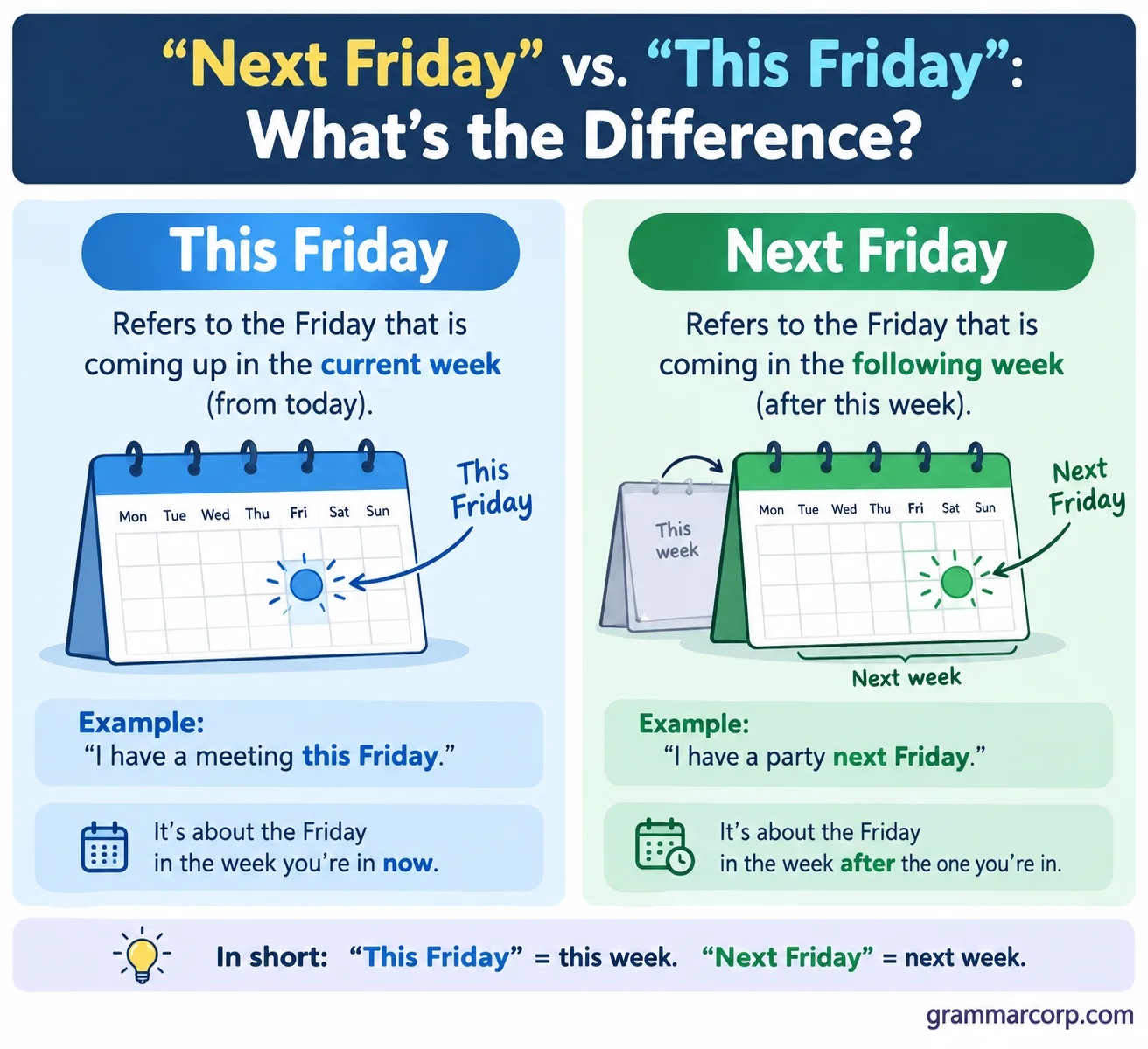
“Next Friday” vs. “This Friday” can cause confusion because time expressions change meaning with context and timing, especially in everyday communication.
In common American English, American English speakers often use this Friday for the upcoming Friday in the current week, while next Friday may mean the Friday in the following week. However, there is no universally enforced interpretation, so the meaning, interpretation, and date interpretation can depend on the reference a person gives.
Someone might mean the very next Friday, while the other person hears next Friday as the Friday after that. These tricky phrases can become ambiguous, particularly when the date, week, following, next week, this week, coming Friday, following Friday, or upcoming day isn’t clear. Even native English speakers may face genuine confusion in conversations, texts, emails, and schedules when discussing a future date.
The issue becomes more important when plans involve arranging meetings, meetings, setting deadlines, deadlines, making appointments, appointments, or planning events. A clear conversation should make the intended time easy to understand, because an unclear phrase may cause a schedule conflict, planning error, communication gap, or misunderstanding. Real-life examples, visual timelines, and context clues can help the speaker and listener apply simple rules and avoid missed meetings, delayed plans, ruined plans, and unnecessary frustration. Good communication skills also help with spoken English, conversational English, and everyday English, while reducing common mistakes in schedule, plan, and planning decisions.
Quick Answer :
“This Friday” usually means the upcoming Friday in the current or immediately relevant week. “Next Friday” usually means the Friday after that.
For example, imagine today is Wednesday, September 2, 2026:
| Expression | Common interpretation | Date |
| This Friday | The upcoming Friday | September 4, 2026 |
| Next Friday | The Friday of the following week | September 11, 2026 |
However, “next Friday” can be ambiguous. Some speakers interpret “next” as the first Friday that comes after today. That interpretation would make “next Friday” September 4 in the example above.
This is why the most reliable solution is simple: when the date matters, give the date.
For example:
Let’s meet on Friday, September 11.
That leaves very little room for misunderstanding.
Comparison Overview
The central difference between next Friday vs. this Friday comes from the way the words this and next establish a time reference.
This generally connects something to the current period or a time that feels immediate. Next normally identifies something that follows the current reference point or period.
Consider this simple timeline:
Today → This Friday → Next Friday
If today is Wednesday, the first Friday is normally this Friday. The Friday after it is normally next Friday.
That pattern is especially easy to understand when today falls early in the week.
| Today | This Friday | Next Friday, in the common interpretation |
| Monday | Friday of this week | Friday of next week |
| Tuesday | Friday of this week | Friday of next week |
| Wednesday | Friday of this week | Friday of next week |
| Thursday | Friday of this week | Friday of next week |
| Friday | Today or context-dependent | Usually the following Friday |
| Saturday | Coming Friday | Interpretation can vary |
| Sunday | Coming Friday | Interpretation can vary |
The weekend deserves special attention. Once the current Monday-to-Friday workweek has ended, phrases such as “this Friday” and “next Friday” can become less predictable because speakers may organize their mental calendar differently.
The simplest practical rule
A useful everyday convention is:
- This Friday = the Friday that belongs to the current or immediately relevant week.
- Next Friday = the Friday after that.
- This coming Friday = usually the nearest upcoming Friday.
- Friday next week = the Friday in the following week.
- Friday, September 11 = one exact date with virtually no ambiguity.
This convention works well in many conversations. Still, it should be treated as a usage guideline rather than an unbreakable grammatical law.
Main Differences Between “Next Friday” vs. “This Friday”
The two phrases differ mainly in their relationship to the speaker’s current time reference.
“This Friday” Usually Feels More Immediate
When someone says “this Friday,” listeners generally think about the Friday that is closest to the current conversational period.
Suppose today is Tuesday.
If someone says:
Let’s meet this Friday.
The natural interpretation is that Friday is only a few days away.
The word “this” creates a sense of connection to the present week or current time frame. It makes the event feel relatively near.
That’s why “this Friday” often works well when discussing ordinary weekly plans.
Examples include:
- The project is due this Friday.
- We’re meeting this Friday.
- The school event is this Friday.
- Can you call me this Friday?
- The store is having a sale this Friday?
In each case, the speaker normally has the nearer Friday in mind.
“Next Friday” Usually Points One Friday Further Ahead
“Next Friday” commonly means the Friday following the upcoming Friday.
Suppose today is Wednesday, September 2.
The upcoming Friday is September 4. Under the common interpretation, next Friday is September 11.
So:
This Friday = September 4
Next Friday = September 11
This distinction resembles the difference between “this week” and “next week.”
However, there is an important complication. The word “next” can also be interpreted as “the next one to occur.”
That creates two possible readings.
Why “Next Friday” Has Two Possible Interpretations
Consider the sentence:
I’ll see you next Friday.
One listener may think:
The next Friday that occurs.
Another may think:
The Friday after this week’s Friday.
Both interpretations have an understandable logic.
The first treats next as a sequence marker. The first Friday after now is the next Friday.
The second treats next as referring to the next calendar period. If the current week contains Friday, then the following week’s Friday becomes next Friday.
This ambiguity has been discussed extensively among English speakers. Language-use discussions show that speakers genuinely differ in how they interpret the phrase.
So it isn’t accurate to claim that everyone who says “next Friday” means exactly the same date.
What Does “This Friday” Mean?
“This Friday” generally identifies the Friday connected to the current week or immediate time period.
If today is Monday through Thursday, the meaning is usually straightforward.
If Today Is Monday
Imagine today is Monday, September 7.
Then:
- This Friday = September 11
- Next Friday = September 18, under the common interpretation
The upcoming Friday is only four days away, so calling it this Friday feels natural.
If Today Is Tuesday
If today is Tuesday, September 8:
- This Friday = September 11
- Next Friday = September 18
The same distinction usually applies.
If Today Is Wednesday
If today is Wednesday, September 9:
- This Friday = September 11
- Next Friday = September 18
Here the difference becomes especially easy to see because the upcoming Friday is only two days away.
If Today Is Thursday
If today is Thursday, September 10:
- This Friday = September 11
- Next Friday = September 18
If someone says, “Let’s meet this Friday,” the natural interpretation is usually tomorrow.
If Today Is Friday
Friday creates a special situation.
If today is Friday, saying “this Friday” may refer to today. For example:
The meeting is this Friday.
If the statement is made on Friday morning, the listener may reasonably understand that the meeting is happening today.
But context matters. If someone is discussing future plans for the following week, they may use “this Friday” differently.
For that reason, Friday itself is a poor time to rely on vague relative expressions. An exact date is clearer.
What Does “Next Friday” Mean?
“Next Friday” commonly means the Friday after the upcoming Friday.
For example, if today is Tuesday, September 8:
- This Friday = September 11
- Next Friday = September 18
That is the interpretation many speakers expect in everyday American English.
But the phrase remains context-sensitive.
Calendar-Based Interpretation
Under a calendar-based interpretation, next Friday means the Friday belonging to the following week.
If the current week is September 7–13, then:
- This Friday = September 11
- Next Friday = September 18
This interpretation treats the week as an important reference point.
Immediate-Sequence Interpretation
Another speaker may interpret next Friday as:
the next Friday that occurs after now.
Under that interpretation, if today is Wednesday, September 9, next Friday means September 11.
That makes “next Friday” and “this Friday” potentially overlap.
This isn’t necessarily a mistake by either speaker. It reflects the fact that ordinary language doesn’t always assign one fixed mathematical meaning to relative time expressions.
Why Is “Next Friday” Sometimes Ambiguous?
The confusion comes from the word “next.”
In many situations, “next” clearly means the first item after the current one.
For example:
- the next page
- the next bus
- the next lesson
- the next person in line
If you’re waiting for a bus, “the next bus” normally means the first bus that arrives after the present moment.
That logic can naturally lead someone to interpret “next Friday” as the first Friday after today.
But time expressions often work differently because people organize time into periods such as days, weeks, months, and years.
A person may therefore think:
This week is Friday.
Next week has another Friday.
Therefore, next Friday means Friday next week.
Both mental models are reasonable.
The Current Week Matters
Suppose someone says:
The report is due next Friday.
If they say this on Monday, many people will understand the deadline as the Friday of the following week.
But if the speaker means the Friday is only four days away, the listener may assume the deadline is sooner than intended.
That difference could matter considerably in a workplace or school setting.
The Day You Ask Can Change the Interpretation
Relative time expressions become more difficult near the end or beginning of a week.
For example, Saturday and Sunday sit outside the usual Monday-through-Friday work rhythm for many people. Someone might say “this Friday” to mean the Friday coming up because that is the Friday associated with the next workweek.
Another person may think of that Friday as “next Friday” because it falls in the next calendar week.
This is one reason weekend conversations can produce more confusion than conversations held early in the workweek.
A Day-by-Day Guide to “Next Friday” vs. “This Friday”
The following table shows the common interpretation, not an absolute rule that every English speaker follows.
| If today is… | “This Friday” commonly means | “Next Friday” commonly means |
| Monday | Friday later this week | Friday next week |
| Tuesday | Friday later this week | Friday next week |
| Wednesday | Friday later this week | Friday next week |
| Thursday | Friday tomorrow | Friday next week |
| Friday | Today or context-dependent | Friday next week |
| Saturday | The coming Friday | Potentially the following Friday |
| Sunday | The coming Friday | Potentially the following Friday |
The last two rows deserve caution.
When today is Saturday or Sunday, “this Friday” can reasonably mean the Friday that is only a few days away. Yet that Friday technically belongs to the upcoming week.
Meanwhile, someone else may use “next Friday” for that same date.
This is exactly where an exact calendar date becomes the better choice.
“This Friday” vs. “This Coming Friday”
These expressions are close in meaning.
“This Friday” commonly identifies the Friday associated with the current conversational week.
“This coming Friday” emphasizes that the speaker means the Friday that is coming up.
For example:
Let’s meet this Friday.
and:
Let’s meet this coming Friday.
Both normally point toward the upcoming Friday when spoken earlier in the week.
The addition of “coming” can make the speaker’s intention more obvious because it emphasizes movement toward the next occurrence of Friday.
Still, if a date has serious consequences, use the date itself.
When “This Coming Friday” Helps
It can be useful when:
- Making casual plans
- Talking about an upcoming event
- Arranging a social activity
- Clarifying that you mean the nearer Friday
- Speaking with someone who already understands the weekly context
For important schedules, however:
Friday, September 11
is stronger than:
this coming Friday
“Friday Next Week” Is Often Clearer Than “Next Friday”
If you specifically mean the Friday belonging to the following week, “Friday next week” can remove much of the ambiguity.
Compare:
Let’s meet next Friday.
with:
Let’s meet on Friday next week.
The second version explicitly connects Friday with next week.
That gives the listener a stronger calendar reference.
For example:
The presentation is Friday next week.
This makes it much harder to interpret the presentation as happening during the current week.
Another clear option is:
Let’s meet next Friday, September 18.
Adding the date makes the intended meaning immediately obvious.
“Friday After Next” Explained
You may also hear “the Friday after next.”
This phrase usually means the Friday after the Friday that is next in the speaker’s intended sequence.
For example:
- Upcoming Friday = September 11
- Next Friday = September 18
- Friday after next = September 25
However, this phrase can sound informal and still requires the listener to calculate the sequence.
If precision matters, the calendar date remains better:
Friday, September 25
The shorter phrase may work in casual conversation when everyone shares the same reference point.
How to Avoid Confusion When Making Plans
The easiest way to prevent misunderstandings is to stop making the listener calculate the date.
Add the Calendar Date
Instead of:
The meeting is next Friday.
Use:
The meeting is Friday, September 11.
You can also combine both:
The meeting is next Friday, September 11.
This preserves the natural phrase while removing uncertainty.
Add the Time Too
For important appointments, include both the date and time.
For example:
The meeting is Friday, September 11, at 2:00 PM.
This is much more precise than:
Let’s meet next Friday afternoon.
The second sentence leaves multiple details open to interpretation.
Confirm Someone Else’s Meaning
If someone tells you:
Let’s meet next Friday.
and you’re unsure what they mean, don’t guess.
Ask:
Do you mean this Friday or the Friday after?
Or:
Just to confirm, do you mean Friday, September 11?
A short clarification can prevent an unnecessary scheduling mistake.
Case Study: A Simple Scheduling Mix-Up
Imagine a team is discussing a project on Wednesday.
One person writes:
Let’s review the final draft next Friday.
The writer means September 18.
Another team member interprets “next Friday” as the next Friday that occurs and puts the review on September 11.
Both people have a reasonable interpretation of the phrase.
The problem isn’t necessarily grammar. The problem is insufficient precision.
A better message would be:
Let’s review the final draft on Friday, September 18.
Now everyone has the same calendar reference.
What This Case Teaches
The lesson is simple:
Relative time expressions work best when everyone shares the same reference point.
When they don’t, an exact date is more reliable.
This matters even more for:
- Work deadlines
- School assignments
- Interviews
- Travel plans
- Appointments
- Events
- Reservations
- Deliveries
- Project milestones
A two-second clarification can prevent a much larger scheduling problem.
Common Examples of “Next Friday” vs. “This Friday”
Casual Conversation
Person A: Are you free this Friday?
Person B: Yes. What time?
Here, the upcoming Friday is normally understood.
Planning for the Following Week
Person A: I can’t meet this Friday.
Person B: How about next Friday?
Here, context makes next Friday naturally contrast with this Friday. The later Friday is the obvious choice.
A Workplace Message
Less precise:
Please send the report next Friday.
More precise:
Please send the report by Friday, September 18.
The second sentence is preferable when a deadline matters.
A Social Invitation
Natural:
We’re getting together this Friday evening.
If there is any doubt:
We’re getting together Friday, September 11, at 7 PM.
The exact date makes the invitation easier to follow.
Common Mistakes With “Next Friday” and “This Friday”
Assuming “Next” Always Means the Closest Friday
This is the most common source of confusion.
The word next can mean the next item in a sequence. Yet many speakers use next Friday to mean the Friday of the following week.
So don’t assume everyone uses the same interpretation.
Assuming “This Friday” Is Always Perfectly Clear
“This Friday” is generally less ambiguous than “next Friday,” but it isn’t completely immune to context.
The phrase can become unclear when:
- Today is Friday
- Today is Saturday or Sunday
- The conversation crosses a week boundary
- The speaker and listener use different calendar conventions
- Several Fridays have already been discussed
Using Relative Dates in Important Emails
A phrase such as:
Your appointment is next Friday.
may be fine in a casual conversation.
For an important appointment, it’s better to write:
Your appointment is Friday, September 11, at 10 AM.
The goal isn’t to make language formal for its own sake. The goal is to make the information unmistakable.
Is “Next Friday” Grammatically Correct?
Yes.
“Next Friday” is a normal and grammatically correct English expression.
So is “this Friday.”
The issue isn’t whether one phrase is grammatically correct. The issue is what date the speaker intends.
English uses many relative time expressions whose interpretation depends on context.
Examples include:
- this week
- next week
- this weekend
- next weekend
- this month
- next month
- tomorrow
- later today
These expressions are useful precisely because they relate information to the current moment. Their weakness is that the reference point moves as time passes.
Is “Next Friday” the Same as “This Friday”?
Usually, no.
In the common interpretation:
- This Friday = the nearer Friday associated with the current week
- Next Friday = the Friday after that
However, some speakers use next Friday for the nearest upcoming Friday.
Therefore, the phrases are not reliably interchangeable.
If the two people already have a shared context, the distinction may be obvious.
If they don’t, clarification is better.
Is “This Friday” the Same as “This Coming Friday”?
Usually, yes.
Both commonly refer to the upcoming Friday.
The phrase “this coming Friday” adds emphasis to the idea that the Friday is approaching.
For example:
The event is this Friday.
and:
The event is this coming Friday.
will normally communicate the same date when the conversation occurs earlier in the week.
What Does “Next Friday” Mean on a Sunday?
This is one of the trickiest situations.
Suppose today is Sunday.
The nearest upcoming Friday is only a few days away. Some speakers may call that this Friday because it is the Friday coming up. Others may call it next Friday because it belongs to the next calendar week.
There isn’t enough consistency to recommend relying on the phrase when the date is important.
Instead, say:
Friday, September 11.
That eliminates the ambiguity.
What Does “Next Friday” Mean on Friday?
If today is Friday, “next Friday” will usually mean the Friday one week later.
For example:
- Today = Friday, September 4
- Next Friday = September 11
“This Friday,” meanwhile, may refer to today.
Because both phrases can become highly context-dependent on Friday itself, using an exact date is the clearest option.
Which Phrase Should You Use?
Use the phrase that matches your intended time reference.
| What you mean | Recommended wording |
| The Friday coming up in the current week | This Friday |
| The nearest Friday after the weekend | This coming Friday |
| Friday in the following week | Friday next week |
| A later Friday where clarity matters | Friday + exact date |
| An important deadline | Exact date and time |
| A casual plan with shared context | This Friday / next Friday |
Best Choice for Casual Conversation
For everyday plans, this Friday and next Friday are usually perfectly useful.
People often understand the intended meaning from the surrounding conversation.
Best Choice for Formal Communication
For work, school, appointments, travel, or deadlines, include the calendar date.
The clearer version is:
Friday, September 18.
not merely:
Next Friday.
A Simple Decision Rule
When you’re about to write “next Friday,” pause for one second.
Ask yourself:
Could the other person reasonably interpret this as two different Fridays?
If the answer is yes, give the date.
This simple habit makes communication much more reliable.
You can also use:
this Friday, September 11
or:
Friday next week, September 18
The date does the important work. The relative phrase simply makes the sentence sound natural.
FAQs:
Is “this Friday” the same as “next Friday”?
Not always. This Friday usually means the upcoming Friday in the current week, while next Friday often means the Friday in the following week. However, context can change the interpretation, so using the exact date is safest when plans matter.
What does “next Friday” usually mean?
Next Friday commonly refers to the Friday of the following week. However, some American English speakers use it to mean the very next Friday, which can create confusion in everyday communication.
What does “this Friday” mean?
This Friday generally refers to the upcoming Friday within the current week. In most conversations, texts, and emails, this is the clearer phrase when you mean the nearest Friday.
Why can “next Friday” cause misunderstandings?
The meaning of next Friday isn’t universally fixed. One person may understand it as the upcoming day, while another may interpret it as the Friday after that, leading to misunderstanding, schedule conflicts, or planning errors.
What is the safest way to avoid confusion?
The safest approach is to give the exact date, especially for meetings, appointments, deadlines, and important events. This simple habit improves communication skills and prevents unnecessary frustration.
Conclusion:
The difference between next Friday and this Friday may seem small, but it can affect plans, schedules, and everyday communication. This Friday generally points to the upcoming Friday, while next Friday often points to the following Friday, although context and language usage can lead to different interpretations.
When the date really matters, don’t leave the meaning to guesswork. Say the exact date or clarify whether you mean this week or next week. That approach keeps spoken English, conversational English, and everyday English clear and helps both the speaker and listener stay on the same page.














1 thought on ““Next Friday” vs. “This Friday”: What’s the Difference?”