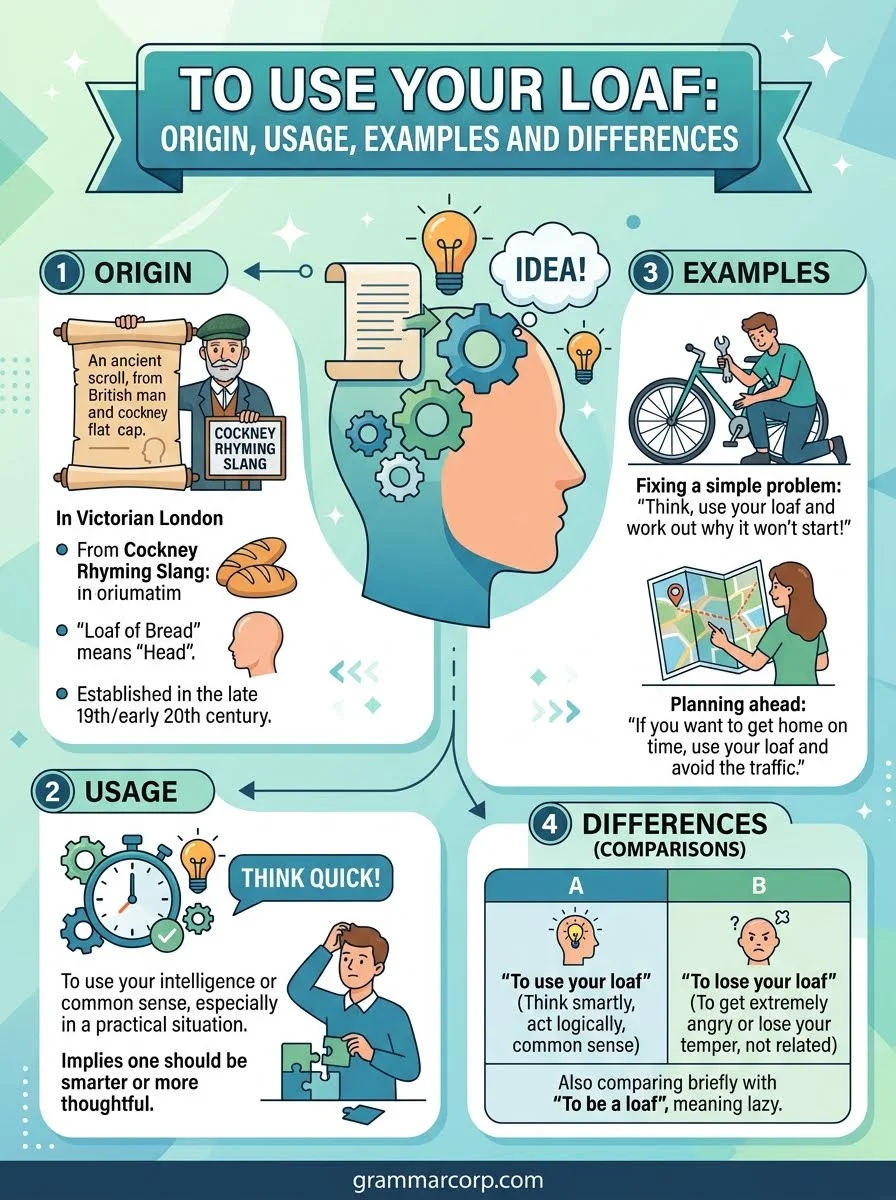
To Use Your Loaf: Origin, Usage, Examples and Differences explains this British idiom, its rhyming slang roots, and how it means to think wisely.
The expression “use your loaf” is a colorful British idiom that means to think carefully, use your brain, and apply common sense in a particular situation. Rather than asking someone to grab a piece of bread, the speaker encourages them to use their judgment, intelligence, and wisdom. In British English, this informal expression connects a loaf of bread with a person’s head through Cockney rhyming slang.
In modern English, “use your loaf” is common in informal speech, everyday conversation, and British slang. Friends, parents, and teachers might use it jokingly when children, students, or other learners overlook an obvious answer. For example, a teacher might say, “Use your loaf and read the question again.
The phrase can sound playful, lighthearted, and teasing, but it can also express impatience in a slightly angry manner. The difference depends on the speaker’s tone and context, which determine how the expression lands. Although the words are not necessarily offensive, they may sound rude if delivered harshly. These practical examples show how humor and irritation can affect the meaning of the same phrase.
Quick Answer:
To use your loaf means to use your head, think carefully, or use common sense.
It is a British English informal idiom. Cambridge labels the expression UK and old-fashioned and says it is used to tell someone to think more carefully about what they are doing.
The word loaf has a slang meaning of head or brains in this expression. Collins also records loaf as British slang for “the head.”
For example:
Use your loaf and check the address before you send the package.
The speaker isn’t talking about bread. The intended message is simple: think first and avoid an obvious mistake.
Comparison Overview
The easiest way to understand how to use your loaf is to compare it with expressions that carry the same basic idea.
| Expression | Basic meaning | Tone | Common usage |
| Use your loaf | Use your head or common sense | Informal, sometimes teasing | British English |
| Use your head | Think sensibly | Informal | British and American English |
| Think carefully | Consider something properly | Neutral | General English |
| Use your common sense | Make a sensible decision | Neutral to informal | General English |
| Think it through | Consider all parts of a situation | Neutral | General English |
| Use your judgment | Make a sensible decision based on the situation | Neutral/formal | General English |
| Put your thinking cap on | Start thinking carefully | Playful | Informal English |
The biggest difference is regional flavor. Using your loaf has a distinctly British character. Oxford specifically identifies it as British English while also giving use your head as the more widely used equivalent.
Cambridge goes a step further by labeling the expression old-fashioned. That doesn’t mean modern British speakers never understand it. It means the phrase has a dated or traditional flavor compared with more ordinary alternatives.
Main Differences Between To Use Your Loaf
The phrase to use your loaf differs from similar expressions in several important ways.
It is strongly associated with British English
Someone in Britain may recognize your loaf immediately. An American English speaker is more likely to hear you use your head or use your common sense.
That doesn’t mean American readers cannot understand the British expression. Context usually makes the meaning clear. The difference is mainly about natural everyday usage.
It has an informal tone
You wouldn’t normally use your loaf in a formal business report or academic essay.
Instead of:
Use your loaf when reviewing the figures.
A professional version would be:
Use careful judgment when reviewing the figures.
The second version sounds neutral. The first sounds conversational and possibly cheeky.
It can sound mildly critical
Oxford says the expression is used when someone has said something stupid or asked a question that the speaker thinks should have been obvious.
That gives the phrase a sharper edge than simply saying think carefully.
For example:
You left your umbrella at home and it’s raining. Use your loaf!
Between close friends this could be playful. From a stranger it might sound condescending.
It has a humorous image behind it
The word loaf makes the expression memorable. Instead of saying use your brain, the speaker replaces head with a slang term connected to bread.
That odd mental picture gives the idiom its personality.
What Does To Use Your Loaf Mean?
The core meaning of to use your loaf is straightforward:
Think about what you’re doing.
Depending on the situation, the phrase can carry several closely related meanings:
- Use your head.
- Use your brain.
- Think carefully.
- Apply common sense.
- Consider the situation.
- Make a sensible decision.
- Work out the answer yourself.
- Don’t overlook the obvious.
- Think before you act.
The exact shade depends on the speaker’s intention.
If someone says:
Use your loaf. The door is already unlocked.
They probably mean, Look at the obvious solution.
If someone says:
Use your loaf before you agree to that deal.
The message is closer to Think carefully before making a decision.
The phrase therefore isn’t limited to solving puzzles. It can apply to practical decisions, everyday mistakes, obvious solutions, and situations where someone needs to exercise better judgment.
A simple definition
If you need to explain the idiom in one sentence, say:
To use your loaf means to use your intelligence or common sense.
That definition captures the central idea without getting distracted by the literal meaning of loaf.
Why Does Loaf Mean Head or Brain?
This is the part that makes the expression interesting.
A loaf normally means a shaped mass of baked bread. Oxford gives this as the ordinary meaning of the noun.
In British slang, however, loaf can also mean head or brains. Collins records this slang sense and gives us your loaf! as an example.
The connection comes from Cockney rhyming slang.
The traditional wordplay works like this:
head → loaf of bread → loaf
The phrase loaf of bread rhymes with head. Over time the longer rhyming phrase could be shortened to simply loaf.
The British Council explains this directly when discussing British slang. It notes that use your loaf means use your head and explains that loaf originally referred to loaf of bread, which rhymes with head.
This is an important point because people sometimes search for a more dramatic explanation of the phrase’s origin. The rhyming-slang explanation has much stronger linguistic support than colorful stories that try to connect the expression to unrelated historical events.
Why rhyming slang matters
Cockney rhyming slang is one of the most recognizable forms of London slang.
It creates replacement words through rhyme. Some expressions later become shortened so much that the original rhyme is no longer obvious.
The British Council gives several familiar examples of this pattern. For instance, apples and pears means stairs while dog and bone means telephone.
Using your loaf fits the same general tradition.
Where Did Your Loaf Come From?
The expression has roots in British slang and is particularly associated with Cockney rhyming slang.
The historical evidence is more interesting when you separate the origin of loaf = head from the later appearance of the full expression use your loaf.
Phrases.org.uk traces loaf of bread as a rhyming-slang expression for head. It cites an early printed example from 1925 in Soldier and Sailor Words and Phrases. The source also identifies a printed example of the full expression in James Curtis’s 1938 novel They Drive by Night.
That evidence gives us a useful timeline.
| Development | Historical detail |
| Rhyming slang | Loaf of bread became associated with head |
| 1925 | A printed slang reference records loaf meaning head |
| 1938 | James Curtis’s They Drive by Night contains the expression use your loaf |
| 1943 | Service Slang records the expression and explains its practical meaning |
| Today | The phrase remains recognizable but has an old-fashioned British flavor |
The 1943 source is especially useful because it shows that the expression was not merely about intelligence in an abstract sense. It could also mean using common sense in a practical situation rather than following instructions blindly.
What about the World War I story?
You may encounter a story claiming that soldiers used bread as a substitute for their heads while checking whether enemy snipers were nearby.
That story appears on some idiom websites. However, it should not be treated as the established origin.
The stronger historical explanation is Cockney rhyming slang. The British Council independently describes use your loaf as a rhyming-slang expression based on loaf of bread and head.
For an accurate article, it is better to distinguish documented linguistic evidence from an appealing but weakly supported anecdote.
How To Use To Use Your Loaf in a Sentence
The expression normally appears in informal conversation.
It often works as an imperative:
Use your loaf!
That structure makes it sound like direct advice or criticism.
You can also place it inside a longer sentence.
Everyday examples
- Use your loaf and check the instructions first.
- You know where you left the keys. Use your loaf.
- Use your loaf before you make a decision.
- Come on, use your loaf. The answer is right in front of you.
- He finally used his loaf and checked the receipt.
- She told me to use my loaf before agreeing to anything.
These examples all share the same basic idea. Someone needs to think instead of acting automatically.
Friendly conversation
Imagine two friends trying to find a missing phone.
Friend A: I can’t find my phone anywhere.
Friend B: Use your loaf. You were charging it in the kitchen.
Here the expression can sound teasing rather than genuinely insulting. The speaker expects the other person to remember something obvious.
Mild criticism
Now consider a different situation:
Person A: I forgot to bring the document again.
Person B: You knew we needed it today. Use your loaf next time.
The same phrase becomes more critical because the speaker is frustrated.
This shows why tone matters more than the literal words.
Giving practical advice
The phrase can also encourage sensible behavior.
Use your loaf and compare the instructions before you start.
Here the speaker isn’t necessarily insulting anyone. They are telling the listener to pause and think.
Is To Use Your Loaf Rude?
It can be.
The phrase isn’t a swear word or an inherently offensive expression. However, it can sound impatient, patronizing, or insulting when aimed at someone who has made an obvious mistake.
Cambridge specifically describes it as something used in a slightly angry way to tell someone to think more carefully.
That description explains why context matters.
When it sounds playful
You might use it with a close friend:
You left your glasses on your head. Use your loaf!
The absurdity makes the remark humorous.
When it sounds harsh
You might hear it during an argument:
I’ve explained this three times. Use your loaf!
Now the phrase clearly communicates frustration.
When you should avoid it
Avoid the expression when you need a respectful or formal tone.
That includes:
- Formal emails
- Academic writing
- Job applications
- Official instructions
- Professional reports
- Customer-service communication
- Serious workplace discussions
A neutral alternative will usually communicate the same idea more effectively.
To Use Your Loaf vs. Use Your Head
These expressions are extremely close in meaning.
Oxford actually lists use your head as the British and North American equivalent of use your loaf.
The major difference is style.
| Feature | Use your loaf | Use your head |
| Meaning | Think or use common sense | Think or use common sense |
| Regional association | Strongly British | British and American |
| Formality | Informal | Informal |
| Age/frequency | More old-fashioned | More widely used |
| Humor | More noticeable | More neutral |
| Potentially critical | Yes | Yes |
| Suitable for formal writing | No | Usually no |
If you’re writing for a broad international audience, use your head is generally easier to understand.
If you’re explaining British slang, however, to use your loaf is the more interesting phrase.
To Use Your Loaf vs. Think Carefully
These expressions share an idea but don’t share the same tone.
Think carefully is neutral.
You can use it in everyday conversation, professional communication, education, or written instructions.
Use your loaf is much more colorful.
Compare these two sentences:
Think carefully before signing the agreement.
Use your loaf before signing the agreement.
The first sounds like sensible advice. The second sounds more like a blunt warning from someone who expects you to know better.
That difference makes idioms useful. They don’t just communicate information. They also communicate attitude.
To Use Your Loaf vs. Use Your Common Sense
These expressions are also close but not identical.
Use your common sense focuses specifically on making a sensible practical decision.
Use your loaf can have a broader meaning. It can tell someone to think through a problem, understand something obvious, or use their intelligence.
For example:
Use your common sense and don’t touch the wet paint.
This focuses on sensible behavior.
Use your loaf and figure out which key opens the door.
This focuses more on reasoning.
The distinction is small but useful.
Common Mistakes When Using To Use Your Loaf
Understanding an idiom means more than memorizing its definition. You also need to know what not to do with it.
Mistake: Taking loaf literally
The most obvious mistake is assuming the phrase has something to do with bread.
It doesn’t.
The loaf in this expression is slang for the head or brain.
Mistake: Treating it as formal English
Although dictionaries recognize the expression, that doesn’t make it suitable for every situation.
Cambridge labels it UK old-fashioned.
That label is useful when deciding whether to use it in professional writing.
Mistake: Assuming it always sounds friendly
The expression can be humorous. It can also sound annoyed.
Always consider the relationship between the speakers.
Mistake: Using it with unfamiliar people
If you’re speaking to someone you don’t know well, think carefully is safer.
You can communicate the same idea without risking a patronizing tone.
Mistake: Confusing the noun with the verb
English has another common use of loaf.
To loaf means to spend time doing very little or avoiding activity. Cambridge defines the verb in this way.
So these two sentences have completely different meanings:
Use your loaf.
This means think.
Stop loafing around.
This means stop being idle.
The similarity is purely in the word itself.
Is Your Loaf Still Used Today?
Yes. The expression is still recognized and appears in modern dictionaries. However, recognition doesn’t mean it is one of the most common expressions in everyday English.
Cambridge currently labels it old-fashioned.
Oxford continues to list it as a British English informal idiom.
That combination tells us something important.
The phrase remains part of the language. Yet many speakers may prefer simpler alternatives such as:
- Use your head.
- Think about it.
- Think carefully.
- Use your common sense.
- Think it through.
Its old-fashioned quality can actually make it useful when a speaker wants a distinctly British, humorous, or slightly cheeky sound.
Read More : Time Off or Time-Off? Understanding the Hyphen Rule
British English vs. American English
The expression has a much stronger identity in British English.
British English contains many idioms that may sound unusual to American readers. Use your loaf is one example.
In American English, using your head is far more natural.
Oxford explicitly pairs use your loaf with use your head and marks the former as British English.
This doesn’t mean an American speaker will be unable to understand how to use your loaf. British television, films, books, and online content have helped spread many British expressions beyond the UK.
Still, if your goal is natural American English, use your head is usually the safer choice.
A quick regional comparison
| Meaning | British English | American English |
| Use your intelligence | Use your loaf | Use your head |
| Think carefully | Think carefully | Think carefully |
| Apply practical judgment | Use your common sense | Use your common sense |
| Think through a problem | Think it through | Think it through |
The meaning travels easily. The slang doesn’t always travel with it.
A Practical Case Study: How Tone Changes the Meaning
Consider a fictional conversation between two friends.
Situation
Alex and Jordan are preparing to leave for a trip. Alex can’t find the tickets.
Alex says:
I can’t find the tickets anywhere.
Jordan replies:
Use your loaf. You put them in the blue folder.
Alex checks the folder and finds them.
Here use your loaf is playful. Jordan isn’t seriously questioning Alex’s intelligence. The phrase simply means think about what you already know.
Now change the situation.
Alex repeatedly forgets important documents after being reminded several times.
Jordan says:
I’ve reminded you all week. Use your loaf next time.
The phrase now sounds irritated.
What changed?
The words stayed the same.
The context changed.
That is one of the most important lessons when learning idioms. Dictionary definitions tell you what a phrase means. Real conversations also depend on relationship, tone, timing, and situation.
Better Alternatives to To Use Your Loaf
Sometimes you want the same message without the slang.
Here are useful alternatives:
For friendly advice
- Think about it.
- Think it through.
- Use your head.
- Have another look.
For professional situations
- Use your judgment.
- Consider the options carefully.
- Review the situation carefully.
- Apply your best judgment.
For encouraging someone
- Take a moment and think it through.
- You can work this out.
- Think about what you already know.
- Consider the obvious possibilities.
For humorous conversation
- Use your head.
- Put your thinking cap on.
- Come on, think!
- Think about it for a second.
The best alternative depends on how much humor, criticism, or formality you want.
Why British Slang Like To Use Your Loaf Survives
Idioms often survive because they offer something plain language doesn’t.
Thinking carefully is clear.
Using your loaf is memorable.
That difference matters.
The expression creates a small mental joke by replacing head with loaf. The listener understands the intended meaning while also noticing the unusual wording.
British slang has many expressions that work in the same way. The British Council describes rhyming slang as a lively part of UK informal language and gives examples such as apples and pears for stairs and dog and bone for telephone.
These expressions also show how language changes.
A phrase can begin as local slang. It can spread into wider English. It can eventually become familiar even when people no longer use it every day.
That appears to be part of the story of use your loaf.
FAQs:
1. What does “use your loaf” mean?
“Use your loaf” is a British idiom that means to think carefully, use your brain, and apply common sense. People use it when someone needs to consider a situation or notice an obvious answer.
2. Where did the phrase “use your loaf” originate?
The expression comes from Cockney rhyming slang, associated with the East End of London. “Loaf” comes from “loaf of bread,” which rhymes with “head.” Over time, the phrase became a humorous way to tell someone to think.
3. Is “use your loaf” formal or informal?
“Use your loaf” is an informal expression in British English. It is common in casual conversations among friends and family, but it is generally unsuitable for formal writing or professional situations.
4. Can “use your loaf” sound rude?
Yes, depending on the speaker’s tone and context. It can sound playful when friends tease each other, but it may seem impatient or insulting when someone says it angrily. The expression is not necessarily offensive, but the way it is delivered matters.
5. Is “use your loaf” commonly used in American English?
The expression is strongly associated with British English and is less familiar in everyday American English. American speakers may use alternatives such as “use your head,” “think carefully,” or “use your common sense.”
Conclusion:
“Use your loaf” is a memorable British idiom that encourages people to think carefully and use common sense. Its connection to Cockney rhyming slang gives it an interesting linguistic history, while its humorous tone makes it useful in casual conversations.
Understanding its meaning, origin, and context helps English learners recognize the expression and use it naturally. Remember that tone matters: the phrase can be friendly and playful among friends, but it may sound rude in more serious situations.












1 thought on “To Use Your Loaf: Origin, Usage, Examples and Differences”