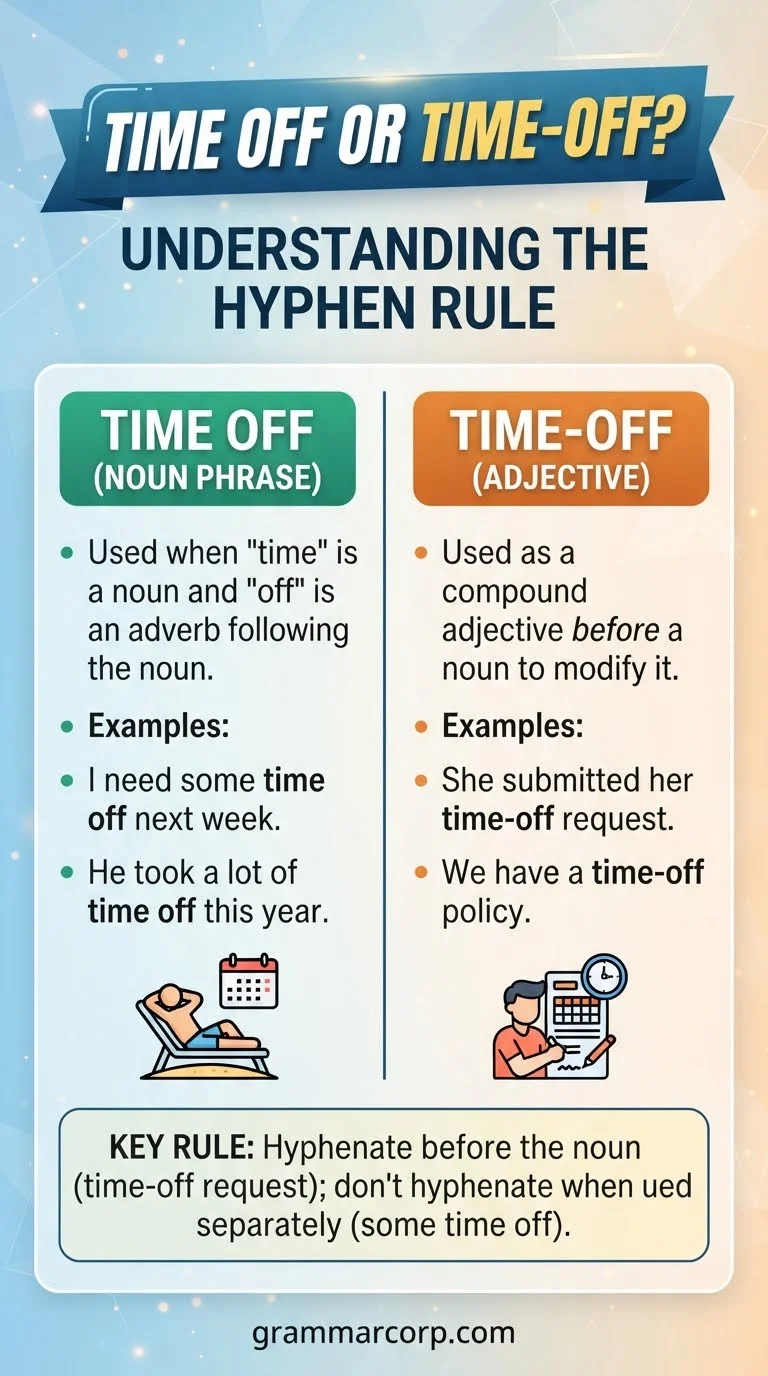
Time Off or Time-Off? Understanding the Hyphen Rule explains when to use the open form and when a hyphenated form may be appropriate in English writing.
The phrase time off is the standard form when referring to a period away from work, school, or another regular activity. It functions as a noun phrase, with time and off written as separate words. The Cambridge Dictionary describes time off as a period when someone does not work because of illness, holidays, or another permitted absence.
For example, employees may request vacation time, personal leave, paid leave, annual leave, holiday leave, sick leave, or paid time off after a busy period. Students may also need time away from school, while others may take personal time, an annual vacation, or a break from work. These examples show how the phrase is used in everyday English and professional communication.
The hyphenated form, time-off, is less common and generally appears as a compound modifier before another noun, as in time-off request, time-off policy, and time-off balance. These expressions are connected to employee benefits, employee leave, leave management, leave policies, workplace policies, staff schedules, employee schedules, and work-life balance. In my editing experience with workplace articles, I have found that this small spelling choice can improve clarity in work emails, HR documents, applications, and other workplace documents.
Quick Answer
Use time off when the phrase functions as a noun phrase.
- I need time off next Friday.
- She requested time off from work.
- We have plenty of time off during the holidays.
- He used his paid time off last month.
Use time-off when the words work together as a compound modifier before another noun, especially when the hyphen improves clarity.
- Submit a time-off request.
- Read the company’s time-off policy.
- Check your time-off balance.
- The system tracks time-off requests.
The simplest rule to remember is:
Time off names the break. Time-off can describe something connected to that break.
There is an important qualification, though. Hyphenation isn’t an absolute mathematical rule. Major style guides allow some variation in compound modifiers, particularly when a familiar open compound creates little risk of confusion. Chicago’s current guidance, for example, says some open compounds can remain open before another noun unless ambiguity threatens.
Comparison Overview
The difference becomes much easier when you compare the two forms side by side.
| Form | Typical function | Example | Why |
| time off | Noun phrase | I need time off. | Refers to the period away from work |
| time off | Noun phrase after a verb | She requested time off. | Acts as the object of requested |
| time-off | Compound modifier | Submit a time-off request. | Modifies request |
| time-off | Compound modifier | Check the time-off policy. | Modifies policy |
| paid time off | Noun phrase | I used paid time off. | Names a type of leave |
| time-off balance | Compound modifier | Check your time-off balance. | Describes the type of balance |
The distinction is grammatical rather than merely visual.
Consider these two sentences:
- I requested time off.
- I submitted a time-off request.
In the first sentence, time off refers directly to the leave itself. In the second, time-off helps describe what kind of request the writer means.
That’s the basic pattern behind most examples.
Main Differences Between Time Off and Time-Off
The most useful way to understand time off vs. time-off is to look at grammatical function.
Time Off Is Usually a Noun Phrase
When you say time off, you’re talking about a period during which someone isn’t working or carrying out their normal duties.
For example:
- I need time off.
- She took time off after finishing the project.
- They approved his time off.
- We have time off next week.
- Employees can request time off through the system.
Cambridge Dictionary treats time off as a noun phrase in workplace English. Its examples include constructions such as take time off, get time off, time off to do something, and paid or unpaid time off.
Notice something important: the phrase remains open even when another word comes before it.
- paid time off
- extra time off
- additional time off
- unpaid time off
- holiday time off
The presence of another modifier doesn’t automatically create a reason to insert a hyphen.
Time-Off Can Act as a Compound Modifier
A different situation occurs when the phrase describes a noun immediately after it.
For example:
- time-off request
- time-off policy
- time-off approval
- time-off system
- time-off balance
Here, time off isn’t simply naming the break. It forms part of a larger descriptive unit.
The hyphen signals that relationship.
Merriam-Webster explains that an open compound will often become hyphenated when it functions as a modifier before another noun. It gives examples such as science-fiction convention, video-game collector, and food-truck business.
The same principle can support time-off request.
The Hyphen Connects the Modifier
Think of the hyphen as a small bridge.
Without the bridge:
time off request
A reader has to work out how time, off, and request relate.
With the bridge:
time-off request
The two words clearly work together to describe request.
This doesn’t mean every writer or style guide will insist on the hyphen in every compound. English has plenty of familiar open compounds that remain open even before nouns. That’s why context and editorial style still matter.
When Should You Write Time Off as Two Words?
In most everyday sentences, time off should remain two words.
The phrase normally stays open when it functions as the thing someone takes, requests, receives, earns, uses, or needs.
After Common Verbs
These constructions are straightforward:
- take time off
- request time off
- receive time off
- get time off
- use time off
- earn time off
- approve time off
- schedule time off
- need time off
Examples:
I need time off before the new semester begins.
My manager approved my time off for Friday.
She decided to take time off after completing the assignment.
Employees can request time off through the company portal.
In each example, time off refers to the absence itself.
With Paid Time Off
One of the most common related expressions is paid time off, often shortened to PTO.
Write:
paid time off
not:
paid-time-off
For example:
- The company provides paid time off.
- I still have five days of paid time off.
- Employees can use paid time off for approved absences.
- She used some of her paid time off last month.
The phrase has become an established workplace expression. Cambridge specifically includes paid/unpaid time off among its examples of the noun phrase.
With Other Modifiers
You also don’t need to hyphenate time off simply because another adjective appears before it.
Correct examples include:
- extra time off
- additional time off
- unpaid time off
- scheduled time off
- holiday time off
- personal time off
The key question remains the same: Are you naming the time away or using the phrase to modify another noun?
When Can Time-Off Be Hyphenated?
The hyphen becomes relevant when time off acts as part of a compound modifier.
A compound modifier contains two or more words that work together to describe another word.
Consider:
time-off request
Here, time-off describes the type of request.
Likewise:
time-off policy
Here, time-off describes the type of policy.
Time-Off Request
This is one of the clearest workplace examples.
Compare:
- I submitted a request for time off.
- I submitted a time-off request.
Both sentences communicate essentially the same idea.
The first uses the open noun phrase.
The second turns the phrase into a compound modifier before request.
That difference explains why both forms can appear in professional writing without actually contradicting each other.
Time-Off Policy
The same principle applies to time-off policy.
For example:
Employees should review the company’s time-off policy before submitting a request.
Here, time-off describes policy.
However, style guides don’t always treat every compound modifier identically. Chicago’s guidance emphasizes that some familiar open compounds can remain open before a noun when there is little chance of ambiguity.
That means you shouldn’t treat the hyphen as an automatic command that applies to every occurrence.
Time-Off Balance
You may also encounter:
- time-off balance
- time-off approval
- time-off calendar
- time-off system
- time-off request form
These are all examples of the same basic construction: the phrase relates to time away and modifies the noun that follows.
The Hyphen Rule Behind Time-Off
To understand why the hyphen appears, you need to understand what hyphens actually do.
A hyphen is a punctuation mark used to join words or word elements. Merriam-Webster defines it as a mark used especially to divide or compound words, word elements, or numbers.
In compound modifiers, the hyphen can tell the reader:
Treat these words as one descriptive unit.
For example:
- long-term plan
- full-time employee
- high-speed connection
- well-known author
- time-off request
The hyphen isn’t decoration. It provides a reading cue.
Before a Noun
Hyphenation often becomes useful when a multiword expression comes directly before a noun.
Compare:
- a time-off request
- a request for time off
The first construction uses the phrase as a modifier.
The second uses it as a noun phrase.
Merriam-Webster describes this as a general guideline rather than an inflexible rule because English compounds vary according to established usage and familiarity.
After the Noun
Compound modifiers often become open when they follow the noun they modify.
For example, compare:
- a well-known writer
- The writer is well known.
Chicago discusses this distinction directly and notes that compound modifiers following the noun are often left open.
The same general reasoning can help you understand why time off works naturally when it functions as a noun phrase.
Is Time-Off Policy or Time Off Policy Correct?
This question deserves special attention because workplace documents frequently use this expression.
Time-off policy is a clear and defensible form when the phrase functions as a compound modifier before policy.
For example:
Please read the company’s time-off policy before submitting your request.
The hyphen tells the reader that time off operates together as a descriptor of policy.
However, English hyphenation doesn’t work like a switch where every multiword modifier must receive hyphens. Chicago’s current guidance recognizes that some familiar open compounds can stay open before nouns when ambiguity isn’t a concern.
So the best practical approach is:
- Use time off for the noun phrase.
- Use time-off policy when you want the compound modifier clearly marked.
- If your organization has a style guide, follow it consistently.
- Don’t add hyphens simply because a phrase appears before a noun if established usage favors the open form.
- When clarity matters, the hyphen can make the relationship easier to read.
Time Off vs. Paid Time Off vs. Time-Off Request
These expressions look similar, but they don’t perform exactly the same grammatical job.
| Expression | Meaning | Example |
| time off | A period away from normal work or duties | I need time off. |
| paid time off | Time away that remains paid | She used paid time off. |
| time-off request | A request concerning time off | Submit a time-off request. |
| time-off policy | A policy concerning time off | Read the time-off policy. |
| PTO | Common abbreviation for paid time off | I have several PTO days left. |
The first two are noun phrases.
The latter two contain a compound modifier.
That’s why you shouldn’t simply decide whether the entire expression “looks like” it needs a hyphen. Look at the grammatical job each word performs.
Common Time Off and Time-Off Mistakes
Mistake: Writing Time-Off as a Noun
A common error is adding a hyphen when time off simply means a break.
Incorrect in standard general usage:
I need some time-off.
Better:
I need some time off.
The hyphen isn’t doing useful work here because the phrase isn’t modifying another noun.
Mistake: Hyphenating Paid Time Off
Another common mistake is:
She requested paid-time-off.
The normal noun phrase is:
She requested paid time off.
The phrase paid time off already works clearly as a noun phrase.
Mistake: Assuming Every Pre-Noun Phrase Needs a Hyphen
The opposite mistake is also common.
Writers sometimes learn “hyphenate compound modifiers” and then apply the rule mechanically to everything.
But English doesn’t work that neatly.
Merriam-Webster notes that many compounds have variable forms and that familiarity, usage, and clarity influence whether a compound remains open or becomes hyphenated.
Mistake: Treating Style Preference as Grammar
Sometimes two forms can both appear in real-world writing because different editorial systems make different choices.
That doesn’t mean grammar has collapsed.
It means hyphenation has a style component.
Chicago itself notes differences between its recommendations and Merriam-Webster in some hyphenation cases and advises following the applicable style system consistently.
Case Study: An HR Handbook
Imagine an HR team preparing an employee handbook.
The writer wants to say:
Employees must submit a time off request before taking leave.
The phrase time off is functioning as part of a modifier before request. A clearer editorial choice is:
Employees must submit a time-off request before taking leave.
Now consider a second sentence:
Employees receive twenty days of paid time off each year.
Here, paid time off is the noun phrase naming the benefit.
The writer should not automatically turn it into paid-time-off.
What the Case Study Shows
The two sentences contain related language but use it differently:
| Sentence | Function | Form |
| Employees must submit a time-off request. | Compound modifier | Hyphenated |
| Employees receive paid time off. | Noun phrase | Open |
| Employees can request time off. | Noun phrase | Open |
| The handbook explains the time-off policy. | Compound modifier | Hyphenated |
The lesson is simple: don’t hyphenate the concept; hyphenate the compound modifier when appropriate.
Case Study: An Everyday Email
Now imagine you’re writing a casual workplace email.
You might write:
Hi Jordan, I’d like to request time off next Friday for an appointment.
There’s no reason to write:
I’d like to request time-off next Friday.
The phrase follows the verb request and functions as the thing being requested.
Now compare:
Please review my time-off request when you have a chance.
Here, time-off describes request.
The same two words appear in both sentences, but their grammatical roles differ.
That’s why looking at the surrounding words is more reliable than memorizing a single spelling.
How to Remember the Time-Off Hyphen Rule
You don’t need to memorize a giant list of hyphenation rules.
Use this simple process.
Ask What the Phrase Means
If you’re talking about the actual break or absence, write:
time off
Example:
I need time off.
Look at the Next Word
If time off directly describes a noun, consider whether a hyphen makes the compound clearer.
Example:
a time-off request
Here, time-off describes request.
Test the Sentence Without the Hyphen
Read the phrase aloud and look at how quickly the reader can understand the relationship.
If the open form creates a confusing string of words, a hyphen can help.
Check Your Style Guide
For professional or published writing, consistency matters.
If your company uses time-off policy throughout its HR documents, don’t randomly switch between time-off policy and time off policy without a reason.
Likewise, if an established editorial style leaves a familiar compound open, follow that convention.
Examples of Time Off and Time-Off in Sentences
Correct Uses of Time Off
- I need time off next week.
- She requested time off for Friday.
- He took time off after the project ended.
- We have time off during the holiday.
- Employees can earn additional time off.
- I still have several days of paid time off.
- The manager approved her time off.
- They received extra time off for the holiday.
Correct Uses of Time-Off
- Submit your time-off request by Monday.
- The manager reviewed the time-off request.
- Check the company’s time-off policy.
- The software tracks each employee’s time-off balance.
- HR updated the time-off approval process.
- The company introduced a new time-off system.
Compare the Difference
| Open form | Hyphenated form |
| I requested time off. | I submitted a time-off request. |
| She needs time off. | She reviewed the time-off policy. |
| We approved his time off. | HR changed the time-off process. |
| They receive paid time off. | The system tracks time-off balances. |
A Practical Guide for Professional Writing
Professional writing benefits from precision, but precision doesn’t mean adding punctuation everywhere.
If you’re writing an email, use the natural noun phrase:
I’m requesting time off next Friday.
If you’re writing an HR policy, a compound modifier may be more useful:
Employees must submit a time-off request at least five business days in advance.
If you’re creating a heading, form label, or software field, follow the organization’s established terminology.
For example, an HR system might label a section Time Off Requests rather than Time-Off Requests. That’s a matter of interface and house style rather than proof that one universal grammar rule exists.
Keep Your Document Consistent
Choose a style and apply it consistently.
For example:
- time off for the noun phrase
- time-off request for the compound modifier
- time-off policy for the compound modifier
- paid time off for the benefit
Consistency makes professional documents easier to scan.
Read More : Informational or Informative: What’s the Difference?
Time Off and Similar Hyphenation Patterns
Understanding time off vs. time-off also helps you recognize similar structures.
Compare these examples:
| Open phrase | Compound modifier |
| work full time | a full-time job |
| work part time | a part-time job |
| the plan is long term | a long-term plan |
| take time off | a time-off request |
| the issue is high risk | a high-risk activity |
These examples illustrate a common pattern: words that function together as a modifier before a noun are often hyphenated.
But don’t treat the pattern as absolute. Established compounds can behave differently, and style guides may deliberately leave familiar expressions open. Merriam-Webster specifically emphasizes that English compounds have no single universal formula.
When You Should Avoid the Hyphen
The safest way to avoid unnecessary hyphens is to identify the phrase’s actual function.
Don’t add one just because the sentence looks formal.
For example:
I am taking time off tomorrow.
Not:
I am taking time-off tomorrow.
Likewise:
She has paid time off available.
Not:
She has paid-time-off available.
And:
They approved my time off.
Not:
They approved my time-off.
In each example, the phrase refers to the leave itself.
Why Context Matters More Than a Simple Rule
You may see explanations claiming that time off is always two words or that time-off is always used before a noun.
Both statements are too simplistic.
English compounds can have open, hyphenated, or closed forms. Their treatment can change as usage develops. Merriam-Webster notes that compounds have historically shifted between forms and that even the common “hyphen before a noun” rule has exceptions.
Chicago’s current guidance takes a similarly nuanced approach. Its 18th edition says some open compounds listed as such in Merriam-Webster may remain open before another noun unless ambiguity threatens.
So the better rule isn’t:
Before a noun = always hyphenate.
Instead, use:
When a multiword expression acts as a compound modifier, consider the hyphen. Then check established usage and your style guide.
That rule is more accurate and more useful.
A Quick Decision Table
Use this table when you’re editing an email, article, report, or policy.
| If you mean… | Use… | Example |
| A break from work | time off | I need time off. |
| An absence someone requests | time off | She requested time off. |
| Paid leave | paid time off | He used paid time off. |
| A request related to leave | time-off request | Submit a time-off request. |
| A policy about leave | time-off policy | Read the time-off policy. |
| A balance of leave | time-off balance | Check your time-off balance. |
| A system for managing leave | time-off system | The company changed its time-off system. |
FAQs:
1. Is it time off or time-off?
Time off is the standard form when referring to a period away from work, school, or regular duties. Time-off is generally used as a compound modifier before a noun, depending on the style guide and context.
2. Should time off be hyphenated before a noun?
Not always. Some writers use a hyphen in phrases such as time-off request or time-off policy to make the compound modifier clear. However, follow your organization’s preferred style guide for consistency.
3. Is time off one word or two words?
Time off is written as two separate words when used as a noun phrase. For example, “I need some time off from work.” The words describe a period away from regular duties.
4. What are some examples of time-off in a sentence?
Here are examples of the hyphenated form used before a noun:
- The manager approved my time-off request.
- Employees can review the time-off policy.
- The HR department updated the time-off balance records.
Some organizations may prefer the open form, so check the relevant style guide.
5. Is time off the same as paid time off?
Not exactly. Time off refers generally to a period away from work or other regular duties. Paid time off (PTO) specifically means an absence for which an employee continues to receive pay, subject to the employer’s policy.
Conclusion:
Understanding the difference between time off and time-off helps you improve your grammar, spelling, and professional writing. Use time off as a noun phrase when talking about a break from work, school, or regular responsibilities.
Use time-off when it serves as a compound modifier before a noun, where appropriate for your chosen style guide. By paying attention to context, established usage, and consistency, you can write clearer emails, workplace policies, HR documents, and everyday sentences with greater confidence.









1 thought on “Time Off or Time-Off? Understanding the Hyphen Rule”