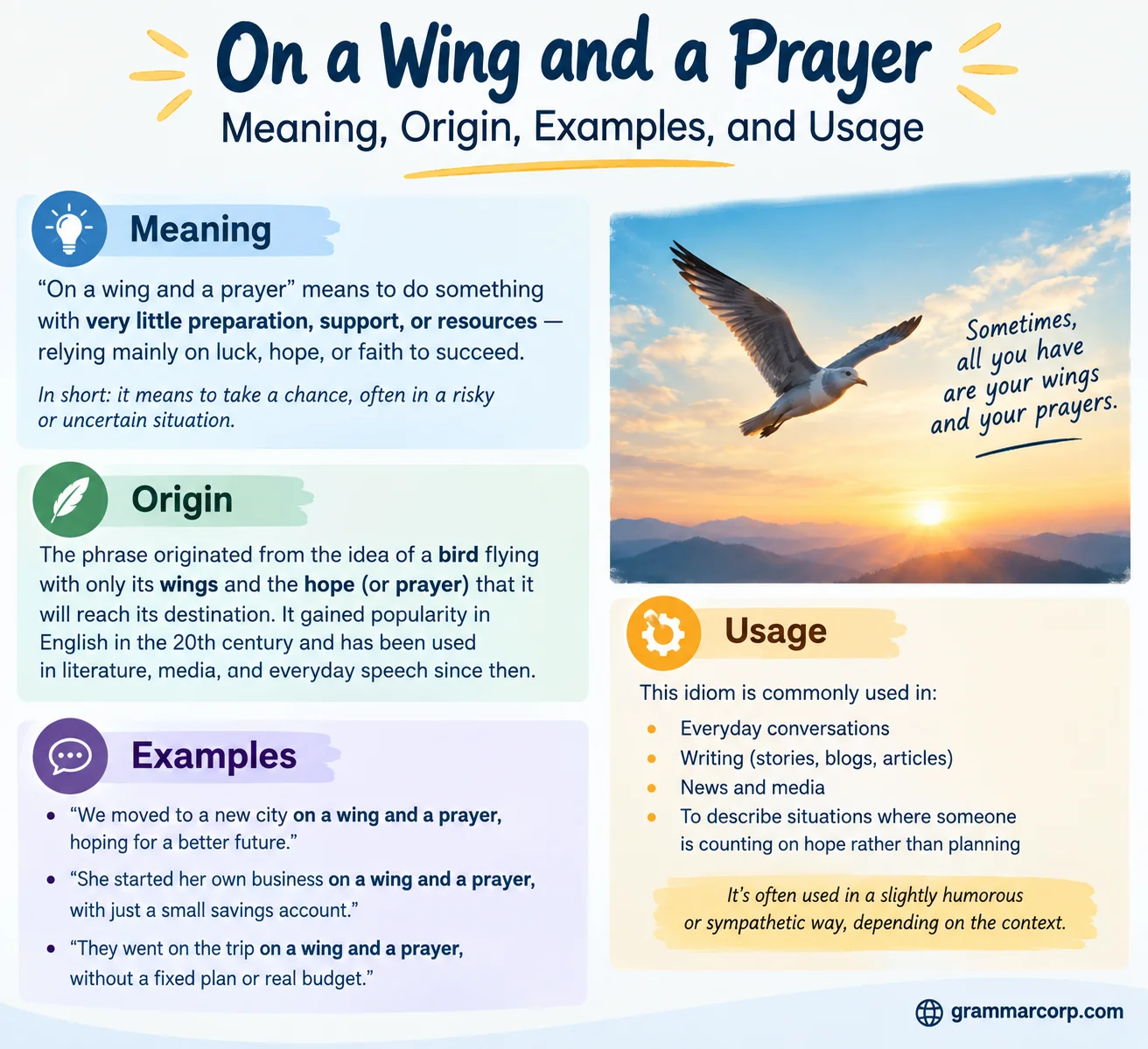
On a Wing and a Prayer: Meaning, Origin, Examples, and Usage explains an expression of hope when success remains uncertain today. The English language is chocked full of phrases that tell stories beyond their literal interpretations, and this powerful, emotional expression describes an attempt to succeed with very little practical support to depend on. Determination and good fortune can make an outcome possible, even when it is far from certain. The phrase has a strong connection to aviation and World War II, where the imagery of a damaged aircraft struggling to return safely with limited practical support remaining creates a memorable picture. .
As an idiom, it captures the feeling of hope, faith, courage, survival, hardship, perseverance, and resilience. Its popular presence in books, songs, movies, motivational discussions, everyday conversations, literature, and popular culture shows how widely the expression has traveled. These emotional journeys often involve an unlikely result that remains possible through belief and effort. I find that a second look helps unpack the phrase because its historical and cultural roots add depth that a simple definition cannot fully show.
I encountered the phrase while considering Baz Luhrmann’s ever popular version of a tragic love story, where ’90s nostalgia and visually fluttering feathery touches seemed to relate to the same hope and magic behind the expression. Laird Borrelli-Persson, writing for Vogue on 10 Oct. 2026, provides another cultural reference for how tiny efforts can carry meaning. The world moves forward, and individual acts can sometimes overcome slim odds by a bit of faith and persistence. That practical use gives the expression a remarkable sense of determination, courage, and timeless resilience that feels genuinely inspiring.
Quick Answer:
On a wing and a prayer means attempting something despite having very limited resources, preparation, or certainty of success.
It suggests a situation where practical support is weak and the outcome depends heavily on hope, luck, determination, or faith.
For example:
We finished the project on a wing and a prayer.
This means the project was completed despite difficult circumstances and without much to rely on.
The expression is usually figurative today. It can describe work, travel, school, business, sports, emergencies, or everyday situations.
At a Glance
| Feature | Explanation |
| Expression | On a wing and a prayer |
| Meaning | Trying to succeed with very little to rely on |
| Tone | Informal, vivid, slightly dramatic |
| Main idea | Uncertainty combined with hope |
| Historical association | Aviation and World War II |
| Modern use | Mostly figurative |
| Common alternatives | Against the odds, by luck, taking a chance |
Comparison Overview
The phrase is closely related to several English idioms about uncertainty and difficult situations. However, these expressions aren’t interchangeable in every context.
| Expression | Main Meaning | What It Emphasizes |
| On a wing and a prayer | Trying despite limited support | Hope and uncertainty |
| Against all odds | Succeeding despite major disadvantages | Difficult odds |
| By the skin of your teeth | Barely succeeding or escaping failure | Narrow success |
| Flying by the seat of your pants | Acting without a clear plan | Improvisation |
| Taking a chance | Accepting an uncertain outcome | Risk |
| By sheer luck | Succeeding because of chance | Fortune |
| Hoping for the best | Expecting a favorable outcome despite uncertainty | Optimism |
| Hanging by a thread | Being in an extremely unstable position | Imminent failure |
The important distinction is that on a wing and a prayer combines two ideas: limited practical support and continued hope.
For example, saying a team won by sheer luck focuses on chance. Saying it won on a wing and a prayer suggests the team struggled with limited resources or advantages while still managing to succeed.
Main Differences Between On a Wing and a Prayer and Similar Idioms
Understanding these differences makes the expression much easier to use correctly.
On a Wing and a Prayer vs. Against the Odds
Against the odds focuses primarily on the difficulty of achieving an outcome.
The small team won against the odds.
The sentence tells you that circumstances strongly favored the other side.
On a wing and a prayer adds another layer. It suggests that the person or group had limited practical support while continuing to hope for success.
The small team reached the final on a wing and a prayer.
The second version creates a stronger picture of struggle and uncertainty.
On a Wing and a Prayer vs. By the Skin of Your Teeth
By the skin of your teeth describes a very narrow escape or success.
She caught the train by the skin of her teeth.
The focus is on how narrowly the event worked out.
On a wing and a prayer focuses more on the precarious circumstances surrounding the attempt.
They completed the repair on a wing and a prayer.
The repair might have involved limited tools, time, or resources.
On a Wing and a Prayer vs. Flying by the Seat of Your Pants
These two expressions can overlap, but they emphasize different things.
Flying by the seat of your pants means improvising rather than following a carefully prepared plan.
On a wing and a prayer emphasizes uncertainty and limited support.
Someone can be carefully prepared yet still face a situation that feels like a wing and a prayer. Conversely, someone can improvise successfully without being in a particularly desperate situation.
On a Wing and a Prayer vs. Taking a Chance
Taking a chance is broader and more neutral.
It simply means accepting some uncertainty or risk.
On a wing and a prayer sounds more precarious. It suggests that the person doesn’t have much working in their favor.
Compare:
We decided to take a chance on the new route.
with:
We found our way home on a wing and a prayer.
The second sentence implies a much more difficult situation.
What Does “On a Wing and a Prayer” Mean?
The phrase describes an attempt made under difficult or uncertain conditions.
The person may lack enough money, time, information, equipment, preparation, or support. Despite those limitations, they continue toward the desired result.
The expression doesn’t necessarily mean failure is inevitable. In fact, it often appears after someone succeeds.
For example:
The team made it through the tournament on a wing and a prayer.
The team succeeded, but the phrase tells you that the journey wasn’t comfortable or secure.
The Three Main Ideas Behind the Expression
Limited resources:
The person doesn’t have everything they need.
Uncertainty:
The outcome isn’t guaranteed.
Hope:
Despite the uncertainty, the person continues believing that things might work out.
That combination gives the idiom its distinctive meaning.
Why Does the Phrase Use “Wing”?
The word wing gives the expression its aviation imagery.
A wing is an essential part of an aircraft. In the phrase, the image is of an aircraft attempting to continue its journey despite serious difficulties.
The exact mental picture doesn’t need to be interpreted literally every time someone uses the idiom. Instead, the damaged or inadequate wing represents limited practical support.
The phrase therefore creates a contrast:
- The wing represents something tangible and practical.
- The prayer represents hope when practical certainty isn’t enough.
- Together, they suggest an attempt that is barely supported.
This is why the phrase feels more dramatic than simply saying with limited resources.
Why Does the Phrase Mention a “Prayer”?
The word prayer introduces the idea of hoping for help or a favorable outcome.
It doesn’t necessarily mean the speaker is making a religious statement. Modern speakers often use the phrase simply to describe a situation where there isn’t much left to rely on.
For example:
We submitted the proposal on a wing and a prayer.
The speaker isn’t necessarily talking about religion. They mean the proposal was submitted despite uncertainty and limited confidence.
The word prayer makes the expression emotionally stronger. It suggests that ordinary preparation or resources aren’t enough to guarantee success.
Where Did “On a Wing and a Prayer” Come From?
The expression is strongly associated with World War II aviation.
During the war, aircraft sometimes returned from missions after suffering significant damage. Stories of crews attempting to bring damaged planes home provided a powerful image of survival under extreme uncertainty.
The phrase became especially prominent in popular culture during the early 1940s.
A major milestone came in 1943, when the song Coming in on a Wing and a Prayer became widely known. The song was written by Harold Adamson with music by Jimmy McHugh.
The phrase also appeared in connection with the 1943 film The Sky’s the Limit, helping spread the expression to a wider audience.
A Short Historical Timeline
| Period | Development |
| Early 1940s | Aviation and wartime experiences provide the cultural setting |
| 1943 | Coming in on a Wing and a Prayer becomes widely associated with the phrase |
| 1940s onward | The expression becomes increasingly familiar outside aviation |
| Modern English | The phrase is commonly used figuratively |
The historical story is sometimes simplified into the claim that one specific damaged aircraft directly created the idiom. That explanation should be treated cautiously.
The safer historical conclusion is that wartime aviation imagery and popular culture helped establish and spread the expression.
How to Use “On a Wing and a Prayer” in a Sentence
The expression normally describes an attempt, achievement, or situation involving uncertainty.
It works particularly well when you want to communicate that someone succeeded despite having little to depend on.
Common Sentence Patterns
Subject + managed to + verb + on a wing and a prayer
They managed to finish the project on a wing and a prayer.
Subject + got through + situation + on a wing and a prayer
We got through the week on a wing and a prayer.
Subject + completed + task + on a wing and a prayer
The crew completed the difficult assignment on a wing and a prayer.
Subject + made it + on a wing and a prayer
Somehow, the team made it on a wing and a prayer.
When the Phrase Works Best
Use it when the situation involves one or more of these conditions:
- Limited preparation
- Limited resources
- Unexpected problems
- Very little time
- Uncertain results
- A difficult challenge
- A narrow path to success
- Strong dependence on hope or luck
“On a Wing and a Prayer” Examples in Different Contexts
The idiom is flexible because uncertainty appears in almost every part of life.
Everyday Situations
We got the old computer working on a wing and a prayer.
I made dinner with what was left in the refrigerator, so it was definitely on a wing and a prayer.
They managed to finish cleaning before the guests arrived on a wing and a prayer.
These examples use the phrase humorously. The situation doesn’t have to be genuinely dangerous.
School and Studying
He prepared for the test on a wing and a prayer.
We finished the presentation on a wing and a prayer after the computer stopped working.
The group completed the assignment on a wing and a prayer.
In these examples, the idiom highlights limited preparation or difficult circumstances.
Work and Business
The team launched the project on a wing and a prayer.
We completed the report on a wing and a prayer after receiving the information late.
The small company survived its first difficult year on a wing and a prayer.
Business writers may use the expression in informal commentary. A formal report would usually replace it with more precise language.
Travel
We reached the station on a wing and a prayer.
They made the connection on a wing and a prayer.
We managed to complete the journey on a wing and a prayer.
Travel examples often communicate last-minute planning, delays, or unexpected problems.
Sports
The team held onto its lead on a wing and a prayer.
They reached the final on a wing and a prayer.
The club survived the final minutes on a wing and a prayer.
The expression works especially well in sports commentary because games frequently involve uncertain outcomes and changing circumstances.
A Practical Case Study: Using the Idiom Correctly
Imagine a student has three days to prepare a large presentation. A technical problem deletes part of the work the night before the deadline.
The student rebuilds the missing section, practices briefly, and presents the project the next morning.
You could say:
The presentation came together on a wing and a prayer.
Why does this work?
The student had:
- Limited time
- An unexpected problem
- Incomplete preparation
- Uncertainty about the result
- Hope that the final presentation would succeed
The phrase summarizes all of those circumstances without requiring a long explanation.
However, suppose another student spends three weeks researching the topic, practices every day, checks the equipment, and delivers the presentation smoothly.
Calling that situation on a wing and a prayer wouldn’t fit well. There isn’t enough uncertainty or lack of preparation to justify the idiom.
Is “On a Wing and a Prayer” Positive or Negative?
The expression can carry both positive and negative elements.
The negative side comes from the uncertainty. The speaker suggests that the situation isn’t secure.
The positive side comes from persistence and the possibility of success.
That’s why the phrase often appears after something works out:
Somehow, they pulled it off on a wing and a prayer.
The outcome is successful, but the speaker still emphasizes how uncertain the situation was.
Emotional Tone
The phrase can sound:
- Hopeful
- Humorous
- Dramatic
- Self-deprecating
- Concerned
- Relieved
Context determines the exact feeling.
A friend might use it jokingly about finishing a household task. A journalist might use it more seriously when describing a struggling organization.
Is “On a Wing and a Prayer” Formal or Informal?
The expression is generally informal to conversational.
It’s familiar enough to appear in journalism and general nonfiction. However, it may not be the best choice for highly technical, academic, or official documents where precise wording matters more than colorful language.
Casual Version
We finished the job on a wing and a prayer.
More Formal Version
We completed the job despite significant resource limitations and uncertainty.
The second version is less colorful but more precise.
Better Formal Alternatives
Depending on the context, you could use:
- Despite limited resources
- Despite significant uncertainty
- With minimal preparation
- Under difficult circumstances
- With little margin for error
- Despite substantial constraints
- Despite considerable obstacles
Choose the alternative that explains the actual problem instead of simply replacing the idiom automatically.
Common Mistakes When Using “On a Wing and a Prayer”
The phrase is easy to understand, but some uses weaken its meaning.
Using It for Every Difficult Situation
Not every difficult situation qualifies.
If something is challenging but well planned, the idiom may sound inaccurate.
Better: Use it when limited support or uncertainty is central to the situation.
Confusing It With “Against All Odds”
These expressions overlap, but they’re not identical.
Against all odds focuses on overcoming unfavorable circumstances.
On a wing and a prayer emphasizes having little to rely on while hoping for success.
Using It in an Extremely Formal Document
The idiom isn’t incorrect in professional writing. However, a precise description may be more useful in a formal report.
Instead of:
The system was maintained on a wing and a prayer.
A technical report could explain exactly what was missing:
The system was maintained despite limited staffing and restricted replacement parts.
The second sentence provides information the reader can act on.
Taking the Phrase Too Literally
Modern use is normally figurative.
Someone doesn’t need to be talking about an airplane for the phrase to make sense.
The project survived on a wing and a prayer.
Here, wing isn’t referring to an actual aircraft component.
Read More : “Next Friday” vs. “This Friday”: What’s the Difference?
Synonyms and Alternatives to “On a Wing and a Prayer”
No single synonym captures every part of the idiom. The best alternative depends on what you want to emphasize.
| Alternative | Meaning | Best Context |
| Against the odds | Despite unfavorable circumstances | Difficult achievement |
| By the skin of your teeth | Barely succeeding | Narrow escape |
| Flying by the seat of your pants | Improvising without preparation | Unplanned situations |
| Taking a chance | Accepting uncertainty | Risky decisions |
| By sheer luck | Succeeding because of chance | Fortunate outcomes |
| Hoping for the best | Expecting a favorable result | Uncertain situations |
| Against all odds | Succeeding despite major obstacles | Exceptional difficulty |
| Barely making it | Succeeding with little margin | Time or resource pressure |
Which Alternative Should You Choose?
Use against the odds when the main point seemed unlikely.
Use by the skin of your teeth when success or escape happened moment.
Use flying by the seat of your pants when someone clear plan.
Use by sheer luck when chance is the main reason for success.
Use taking a chance when you want a neutral description of risk.
Use on a wing and a prayer when limited support with hope and uncertainty.
Related Idioms About Risk, Hope, and Uncertainty
English has many expressions that describe uncertain situations.
Against All Odds
This means achieving something despite circumstances that make success unlikely.
She completed the challenge against all odds.
The focus is on the unfavorable odds.
By the Skin of Your Teeth
This describes a very narrow success or escape.
He caught the bus by the skin of his teeth.
The key idea is barely.
Flying by the Seat of Your Pants
This means handling a situation through improvisation rather than careful planning.
We were flying by the seat of our pants during the event.
The key idea is improvisation.
Taking a Leap of Faith
This means making a decision despite lacking certainty about the result.
It can overlap with on a wing and a prayer, but it often focuses more on the decision itself than on limited resources.
Hanging by a Thread
This describes an extremely unstable situation.
The agreement is hanging by a thread.
The emphasis is on fragility and the possibility of failure.
Throwing Caution to the Wind
This means deliberately ignoring normal caution or restraint.
It’s more about recklessness or boldness than limited resources.
Facts About “On a Wing and a Prayer”
Several facts help put the expression into context:
- The phrase is strongly associated with wartime aviation.
- Its imagery comes from the idea of continuing despite serious difficulty.
- 1943 was an important year in the phrase’s popularization.
- The song Coming in on a Wing and a Prayer helped bring the expression to a broad audience.
- The phrase eventually moved beyond aviation into everyday English.
- Modern usage is overwhelmingly figurative.
- The expression can describe both successful and unsuccessful attempts.
- It usually carries an idea of uncertainty rather than guaranteed failure.
- It is more colorful than formal alternatives such as despite limited resources.
Why the Idiom Still Works Today
The phrase has survived because its underlying situation remains universal.
People still face deadlines without enough time. Teams still work with limited resources. Travelers still deal with unexpected problems. Organizations still operate under uncertainty.
The circumstances change, but the basic human experience doesn’t.
That makes on a wing and a prayer particularly effective. Instead of merely saying something was difficult, the expression creates a compact mental picture of someone continuing forward when the practical odds aren’t comfortable.
Its strength comes from that combination of imagery and meaning.
FAQs:
What does “on a wing and a prayer” mean?
“On a wing and a prayer” means trying to succeed with very limited resources, preparation, or support while relying heavily on hope, faith, or good fortune. The result is uncertain, but success is still possible.
Where did “on a wing and a prayer” come from?
The expression is strongly associated with aviation and World War II. It became popular through the image of a damaged aircraft attempting to make it home despite serious problems, with the “prayer” representing hope for a safe outcome.
Is “on a wing and a prayer” positive or negative?
It can be either. The phrase often highlights risk, uncertainty, or poor preparation, but it can also express courage, determination, resilience, and perseverance when someone keeps going despite difficult circumstances.
How do you use “on a wing and a prayer” in a sentence?
You can use it when someone attempts something without enough resources or preparation. For example: We finished the project on a wing and a prayer because we had almost no time left.
Is “on a wing and a prayer” an idiom?
Yes. It is an English idiom and a form of figurative language. Its meaning goes beyond the literal image of an aircraft and a prayer.
Conclusion:
On a wing and a prayer remains a memorable expression because it combines uncertainty with hope. It describes those moments when you don’t have everything you need, yet you still decide to move forward.
Its connection to aviation and World War II gives the phrase a vivid historical background, while its modern use extends to work, business, travel, personal challenges, and everyday situations. Whether you’re describing a risky attempt or someone showing remarkable resilience, the idiom captures the idea of continuing despite the odds.














1 thought on “On a Wing and a Prayer: Meaning, Origin, Examples, and Usage”