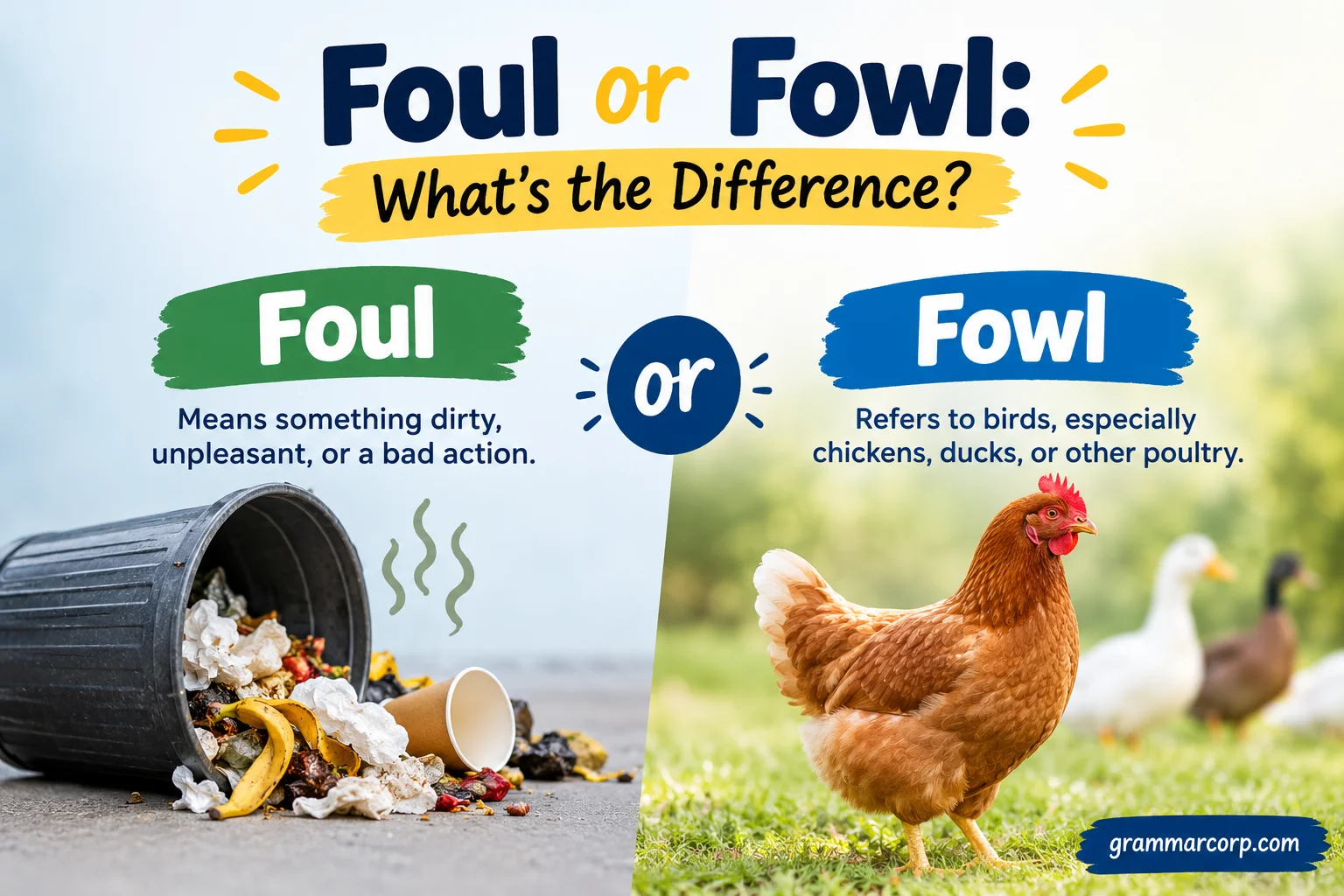
Foul or Fowl: What’s the Difference? helps learners understand these homophones through spelling, pronunciation, context, and everyday usage. Foul and fowl have sounds that are exactly alike, but their spelling and meanings are different, which can make learners confuse them in writing, speaking, or conversation.
The difference becomes easier when each word is connected with its main meaning. Foul can describe something unpleasant, dirty, offensive, unfair, or bad, including a foul smell or foul behavior. In sports, a player may commit a foul when an action breaks the rules, and the word can also indicate certain illegal actions or a violation. Fowl, however, is a noun for birds, especially birds kept or hunted for food. On a farm, chickens, ducks, geese, and turkeys may be seen walking around, while waterfowl, water birds, and barnyard birds provide useful examples for remembering the correct term.
In everyday English, context clues, grammar, semantics, and word choice help show the correct term. Fowl can refer to gallinules, coots, snake birds, mergansers, anhingas, egrets, cranes, storks, and herons, especially when discussing edible birds, bird meat, dinner, a food source, or poultry. By comparison, foul appears in common phrases and usage rules involving bad smells, unpleasant language, unfair behavior, and sports. A fowl-mouthed rooster can create a humorous joke, while the phrase fowl foul makes the spelling difference memorable.
From my experience explaining confusing word pairs, learners often build confidence faster when they use examples and comparison instead of memorizing definitions alone. A friend can become confused in a conversation, while kids who played with chickens might laugh when someone yelled “fowl foul.” Such playful kids, cheerful moments, and memorable phrases can make vocabulary learning more natural.
Quick Answer:
Foul and fowl are different words with different meanings.
- Foul means unpleasant, dirty, offensive, unfair, or against a rule.
- Fowl means a bird, especially a domesticated or game bird.
- Foul can work as a noun, verb, and adjective.
- Fowl is mainly used as a noun.
- Both words are generally pronounced /faʊl/.
- Because they sound alike, they can be confusing when heard rather than seen.
Foul example
The kitchen had a foul smell.
Here, foul means unpleasant.
Fowl example
The farmer keeps several types of fowl.
Here, fowl means birds.
The easiest rule is simple: if you’re talking about birds, use fowl. If you’re describing something bad, unpleasant, dirty, or against the rules, use foul.
Comparison Overview
| Feature | Foul | Fowl |
| Main meaning | Unpleasant, dirty, offensive, unfair, or illegal | A bird, especially a domesticated or game bird |
| Pronunciation | /faʊl/ | /faʊl/ |
| Word type | Noun, verb, adjective | Mainly noun |
| Common context | Sports, smells, behavior, pollution, weather | Farming, food, hunting, birds |
| Example | That was a foul smell. | The farmer raised fowl. |
| Common phrase | Foul play | Wild fowl |
| Easy association | Bad or wrong | Bird |
The biggest difference isn’t pronunciation. It’s meaning and spelling.
Think of the two words as two roads that sound the same when spoken but lead somewhere completely different.
Main Differences Between Foul or Fowl
The distinction between foul or fowl becomes clearer when you examine how each word behaves in a sentence.
Foul Describes Something Bad, Unpleasant, or Wrong
Foul has several meanings. Its exact definition depends on context.
It can describe something:
- Dirty
- Unpleasant
- Offensive
- Smelly
- Unfair
- Against the rules
- Polluted
- Obstructed
- Unacceptable
For example:
- The garbage produced a foul odor.
- The player committed a foul.
- They were accused of foul play.
- The workers had to clear a fouled drain.
- The region experienced foul weather.
Notice how none of these examples refers to a bird.
Fowl Refers to Birds
Fowl has a much more specific meaning.
It commonly refers to birds that people raise, hunt, or use for food. Chickens, turkeys, ducks, and geese can all fall under this broad category.
For example:
- The farmer raises fowl.
- Several types of fowl live near the wetland.
- The property has a small enclosure for domestic fowl.
The word can sound somewhat formal or traditional in everyday conversation. People often simply say birds or poultry instead.
Their Grammatical Roles Differ
Another useful distinction involves grammar.
Foul can function as:
- An adjective: a foul smell
- A noun: the referee called a foul
- A verb: the pollution fouled the water
Fowl generally functions as a noun:
- The farmer raises fowl.
This grammatical difference can sometimes help you identify the correct spelling.
What Does Foul Mean?
The word foul has a long history and several established meanings. Modern English uses it in everyday descriptions, sports terminology, idiomatic expressions, and technical contexts.
Foul as an Adjective
As an adjective, foul often describes something unpleasant or offensive.
A foul smell, for instance, is a very unpleasant odor.
You might say:
- The trash gave off a foul smell.
- The water had a foul odor.
- He used foul language.
- The team faced foul weather during the match.
The word can also describe behavior.
If someone acts dishonestly or unfairly, you can describe that behavior as foul.
Foul as a Noun
In sports, a foul is an action that violates the rules.
Basketball provides a familiar example. A player can commit a personal foul by breaking certain rules involving physical contact.
Baseball also uses the word differently. A foul ball travels outside the designated fair area under the game’s rules.
So when someone writes fowl ball in a sports context, they’ve chosen the wrong word.
Foul as a Verb
Foul can also describe the act of making something dirty or contaminated.
For example:
- Industrial waste can foul a waterway.
- Leaves may foul a filter.
- The machine became fouled by debris.
It can also mean to interfere with something.
This broader meaning explains why foul appears in several technical and everyday expressions.
What Does Fowl Mean?
Fowl refers to birds. The term traditionally covers birds that people keep or hunt, particularly those associated with food.
Common examples include:
- Chickens
- Turkeys
- Ducks
- Geese
- Pheasants
- Other game or domestic birds in appropriate contexts
The exact boundaries of the word depend on context.
Fowl and Poultry Aren’t Always Identical
People sometimes use fowl and poultry as if they mean exactly the same thing. They overlap, but they aren’t perfect synonyms in every context.
Poultry usually refers to domesticated birds raised for meat, eggs, or other agricultural purposes.
Fowl has broader traditional uses and can include certain wild or game birds.
For example, waterfowl refers to birds associated with aquatic environments, including ducks and geese.
Fowl in Farming
The word appears naturally in agricultural contexts.
A farmer might discuss:
- Domestic fowl
- Breeding fowl
- Fowl housing
- Fowl feed
- Game fowl
However, modern everyday speech often favors more specific terms such as chickens, ducks, or poultry.
Foul vs. Fowl Pronunciation
One major reason people confuse these words is pronunciation.
In standard American English, foul and fowl are generally pronounced the same:
/faʊl/
The vowel sound is similar to the sound in house and out.
Because the spoken forms match, listeners usually need context to determine which word someone means.
What Is a Homophone?
A homophone is a word that sounds the same as another word but has a different meaning or spelling.
For example:
- Foul / fowl
- Flower / flour
- Sea / see
- Right / write
The pronunciation doesn’t tell you which spelling belongs on the page.
That matters particularly in emails, essays, reports, captions, and other written communication.
When Should You Use Foul or Fowl?
Choosing between these words becomes easier when you focus on what you’re describing.
Use Foul for Something Unpleasant
Choose foul when you’re describing a bad smell, dirty condition, unpleasant substance, or offensive behavior.
Examples:
- Foul air
- Foul odor
- Foul language
- Foul water
- Foul behavior
Use Foul for Sports Violations
Use foul when talking about an action that breaks sports rules.
Examples include:
- A basketball foul
- A soccer foul
- A baseball foul ball
- Foul play
The spelling stays foul because the word has nothing to do with birds.
Use Fowl for Birds
Choose fowl when the subject is a bird within the traditional meaning of the word.
Examples:
- Domestic fowl
- Wild fowl
- Waterfowl
- Game fowl
If you’re describing chickens or ducks in a farming context, fowl can be appropriate.
Foul or Fowl in Sentences
Seeing the words in context makes the distinction much easier.
Examples Using Foul
- The refrigerator had a foul smell.
- The referee called a foul.
- The players were warned against foul play.
- The factory was accused of fouling the river.
- The hikers faced foul weather.
- He apologized for using foul language.
- The drain became fouled with debris.
Examples Using Fowl
- The farmer raises fowl.
- Ducks are common waterfowl.
- The property contains several domestic fowl.
- Hunters once traveled there to pursue wild fowl.
- The enclosure protects the fowl from predators.
The difference becomes obvious when you replace each word with its basic meaning.
If bad, dirty, unpleasant, unfair, or against the rules fits, think foul.
If a bird fits, think of a fowl.
Common Foul vs. Fowl Mistakes
These two words create several predictable spelling errors.
Mistake: Fowl Smell
A common mistake is writing fowl smell when describing an unpleasant odor.
The correct phrase is:
foul smell
Why? Because foul means unpleasant or offensive in this context.
Mistake: Fowl Play
Another frequent mistake is fowl play.
The correct expression is:
foul play
Here, foul means dishonest, unfair, or improper behavior.
It has nothing to do with birds.
Mistake: Fowl Ball
In sports writing, fowl ball is incorrect.
The correct term is:
foul ball
The word foul describes the rule-related status of the ball.
Mistake: Foul Birds
Calling birds foul isn’t automatically wrong because foul can describe something unpleasant or offensive. However, if you mean the noun that refers to birds, the correct word is fowl.
Compare:
- The farmer raises fowl. ✓
- The farmer raises a foul. ✗
The first sentence identifies birds.
Mistake: Assuming Similar Sounds Mean Similar Meanings
English contains many homophones. Foul and fowl belong to this group.
Their identical pronunciation doesn’t create a relationship between their meanings.
This is why relying on sound alone can cause spelling mistakes.
Foul and Fowl: Common Expressions
Certain phrases make the distinction especially easy to remember.
Common Expressions With Foul
Foul play
Foul play means dishonest, unfair, or improper behavior.
Example:
The investigation raised concerns about possible foul play.
Foul language
Foul language refers to offensive or vulgar language.
Example:
The teacher asked students to avoid foul language.
Foul smell
A foul smell is an extremely unpleasant odor.
Example:
A foul smell came from the old drain.
Foul weather
Foul weather refers to unpleasant or severe weather conditions.
Example:
The flight was delayed because of foul weather.
Foul ball
In baseball, a foul ball is a ball that meets the game’s definition of a foul.
Example:
The batter hit a foul ball into the stands.
Foul up
As a phrasal verb, foul up means to make a mistake or cause something to go wrong.
Example:
A small error could foul up the entire schedule.
Common Expressions With Fowl
Wild fowl
Wild fowl refers to birds that live in the wild and fall within the traditional category of fowl.
Waterfowl
Waterfowl refers to birds associated with water. Ducks, geese, and swans are familiar examples.
Domestic fowl
Domestic fowl refers to domesticated birds kept by people.
Game fowl
Game fowl can refer to birds traditionally kept or hunted as game birds, depending on context.
Foul vs. Fowl: A Practical Decision Guide
When you’re unsure which spelling to use, ask one question:
Are you talking about a bird?
Yes → Fowl
Examples:
- Chickens are domestic fowl.
- Ducks are common waterfowl.
- The farm keeps several kinds of fowl.
No → Consider Foul
Examples:
- That’s a foul smell.
- The referee called a foul.
- The workers had to clean the fouled equipment.
This test won’t replace understanding the full definitions, but it works well for the most common cases.
Easy Ways to Remember Foul vs. Fowl
Memory tricks work best when they connect the spelling with meaning.
Remember Fowl With Bird
Think:
Fowl = feathered animal
The shared owl sequence in fowl can also make the word visually memorable because an owl is a bird.
The connection isn’t an etymological rule. It’s simply a useful spelling aid.
Remember Foul With Bad or Wrong
Think:
Foul = bad, dirty, unpleasant, or against the rules
A foul smell is bad.
A foul in sports breaks a rule.
Foul play involves improper behavior.
Once you associate foul with something negative, the distinction becomes much easier.
Read More : Masonry vs Masonry: Which Spelling Is Correct?
A Mini Foul or Fowl Practice Quiz
Try choosing the correct word before checking the answers.
Fill in the blanks
- The garbage produced a ___ odor.
- The farmer raises domestic ___.
- The referee called a ___.
- Ducks are a type of ___.
- The players were accused of ___ play.
- The old pipe had ___ water inside it.
- The batter hit a ___ ball.
Answers
- The garbage produced a foul odor.
- The farmer raises domestic fowl.
- The referee called a foul.
- Ducks are a type of fowl.
- The players were accused of foul play.
- The old pipe had foul water inside it.
- The batter hit a foul ball.
The pattern is consistent: fowl refers to birds, while foul covers the other meanings shown here.
A Closer Look at Foul in Sports
Sports terminology accounts for many everyday uses of foul.
The exact meaning changes between sports, but the central idea remains connected to a violation or restricted play.
Basketball
A foul generally involves an illegal action under the game’s rules, often involving prohibited physical contact.
Soccer
A foul occurs when a player commits an offense defined by the Laws of the Game.
Baseball
A foul ball has a specific meaning under baseball’s rules. The ball’s location relative to the foul lines determines whether it is foul in many situations.
Why This Matters for Spelling
None of these sports meanings uses fowl.
So phrases such as:
- foul ball
- personal foul
- foul play
all use foul.
Fowl, Poultry, and Bird: What’s the Difference?
These terms overlap, but they aren’t interchangeable in every sentence.
| Word | General meaning |
| Bird | Broad term covering the entire class of birds |
| Fowl | Traditional term for certain birds, especially domestic or game birds |
| Poultry | Domesticated birds raised for food or agricultural purposes |
| Waterfowl | Birds associated with aquatic environments |
This distinction helps explain why fowl can sometimes sound more specialized than bird.
For everyday conversation, someone might say:
There are several birds near the pond.
In a more specific context, someone could say:
Several species of waterfowl are near the pond.
The second sentence uses more specialized terminology.
Why Foul and Fowl Are So Easy to Confuse
English spelling doesn’t always provide a reliable guide to pronunciation.
In this case, the problem comes from homophony. Your ears hear one sound while your brain must select between two spellings.
Several factors make the confusion more likely:
- The words have identical common pronunciation.
- Both words are short.
- Both can appear in familiar phrases.
- Context determines the intended meaning.
- Spell-check software may not catch a correctly spelled but incorrectly chosen word.
That final point matters.
A spell checker may accept fowl because it is a legitimate English word. It can’t always determine that you meant foul.
For example:
The garbage has a fowl smell.
Every word is spelled correctly according to the dictionary. Yet the sentence uses the wrong word.
Human understanding and context still matter.
Foul or Fowl: Real-World Usage Examples
Consider this short scenario.
Case Study: A Farm Report
Imagine you’re writing a report about a small farm.
You might write:
The farm keeps several types of fowl, including chickens and ducks.
Here, fowl correctly identifies the birds.
Now imagine that the farm’s drainage system has a problem.
You might write:
A foul smell came from the blocked drain.
This time, foul describes the unpleasant smell.
The two words can appear in the same paragraph without meaning anything similar:
The farm raises fowl, but a foul smell from the drainage area needs attention.
That’s the distinction in its simplest form.
Foul or Fowl in Formal Writing
Choosing the correct word becomes particularly important in professional and academic writing.
A spelling mistake involving a homophone can change the meaning of an otherwise polished sentence.
Before submitting your writing, check:
- Is the word describing something unpleasant?
- Is it referring to a sports violation?
- Does it describe unfair or improper behavior?
- Is it referring to pollution or contamination?
- Or is it actually naming a type of bird?
If the sentence concerns birds, fowl may be correct.
If it concerns unpleasantness, violations, contamination, or improper behavior, foul is usually the correct choice.
FAQs:
1. What is the difference between foul and foul?
Foul usually describes something unpleasant, offensive, dirty, unfair, or against the rules. Fowl is a noun that refers to birds, especially birds kept or hunted for food.
2. Are foul and fowl pronounced the same?
Yes. Foul and fowl are homophones, meaning they have the same or very similar pronunciation but different spellings and meanings.
3. What is an example of foul play?
You can say, “The room had a foul smell.” In sports, foul can also describe an action that breaks the rules.
4. What is an example of a fowl?
You can use fowl when talking about birds such as chickens, ducks, geese, or turkeys, especially when discussing birds kept for food.
5. How can I remember the difference between foul and fowl?
A simple memory trick is to connect fowl with birds and foul with something unpleasant or a rule-breaking action. Looking at the context can also help you choose the correct word.
Conclusion:
Understanding foul and fowl becomes easier once you connect each spelling with its meaning. Although these homophones sound alike, foul relates to unpleasant things, unfair actions, or rule violations, while fowl refers to birds.
Paying attention to context, spelling, and usage will help you use the correct word confidently in everyday English.














1 thought on “Foul or Fowl: What’s the Difference?”