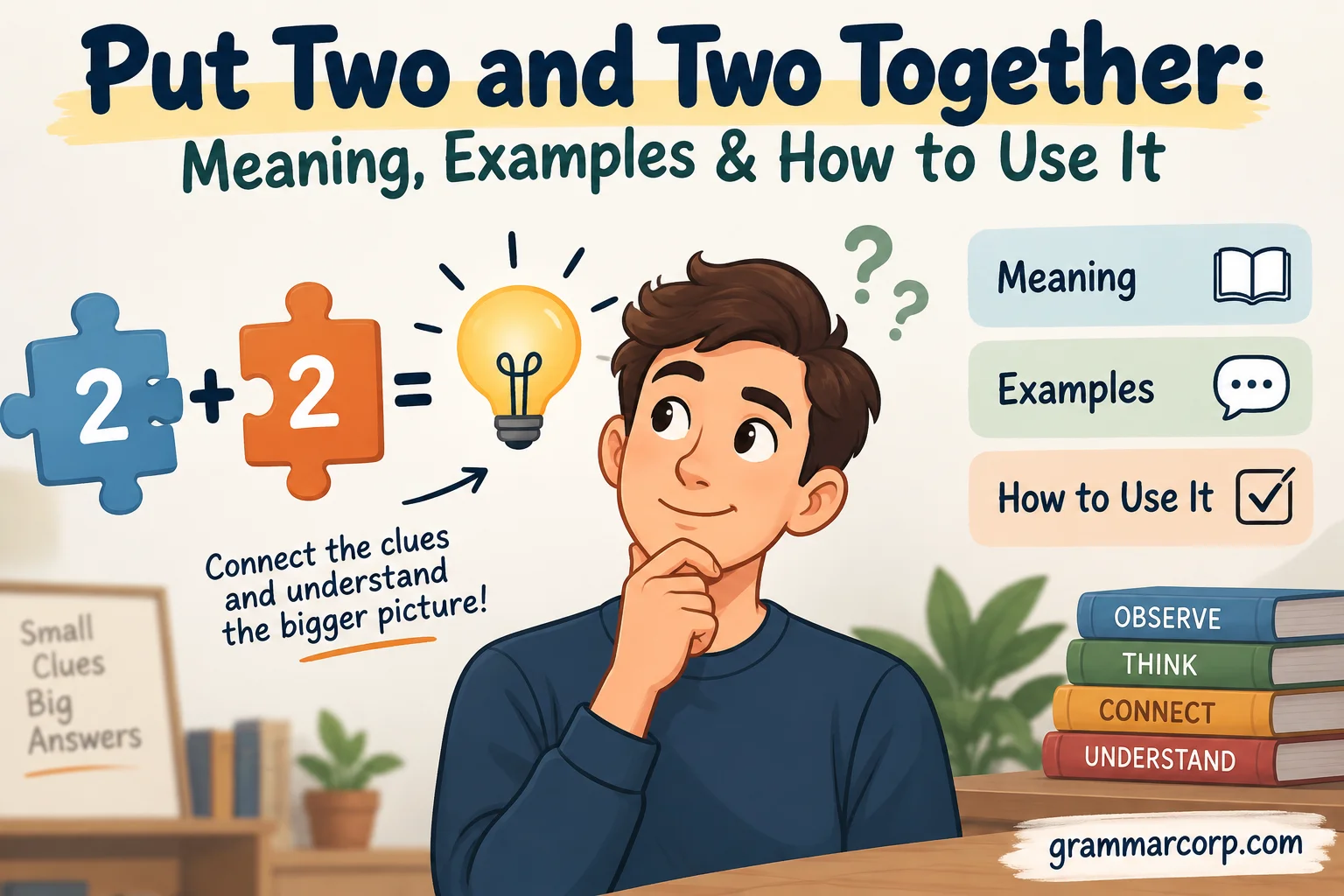
Put Two and Two Together: Meaning, Examples & How to Use It explains how facts and clues lead to a logical conclusion in daily speech. When you put two and two together, you figure something out by noticing small clues, facts, and circumstances and reaching a logical conclusion from available information. The phrase works well when someone doesn’t give you a direct explanation, but the truth becomes clear through connecting information, connecting facts, and connecting clues.
For example, a friend may keep checking the time, packed their bag, and mentioned an appointment without explaining the reason. You can then connect the dots, understand what is happening, and make a correct guess. This is the basic idiom definition of the common English idiom and popular English expression. Cambridge describes it as an informal idiom, while Merriam-Webster relates it to understanding something from what you have seen or heard.
The phrase also has a simple math analogy: adding two plus two gives four, while combining separate pieces of information can create a clear understanding. The mental process may involve observation, reasoning, inference, and deduction. You notice different facts, different clues, strange behavior, or other evidence, then discover the reason behind it without being told the answer directly.
That moment of realization can create a spark of pride, especially when you have figured something out on your own. It can feel like solving a puzzle that has been sitting on a table for days: the pieces finally fit, everything makes sense, and you see the full picture. The satisfaction of seeing that connection can be immensely rewarding. In this sense, the phrase, its meaning, and its origin connect with communication, context, interpretation, and everyday reasoning.
Quick Answer:
Put two and two together means to connect separate pieces of information and use them to reach a conclusion, usually without being told the answer directly.
For example:
The lights were off, the door was locked, and nobody answered. She put two and two together and realized they weren’t home.
Here, the person doesn’t perform a mathematical calculation. Instead, she combines several clues and reaches a logical conclusion.
The phrase can also mean figure something out, connect the dots, work out what happened, or draw an obvious conclusion. However, these alternatives don’t always have exactly the same tone.
Comparison Overview
The easiest way to understand put two and two together is to compare it with expressions that describe similar kinds of reasoning.
| Expression | Basic meaning | Tone | Common use |
| Put two and two together | Combine clues to reach a conclusion | Informal | Everyday conversation |
| Connect the dots | See how separate facts relate | Informal | Patterns and clues |
| Figure it out | Discover or understand something | Casual | General problem-solving |
| Piece things together | Build an understanding from separate details | Neutral | Investigations and explanations |
| Draw a conclusion | Reach a judgment from information | Formal | Academic and professional writing |
| Infer | Reach a conclusion from evidence | Formal | Academic, technical, and analytical contexts |
| Catch on | Finally understand something | Casual | Conversations and explanations |
The closest everyday alternatives are connect the dots, figure it out, and piece things together. The best choice depends on what you want to emphasize.
If you want to stress that the answer became obvious from several clues, put two and two together works especially well.
Main Differences Between Put Two and Two Together and Similar Expressions
Although several English expressions describe reasoning, they aren’t interchangeable in every sentence.
Put Two and Two Together vs. Connect the Dots
Both expressions involve combining separate pieces of information.
However, put two and two together often emphasizes reaching a particular conclusion from clues. Connect the dots focuses more broadly on recognizing how separate facts, events, or ideas relate.
Compare these:
- I saw his car outside the restaurant and his coat on a chair, so I put two and two together.
- After looking at the sales figures, the manager connected the dots.
The first sentence suggests a specific realization. The second highlights a broader relationship between pieces of information.
Put Two and Two Together vs. Figure It Out
Figure it out has a much wider meaning.
You can figure out a math problem, a software issue, a puzzle, or a person’s behavior. Put two and two together specifically suggests that separate clues helped produce the answer.
For example:
- I couldn’t open the file, but eventually I figured it out.
- I saw the missing keys on the kitchen counter and put two and two together.
The second sentence naturally suggests a conclusion based on clues.
Put Two and Two Together vs. Draw a Conclusion
Draw a conclusion sounds more formal and analytical.
It works well in reports, essays, research discussions, and professional communication. Put two and two together sounds more conversational.
For example:
- After reviewing the evidence, the investigators drew a conclusion.
- I noticed all the clues and put two and two together.
Both describe reasoning. The difference lies largely in register and context.
Put Two and Two Together vs. Piece Things Together
Piece things together suggests constructing an understanding from separate fragments.
The expression often fits situations where information is incomplete or scattered.
For example:
- She found several old messages and gradually pieced things together.
- She saw his suitcase by the door and put two and two together.
The first implies a process of assembling information. The second can suggest a quicker realization.
What Does Put Two and Two Together Really Mean?
At its core, the expression describes reasoning from available information.
Imagine that you notice three things:
- Someone has packed a suitcase.
- Their travel documents are on the table.
- They mention leaving early the next morning.
Nobody tells you that they’re going on a trip. Yet the clues point toward that conclusion.
You put two and two together.
Cambridge explains the phrase as guessing the truth about a situation from what you have seen or heard. Its American Dictionary entry similarly describes understanding something by using the information available to you.
That detail matters because the idiom isn’t simply another way to say know.
There is a difference between knowing something and working it out.
If someone tells you, “The store closes at six,” you know the store closes at six.
If you see employees locking the doors and notice the clock says 5:58, you might put two and two together and realize the store is closing.
The idiom therefore highlights the process of deduction rather than the information itself.
How to Use Put Two and Two Together in a Sentence
The phrase normally appears as put two and two together. You can change the tense or grammatical form of put when the sentence requires it.
Present Tense
Use put two and two together when describing a general or current realization.
I saw the signs and put two and two together.
Past Tense
The phrase itself already uses the irregular past form of put, so the wording stays the same.
She put two and two together after hearing the conversation.
This can confuse English learners because put has the same form in the present and past.
Third-Person Present
With a singular subject, use puts.
He puts two and two together whenever something seems unusual.
Present Progressive
Use putting two and two together when the reasoning is happening at that moment.
We’re putting two and two together now.
Perfect Tense
You can also use put after auxiliary verbs such as have or had.
They had put two and two together before anyone explained the situation.
Useful Sentence Patterns
Several patterns sound natural:
- I put two and two together and realized…
- She finally put two and two together.
- He quickly put two and two together.
- They had already put two and two together.
- Once I put two and two together, everything made sense.
- It didn’t take long to put two and two together.
These patterns work because the idiom naturally connects evidence with a conclusion.
Put Two and Two Together Examples
Examples make the meaning much easier to recognize because the expression usually depends on context.
Everyday Examples
The refrigerator was empty and his suitcase was gone. I put two and two together and realized he had left town.
She kept checking the weather forecast and looking at hiking trails. I put two and two together and guessed she was planning a trip.
The lights were off and the curtains were closed. We put two and two together and realized the office had already closed.
School Examples
The teacher handed everyone a review sheet before the test. We put two and two together and realized the exam was probably coming soon.
Jake kept asking about the science project deadline. I put two and two together and realized he hadn’t started it yet.
The classroom was decorated with balloons and a cake sat on the desk. The students put two and two together.
Workplace Examples
The company scheduled an unexpected meeting and asked everyone to bring their project reports. The team put two and two together and expected an important announcement.
Sales had fallen for three months and several clients had complained. The manager put two and two together and identified the main problem.
Her calendar showed several meetings with the same client. I put two and two together and realized she was leading the new account.
Friendship Examples
He suddenly started asking about restaurants in the city. I put two and two together and realized he was planning a surprise dinner.
She kept checking the same delivery app. I put two and two together and guessed that she was waiting for an order.
Mystery and Clue-Based Examples
This is one of the most natural settings for the expression.
The muddy footprints led toward the back door, and the missing umbrella was sitting outside. The detective put two and two together.
The package had the wrong address, but the sender’s name matched an old contact. She put two and two together and realized the delivery belonged to her neighbor.
The common thread in all these examples is simple: separate facts become meaningful when considered together.
What Does It Mean When Someone Says You Should Put Two and Two Together?
When someone tells you to put two and two together, they’re suggesting that the available clues should allow you to reach the conclusion yourself.
The exact meaning can depend on tone.
Sometimes the phrase sounds completely neutral:
Once you put two and two together, the answer becomes clear.
In this case, the speaker simply encourages logical reasoning.
Other times, it can sound teasing:
You really didn’t put two and two together?
Here, the speaker thinks the clues were fairly obvious.
It can also sound mildly frustrated:
I gave you all the details. You need to put two and two together.
That version may imply that the listener overlooked information that should have led to an obvious conclusion.
Tone Comparison
| Tone | Example | What it suggests |
| Neutral | Once you put two and two together, it makes sense. | The clues lead naturally to an answer |
| Friendly | You didn’t put two and two together? | Playful surprise |
| Teasing | Come on, put two and two together! | The answer seems obvious |
| Frustrated | I’ve explained everything. Put two and two together. | The listener should understand by now |
| Critical | Anyone could put two and two together. | The conclusion seems especially obvious |
Because tone matters, this expression can occasionally sound dismissive. In a sensitive conversation, looking at the facts together or the connection becomes clear may sound gentler.
Is Put Two and Two Together an Idiom?
Yes. Put two and two together is an idiom because its intended meaning goes beyond the literal action described by the words.
Literally, putting two and two together might suggest combining the numbers 2 and 2.
Idiomatic English uses the mathematical image differently. The phrase describes combining facts or clues to reach an understanding.
Merriam-Webster defines it as making a correct guess based on what someone has seen or heard and gives figure something out as a related meaning.
The expression also has an interesting relationship with the familiar mathematical statement that two plus two equals four. The imagery works because arriving at a simple conclusion can be compared with performing an elementary calculation.
In other words:
2 + 2 → 4
becomes a metaphor for:
clue + clue → conclusion
The conclusion isn’t necessarily obvious to everyone. It is simply presented as something that can be reached by combining the available information.
Where Did Put Two and Two Together Come From?
The phrase has a long history in English.
Dictionary.com dates the idiomatic expression to the mid-1800s and defines it as drawing the proper inference from existing evidence.
Historical evidence points to related wording appearing earlier. Research into the phrase has identified examples from the early 19th century, including an 1815 work by Charles Taylor and an 1816 version that explicitly connects putting two and two together with making four.
The broader expression two and two makes four is older still. One historical reference traces that formulation to Jeremy Collier’s Miscellanies Upon Moral Subjects, published in 1695.
This history helps explain the imagery without requiring an elaborate origin story.
The basic idea is straightforward: two and two make four, so combining two pieces of information should lead to a clear result.
Over time, the phrase developed into a figurative way of describing deduction.
A Related Expression: Put Two and Two Together and Make Five
English also uses the humorous expression put two and two together and make five.
It describes reaching a wrong, exaggerated, or unsupported conclusion from available information.
For example:
She saw me talking to the new employee and assumed we were business partners. She put two and two together and made five.
The joke works because the normal expectation is that putting two and two together produces the correct result.
Cambridge specifically lists put two and two together and make five as a related idiom.
This variation shows an important feature of the original expression: it normally carries the idea of a conclusion that makes sense from the evidence.
When Should You Use Put Two and Two Together?
Use the expression when someone reaches a conclusion by combining clues or information.
It works particularly well when the speaker wants to emphasize that the conclusion wasn’t handed to them.
Good Situations for the Idiom
Everyday conversations:
It sounds natural when explaining how you realized something.
Stories:
Writers can use it to show a character’s realization without explaining every mental step.
Mystery or investigative contexts:
The phrase fits situations involving clues and deductions.
Workplace conversations:
It can describe recognizing a connection between events or information.
Informal writing:
It works well in blogs, personal posts, messages, and conversational articles.
Situations Where Another Expression May Work Better
The phrase is informal according to Cambridge.
For a formal report, you may prefer:
- The evidence suggests…
- The findings indicate…
- The analysis shows…
- The available information supports the conclusion that…
- The facts point to…
- The data indicate…
These alternatives sound more precise in academic or professional writing.
That doesn’t make put two and two together incorrect. It simply makes register important.
Common Mistakes With Put Two and Two Together
The phrase is easy to understand once you know it, but several mistakes can make its use awkward.
Mistake: Taking the Expression Literally
Someone learning English might assume the phrase always relates to arithmetic.
Usually, it doesn’t.
I saw the empty parking lot and put two and two together.
This has nothing to do with mathematics. It means the speaker connected the available clues.
Mistake: Changing the Standard Expression
The established idiom is:
put two and two together
Don’t randomly replace the numbers with other values.
The numbers create the familiar fixed expression.
Mistake: Using It Without a Clear Conclusion
The phrase works best when the surrounding context provides clues and a logical result.
Weak:
I saw something and put two and two together.
The reader has no idea what the speaker discovered.
Clearer:
I saw the packed suitcase and the train ticket on the table, so I put two and two together and realized she was leaving that evening.
Now the clues and conclusion are understandable.
Mistake: Assuming It Always Has a Positive Tone
The phrase can sound teasing or critical.
If someone says, You should have put two and two together, they may imply that the answer was obvious.
Use it carefully when speaking to someone who might interpret the remark as criticism.
Mistake: Using It as a Synonym for Every Kind of Thinking
The expression specifically relates to connecting information to reach a conclusion.
It isn’t the best replacement for every mental activity.
You wouldn’t normally say:
I put two and two together to memorize the vocabulary.
That isn’t deduction.
You could say:
I figured out a better way to memorize the vocabulary.
The distinction keeps the idiom natural.
Read More : Commensurate With or To: Which Is Correct?
Put Two and Two Together in Different Tenses
Because put is an irregular verb with the same form in several tenses, learners sometimes find this phrase confusing.
| Tense or form | Example |
| Present | I put two and two together quickly. |
| Past | I put two and two together yesterday. |
| Third-person present | She puts two and two together quickly. |
| Present progressive | She is putting two and two together now. |
| Present perfect | She has put two and two together already. |
| Past perfect | She had put two and two together before I explained it. |
| Infinitive | He wants to put two and two together. |
| Gerund | Putting two and two together wasn’t difficult. |
Notice that put stays unchanged in the simple present and simple past when the subject is I, you, we, or they.
Only the third-person singular present takes puts.
How Context Changes the Meaning of Put Two and Two Together
The core meaning remains stable, but context determines what kind of conclusion someone reaches.
A Practical Example
Suppose a student arrives at school and notices:
- Several teachers are standing in the hallway.
- The normal classroom has been locked.
- A large sign points toward the auditorium.
- Other students are carrying chairs.
The student might say:
I put two and two together and realized there was a school event.
The expression tells us that nobody necessarily explained the event directly. The student combined the clues.
Now imagine a different situation:
The lights were on, the car was in the driveway, and music was playing. I put two and two together and figured they were home.
Again, separate observations produce a conclusion.
This clue-to-conclusion structure is the heart of the idiom.
Case Study: How the Idiom Works in a Realistic Situation
Consider a simple workplace scenario.
A team notices that their manager suddenly schedules a meeting for Friday afternoon. The invitation includes senior leadership. Everyone is asked to bring the latest project numbers. No one receives a detailed explanation.
One employee notices three clues:
- Senior leaders will attend.
- The latest performance numbers are required.
- The meeting has been scheduled unexpectedly.
The employee might say:
I put two and two together and realized we were going to discuss the project’s performance.
The phrase doesn’t claim certainty about every detail. It describes how the employee formed a reasonable conclusion from available information.
That distinction is useful. Putting two and two together can describe a correct deduction, but the related expression put two and two together and make five shows that people can also draw conclusions that go beyond the evidence.
Good reasoning still depends on the quality of the clues.
Is Put Two and Two Together Formal or Informal?
Putting two and two together is informal. Cambridge explicitly labels it as an informal idiom.
That makes it especially natural in:
- Conversations
- Emails between familiar coworkers
- Personal writing
- Blogs
- Stories
- Interviews
- Informal explanations
- Social media posts
For highly formal writing, alternatives such as infer, deduce, conclude, or draw a conclusion may fit better.
Informal Example
I saw the empty shelves and put two and two together.
More Formal Example
Based on the available evidence, the researchers inferred that demand had increased.
Both sentences describe reasoning, but the second uses more formal language.
Synonyms for Put Two and Two Together
No synonym matches the expression perfectly in every situation. Still, several alternatives can replace it depending on context.
Figure It Out
Best for general problem-solving or understanding.
I couldn’t understand the instructions at first, but I eventually figured it out.
Connect the Dots
Best when several facts form a larger pattern.
Once we connected the dots, the pattern became obvious.
Piece Things Together
Best when information comes from separate or incomplete sources.
She pieced things together from the old records.
Infer
Best for formal reasoning based on evidence.
From the available evidence, the researchers inferred that the process had changed.
Deduce
Best when the conclusion follows through logical reasoning.
The detective deduced where the missing item had gone.
Catch On
Best for casual situations where someone finally understands.
He eventually caught on to what was happening.
Draw a Conclusion
Best for formal or analytical writing.
The committee drew a conclusion after reviewing the evidence.
Quick Reference: Put Two and Two Together
| Question | Answer |
| What does it mean? | To connect information and reach a conclusion |
| Is it an idiom? | Yes |
| Is it informal? | Yes |
| Does it relate to mathematics? | The wording uses a mathematical image, but the usual meaning is figurative |
| What is a close synonym? | Figure it out or connect the dots |
| Can it describe deduction? | Yes |
| Can it have a teasing tone? | Yes |
| Can it sound critical? | Yes, depending on context |
| Can it be used in formal writing? | It can, but more formal alternatives may be better |
| What is the related opposite-style expression? | Put two and two together and make five |
FAQs:
What does “put two and two together” mean?
“Put two and two together” means to connect facts, clues, or pieces of information and reach a logical conclusion. You understand something without being told the answer directly.
Is “put two and two together” an idiom?
Yes. Put two and two together is a common English idiom. It is generally used in informal communication when someone figures out the truth by connecting different clues or facts.
How do you use “put two and two together” in a sentence?
You can use it when someone realizes something from available information. For example: “I saw the empty boxes and noticed the new furniture, so I put two and two together.”
What is the difference between “put two and two together” and “figure something out”?
They are closely related, but put two and two together emphasizes connecting separate clues or facts to reach a conclusion. Figure something out is broader and can describe solving a problem or understanding something in general.
Is “put two and two together” formal or informal?
It is mainly an informal expression. It works naturally in everyday conversations, stories, workplace discussions, and casual writing, but a more direct phrase such as “reach a conclusion” may be better in highly formal writing.
Conclusion:
Put two and two together is a simple and useful English idiom for describing the moment when separate clues finally make sense. It shows how you can use observation, reasoning, and available information to understand something that wasn’t immediately obvious.
Once you recognize its meaning and context, you can use the expression naturally in conversations, writing, stories, and everyday situations.














1 thought on “Put Two and Two Together: Meaning, Examples & How to Use It”