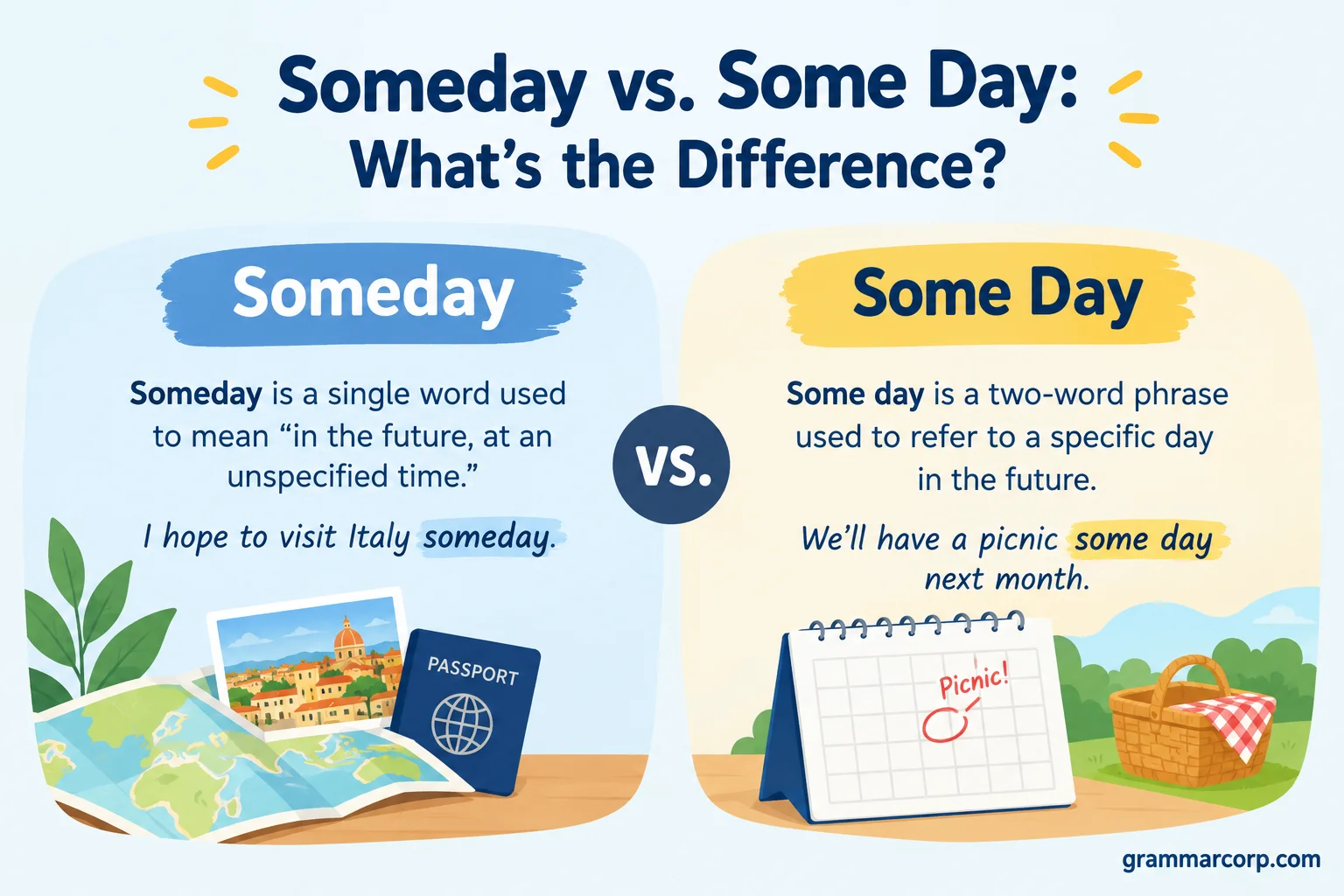
Someday vs. Some Day: What’s the Difference? becomes easier to understand when you compare their grammar, meaning, context, and everyday usage in writing. Someday and some day sound the same in ordinary speech and spoken English, so writers may mix up the two forms. Someday is one word and works as an adverb for an unknown, unspecified time in the future. It can express hope, possibility, loose planning, and an open feeling when someone wants to travel the world, visit Italy, or visit Paris someday without caring about the exact timing. Some day, however, is two words, where some modifies the noun day and can describe an unspecified day, particular day, or specific day within a broader period. It may overlap with one day, so the correct choice depends on what you mean, the expression you need, and how it functions in the sentence.
From my editing experience, I have seen English learners, native speakers, students, professionals, writers, bloggers, and other people pause, type, delete, and type again because both forms can look right. In modern English writing, usage, semantics, intent, sentence construction, and careful word choice help determine the right choice. When someone plans to travel the world someday, the one-word adverb refers to an indefinite future, undefined future, or unspecified future time. When an appointment is expected next week or next month, some day can point to a specific time, even when the exact date is not fully defined. This difference involves specificity, precision, expectation, expression choice, word form, phrase form, noun form, verb modification, and modifying function. In professional communication, choosing the form that fits the meaning improves overall communication, ensures clarity, and supports formal communication, casual sentence writing, and professional writing.
Although the forms are sometimes used almost interchangeably, understanding their subtle difference helps writers avoid confusion, avoid mistakes, build confidence, and produce polished English with better correctness, clarity, and accuracy. Language rules, grammar rules, usage rules, and intentional usage also make the distinction easier to see. Language tools, NLP, syntax analysis, and even weatherization systems may treat these as separate expressions because they carry a different level of expectation and tone. Authorities and usage authorities may discuss whether the terms can be used interchangeably, but strong examples, clear usage rules, and careful sentence construction support deeper analysis, interpretation, understanding, learning, and language learning.
Quick Answer:
Someday is normally the best choice when you mean at some unknown or unspecified time in the future.
- I want to travel the world someday.
- She hopes to become a writer someday.
- We may understand the decision someday.
Some day is the two-word phrase made from the determiner some and the noun day. It can refer to an unspecified day and may be followed by additional information that identifies or limits the day.
- We should meet some day next week.
- I remember some day during that summer.
- Pick some day that works for everyone.
There’s also an important overlap. In sentences such as I’d love to visit China some day, some day can express essentially the same future idea as someday. Cambridge lists some/one day as an expression meaning “at some time in the future.”
Simple rule: If you mean an indefinite future time and need an adverb, choose someday. If day is functioning as an ordinary noun, some day may be appropriate.
Comparison Overview
| Expression | Typical role | Basic meaning | Example |
| someday | Adverb | At an unknown or unspecified future time | I hope to travel someday. |
| some day | Phrase | An unspecified day | We can meet some day next week. |
| one day | Phrase | An unspecified or particular day, depending on context | One day, I’ll visit Japan. |
The biggest practical difference is that someday it has become an established single-word adverb.
Cambridge Dictionary defines someday as an adverb referring to a future time that is “not yet known or not stated.”
Meanwhile, some can work as a determiner before a noun. Some day, the word some modifies day. Cambridge notes that some can refer to something particular without stating exactly which one.
That grammatical difference explains why the spacing can matter.
Main Differences Between Someday vs. Some Day
The distinction becomes clearer when you look at the four main differences: word class, meaning, sentence structure, and context.
Someday is normally an adverb
In someday, the entire word functions as an adverb.
It tells the reader when something may happen.
Consider this sentence:
I hope to visit Australia someday.
The word someday doesn’t describe a particular day. Instead, it tells us that the visit may happen at an unknown point in the future.
You don’t know the date. You may not even know the year.
That’s exactly the kind of uncertainty that someday expresses.
Some day contains the noun day
Some day, day remains a noun.
The word some modifies it.
For example:
We need to choose some day next month.
Here, you’re talking about a day within a particular period. The phrase next month narrows the possible time.
You aren’t necessarily talking about an abstract future. You’re thinking about an actual day that could be selected from that month.
Someday usually emphasizes an indefinite future
When someone says:
I’ll learn Spanish someday.
The speaker isn’t identifying a particular day.
The statement expresses a future intention or possibility.
The same pattern appears with dreams, plans, ambitions, and hopes:
- I’ll write a book someday.
- She wants to start her own business someday.
- We’ll visit New York someday.
- He hopes to see the Northern Lights someday.
In each example, the exact time remains unknown.
Some day can emphasize an unspecified day
Now consider:
We should meet some day next week.
The speaker is still uncertain about the exact day. However, the phrase next week provides a time frame.
The sentence essentially means that there is an unspecified day next week when the meeting could happen.
This is why context matters more than a rigid one-word-versus-two-word rule.
What Does “Someday” Mean?
Someday means at some unknown or unspecified time in the future.
It is an adverb and commonly appears when someone talks about something that could happen later.
Cambridge gives examples such as Maybe someday you’ll both meet again and Someday soon you’re going to have to make a decision.
The word often carries a sense of possibility.
It doesn’t promise that something will happen on a known date. Instead, it leaves the timing open.
Someday and future dreams
You frequently see someday in sentences about aspirations.
For example:
- I want to become a published author someday.
- She hopes to travel through Europe someday.
- I’d like to learn another language someday.
- They want to build their own home someday.
These sentences don’t identify a particular day.
The speaker simply imagines a future point when the event might happen.
Someday and future possibilities
The word can also describe something that may happen without expressing a personal dream.
For example:
- Technology may solve this problem someday.
- People may discover a better solution someday.
- We may understand what happened someday.
Again, the exact timing remains unspecified.
Someday can appear at different positions
You aren’t restricted to putting someday at the end of a sentence.
For example:
- Someday, I’ll visit Iceland.
- I’ll someday understand why she made that decision.
- I hope to visit Iceland someday.
The final position is particularly natural in everyday English.
What Does “Some Day” Mean?
Some days consist of two separate words.
Here, some works with the noun day.
The phrase can refer to an unspecified day without naming exactly which day it is.
For example:
We can meet some day next week.
The speaker has not chosen the day yet.
The phrase can also occur in contexts involving memories or descriptions:
I remember some day during that summer when everything changed.
Here, some identifies an unspecified member of the set of days that occurred during that summer.
Some day can refer to a future day
A common misconception is that some day is automatically wrong when talking about the future.
That’s not true.
For example:
We should go there some day.
This can communicate essentially the same idea as:
We should go there someday.
Cambridge specifically recognizes some day and one day as expressions meaning “at some time in the future.”
Therefore, you shouldn’t treat the two-word version as a grammatical error.
Some day can be followed by extra information
The two-word construction becomes particularly easy to understand when other words modify or identify the day.
Examples include:
- some day next week
- some day next month
- some day in June
- some day during the vacation
- some day this summer
- some day during our trip
For example:
Let’s choose some day next week for the meeting.
The phrase describes one day from the available days next week.
Someday vs. Some Day Examples
Examples make the distinction much easier to see.
Examples using someday
- I hope to travel around Asia someday.
- She wants to open a restaurant someday.
- We’ll understand the decision someday.
- I would love to see the Grand Canyon someday.
- He hopes to publish a novel someday.
- Maybe we’ll work together someday.
- I want to learn how to play the piano someday.
- They may return someday.
Each sentence refers to an indefinite future time.
Examples using some day
- We should meet some day next week.
- Choose some day in June for the event.
- I remember some day during that vacation.
- Let’s pick some day this summer.
- We can discuss it on some day when everyone is available.
Here, day operates as a noun and additional words can provide more information about it.
Examples where both can work
Some sentences don’t create a meaningful difference between the two forms.
For example:
I’ll visit you someday.
and
I’ll visit you some day.
Both can express the idea of visiting at an unspecified point in the future.
However, someday is generally the cleaner choice when the expression simply means at some time in the future.
That distinction is useful in polished writing because it avoids unnecessary ambiguity.
When Should You Use “Someday”?
Use someday when you’re treating the expression as an adverb meaning at an unspecified time in the future.
Use someday for hopes
This is one of its most common uses.
- I hope to travel someday.
- I hope we can meet someday.
- She hopes to become a teacher someday.
The focus is on the future possibility rather than a particular day.
Use someday for long-term goals
Long-term ambitions often don’t have fixed dates.
For example:
I want to write a novel someday.
The speaker has a goal but hasn’t identified when it will happen.
Compare that with:
I want to write a novel next year.
The second sentence gives a defined period.
Use someday for vague future predictions
You can also use the word when you think something might happen eventually.
- Scientists may solve the problem someday.
- You may look back on this experience someday.
- We might understand the consequences someday.
The timing stays deliberately vague.
When Should You Use “Some Day”?
Use some day when day is functioning as a noun and some modifies it.
This construction becomes especially useful when you add information about the day.
Some day next week
Let’s meet some day next week.
The speaker hasn’t selected the exact day.
Some day in the future
Some day in the future, people may look back on this period differently.
This construction treats day as a noun within the larger phrase.
However, someday in the future can also work naturally:
Someday in the future, people may look back on this period differently.
Both are possible. The choice depends on how you structure the sentence.
Some day during a particular period
Consider:
I remember some day during my childhood when we got lost.
The phrase refers to an unspecified day within a known period.
The exact date isn’t stated.
Someday vs. Some Day vs. One Day
Adding one day to the comparison makes the pattern clearer.
Someday
Someday normally means an unspecified future time.
I want to visit Greece someday.
The exact day doesn’t matter.
Some day
Some day can mean an unspecified day.
We should visit Greece some day.
In this context, the meaning can overlap heavily with someday.
But it can also be tied to a particular range:
We should visit Greece some day next summer.
Now the phrase identifies an unspecified day within next summer.
One day
One day has several possible meanings depending on context.
It can describe an unspecified future time:
One day, I’ll finish this project.
It can also refer to a particular day:
One day last winter, the power went out.
The surrounding words tell you which meaning applies.
Comparison table
| Expression | Common meaning | Example |
| someday | At an unspecified future time | I’ll travel there someday. |
| some day | An unspecified day; sometimes a future day | Let’s meet some day next week. |
| one day | An unspecified future time or a particular day | One day last winter, it snowed heavily. |
Read More : Restroom vs. Bathroom vs. Washroom: What’s the Difference?
Common Mistakes With Someday and Some Day
Treating some day as always incorrect
This is one of the biggest mistakes.
Some day is not automatically wrong.
The two-word construction can be grammatically appropriate when some modifies the noun day. It can also overlap with someday in expressions about the future.
Using someday when you mean a specific day
Suppose you write:
Choose someday next week for the meeting.
The sentence isn’t necessarily impossible to understand. However, if your intention is to choose one day from next week, some day next week makes the noun structure clearer.
A more precise option might be:
Choose a day next week for the meeting.
That version removes the ambiguity completely.
Assuming pronunciation tells you the spelling
In ordinary speech, someday and some day can sound alike.
That means listening isn’t enough.
When writing, ask yourself:
Am I using an established adverb meaning an indefinite future time, or am I treating day as a noun?
That question usually solves the problem.
Confusing someday with sometime
These words look similar, but they aren’t interchangeable.
Someday refers specifically to a future day or future time in the sense described above.
Sometime means at an unknown or unstated time in the past or future.
For example:
Let’s meet sometime next week.
This doesn’t necessarily identify a particular day.
Cambridge defines sometime as a time in the future or past that isn’t known or stated.
By contrast:
I hope to visit Japan someday.
The focus is on a future point when the visit might happen.
Don’t confuse someday with sometimes
Sometimes it means on some occasions but not always or often.
For example:
I sometimes read before bed.
That’s completely different from:
I hope to travel someday.
Cambridge explicitly distinguishes sometimes from sometime, with sometimes referring to repeated occasions.
A Simple Test for Someday vs. Some Day
If you’re still unsure, try a few quick tests.
Try the “eventually” test
Replace the expression with eventually.
If the sentence keeps roughly the same meaning, someday will often be the natural choice.
I’ll visit Canada someday.
Becomes:
I’ll eventually visit Canada.
The basic future meaning remains.
Try the “one particular day” test
Ask whether day is being treated as a noun.
For example:
We need some day next week for the meeting.
You can think of this as:
We need one day next week for the meeting.
That makes the noun day easy to see.
Try the calendar test
Imagine looking at a calendar.
If you’re choosing one day from a particular period, some day may fit naturally.
Pick some day in June.
You’re effectively choosing one day from the calendar.
If you’re simply talking about an unknown point in the future, someday is usually better.
I’ll visit you someday.
You aren’t choosing a date.
A Practical Case Study: Choosing the Right Form
Imagine two friends discussing a future trip.
The first person says:
I’d love to visit Japan someday.
This person has a general dream. No date has been selected.
Later, they start planning:
We should choose some day next spring when both of us are free.
Now the context has changed.
They’re no longer simply discussing an abstract future possibility. They’re considering an actual day within a defined period.
A third sentence could use one day:
One day during our trip, let’s visit Kyoto.
Here, one day identifies a day during the trip without specifying exactly which day.
What this case study teaches
The important point isn’t that one spelling is always right and the other is always wrong.
Instead, meaning controls the choice.
| Situation | Natural wording |
| General future dream | I hope to go someday. |
| Unspecified day within a period | Let’s go some day next spring. |
| Particular but unnamed day during an event | One day during the trip, we’ll visit Kyoto. |
Someday vs. Some Day: How Context Changes Meaning
Context can make the intended meaning obvious even when the expressions look similar.
Compare:
I’ll call you someday.
This sounds like a general promise to call at an unspecified future time.
Now compare:
I’ll call you some day next week.
The second sentence places the possible call within next week.
You still don’t know exactly which day. Yet the time frame is narrower.
This difference is subtle but useful in careful writing.
Context can eliminate ambiguity
When precision matters, you don’t always need to choose between the two forms.
You can rewrite the sentence.
Instead of:
Let’s meet some day.
Write:
Let’s choose a day to meet.
Instead of:
I’ll do it some day in the future.
Write:
I’ll do it someday.
Good writing often comes from choosing the clearest construction rather than obsessing over a tiny spelling distinction.
Is “Someday” One Word or Two?
Someday is one word.
It functions as an adverb meaning an unknown or unspecified time in the future. Cambridge categorizes it as an adverb and gives examples involving future possibilities and plans.
For example:
I hope to see you someday.
Writing some day isn’t automatically ungrammatical. It simply creates a different grammatical structure because day remains a noun.
This is why both forms can appear in correct English.
Is “Some Day” Grammatically Correct?
Yes.
Some days are grammatically correct when the two words function naturally together in a sentence.
For example:
We can choose some day next month.
Here, some modified day.
It can also appear in expressions that overlap with someday:
I’d like to visit Canada some day.
Cambridge’s dictionary entry for one/some day specifically recognizes this construction as meaning a future time.
Therefore, don’t rely on the oversimplified rule that someday is correct and some day is wrong.
The better rule is to look at grammar, meaning, and context.
FAQs:
1. Is “someday” one word or two words?
Someday is one word when it means an unspecified or indefinite time in the future. For example, “I hope to visit Paris someday.”
2. What does “some day” mean?
Some day consists of two words. Here, some modifies the noun day, usually referring to a particular or specific day that may not be fully identified. For example, “We should meet some day next week.”
3. Are “someday” and “some day” interchangeable?
They can overlap in some contexts, but they are not always interchangeable. Someday generally refers to an unspecified future time, while some day emphasizes a day as a noun.
4. What is the difference between “someday” and “one day”?
Someday normally refers to an unspecified future time. One day can refer to either a future possibility or a past event, depending on the sentence and context.
5. How can I remember the difference between “someday” and “some day”?
Use someday when you mean “at an unspecified time in the future.” Use some day when some directly describes the noun day, especially when you have a particular day or period in mind.
Conclusion:
Someday and some day sound alike, but their grammatical roles and meanings can differ. Someday is an adverb for an unspecified future time, while some day uses some to modify the noun day.
Paying attention to context, sentence structure, and intended meaning makes the choice easier and helps you write with greater clarity and accuracy.














1 thought on “Someday vs. Some Day: What’s the Difference?”