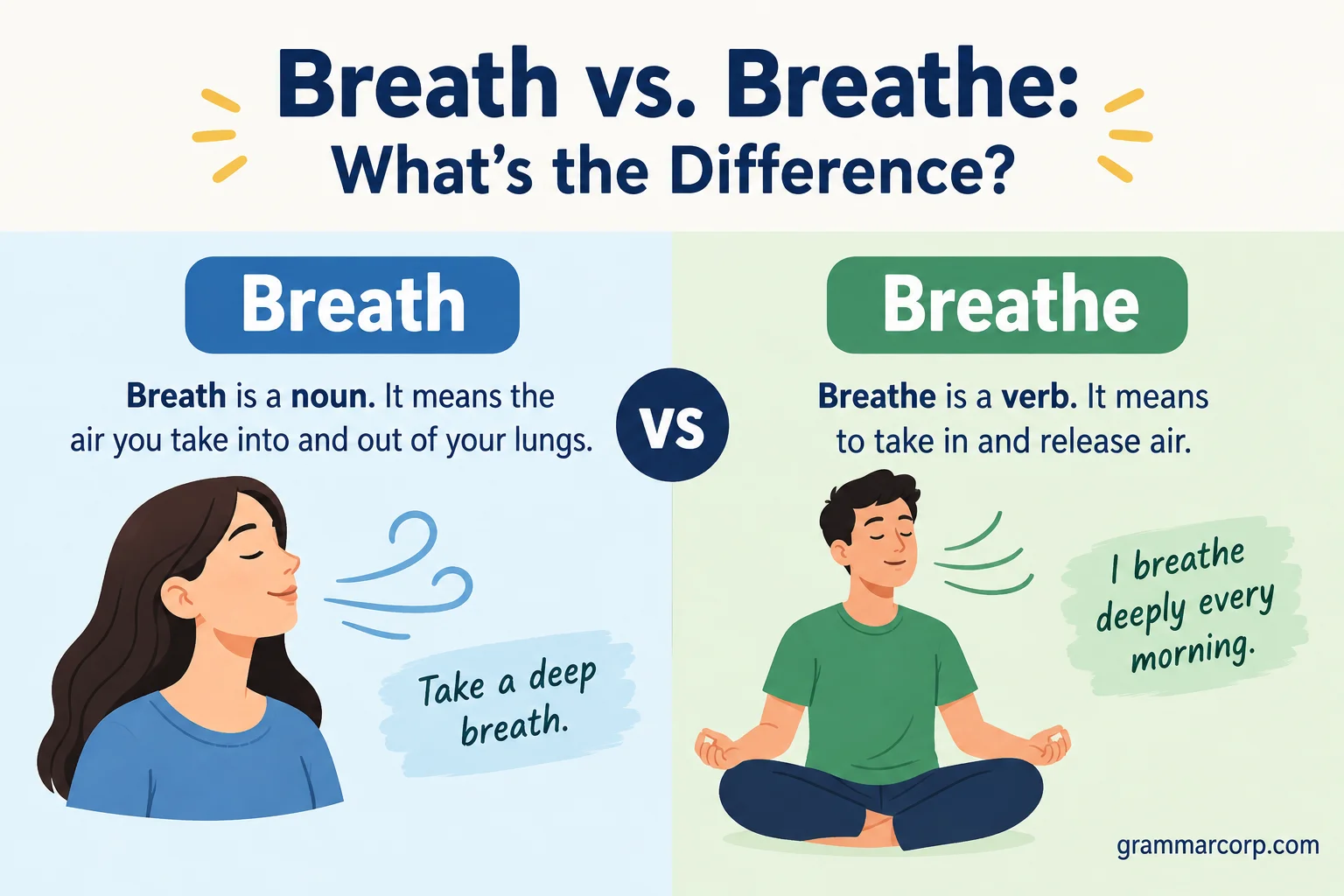
Breath vs. Breathe: What’s the Difference? is a common English question, and learning this small difference makes everyday writing clearer and easier. Breath and breathe are closely related words, but they can cause a common English grammar question because they look almost identical and share the same basic idea while having a different role in a sentence. Breath is a noun, while breathe is a verb. A breath means air that is taken into or released from the lungs, a single act of breathing, or an act of respiration. It can also express related ideas such as a pause or a faint amount of something.
Breathe describes the action of taking air into the lungs and releasing air from them. This difference comes from one letter in the spelling, but that letter changes the grammatical role, pronunciation, and function of each word. In standard US English, breath is pronounced /brɛθ/, while breathe is pronounced /briːð/; the vowel sound and final the sound change, giving you a useful clue when making your choice.For example, you can say “Take a deep breath” when you need the noun and “breathe slowly” when you need the verb.
Instead of memorizing dozens of rules, simply look at what the sentence needs. This approach is useful in writing, including an email, school assignment, social media post, or professional document, because choosing the wrong word can make a sentence incorrect. The extra e in breathe is a helpful memory clue, while British usage and American usage may have some differences in English without changing this basic distinction.
Quick Answer:
Breath is a noun that means the air taken into or released from the lungs, or one act of breathing.
Breathe is a verb that means to take air into the lungs and release it.
The simplest rule
- Breath = noun
- Breathe = verb
For example:
- Take a deep breath.
- Remember to breathe slowly.
In the first sentence, breath names something you take. In the second, breathe describes an action.
A useful spelling clue can help, too: breathe has an extra e because it is the verb. The spelling doesn’t explain every English word pattern, but it provides a handy reminder for this pair.
Comparison Overview
| Feature | Breath | Breathe |
| Part of speech | Noun | Verb |
| Basic meaning | Air taken into or released from the lungs | The action of taking air into and releasing it from the lungs |
| US pronunciation | /brɛθ/ | /briːð/ |
| Main sound | Short vowel | Long ee vowel |
| Final sound | Unvoiced th | Voiced th |
| Common use | Take a breath | Breathe deeply |
| Example | She took a deep breath. | She began to breathe slowly. |
| Easy clue | Names the thing or act | Names the action |
Cambridge identifies breath as a noun and breathe as a verb. Its dictionary gives /breθ/ for breath and /briːð/ for breathe in its standard pronunciation listings.
Main Differences Between Breath vs. Breathe
The biggest difference between breath vs. breathe is grammatical.
Breath functions as a noun. You can usually put words such as a, the, your, my, or one before it.
Take a deep breath.
Here, breath names a thing or a single act.
Breathe, on the other hand, functions as a verb.
Try to breathe slowly.
Here, breathe describes what someone does.
Breath is a noun
A noun can name a person, place, thing, or idea. In this case, breath refers to air moving into or out of the lungs or to a single action of taking in air.
Consider these examples:
- I took a deep breath.
- She held her breath.
- He was out of breath.
- Take another breath.
- I could feel his warm breath.
Each sentence treats breath as a noun.
Breathe is a verb
A verb describes an action or state. Breathe tells you what someone or something does.
For example:
- Try to breathe slowly.
- We need to breathe fresh air.
- She couldn’t breathe comfortably.
- The instructions told us to breathe in.
- Remember to breathe out slowly.
Cambridge defines breathe as the action of moving air into and out of the lungs.
The grammar test
When you’re unsure, look at the words around the blank.
If the sentence needs a noun, choose breath.
Take a deep .
The answer is breath.
If the sentence needs a verb, choose breathe.
Remember to slowly.
The answer is breathe.
This simple grammar test solves most breath vs. breathe mistakes.
What Does Breath Mean?
Breath is a noun. It refers to the air that goes into and out of your lungs or to a single action of breathing.
Cambridge also uses breath for a single action of breathing and documents common expressions such as take a breath, catch your breath, and hold your breath.
Breath as air
In some sentences, breath refers to the air associated with breathing.
For example:
- His breath smelled like garlic.
- I could see my breath in the cold air.
- Her warm breath fogged the glass.
The word doesn’t describe the action itself. Instead, it identifies the air produced or exchanged through breathing.
Breath as one act of breathing
Breath can also describe a single action.
For example:
- Take one deep breath.
- She took a quick breath before speaking.
- He paused for a breath.
Here, you can think of breath as something you can take, hold, catch, or lose.
Common expressions with breath
English uses breath in many established phrases.
Some of the most common include:
- take a breath
- take a deep breath
- catch your breath
- hold your breath
- out of breath
- short of breath
- a breath of fresh air
- under your breath
- in the same breath
- take someone’s breath away
For example, if someone runs upstairs and needs a moment to recover, you might say they are out of breath.
If someone pauses after running, they might need to catch their breath.
These expressions all use the noun breath, not the verb breathe.
What Does Breathe Mean?
Breathe is a verb. It describes the process of taking air into the lungs and releasing it.
It can appear in several forms, including:
- breathe
- breathes
- breathed
- breathing
The basic verb remains breathe.
Breathe in
Breathe means to move air into your lungs.
For example:
- Breathe in slowly.
- She breathed in the cool morning air.
- The instructor told everyone to breathe in.
Cambridge specifically defines breathe in as moving air into the lungs.
Breathe out
Breathe out means to release air from your lungs.
For example:
- Breathe out slowly.
- He breathed out after holding his breath.
- The instructor asked everyone to breathe out.
The phrase uses the verb breathe, so breath out would be incorrect in this context.
Breathe in other contexts
The verb has meanings beyond ordinary breathing.
For example, English can use breathe in expressions such as breathe new life into something, meaning to give something fresh energy or activity.
Cambridge also records a literary use in which breathe means to say something very quietly. It also records the specialized expression of allowing wine to breathe.
These uses don’t change the basic grammar rule. Breathe remains a verb.
Breath vs. Breathe Pronunciation
Pronunciation makes breath vs. breathe even easier to distinguish.
In US English:
- breath — /brɛθ/
- breathe — /briːð/
The words differ in both their vowel sound and their final consonant sound.
How to pronounce breath
Breath has the short vowel sound found in words such as bed.
It sounds approximately like:
breth
The final th is unvoiced, similar to the sound at the end of death.
How to pronounce breathe
Breathe has the long ee sound found in words such as see.
It sounds approximately like:
breeth
The final th is voiced, which makes it different from the ending of breath.
A useful pronunciation memory trick
Think of these two approximate sound patterns:
- breath → rhymes closely with death
- breathe → rhymes closely with these
The spelling gives another clue:
breath → short vowel
breathe → long vowel
This pronunciation difference isn’t just a speaking detail. It can help you remember which spelling belongs to which grammatical role.
When Should You Use Breath or Breathe?
The fastest way to choose between breath or breathe is to identify the job the word performs.
Ask yourself:
Am I naming something?
If yes, you probably need breath.
Am I describing an action?
If yes, you probably need to breathe.
Use breath when the sentence needs a noun
Common patterns include:
- take a breath
- hold your breath
- catch your breath
- lose your breath
- out of breath
- a breath of fresh air
For example:
I need to take a breath before continuing.
You can place a before breath, which is a strong clue that you’re dealing with a noun.
Use breathe when the sentence needs a verb
Common patterns include:
- breathe slowly
- breathe deeply
- breathe normally
- breathe in
- breathe out
- breathe fresh air
For example:
Try to breathe slowly before you speak.
The word describes an action, so the verb breathe fits.
A simple substitution test
Try replacing the word with air or inhale/exhale.
If air makes sense, you may need the noun breath.
If inhale or exhale makes sense, you may need the verb breathe.
This isn’t a perfect test for every idiom, but it works well for basic sentences.
Common Mistakes With Breath and Breathe
These words cause predictable spelling errors because they look and sound related.
The good news? Most mistakes disappear once you recognize the grammatical difference.
Mistake: Take a deep breathe
Incorrect: Take a deep breathe.
Correct: Take a deep breath.
Why? The sentence needs a noun after a deep. You’re naming the act or amount of air taken in.
Mistake: Remember to breath
Incorrect: Remember to breath.
Correct: Remember to breathe.
Why? The word follows to and functions as a verb.
Mistake: Catch your breathe
Incorrect: Catch your breathe.
Correct: Catch your breath.
The established expression is catch your breath.
Mistake: Out of breathe
Incorrect: She was out of breathe.
Correct: She was out of breath.
Again, breath is the noun used in the established phrase out of breath.
Mistake: Breathe of fresh air
Incorrect: It was a breathe of fresh air.
Correct: It was a breath of fresh air.
The phrase a breath of fresh air uses the noun.
Cambridge lists a breath of air and a breath of fresh air among established uses of breath.
Breath vs. Breathe Examples in Sentences
Seeing the words in context makes the difference much easier to remember.
Examples with Breath
- Take a deep breath before you begin.
- She held her breath during the exciting moment.
- He was completely out of breath after the race.
- I need a moment to catch my breath.
- The cold air made my breath visible.
- His breath smelled strongly of peppermint.
- Take another breath and try again.
- She spoke under her breath.
- The view was enough to take my breath away.
- A walk outside felt like a breath of fresh air.
Examples with Breathe
- Remember to breathe slowly.
- Try to breathe deeply.
- She began to breathe normally again.
- He stopped talking so he could breathe.
- Breathe in through your nose.
- Breathe out slowly.
- It was difficult to breathe in the stuffy room.
- The runner paused to breathe.
- We all need to breathe.
- She breathed in the cool morning air.
Paired examples
Putting the two words side by side makes the difference obvious.
| Breath | Breathe |
| Take a deep breath. | Breathe deeply. |
| Hold your breath. | Try to breathe normally. |
| Catch your breath. | Stop and breathe. |
| I was out of breath. | I couldn’t breathe comfortably. |
| Take another breath. | Breathe in slowly. |
| His breath was warm. | He began to breathe slowly. |
Notice the pattern. Breath names something. Breathe describes an action.
A Practical Breath vs. Breathe Case Study
Imagine a student writing this sentence:
Before the presentation, I took a deep breathe and tried to breath slowly.
There are actually two errors.
The corrected version is:
Before the presentation, I took a deep breath and tried to breathe slowly.
Why?
The first blank follows a deep, so it needs the noun breath.
The second follows to, so it needs the verb breathe.
This example shows why memorizing the words separately isn’t enough. You need to understand their grammatical roles.
What the sentence teaches
| Sentence part | Correct word | Reason |
| took a deep | breath | Noun |
| tried to | breathe | Verb |
That distinction works across countless everyday sentences.
Easy Ways to Remember Breath vs. Breathe
A few simple memory tricks can save you from repeated spelling mistakes.
Remember: Breath is the noun
Think:
Take a breath.
You can take a breath, hold a breath, or catch your breath.
Those phrases treat breath as a noun.
Remember: Breathe is the verb
Think:
Remember to breathe.
You can breathe slowly, breathe deeply, breathe in, or breathe out.
Those phrases use breathe as a verb.
Watch for the extra E
The extra e in breathe can serve as a visual reminder that you’re looking at the verb.
Don’t treat this as a universal English spelling rule. Instead, use it as a convenient memory aid for this particular pair.
Remember the sound
Breath has the shorter vowel sound.
Breathe has the longer ee sound.
If you say the words aloud, the difference becomes much more noticeable.
Compare bath and bathe
Another useful spelling comparison is:
- bath → noun
- bathe → verb
The pair isn’t identical in every grammatical detail, but the spelling pattern can help you remember why breathe contains an extra e.
Read More : Someday vs. Some Day: What’s the Difference?
Common Phrases With Breath and Breathe
Learning common expressions can make correct usage almost automatic.
Phrases with breath
Taking a breath means to take one act of breathing.
Catching your breath means to pause and recover your normal breathing, often after physical effort. Cambridge lists this as an established expression.
Holding your breath means to keep air in your lungs without releasing it. It can also have a figurative meaning when someone waits anxiously for an outcome.
Out of breath describes someone who has difficulty breathing comfortably, often after physical activity.
A breath of fresh air can describe fresh air itself or something pleasantly new or refreshing.
Under your breath describes speaking very quietly.
Phrases with breathe
Breathe means to move air into the lungs.
Breathe out means to release air from the lungs.
Breathing new life into something means to bring fresh energy or activity to it.
Breathing easier means to feel less worried or relieved.
Cambridge records these expressions among the established uses of breathe.
Breath vs. Breathe: A Quick Grammar Test
Try these sentences without looking at the answers.
- Take a deep .
- Remember to slowly.
- She was out of after running.
- Try to through your nose.
- He held his .
- The instructions told us to out.
- I couldn’t catch my .
- She needed to normally.
Answers
- Take a deep breath.
- Remember to breathe slowly.
- She was out of breath after running.
- Try to breathe through your nose.
- He held his breath.
- The instructions told us to breathe out.
- I couldn’t catch my breath.
- She needed to breathe normally.
The pattern is consistent: nouns use breath, while verbs use breathe.
Breath vs. Breathe Quick Reference
| Question | Answer |
| Is breath a noun? | Yes |
| Is breathe a verb? | Yes |
| What does breath mean? | Air moving into or out of the lungs, or one act of breathing |
| What does breathe mean? | To take air into the lungs and release it |
| How is breath pronounced? | /brɛθ/ |
| How is breathe pronounced? | /briːð/ |
| Which is correct: take a breath? | Take a breath |
| Which is correct: remember to breathe? | Remember to breathe |
| Which is correct: catch your breath? | Catch your breath |
| Which is correct: breathe deeply? | Breathe deeply |
The most useful rule remains short enough to memorize:
FAQs:
1. What is the difference between breath and breathe?
Breath is a noun that refers to the air taken into or released from the lungs, while breathe is a verb that describes the action of taking air in and letting it out.
2. Is it correct to say “take a deep breath”?
Yes. “Take a deep breath” is correct because breath is a noun in this sentence. It refers to one act of breathing or the air taken into the lungs.
3. How do you pronounce breath and breathe?
In standard US English, breath is pronounced /brɛθ/, while breathe is pronounced /briːð/. The vowel sound and final th sound are different.
4. Should I use breathe or breath after “to”?
Use breathe after to when you are describing an action. For example, “Try to breathe slowly.” Breath is a noun, so it does not normally follow “to” in this structure.
5. What is an easy way to remember breath vs. breathe?
Remember that breath is the noun and breathe is the verb. The extra e in breathe can help you remember that it describes the action of breathing.
Conclusion:
Understanding breath vs. breathe becomes much easier once you remember their grammatical roles. Breath is a noun for air or an act of breathing, while breathe is a verb for the action itself.
Paying attention to spelling, pronunciation, and the needs of the sentence can help you choose the correct word in everyday and professional writing.









1 thought on “Breath vs. Breathe: What’s the Difference?”