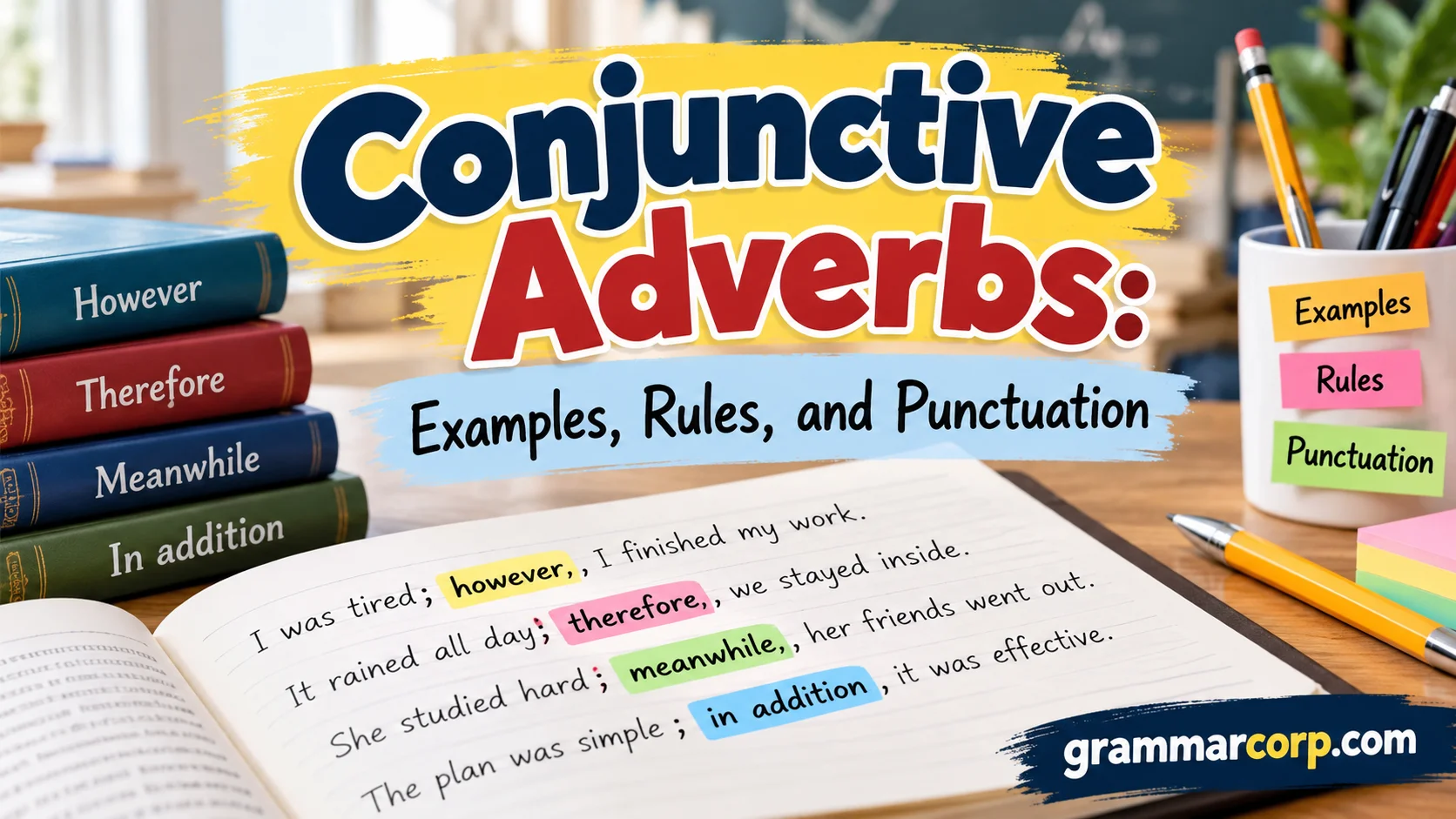
Conjunctive Adverbs:Examples, Rules, and Punctuation explains how these little words make a big punch in the English language by connecting ideas, sentences, and clauses clearly. Although adverbs often act as modifiers that modify words, conjunctive adverbs have a different function: they connect thoughts and establish a logical connection between them. Like glue or traffic signals, they help by directing readers toward the next idea and clarifying relationships within a written text. Choosing suitable transition words, transitional adverbs, and transitional expressions improves clarity, gives sentences a natural rhythm, and makes ideas easier to follow.
Understanding the conjunctive adverb meaning, conjunctive adverb definition, and conjunctive adverb function also helps explain the difference between these words and coordinating conjunctions such as and, but, and so. While coordinating conjunctions join words, phrases, or clauses, conjunctive adverbs explain the logical relationship between ideas.
For example, “The report was detailed; however, it needed more evidence” shows a contrastive relationship between two independent clauses. Similarly, “The deadline was approaching; therefore, we finished the essay early” expresses cause and result. These sentence transitions, sentence connectors, linking words, and connecting words improve thought organization, idea progression, and logical sequence. Whether you are writing essays, writing reports, writing emails, or preparing an everyday message, these writing techniques strengthen written communication, academic writing, professional writing, and everyday.
Quick Answer:
A conjunctive adverb is an adverb that connects ideas by showing a logical relationship between them. Common examples include however, therefore, moreover, nevertheless, consequently, furthermore, and meanwhile.
When a conjunctive adverb connects two independent clauses, use a semicolon before it and usually a comma after it:
The weather looked terrible; however, we continued the trip.
You can also use two separate sentences:
The weather looked terrible. However, we continued the trip.
The most important rule is simple: don’t use a comma alone to join two independent clauses with a conjunctive adverb.
Comparison Overview
| Feature | Conjunctive Adverb | Coordinating Conjunction | Subordinating Conjunction |
| Main purpose | Shows a logical relationship | Joins equal grammatical elements | Makes one clause dependent |
| Examples | however, therefore, moreover | and, but, so, yet | because, although, while |
| Can connect independent clauses? | Yes, with appropriate punctuation | Yes | Yes, by creating a dependent clause |
| Common punctuation | Semicolon + conjunctive adverb + comma | Comma before conjunction | Depends on clause order |
| Example | I was tired; however, I continued. | I was tired, but I continued. | Although I was tired, I continued. |
| Typical effect | Highlights the relationship | Joins ideas directly | Establishes dependence |
The distinction matters because these three categories may express similar meanings while following different grammatical rules.
For example, but and however both commonly signal contrast. They don’t occupy the same grammatical position, though.
I wanted to go, but I was busy.
I wanted to go; however, I was busy.
The first sentence uses a coordinating conjunction. The second uses a conjunctive adverb.
Main Differences Between Conjunctive Adverbs
Conjunctive adverbs differ from other connecting words mainly in function, punctuation, and sentence structure.
Conjunctive Adverbs Show Logical Relationships
A conjunctive adverb tells readers how one idea relates to another.
Consider these examples:
- The store was crowded; however, we found what we needed.
- The road was closed; therefore, we took another route.
- She finished the project early; moreover, she helped her teammates.
- The train arrived late; consequently, we missed the meeting.
Each word gives the reader a specific clue.
However signals contrast.
Therefore signals a conclusion or result.
Moreover adds another point.
Consequently introduces an outcome.
Conjunctive Adverbs Don’t Work Like And or But
A common mistake involves treating however as though it were but.
This sentence works:
I wanted to attend, but I had another appointment.
This structure doesn’t work in standard formal English:
I wanted to attend, however I had another appointment.
The second sentence creates a comma splice because the comma doesn’t adequately separate the two independent clauses.
Instead, write:
I wanted to attend; however, I had another appointment.
Or:
I wanted to attend. However, I had another appointment.
What Are Conjunctive Adverbs?
A conjunctive adverb is an adverb that connects one idea to another by expressing a relationship such as contrast, cause and effect, addition, or time.
The word conjunctive describes its linking function. The word adverb reflects its grammatical category.
Unlike a coordinating conjunction, a conjunctive adverb doesn’t simply join two equal grammatical units. Instead, it explains the logical connection between them.
For example:
The experiment produced unexpected results; therefore, the researchers repeated it.
Here, therefore tells readers that the second action follows logically from the first.
Without the word, the relationship remains possible:
The experiment produced unexpected results; the researchers repeated it.
Adding therefore makes the reasoning explicit.
Common Conjunctive Adverbs
| Conjunctive Adverb | Relationship | Meaning |
| however | Contrast | In contrast or despite that |
| therefore | Result | For that reason |
| moreover | Addition | In addition |
| furthermore | Addition | Also or additionally |
| nevertheless | Contrast | Despite what was just stated |
| nonetheless | Contrast | In spite of that |
| consequently | Result | As a result |
| thus | Result | In this way or as a result |
| meanwhile | Time | At the same time |
| otherwise | Alternative | If not or under different circumstances |
| instead | Alternative | As a replacement |
| subsequently | Sequence | Later or afterward |
| additionally | Addition | In addition |
| accordingly | Result | In a way that follows from something |
| conversely | Contrast | From the opposite perspective |
Not every word works naturally in every sentence position. Meaning and context still matter.
Types of Conjunctive Adverbs
Conjunctive adverbs become easier to understand when you group them according to the relationship they express.
Conjunctive Adverbs for Contrast
Words such as however, nevertheless, nonetheless, and conversely tell readers that the next idea differs from or challenges the previous one.
The apartment was small; however, its location was excellent.
The task was difficult; nevertheless, the team completed it.
However is common and flexible. Nevertheless and nonetheless often sound more formal or emphatic.
Conversely works differently. It usually introduces an opposing situation or perspective.
Urban areas experienced population growth. Conversely, some rural communities lost residents.
Conjunctive Adverbs for Cause and Effect
Words such as therefore, consequently, thus, hence, and accordingly indicate that one idea leads to another.
The deadline had passed; therefore, the application was rejected.
The machine overheated; consequently, production stopped.
These words work especially well when writing about reasoning, evidence, decisions, and outcomes.
Therefore vs. Consequently
The two words often overlap.
Therefore commonly emphasizes a logical conclusion:
The evidence was incomplete; therefore, the researchers couldn’t draw a firm conclusion.
Consequently often emphasizes the resulting effect:
The bridge suffered significant damage; consequently, officials closed it.
The difference isn’t absolute. Context determines the best choice.
Conjunctive Adverbs for Addition
Moreover, furthermore, additionally, and besides add information.
The course covers grammar; moreover, it includes practical writing exercises.
The hotel is affordable; furthermore, it’s close to public transportation.
These words often appear in formal or academic writing. In casual writing, also or in addition may sound more natural.
Conjunctive Adverbs for Time and Sequence
Words such as meanwhile, subsequently, afterward, and eventually help readers follow events.
Maria prepared the presentation; meanwhile, James organized the data.
The company announced the policy; subsequently, it released additional details.
These expressions can also organize arguments, not just physical events.
Conjunctive Adverbs for Alternatives
Otherwise, instead, and alternatively introduce another possibility or action.
Leave now; otherwise, you may miss the bus.
We didn’t take the highway; instead, we used a smaller road.
You can submit the form online; alternatively, you can deliver it in person.
These words are particularly useful when explaining choices or consequences.
How to Punctuate Conjunctive Adverbs
Punctuation represents one of the most important parts of using conjunctive adverbs correctly.
Conjunctive Adverbs Between Independent Clauses
When a conjunctive adverb connects two independent clauses, a common structure is:
Independent clause; conjunctive adverb, independent clause.
For example:
The forecast predicted rain; however, the event continued.
Both parts can stand alone:
The forecast predicted rain.
The event continued.
The semicolon separates the independent clauses. The comma after however separates the conjunctive adverb from the clause that follows.
Other examples include:
The restaurant was busy; therefore, we decided to wait.
The product costs more; nevertheless, many customers prefer it.
The first plan failed; consequently, the team developed another approach.
Using a Period Instead of a Semicolon
A semicolon isn’t your only option.
You can separate the clauses into two sentences:
The restaurant was busy. Therefore, we decided to wait.
This construction often feels cleaner when the ideas deserve more separation.
The choice depends on rhythm and emphasis. A semicolon keeps the ideas closely connected. A period gives each idea more independence.
Conjunctive Adverbs at the Beginning of a Sentence
A conjunctive adverb can begin a sentence.
However, the results were encouraging.
Therefore, the committee postponed the decision.
Meanwhile, the students continued working.
Moreover, the proposal addresses the main concern.
A comma commonly follows an introductory conjunctive adverb when it functions as an introductory element.
Conjunctive Adverbs in the Middle of a Sentence
Some conjunctive adverbs can appear inside a clause.
The plan, however, has several weaknesses.
The results were, therefore, difficult to interpret.
Here, commas set the conjunctive adverb apart as an interruption or parenthetical element.
However, punctuation can vary with placement and emphasis. Don’t assume every occurrence of a word like however requires exactly the same punctuation.
Conjunctive Adverbs vs. Coordinating Conjunctions
This comparison causes many grammar mistakes.
Coordinating conjunctions include the familiar FANBOYS:
- For
- And
- Nor
- But
- Or
- Yet
- So
These words can coordinate independent clauses.
The test was difficult, but I finished it.
A conjunctive adverb uses a different structure:
The test was difficult; however, I finished it.
However vs. But
But directly coordinates the two clauses.
However comments on the relationship between the ideas.
Compare:
The task was difficult, but we completed it.
The task was difficult; however, we completed it.
The meaning is similar. The grammatical construction differs.
Therefore vs. So
So can coordinate two independent clauses:
The road was closed, so we turned around.
Therefore requires a different structure:
The road was closed; therefore, we turned around.
This distinction becomes particularly important in formal writing.
Moreover vs. And
And simply adds information.
She completed the report, and she sent it to her manager.
Moreover emphasizes that the second point provides additional support or significance.
She completed the report; moreover, she identified several errors.
Conjunctive Adverbs vs. Subordinating Conjunctions
Subordinating conjunctions include words such as because, although, while, since, unless, and if.
They introduce dependent clauses.
Compare:
Although the weather was poor, we continued the trip.
Here, although the weather was poor cannot stand alone as a complete sentence.
Now compare:
The weather was poor; however, we continued the trip.
Both clauses are independent.
That’s the core grammatical difference.
However connects two independent clauses:
The project was expensive; however, the company approved it.
Because vs. Therefore
Because introduces a reason:
We stayed inside because it was raining.
Therefore introduces a result:
It was raining; therefore, we stayed inside.
The relationship between the ideas is similar, but the grammatical structure differs.
Common Mistakes With Conjunctive Adverbs
Using Only a Comma
One of the most common errors looks like this:
The weather was cold, however we went outside.
This joins two independent clauses with only a comma.
Better options include:
The weather was cold; however, we went outside.
Or:
The weather was cold. However, we went outside.
Treating However Like But
Another common mistake occurs when writers replace but with however without changing punctuation.
Incorrect:
I wanted to help, however I didn’t have enough time.
Correct:
I wanted to help, but I didn’t have enough time.
Or:
I wanted to help; however, I didn’t have enough time.
Misusing Semicolons
A semicolon doesn’t automatically make a sentence correct.
The clauses on both sides should generally be independent when you’re using the semicolon to connect complete clauses.
Incorrect:
Because the weather was bad; however, we stayed inside.
The first part begins with because, so it isn’t an independent clause.
Better:
The weather was bad; however, we stayed inside.
Choosing the Wrong Conjunctive Adverb
A transition should match the relationship between ideas.
For example:
The project was completed early; therefore, the team received praise.
This makes sense because the second idea follows from the first.
But:
The project was completed early; however, the team received praise.
This creates a contrast that probably doesn’t make sense.
The problem isn’t punctuation. It’s logic.
Overusing Conjunctive Adverbs
Strong writing doesn’t require a transition in every sentence.
Consider:
Moreover, the company increased production. Furthermore, it hired more workers. Additionally, it opened another facility.
The paragraph may be grammatically correct. It can still sound mechanical.
Sometimes simple sentence structure works better:
The company increased production. It also hired more workers and opened another facility.
Use conjunctive adverbs when the relationship deserves emphasis.
Conjunctive Adverbs in Academic and Professional Writing
Conjunctive adverbs become especially useful when readers need to follow a chain of reasoning.
Academic writing often moves through claims, evidence, contrasts, and conclusions. Clear transitions help readers understand those movements.
For example:
The initial study produced promising results. However, the sample size was relatively small.
The word however tells readers that the second sentence qualifies the first claim.
Another example:
The evidence supports the proposed explanation. Therefore, further testing should focus on alternative variables.
Here, therefore, signals a conclusion based on the preceding statement.
Academic Writing
Useful conjunctive adverbs include:
- however for qualification or contrast
- therefore for conclusions
- moreover for additional support
- nevertheless for an unexpected continuation
- consequently for results
- conversely for an opposing perspective
Don’t choose these words simply because they sound academic. Choose them because they accurately describe the relationship between your ideas.
Professional Writing
Business reports and workplace documents benefit from precise transitions.
Sales declined during the first quarter; consequently, the company revised its forecast.
The transition makes the cause-and-effect relationship immediately visible.
However, professional writing also values efficiency. If so communicates the idea clearly, there’s no need to replace it with therefore just to sound more formal.
Real-World Writing Examples
Consider this short case study.
Case Study: Improving a Report
A report originally says:
Customer complaints increased. The company expanded its support team.
The relationship remains unclear. Did the increase cause the expansion? Did the expansion happen for another reason?
A conjunctive adverb can clarify the intended relationship:
Customer complaints increased; therefore, the company expanded its support team.
Now the reader immediately understands the intended logic.
Here’s another example:
The new software costs more than the previous system. However, it requires less maintenance.
The writer doesn’t simply add another fact. However tells the reader that the second fact contrasts with the first.
That small word carries substantial meaning.
Read More : Honor or Honour: Which Spelling Is Correct?
How to Choose the Right Conjunctive Adverb
Start by asking one question:
What relationship exists between these two ideas?
Then choose the transition.
| Relationship | Strong Choices |
| Contrast | however, nevertheless, nonetheless |
| Result | therefore, consequently, thus |
| Addition | moreover, furthermore, additionally |
| Time | meanwhile, subsequently, afterward |
| Alternative | otherwise, instead, alternatively |
| Opposite perspective | conversely |
| Logical consequence | accordingly, hence |
Don’t confuse formal with better.
For example, moreover isn’t automatically better than also. If your sentence simply adds a small piece of information, also may sound more natural.
Likewise, therefore works when you want to signal a logical conclusion. It shouldn’t appear simply because you want your writing to sound sophisticated.
Conjunctive Adverb Examples
Contrast Examples
- The instructions seemed simple; however, several students misunderstood them.
- The hotel was expensive; nevertheless, the location was convenient.
- The first approach failed; nonetheless, the team continued testing.
- The north side became more crowded; conversely, the southern area became quieter.
- The proposal has weaknesses. However, it addresses the central problem.
Cause-and-Effect Examples
- The roads were flooded; therefore, officials closed them.
- The equipment malfunctioned; consequently, production stopped.
- The evidence was incomplete; thus, the researchers avoided a final conclusion.
- The deadline changed; accordingly, the team revised its schedule.
- The first method proved unreliable. Therefore, the researchers tested another method.
Addition Examples
- The course teaches grammar; moreover, it provides writing practice.
- The building is affordable; furthermore, it requires little maintenance.
- The report includes financial data; additionally, it explains the main risks.
- The proposal is practical; moreover, it can be implemented quickly.
Sequence Examples
- Sarah prepared the documents; meanwhile, David contacted the clients.
- The company launched the product; subsequently, it expanded into new markets.
- The team completed the first phase. Afterward, it reviewed the results.
- The process took several months; eventually, the researchers reached a conclusion.
Alternative Examples
- Submit the form today; otherwise, your application may be delayed.
- We didn’t use the original design; instead, we created a simpler version.
- You can attend the meeting online; alternatively, you can join in person.
Conjunctive Adverbs vs. Transition Words
The terms conjunctive adverb and transition word often appear together, but they aren’t always exact synonyms.
Transition word is a broad writing term. It can describe words and phrases that guide readers from one idea to another.
Conjunctive adverb refers to a particular grammatical category.
For example, however is commonly treated as a conjunctive adverb when it connects ideas.
The practical lesson is more important than the terminology: identify the relationship and use punctuation that matches the grammatical structure.
How to Avoid Overusing Conjunctive Adverbs
Transitions should guide readers rather than decorate sentences.
You can improve your writing by:
- Using a transition only when it adds meaning.
- Varying your transition words.
- Choosing simple words when they work.
- Avoiding several formal transitions in consecutive sentences.
- Letting sentence order establish obvious relationships.
- Checking whether the transition actually matches the logic.
Compare:
Furthermore, the product is affordable. Moreover, it is durable. Additionally, it is easy to use.
With:
The product is affordable. It’s also durable and easy to use.
The second version feels lighter because the ideas don’t require heavy signposting.
Quick Rules for Conjunctive Adverbs
Keep these rules nearby when proofreading.
- Identify the relationship between your ideas first.
- Use however for contrast.
- Use therefore for a logical result or conclusion.
- Use moreover or furthermore to add supporting information.
- Use meanwhile to show simultaneous action or circumstances.
- Use otherwise to introduce an alternative or consequence.
- When connecting two independent clauses with a conjunctive adverb, use a semicolon before it.
- Usually place a comma after an introductory conjunctive adverb.
- Don’t join two independent clauses with only a comma.
- Don’t automatically treat however like but.
- Don’t use a transition simply to make writing sound formal.
- Make sure the conjunctive adverb accurately expresses the intended relationship.
FAQs:
1. What is a conjunctive adverb?
A conjunctive adverb is a word that connects ideas and shows the logical relationship between independent clauses. Examples include however, therefore, moreover, consequently, and meanwhile. These words improve sentence flow and make writing easier to understand.
2. What are some common examples of conjunctive adverbs?
Common conjunctive adverb examples include however for contrast, therefore for results, moreover for additional information, nevertheless for unexpected contrast, and meanwhile for events happening at the same time.
3. How do you punctuate conjunctive adverbs?
When a conjunctive adverb connects two independent clauses in a compound sentence, use a semicolon before it and a comma after it.
Example: She was tired; however, she finished her homework.
4. What is the difference between conjunctive adverbs and coordinating conjunctions?
Coordinating conjunctions, such as and, but, and so, connect words, phrases, or clauses. Conjunctive adverbs, such as however and therefore, express the logical relationship between ideas and often require different punctuation when joining independent clauses.
5. Can you start a sentence with a conjunctive adverb?
Yes, you can begin a sentence with a conjunctive adverb. Place a comma after it when it introduces the sentence.
Example: However, we decided to continue with the project.
Conclusion:
Conjunctive adverbs help writers connect ideas, show relationships, and create smooth transitions between sentences. Words such as however, therefore, moreover, and nevertheless make writing clearer and more organized.
By understanding their meanings, recognizing their functions, and following the correct punctuation rules, you can avoid common grammar mistakes and improve your academic, professional, and everyday writing.








1 thought on “Conjunctive Adverbs:Examples, Rules, and Punctuation”