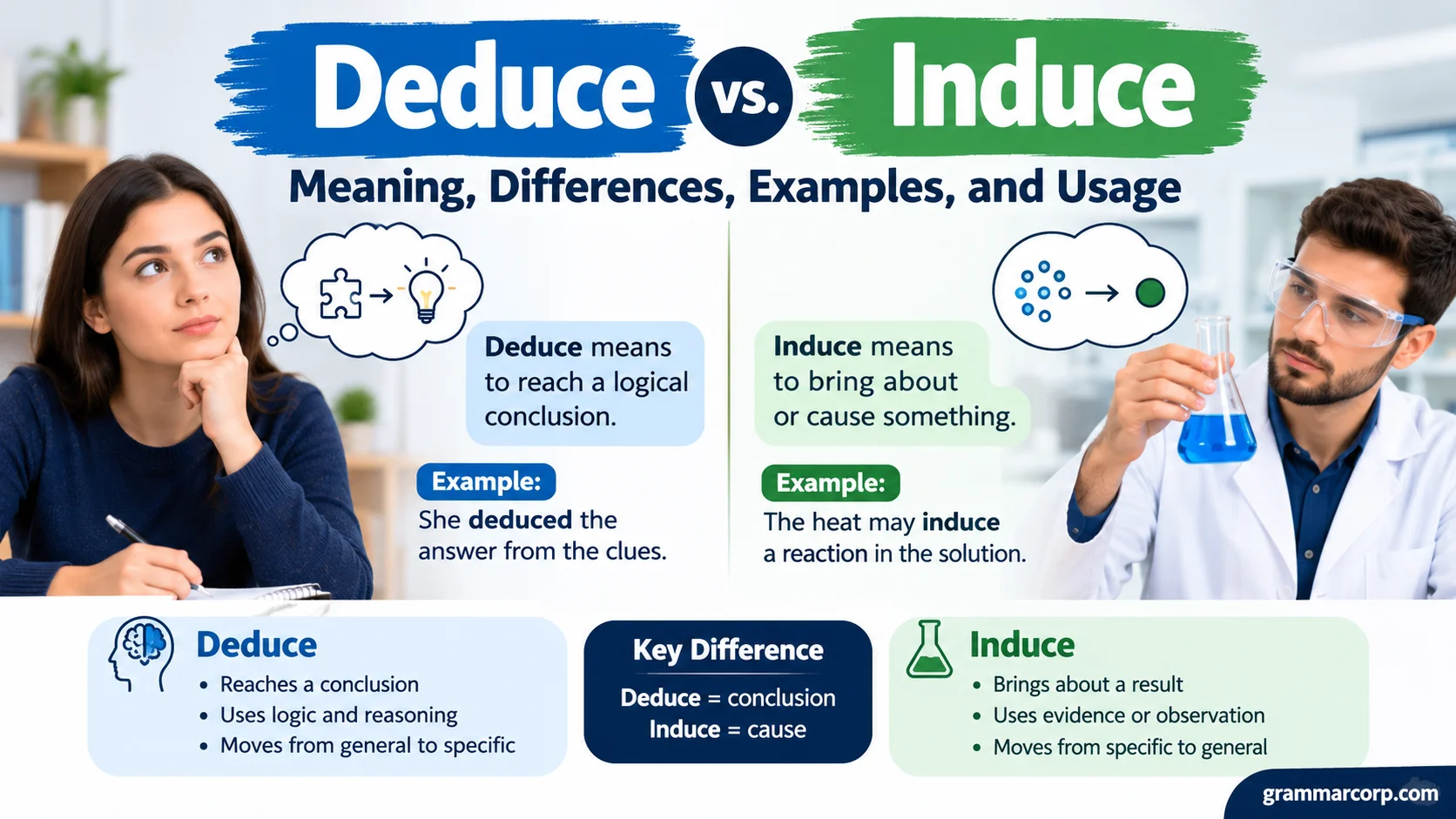
Deduce vs. Induce: Meaning, Differences, Examples, and Usage explains how deduction uses general rules to reach specific conclusions while induction builds broader rules from observations.
Deduce and induce look and sound similar, but they describe different reasoning processes. Deduction starts with a general rule or known principle and ends with a specific conclusion. Induction starts with specific facts and observations and moves toward a broader rule. Understanding this distinction helps you choose the right word in academic writing, scientific discussions, everyday conversations, and logical arguments.
Imagine finding wet footprints across your kitchen floor. You might deduce that someone walked inside with wet shoes. However, if you observe several people walking carefully on slippery floors and form a general rule from those observations, you are using induction. Both processes connect evidence and conclusions, but they move in opposite directions.
Remember this quick tip: deduction moves from a general rule to a specific result, while induction moves from specific examples toward a broader pattern. Sherlock Holmes often illustrates deduction by examining clues to reach possible explanations. Recognizing these differences in practical examples, real-world scenarios, and practice questions helps you use related terms such as infer and inductive reasoning correctly and avoid common grammatical mistakes.
Quick Answer: Deduce vs. Induce
Deduce means to reach a conclusion by reasoning from facts, clues, observations, or established principles. Induce generally means to cause an effect, bring about a condition, or persuade someone to do something.
Consider these examples:
- Deduce: From the muddy footprints, Sarah deduced that someone had entered through the garden.
- Induce: The strong smell of freshly baked bread induced hunger among the visitors.
In the first sentence, Sarah uses available evidence to reach a conclusion. In the second, the smell causes a physical response.
| Feature | Deduce | Induce |
| Part of speech | Verb | Verb |
| Main meaning | Reach a conclusion through reasoning | Cause an effect or influence an action |
| Typical starting point | Facts, clues, or premises | An action, substance, condition, or influence |
| Typical outcome | An inference or conclusion | A reaction, change, condition, or action |
| Common contexts | Logic, investigations, reading, research | Medicine, science, psychology, persuasion |
| Example | We deduced that the store had closed. | The medication induced drowsiness. |
Quick memory tip: You deduce an answer from evidence, but you induce a result by causing or encouraging it.
Comparison Overview
The easiest way to distinguish deduce from induce is to examine what happens in the situation you’re describing. Does someone interpret information to reach a conclusion, or does something produce an effect?
Both verbs connect one thing to another, but the connection works differently.
- Deduce: Evidence leads to a conclusion through reasoning.
- Induce: A cause, influence, or action produces a result.
For example, a detective might deduce that a window was opened because rainwater appears on the windowsill. Meanwhile, the rain might induce the homeowner to close the window.
The same event can involve both verbs, but each describes a separate part of the situation.
| Example situation | Correct verb | Explanation |
| A student works out an unfamiliar word from surrounding sentences. | Deduce | The student uses contextual clues to reach a conclusion. |
| A loud alarm causes people to leave a building. | Induce | The alarm produces a response. |
| A researcher reaches a conclusion from test results. | Deduce | The researcher interprets evidence. |
| A discount encourages customers to purchase a product. | Induce | The discount influences their behavior. |
| A doctor concludes that a patient may have an infection from test results. | Deduce | The doctor reasons from available evidence. |
| A medication causes a patient to feel sleepy. | Induce | The medication produces an effect. |
One important detail: deduce doesn’t guarantee that a conclusion is correct. A person can reason carefully but still reach the wrong answer if the evidence is incomplete or the underlying assumptions are false. Similarly, induce describes an intended or actual cause, depending on the sentence, but it doesn’t automatically mean the effect is guaranteed.
What Does Deduce Mean?
The verb deduce means to reach a conclusion by examining facts, clues, information, or logical premises. When you deduce something, you use what you already know to work out something that isn’t directly stated or immediately obvious.
For example, suppose you arrive at a friend’s house and notice that every light is off, the curtains are closed, and no car is in the driveway. You might deduce that your friend isn’t home. However, you don’t know that for certain. Your conclusion comes from the available clues rather than direct confirmation.
Deduction appears in many areas of life, including problem-solving, detective work, mathematics, scientific research, and reading comprehension.
Definition of Deduce
According to the standard meaning of the word, deduce involves drawing a conclusion from information or reasoning. It often emphasizes a logical connection between what you know and what you conclude.
Here are three essential features of deduction:
- Evidence or premises: You begin with facts, observations, statements, or established rules.
- Reasoning: You examine how those facts relate to one another.
- Conclusion: You arrive at an answer or interpretation based on that reasoning.
Consider this example:
All employees must wear identification badges. Maria is an employee. Therefore, Maria must wear an identification badge.
The conclusion follows logically from the two premises. You can deduce the final statement without checking whether Maria is wearing her badge at that moment.
In formal logic, this kind of reasoning is called deductive reasoning. In everyday conversation, however, people also use deduce for conclusions based on clues that suggest a likely explanation rather than establish absolute certainty.
For example:
The kitchen smells like burnt toast, so I deduced that someone had left breakfast in the toaster too long.
The conclusion is reasonable, but other explanations remain possible.
Examples of Deduce in Sentences
Seeing deduce in different contexts helps you understand how naturally it fits into a sentence.
- Everyday observation: From the wet umbrellas by the door, we deduced that it had been raining.
- Investigation: The detective deduced the suspect’s route from the security footage.
- Education: Students can deduce the meaning of an unfamiliar word from its surrounding sentences.
- Business: The manager deduced that demand had increased after reviewing the monthly sales figures.
- Mathematics: We deduced the missing value by applying the equation.
- Literature: Readers can deduce the character’s feelings from her actions and dialogue.
- Science: The researchers deduced that the equipment had malfunctioned after comparing the measurements.
- Daily conversation: I deduced from his hurried departure that he was running late.
Notice the recurring pattern. Someone examines information and uses it to reach a conclusion.
The word doesn’t require complicated reasoning, either. You can deduce something from a simple clue or from a detailed investigation.
Common Grammar Patterns With Deduce
Although deduce has a straightforward meaning, understanding its common sentence structures will help you use it correctly.
Deduce Something
Use this pattern when the object is the conclusion, answer, or fact being worked out.
Structure: Subject + deduce + object.
Examples:
- We deduced the answer from the available information.
- The investigators deduced the likely sequence of events.
- She deduced his intentions from his behavior.
The object identifies what the person worked out.
Deduce Something From Something
This construction explicitly identifies the evidence behind a conclusion.
Structure: Subject + deduce + conclusion + from + evidence.
Examples:
- The teacher deduced the student’s difficulty from her mistakes.
- We deduced the cause of the delay from the delivery records.
- Researchers deduced a pattern from repeated observations.
The word from introduces the information that supports the conclusion.
Deduce That Something Is True
Use that to introduce a complete statement expressing the conclusion.
Examples:
- I deduced that the meeting had already started.
- They deduced that the original estimate was incorrect.
- The team deduced that the machine needed further testing.
This structure works especially well in formal writing because it clearly separates the reasoning process from the conclusion.
Deduce Something About Someone or Something
This pattern works when evidence helps you reach a conclusion about a person, object, or situation.
Examples:
- We deduced something about the author’s intentions from the final paragraph.
- The analyst deduced several things about customer behavior from the survey.
- From his response, she deduced that he disagreed with the proposal.
You can use these constructions in academic papers, reports, essays, and everyday communication.
Synonyms and Related Words for Deduce
Several English verbs express ideas similar to deduce. However, their meanings aren’t identical in every context.
| Word | Meaning | Example |
| Infer | Reach a conclusion from clues or evidence | I inferred that she was upset from her silence. |
| Conclude | Decide or determine something after considering information | We concluded that the plan was too expensive. |
| Determine | Establish or find out something | The test determined the water’s temperature. |
| Reason | Think logically about a situation | He reasoned that the earlier train would be less crowded. |
| Work out | Find an answer through thought or calculation | She worked out the solution to the problem. |
| Figure out | Understand or solve something | I figured out why the printer wasn’t working. |
Deduce and infer are particularly close in meaning. Both involve reaching a conclusion from information. Determine is broader because you can determine a fact through measurement, testing, or direct investigation rather than reasoning alone.
Likewise, conclude can refer to reaching a final judgment after considering evidence, while figure out is more informal.
Choose the synonym that matches the exact action you want to describe.
What Does Induce Mean?
The verb induce generally means to cause something to happen, produce a particular effect, or influence someone to do something. Unlike deduce, it doesn’t primarily describe reaching a conclusion.
For example, a sudden drop in temperature may induce plants to enter a dormant state. A persuasive argument might induce someone to reconsider a decision. In both cases, one factor produces or encourages a change.
The word appears frequently in medicine, biology, psychology, business, and everyday communication. Its precise meaning depends on the context.
Definition of Induce
Induce has several closely related meanings.
To cause an effect: Something produces a physical, emotional, or practical result.
- The medication induced drowsiness.
- The announcement induced widespread concern.
- The chemical induced a reaction in the sample.
To persuade or influence someone: A person or circumstance encourages someone to act.
- The discount induced shoppers to try the new product.
- Her explanation induced him to reconsider his position.
- The promise of a reward induced the team to participate.
To initiate a process: In certain medical and scientific contexts, induce means to bring about a particular condition or begin a process.
- The medical team discussed whether to induce labor.
- The researchers induced a controlled response under laboratory conditions.
These meanings share a central idea: something brings about an effect or encourages an action.
The effect may be physical, emotional, behavioral, or procedural. That’s why the word works in so many different fields.
Examples of Induce in Sentences
Here are examples showing how induce works in practical situations.
- Medicine: The medication may induce nausea in some patients.
- Psychology: Repeated exposure to a stressful situation can induce anxiety.
- Business: The retailer offered free shipping to induce more customers to complete their purchases.
- Science: The researchers used heat to induce a chemical reaction.
- Education: The teacher used an interesting experiment to induce curiosity among the students.
- Weather: The sudden change in temperature induced a rapid response in the plants.
- Behavior: The warning induced the driver to slow down.
- Daily life: The smell of coffee induced a strong desire for breakfast.
- Medicine and childbirth: The doctor explained the circumstances under which clinicians may induce labor.
- Emotions: The unexpected announcement induced a sense of relief throughout the office.
In each sentence, an action, condition, substance, or influence brings about a result.
Keep in mind that induce can sound more formal than cause or make. It’s particularly useful when you want to describe a specific effect without using informal language.
Common Grammar Patterns With Induce
The grammatical structure often reveals which meaning of induce the writer intends.
Induce Something
Use this pattern when the thing being caused is the direct object.
Structure: Subject + induce + effect.
Examples:
- The medication induced sleepiness.
- The experiment induced a measurable change.
- The news induced a feeling of relief.
This construction is common when discussing physical reactions, emotions, conditions, and scientific processes.
Induce Someone to Do Something
Use this structure when an action or influence persuades someone to act.
Structure: Subject + induce + person + to + base-form verb.
Examples:
- The offer induced customers to sign up.
- His explanation induced the committee to reconsider its decision.
- The warning induced the hikers to turn back.
The infinitive phrase beginning with to identifies the action that the person was encouraged or persuaded to take.
This construction is particularly useful in formal writing about incentives, persuasion, and decision-making.
Induce Something in Someone
This pattern identifies the person who experiences an effect.
Examples:
- The treatment induced a temporary change in the patient.
- The story induced a sense of nostalgia in its readers.
- The exercise induced a relaxation response in the participants.
In many sentences, you can express the same idea more directly: The story induced nostalgia among its readers.
The best construction depends on the effect you want to emphasize and how naturally the sentence reads.
Induce a State or Condition
Induce frequently appears with nouns describing a physical or mental state.
Common combinations include:
- Induce sleep
- Induce drowsiness
- Induce nausea
- Induce a reaction
- Induce a response
- Induce labor
- Induce a change
- Induce a sense of calm
These combinations are especially common in medical, scientific, and technical writing.
However, the fact that a phrase is grammatically correct doesn’t mean the described effect is certain. For example, saying that a drug may induce drowsiness expresses a possibility rather than a guaranteed outcome.
Synonyms and Related Words for Induce
The best synonym for induce depends on whether you’re describing a cause, a reaction, or persuasion.
| Word | Typical meaning | Example |
| Cause | Make something happen | The delay caused frustration. |
| Produce | Create or generate an outcome | The treatment produced a positive response. |
| Trigger | Set off a reaction or event | The alarm triggered a response. |
| Bring about | Make a change or result happen | The reform brought about improvements. |
| Prompt | Cause or encourage an action | The question prompted further discussion. |
| Persuade | Convince someone to do something | She persuaded him to apply. |
| Encourage | Give someone a reason or confidence to act | The feedback encouraged students to participate. |
Although these words overlap, they emphasize different aspects of the situation.
For instance, trigger often suggests setting off a reaction, while persuade focuses on influencing someone’s decision. Produce emphasizes the result, and bring about is a broad alternative that works well in formal writing.
Use induce when its particular shade of meaning fits the sentence better than these alternatives.
Main Differences Between Deduce and Induce
Now that you understand each word individually, it’s easier to see where their meanings diverge. The main difference isn’t simply that one word sounds more formal than the other. They describe fundamentally different relationships between information, reasoning, causes, and outcomes.
Difference in Meaning: Deduce vs. Induce
Deduce describes a mental process. You examine information and arrive at a conclusion. Induce describes a causal or influential process. Something produces an effect or encourages an action.
Consider these examples:
- The detective deduced that the window had been opened from the inside.
- The strong wind induced the homeowner to close the window.
The detective interprets evidence to reach a conclusion. The wind influences the homeowner’s behavior.
Here’s another comparison:
- The analyst deduced that customer demand was falling.
- The price reduction induced more customers to make purchases.
The analyst interprets data in the first sentence. In the second, the price reduction influences customer behavior.
One useful question can help you distinguish the two: Are you describing how someone worked something out, or what caused something to happen?
If you’re describing reasoning, deduce is usually appropriate. If you’re describing a cause or influence, induce is usually the better choice.
Difference in Purpose
The two verbs also differ in what they communicate about an event.
When you use deduce, you emphasize the process of understanding. You’re explaining how someone arrived at a conclusion based on the information available.
When you use induce, you emphasize the relationship between an influencing factor and a resulting effect.
For example, imagine a company investigating why sales declined.
The marketing team might deduce that customers disliked the new packaging after reviewing customer feedback. The company might then redesign its packaging to induce more customers to purchase the product.
The first action involves interpretation. The second involves trying to influence an outcome.
Difference in Grammatical Usage
Although both words function as verbs, they commonly appear with different objects and sentence structures.
| Grammar pattern | Deduce | Induce |
| Verb + noun | Deduce an answer | Induce a reaction |
| Verb + that-clause | Deduce that sales declined | Induce that sales declined is generally incorrect for the intended meaning |
| Verb + noun + from | Deduce a conclusion from evidence | Induce a reaction from a stimulus |
| Verb + person + to-infinitive | Not the usual construction for drawing a conclusion | Induce someone to participate |
| Verb + effect or condition | Deduce the cause | Induce a response |
The distinction matters because you can’t always replace one verb with the other while keeping the sentence’s intended meaning.
For example:
- Correct: We deduced that the machine had stopped working.
- Correct: The electrical fault induced the machine to shut down.
- Incorrect for the intended meaning: We induced that the machine had stopped working.
In the last example, the writer wants to express a conclusion drawn from evidence. The correct verb is deduced.
Deduce vs. Induce: Side-by-Side Comparison
The following table summarizes the differences in a practical format.
| Feature | Deduce | Induce |
| Core idea | Reason toward a conclusion | Cause an effect or influence an action |
| Main process | Interpretation | Causation or persuasion |
| Typical subject | A person, investigator, researcher, or reader | A person, substance, event, condition, or influence |
| Typical object | An answer, conclusion, motive, or fact | A reaction, condition, behavior, or process |
| Common question answered | What can we conclude? | What caused this or encouraged this action? |
| Everyday example | I deduced that you were busy. | The message induced me to call you. |
| Scientific example | Researchers deduced a pattern from the data. | Heat induced a change in the material. |
| Business example | The manager deduced that demand had declined. | The promotion induced customers to buy. |
A useful distinction is that deduce typically describes reasoning about what is true or likely, whereas induce describes bringing about or encouraging an outcome.
Deduce vs. Induce in Different Contexts
The distinction becomes clearer when you see how the verbs function in specific fields. Their meanings remain consistent, but the situations in which writers use them vary.
Deduce vs. Induce in Everyday Conversation
In everyday conversation, deduce often describes figuring something out from clues. Induce usually describes something that causes a feeling, reaction, or action.
Imagine that your friend arrives at school carrying a wet umbrella and wearing damp shoes.
You might deduce that your friend walked through the rain. You used the visible clues to reach a conclusion.
Now imagine that the cold, rainy weather induces your friend to stay indoors during lunch. The weather has influenced a decision.
Here are more examples:
- I deduced from her expression that she disliked the surprise.
- The unexpected gift induced a feeling of happiness.
- We deduced that the restaurant was closed because its lights were off.
- The long wait induced several customers to leave.
- He deduced that his phone battery was dead when the screen wouldn’t turn on.
- The loud noise induced everyone to look toward the door.
In casual speech, people might choose figure out instead of deduce or cause instead of induce. Both alternatives can sound more natural in informal situations.
However, knowing the distinction helps you choose precise language when the context calls for it.
Deduce vs. Induce in Science and Research
Scientific writing uses both verbs, but it also introduces an important distinction between deductive reasoning and inductive reasoning.
Deductive reasoning begins with general principles or premises and uses them to reach a more specific conclusion. When the premises are true and the logical argument is valid, the conclusion follows necessarily.
For example:
- All metals conduct electricity under suitable conditions.
- Copper is a metal.
- Therefore, copper conducts electricity under those conditions.
The conclusion follows from the premises.
Inductive reasoning works differently. It uses observations or particular examples to support a broader generalization. The conclusion may be well supported without being logically guaranteed.
For example:
- A researcher observes that several plant species grow faster under a particular lighting condition.
- The researcher identifies a recurring pattern.
- The researcher proposes that the lighting condition may promote plant growth more generally.
Further testing would be necessary to establish how widely that pattern applies.
The verb induce can mean “cause” in a scientific experiment, as in The researchers induced a change in temperature. That meaning should not be confused with induction, the reasoning process that moves from particular observations toward broader conclusions.
| Concept | Direction or function | Example |
| Deductive reasoning | General premises to a specific conclusion | Applying a mathematical rule to solve a problem |
| Inductive reasoning | Specific observations to a broader generalization | Using repeated observations to propose a scientific pattern |
| Deduce | Reach a conclusion through reasoning | Deduce a relationship from established principles |
| Induce | Cause an effect or initiate a process | Induce a reaction in a laboratory sample |
This distinction is particularly important in research papers, where confusing a causal process with a reasoning method can make an explanation inaccurate.
Deduce vs. Induce in Medicine
Medicine provides clear examples of both words.
A clinician may deduce a possible explanation for a patient’s symptoms by considering medical history, physical examination findings, and test results. The conclusion remains subject to the available evidence and the possibility of alternative explanations.
For example:
After reviewing the patient’s symptoms and test results, the physician deduced that an infection was a likely explanation.
Here, deduced describes reasoning. It doesn’t mean that the physician created the infection or established the diagnosis with absolute certainty.
By contrast, a medication may induce a physical effect.
For example:
The medication may induce drowsiness in some patients.
The medication produces or contributes to the effect rather than drawing a conclusion about it.
Another established medical expression is induce labor, which refers to using medical methods to initiate labor when clinically appropriate.
The distinction is straightforward:
- A clinician deduces a possible explanation from medical evidence.
- A treatment may induce a physiological response.
- A medical team may induce labor as part of a planned clinical intervention.
Because medical outcomes vary, statements about treatments should reflect the evidence and avoid implying that a particular result is guaranteed.
Deduce vs. Induce in Education and Writing
Students often use deduction when interpreting information that an author doesn’t state directly.
Suppose a short story describes a character checking the clock repeatedly, pacing near the door, and glancing at a phone. The author never explicitly says the character feels anxious.
A reader might deduce that the character is worried about an upcoming event. The reader draws a conclusion from the character’s actions.
An educator, meanwhile, might use an engaging demonstration to induce curiosity. The demonstration encourages students to ask questions and investigate the subject.
Examples include:
- From the final paragraph, students deduced why the character left home.
- The teacher’s experiment induced students to ask more questions.
- Readers can deduce the author’s attitude from the language and tone.
- The classroom activity induced greater participation among the students.
In academic writing, use deduce when describing the interpretation of evidence. Use induce when describing an action or influence that produces a response.
Deduce vs. Infer vs. Induce
One reason people confuse deduce and induce is that they encounter both words alongside infer. The three verbs can appear in similar discussions, but their meanings differ.
Deduce vs. Infer
Deduce and infer both describe reaching conclusions from information. In many everyday contexts, their meanings overlap considerably.
For example:
- From the dark clouds, we deduced that rain was approaching.
- From the dark clouds, we inferred that rain was approaching.
Both sentences are understandable and convey essentially the same conclusion.
However, infer is a broad, common choice for interpreting clues or evidence. Deduce often emphasizes a conclusion reached through a chain of reasoning or the application of known facts.
Compare these examples:
| Word | Example | Emphasis |
| Deduce | We deduced the answer from the available evidence. | Reasoning toward a conclusion |
| Infer | We inferred from her tone that she was disappointed. | Interpreting clues or indirect information |
| Induce | The disappointing result induced her to change her approach. | Causing or encouraging a change |
The first two verbs describe understanding. The third describes influence.
One further distinction is worth knowing: in traditional usage, infer often refers to the reasoner’s act of drawing a conclusion, while imply refers to suggesting something indirectly. Modern usage can be flexible, but the distinction remains useful in formal writing.
For example:
- The author implied that the character was unhappy.
- The reader inferred that the character was unhappy.
The author suggests something; the reader interprets that suggestion.
Deduce vs. Induce
The difference between these two verbs is more pronounced.
If you deduce that a product is defective after examining customer complaints, you’re interpreting evidence. If a faulty component induces the product to overheat, that component causes an effect.
Compare:
- The engineer deduced that the circuit was damaged.
- The damaged circuit induced the device to shut down.
The first sentence describes the engineer’s reasoning. The second describes a causal relationship.
Although both sentences concern the same technical problem, the verbs perform different jobs.
Induce vs. Inductive
The words induce and inductive look related because they share a historical linguistic connection. However, they serve different grammatical and conceptual roles.
Induce is a verb that generally means to cause something or persuade someone.
Inductive is an adjective commonly used to describe reasoning that develops general conclusions from particular observations.
Examples:
- The chemical induced a reaction.
- The researchers used inductive reasoning to develop a hypothesis.
In the first sentence, the chemical causes an effect. In the second, the researchers reason from observations toward a broader conclusion.
This difference is crucial: inducing an effect is not the same thing as using inductive reasoning.
Read More : Relate To or Relate With: Which Is Correct?
Common Mistakes When Using Deduce and Induce
Even when you understand the definitions, certain sentence patterns can cause confusion. These are the most common mistakes to avoid.
Using Induce When You Mean Deduce
A common error occurs when someone uses induce to describe drawing a conclusion.
Incorrect: From the footprints, we induced that the visitor had entered through the back door.
Correct: From the footprints, we deduced that the visitor had entered through the back door.
The sentence describes an inference from evidence, so deduced is the appropriate choice.
Another example:
Incorrect: The researcher induced from the results that the hypothesis was incorrect.
Correct: The researcher deduced from the results that the hypothesis was incorrect.
You could also write, The researcher inferred from the results that the hypothesis was incorrect.
Using Deduce When You Mean Induce
The opposite mistake occurs when someone uses deduce to describe causing an effect.
Incorrect: The medication deduced drowsiness.
Correct: The medication induced drowsiness.
The medication doesn’t reason its way toward a conclusion. It causes or contributes to a physical response.
Consider another example:
Incorrect: The discount deduced customers to purchase the product.
Correct: The discount induced customers to purchase the product.
A more conversational alternative would be, The discount encouraged customers to purchase the product.
Confusing Deduction With Inductive Reasoning
The terms deduction and induction also describe different reasoning methods.
Deduction moves from premises to a conclusion that follows logically from them. Induction uses particular observations to support a broader conclusion that may be probable rather than certain.
For example, applying a mathematical formula to calculate a specific result is a deductive task. Observing the same pattern across many experiments and proposing a general rule is an inductive task.
Neither process should be confused with the verb induce when it means “cause.”
Choosing a Synonym That Changes the Meaning
Synonyms aren’t interchangeable in every sentence.
For example, The evidence caused us to conclude that the report was inaccurate is understandable, but The evidence led us to conclude that the report was inaccurate may sound more natural.
Similarly, The incentive induced employees to participate emphasizes influence, while The incentive persuaded employees to participate focuses more directly on convincing them.
Before replacing a word, ask yourself what relationship you want to express:
- Conclusion: deduce, infer, conclude.
- Cause or result: induce, cause, produce.
- Influence or persuasion: induce, persuade, encourage.
- Reasoning from observations: use the appropriate expression for deductive or inductive reasoning.
The right choice depends on both meaning and sentence structure.
How to Remember the Difference Between Deduce and Induce
A simple memory aid can help you select the correct verb without stopping to consult a dictionary.
A Simple Memory Trick
Associate deduce with reaching a decision or conclusion from evidence. Associate induce with initiating an effect.
Try remembering these two phrases:
- Deduce from clues.
- Induce an effect.
The first phrase highlights reasoning. The second highlights causation.
For instance, if you notice that your laptop won’t turn on and deduce that its battery is empty, you’ve reached a conclusion from the available clues.
If a power surge induces a shutdown, the surge has caused an event.
The distinction becomes easier to remember when you focus on the action rather than the spelling.
A Quick Decision Test
When you’re unsure which word to use, ask yourself one question: Am I working something out, or am I bringing something about?
Use deduce
You’re interpreting facts, clues, or premises to reach a conclusion.
Example: We deduced that the meeting had been canceled.
Use induce
You’re describing something that causes a result or encourages an action.
Example: The cancellation induced disappointment among the attendees.
This test works in most everyday and academic contexts. If neither definition seems to fit, consider whether another verb, such as infer, determine, or encourage, would express your meaning more naturally.
Side-by-Side Examples
Sometimes the same situation can involve both verbs. The following examples demonstrate how the words work together.
Example: A delayed train
- Passengers deduced that the train had broken down after checking the departure board.
- The long delay induced several passengers to find another route.
The passengers interpret information in the first sentence. The delay influences their decisions in the second.
Example: A classroom experiment
- The students deduced that sunlight affected plant growth after comparing their observations.
- The unusual results induced the students to conduct another experiment.
The students reach a conclusion and then respond to the results.
Example: A business decision
- The manager deduced that customers preferred the older design from the survey results.
- The redesigned packaging induced more customers to try the product.
These examples show that the verbs aren’t competing alternatives for the same action. They describe different relationships within a situation.
Practice Exercise: Deduce or Induce?
Test your understanding by choosing the correct form of deduce or induce for each sentence. Pay attention to whether the sentence describes reasoning or a cause-and-effect relationship.
Complete each sentence with the appropriate form of the verb.
- From the empty seats and darkened stage, we that the performance had ended.
- The new promotion more customers to visit the store.
- The doctor from the test results that further examination was necessary.
- The medication may drowsiness in some patients.
- The students a general pattern after examining several examples.
- The unexpected announcement a sense of relief among the employees.
- Investigators that the door had been left unlocked after examining the security footage.
- The discount shoppers to purchase the product earlier than planned.
Answer Key and Explanations
- Deduced — The observers use visible clues to reach a conclusion.
- Induced — The promotion encourages or causes more customers to visit.
- Deduced — The doctor reasons from test results.
- Induce — The medication may cause a physical effect.
- Deduced — The students interpret their observations to reach a conclusion. If the intended meaning is specifically that they generalized from particular observations, developed or identified may be more precise depending on the context.
- Induced — The announcement produces an emotional response.
- Deduced — The investigators draw a conclusion from evidence.
- Induced — The discount influences shoppers’ behavior.
The key is to focus on the action each sentence describes. If the subject interprets evidence, deduce is generally the right choice. If a factor produces an effect or encourages an action, induce usually fits.
FAQs:
1. What is the main difference between deduce and induce?
Deduce means using general rules, known facts, or evidence to reach a specific conclusion. Induce means using specific observations or examples to develop a broader conclusion or pattern.
2. What is an example of deduce in a sentence?
“She saw wet footprints on the kitchen floor and deduced that someone had entered with wet shoes.” The speaker uses available evidence to reach a conclusion.
3. What is an example of induce in a sentence?
“After observing several students learn better through practice, the teacher induced that hands-on activities can improve learning.” More naturally, you could say the teacher inferred this pattern or concluded that practice helps students learn.
4. Are deduce and infer the same?
They have similar meanings, but they can differ in emphasis. Deduce often highlights reaching a conclusion through logical reasoning, while infer refers more broadly to drawing a conclusion from evidence or clues.
5. How can I remember the difference between deduce and induce?
Remember the direction of reasoning. Deduce moves from a general rule toward a specific conclusion. Induce moves from specific observations toward a broader rule or pattern.
Conclusion:
Understanding deduce vs. induce becomes easier when you focus on how each word connects evidence and conclusions. Deduction applies general principles to specific situations, while induction uses individual observations to identify broader patterns.
Whether you’re writing an academic paper, explaining a scientific idea, or making sense of everyday events, choosing the correct term makes your meaning clearer. Practice recognizing these two reasoning methods, and you’ll feel more confident using both words correctly.













1 thought on “Deduce vs. Induce: Meaning, Differences, Examples, and Usage”