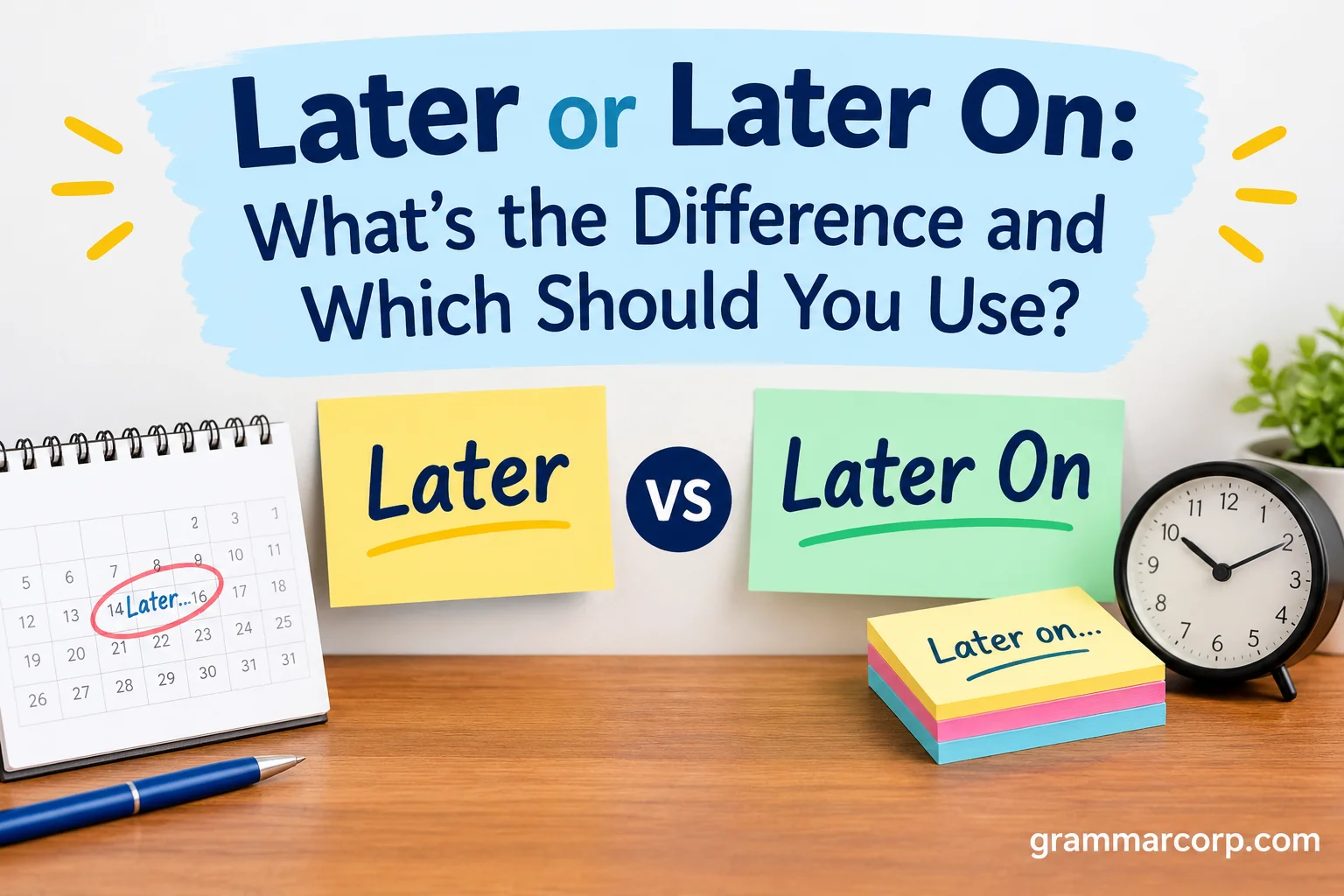
Later or Later On: What’s the Difference and Which Should You Use? Learn how these expressions fit naturally into everyday English and when to choose each one.
When you’re writing a message, you might wonder whether to say “I’ll call you later” or “I’ll call you later on.” Both expressions sound natural in everyday American English because they refer to a time after the present moment or another event. However, their grammatical uses can vary depending on the sentence and its context.
You don’t need to memorize complicated rules to use them correctly. Understanding how these phrases function makes choosing the right one easier. Although both are grammatically correct, they aren’t always completely interchangeable.
The main difference involves style, emphasis, and grammatical flexibility. Later works well in formal English and informal English. It can mean afterward or refer to a future time, such as when you plan to finish your homework or discuss future plans. You can also use it to describe past events and tell stories.
Quick Answer: Later vs. Later On
Later and later on both mean at a time after the present moment or after another event. They’re often interchangeable when you refer to an unspecified future time or describe a sequence of events.
However, later is more versatile because it can function as an adverb or an adjective. Later on functions as an adverbial phrase and often emphasizes a subsequent point in time or stage.
Consider these examples:
- Later: I’ll call you later.
- Later on: I’ll call you later on.
- Later as an adjective: We scheduled a later meeting.
- Later in a sequence: Two hours later, the train arrived.
Both I’ll call you later and I’ll call you later on are grammatically correct. The first is more concise, while the second can place slightly more emphasis on the fact that the call will happen at a subsequent time.
Here’s the simplest way to remember the distinction:
- Use later for general references to future time, comparisons, and established expressions such as later today and no later than Friday.
- Use later on when you want to refer to a subsequent time or stage and the phrase fits naturally into the sentence.
- Use later, not later on, before a noun when it functions as an adjective. For example, say a later appointment rather than a later on appointment.
Neither expression is inherently more correct than the other. The best choice depends on what you want to say.
Comparison Overview
The following table highlights the main similarities and differences between later and later on.
| Feature | Later | Later On |
| Basic meaning | At a future time or afterward | At a future time or afterward |
| Grammatical function | Adverb or adjective | Adverbial phrase |
| Common purpose | Referring to future time, sequence, or comparison | Referring to a subsequent time or stage |
| Tone | Neutral, concise, and versatile | Often conversational or slightly more emphatic |
| Sentence placement | Beginning, middle, or end | Beginning, middle, or end, depending on the construction |
| Use before a noun | Yes, as in a later meeting | No, not directly |
| Common expression | Later today | Later on |
| Deadline expression | No later than Friday | Not normally used in no later than constructions |
| Example | I’ll finish the report later. | I’ll finish the report later on. |
The most important distinction is grammatical rather than a strict difference in meaning. Both expressions can refer to the same event at the same time, but only later can directly modify a noun as an adjective.
For instance, you can say, “We decided to hold the meeting later.” You can also say, “We decided to hold the meeting later on.” However, if you want to describe the meeting itself, you need “a later meeting.”
This flexibility makes later especially useful in both spoken and written English.
What Does Later Mean?
The word later is a common English adverb that refers to a time after the present moment or after another event. It’s also the comparative form of the adjective late. Depending on the sentence, it can describe when something happens or indicate that one thing occurs after another.
For example, if you tell a friend, “I’ll finish my homework later,” you’re saying that you’ll complete it at a future time. You haven’t specified exactly when, but the listener understands that the task won’t happen immediately.
Similarly, if you write, “Three days later, the package arrived,” you’re describing an event that happened three days after a previously established point in time.
Definition of Later
According to the later can refer to a time in the future or a point after a particular event. It can also describe something that occurs nearer the end of a period or sequence.
Here are the main ways to use later:
- Future time: Something will happen after the present moment.
- Sequence of events: One event happens after another.
- Comparison: One event or time occurs after another.
- Adjective use: Something belongs to a more recent or subsequent time.
Consider these examples:
- I’ll finish the presentation later.
- We arrived at the restaurant two hours later.
- Let’s discuss that issue at a later meeting.
- She became interested in painting later in life.
Notice that later doesn’t always refer to the future. In the second example, the speaker describes a past event that happened after another event. The surrounding sentence establishes the reference point.
This distinction matters because English uses later to describe both future plans and the order of past events.
Examples of Later in Sentences
The easiest way to understand later is to see how it works in different situations.
Example: Future plans
“I’m busy right now, but I’ll help you later.”
Here, later refers to an unspecified future time. The speaker plans to help but hasn’t given an exact time.
Example: Past events
“We left the office at noon and returned two hours later.”
The word later establishes the time between two events. The return happened at 2 p.m.
Example: Storytelling
“Years later, Daniel discovered the letter his grandfather had written.”
In this sentence, years later signals a significant gap between the original event and the discovery.
Example: Comparing times
“The second train arrived later than the first.”
Here, later compares the arrival times of two trains. It doesn’t simply refer to the future.
Example: Describing a subsequent item
“The later chapters explain the author’s main argument.”
In this example, later functions as an adjective. It describes chapters that appear farther along in the book.
These examples demonstrate why later is more flexible than later on. It works in a wide range of grammatical structures without requiring additional words.
When to Use Later
Use later when you want to refer to a future time, describe the order of events, or compare one time with another.
It’s especially useful in the following situations.
- Making plans: “I’ll send you the address later.”
- Discussing schedules: “The meeting starts later today.”
- Describing chronology: “The company expanded three years later.”
- Comparing events: “The second performance began later than expected.”
- Describing a future item: “We’ll consider that option at a later stage.”
- Setting a deadline: “Please arrive no later than 9 a.m.”
Certain expressions containing later are particularly common in American English:
| Expression | Meaning | Example |
| Later today | At a future time today | I’ll email you later today. |
| Later this week | At a future time during the current week | We’ll meet later this week. |
| Later in life | During a more advanced stage of life | He learned to play the piano later in life. |
| At a later date | At another time in the future | The event will take place at a later date. |
| No later than | By a specified deadline | Submit the form no later than Friday. |
| Sooner or later | At some point, eventually | Sooner or later, you’ll need to make a decision. |
These expressions are established constructions. Although later on is correct English, you shouldn’t automatically insert on into every phrase containing later.
For instance, “I’ll see you later today” is natural and concise. The version “I’ll see you later on today” is also possible, but the extra words aren’t necessary in most contexts.
What Does Later On Mean?
The phrase later on is an established expression that refers to a future time or a point after another event. It often appears in conversations, narratives, and explanations that describe how circumstances develop over time.
Imagine you’re telling a friend about your weekend. You might say, “We went shopping in the morning and watched a movie later on.” The phrase helps move the story forward by showing that the movie came after the shopping trip.
You could also say, “We watched a movie later.” Both sentences communicate the same basic sequence. The addition of on doesn’t create a different timeline or establish a more precise time.
Definition of Later On
Later on functions as an adverbial phrase. It can modify a verb or describe when an action takes place in relation to the present or another event.
The phrase doesn’t specify an exact time on its own. Context supplies that information.
For example:
- “I’ll explain the details later on.”
- “Later on, we discovered what had happened.”
- “She hopes to travel more later on in life.”
- “The team will review the results later on.”
In each example, later on points to a subsequent time. The surrounding words determine whether that time falls a few minutes, several days, or many years later.
The phrase can also help organize a longer explanation. When you use it to introduce a new development, readers understand that the next event follows something already mentioned.
Examples of Later On in Sentences
Here are several examples that show how later on works in everyday English.
Example: Discussing future plans
“We can talk about the budget later on.”
The speaker wants to postpone the discussion until another time. The exact time remains unspecified.
Example: Describing a past event
“Later on, the guests moved from the dining room to the garden.”
The phrase establishes the order of events in a narrative. The guests moved outside after spending time in the dining room.
Example: Explaining a later development
“Initially, the project seemed simple, but later on, the team encountered several challenges.”
Here, later on marks a change in circumstances. It helps distinguish the project’s early stage from what happened afterward.
Example: Discussing a future stage of life
“She plans to return to college later on.”
The phrase refers to a future stage without specifying a date.
Example: Explaining a lesson learned
“Later on, I realized that asking questions would have saved me time.”
The speaker looks back on an experience and identifies a realization that occurred afterward.
These sentences illustrate an important point: later on is not limited to casual conversation. It also works well in stories, explanations, and other forms of writing.
When to Use Later On
Use later on when you want to indicate that something will happen or happened at a subsequent time. It can be especially helpful when describing a sequence or moving from one stage to another.
Consider these situations:
- Conversational plans: “Let’s decide what to order later on.”
- Narrative transitions: “Later on, the travelers reached a small village.”
- Developing situations: “The initial plan changed later on.”
- Future stages: “You’ll understand the importance of this skill later on.”
- Explanations: “We’ll examine the exceptions later on in this article.”
The phrase can make a transition feel natural, particularly when you have already established a starting point.
However, don’t assume that later on always sounds better than later. In many sentences, the shorter option is equally clear and more direct.
For example, “I’ll explain everything later” is perfectly natural. You don’t need to add on unless you prefer the rhythm or emphasis of the longer expression.
Main Differences Between Later and Later On
Although later and later on share a core meaning, several differences can help you decide which expression to use.
Difference in Meaning
The primary meaning of both expressions is nearly identical: they refer to a time after the present moment or another reference point.
The difference usually comes from context rather than a strict distinction between the words.
Compare these sentences:
- “I’ll finish the report later.”
- “I’ll finish the report later on.”
Both indicate that the speaker will finish the report at a future time. Neither sentence specifies when the work will be completed.
Now consider a narrative:
- “Three months later, the company opened another branch.”
- “Later on, the company opened another branch.”
The first sentence specifies the interval between the earlier event and the opening. The second indicates that the opening happened afterward without providing an exact interval.
This difference comes from the additional time expression three months, not from a special meaning of later that later on lacks.
Key point: Neither expression automatically tells you how much time will pass. You need additional context to determine whether the interval lasts minutes, months, or years.
Difference in Tone and Emphasis
The two expressions can also create slightly different effects.
Later is compact and direct. It’s a natural choice when you want to communicate information without drawing particular attention to the passage of time.
For example:
“Let’s review the results later.”
The sentence is straightforward. It postpones the review without adding emphasis.
Later on can sometimes place more attention on a subsequent time or stage.
For example:
“Let’s review the results later on, after everyone has read the report.”
The longer phrase fits naturally into a discussion about what will happen after another activity.
However, this distinction isn’t absolute. Speakers use later on in casual conversation and formal explanations, while later can also emphasize a particular point in a sequence.
The surrounding sentence, not simply the choice between these two expressions, determines the overall tone.
Difference in Grammatical Function
This is the clearest grammatical difference between later and later on.
The word later can function as both an adverb and an adjective. By contrast, later on functions as an adverbial phrase.
An adverb modifies a verb, an adjective, another adverb, or a larger part of a sentence. An adjective describes a noun.
Consider the following examples:
| Sentence | Grammatical Function |
| I’ll call you later. | Later is an adverb. |
| We arrived two hours later. | Later is an adverb. |
| We booked a later flight. | Later is an adjective. |
| We’ll discuss it later on. | Later on is an adverbial phrase. |
The adjective use explains why you can’t always replace later with later on.
For example:
- Correct: “We scheduled a later appointment.”
- Incorrect: “We scheduled a later on appointment.”
The problem isn’t the meaning. It’s the grammatical structure. English uses later directly before the noun appointment to describe its timing.
You can express the same idea with a different construction: “We scheduled the appointment for later on.” In that sentence, the phrase appears in an adverbial position rather than directly before the noun.
Difference in Sentence Placement
Both expressions can appear in different positions within a sentence.
At the beginning:
- “Later, we returned to the office.”
- “Later on, we returned to the office.”
At the end:
- “We returned to the office later.”
- “We returned to the office later on.”
In the middle:
- “The team later announced the results.”
- “The team announced the results later on.”
The first two examples in each pair are natural ways to establish when something happened. Beginning a sentence with either expression can place more emphasis on chronology, especially in storytelling.
Punctuation also matters. When later or later on begins a sentence as an introductory adverbial, a comma often helps separate it from the main clause.
For example:
“Later on, we discovered that the original estimate was incorrect.”
At the end of a short sentence, however, you generally don’t need a comma before the expression:
“We discovered the mistake later on.”
Choose the placement that makes your sentence easy to follow. Both expressions allow flexibility, but the surrounding sentence still needs to be grammatically sound.
Can Later and Later On Be Used Interchangeably?
Yes, in many situations. When both expressions refer to an unspecified future time or a subsequent event, you can often substitute one for the other without changing the essential meaning.
However, interchangeability has limits. The grammatical function of later and established expressions can prevent a direct substitution.
When Both Expressions Work
Both forms work well when you’re referring to future plans, describing a sequence, or discussing a later stage.
| Using Later | Using Later On |
| I’ll finish the work later. | I’ll finish the work later on. |
| We went for a walk later. | We went for a walk later on. |
| She explained the problem later. | She explained the problem later on. |
| We’ll discuss the proposal later. | We’ll discuss the proposal later on. |
Each pair communicates essentially the same idea. The choice comes down to sentence rhythm, context, and personal preference.
For example, imagine you’re telling a colleague about a meeting. You might say, “The manager explained the new policy later.” If you prefer a slightly different rhythm, “The manager explained the new policy later on” works as well.
Neither version is inherently more professional or grammatically superior.
When Later Is the Better Choice
Although later on is widely accepted, later is the better choice in several grammatical structures.
Before a noun
Use later when it describes a noun directly.
- Correct: “We’ll discuss this at a later meeting.”
- Incorrect: “We’ll discuss this at a later on meeting.”
In deadline expressions
The standard expression is no later than.
- Correct: “Please submit your application no later than October 30.”
- Incorrect: “Please submit your application no later on than October 30.”
In concise time expressions
Expressions such as later today, later tomorrow, and later this week are natural ways to specify a future time.
- “I’ll send the file later today.”
- “We’ll review the figures later this week.”
Although later on today is also possible, the shorter version usually communicates the same idea more efficiently.
When Later On May Sound More Natural
Later on can be a good choice when you’re telling a story, describing a sequence, or explaining how a situation changes.
For example:
“At first, everyone supported the proposal. Later on, several members raised concerns.”
The phrase creates a natural transition between the initial reaction and the later development.
You could also write:
“Later, several members raised concerns.”
That version is equally correct. The longer phrase simply offers another way to move the narrative forward.
Use later on when it fits your intended rhythm and emphasis. Don’t add it merely to make a sentence sound more sophisticated.
Later vs. Later On in Different Contexts
The best choice can depend on what you’re writing or discussing. Both expressions appear in everyday speech, professional communication, storytelling, and explanations, but some contexts favor particular constructions.
Later vs. Later On in Everyday Conversations
In casual conversations, both expressions are common.
For instance, you might tell a friend:
“I’m busy right now. Can we talk later?”
Or you could say:
“I’m busy right now. Can we talk later on?”
Both sentences politely postpone the conversation. The first is more concise, while the second can sound natural if you’re emphasizing a subsequent time.
One particularly common expression is “See you later!” People use it as a casual farewell even when they haven’t arranged an exact meeting time.
For example:
“Thanks for stopping by. See you later!”
You can also hear “See you later on” when the context suggests that the speakers will meet again at a subsequent time. However, “See you later” is the more conventional, concise farewell.
Later vs. Later On in Professional and Academic Writing
Both expressions can appear in professional and academic writing. The best choice depends on the sentence’s purpose.
In a business email, later often works well because it keeps the wording concise.
For example:
“I’ll send you the revised document later today.”
The sentence communicates the expected timing without unnecessary words.
In an academic explanation, later on can also help introduce a subsequent stage in a process.
For example:
“Later on in the study, the researchers compared the results from both groups.”
However, you could write “Later in the study” instead. The shorter construction is equally clear.
For professional writing, focus on precision. If the timing matters, specify it instead of relying on either expression alone.
Compare these examples:
- Vague: “I’ll send the report later.”
- More specific: “I’ll send the report by 3 p.m.”
- Vague: “We’ll review the results later on.”
- More specific: “We’ll review the results during Thursday’s meeting.”
When deadlines or schedules matter, a specific time is more useful than a general reference to the future.
Later vs. Later On in Storytelling and Narration
Storytelling depends on clear transitions between events. Both expressions can help readers follow the timeline.
Consider this short example:
“Emma arrived at the station shortly before noon. She bought a ticket and found a seat near the window. Later on, she noticed a familiar face across the platform.”
The phrase later on signals that another event occurred after the initial actions.
You could replace it with later without changing the basic sequence:
“Later, she noticed a familiar face across the platform.”
Both versions are correct. Writers often choose between them based on rhythm and the flow of the surrounding paragraphs.
For a longer narrative, you can also use more precise time expressions:
- “Ten minutes later, the train arrived.”
- “The following morning, Emma returned to the station.”
- “Several years later, she remembered that encounter.”
These expressions provide more information than later on alone. If chronology is important to your story, specific time references can make the sequence easier to understand.
Later vs. Later On in Scheduling and Deadlines
When discussing appointments, deadlines, or schedules, distinguish an unspecified future time from a definite cutoff.
For example:
“I’ll complete the task later.”
This sentence tells the reader that the task will happen in the future. It doesn’t establish a deadline.
By contrast:
“I’ll complete the task no later than Friday.”
This sentence sets a clear deadline. The task must be completed by Friday at the latest.
Here’s a quick comparison:
| Expression | What It Communicates |
| Later | At a future time or afterward |
| Later on | At a subsequent time or stage |
| Later today | At some point later in the current day |
| Later this week | At a future point during the current week |
| No later than Friday | Friday is the latest acceptable deadline |
| In two hours | Two hours from the relevant starting point |
The key distinction is precision. Later and later on leave the exact time open unless the context supplies it. A deadline expression establishes a limit.
Common Mistakes to Avoid When Using Later and Later On
Even though both expressions are straightforward, certain mistakes can make sentences awkward or grammatically incorrect.
Assuming Later On Is Always More Correct
Adding on doesn’t make a sentence more grammatical.
For example:
- “I’ll speak to you later.”
- “I’ll speak to you later on.”
Both are correct. The first sentence isn’t incomplete simply because it doesn’t contain on.
Choose the expression that fits your sentence. A longer phrase doesn’t automatically provide greater clarity.
Using Later On Before a Noun
Remember that later can function as an adjective, but later on cannot directly perform the same role.
Incorrect: “We booked a later on flight.”
Correct: “We booked a later flight.”
You could also write, “We booked the flight for later on.”
The correction depends on how you structure the sentence. Use later before a noun and reserve later on for an adverbial construction.
Misusing Later On in Deadline Expressions
The expression no later than is standard English. Adding on to this construction is unnecessary and generally incorrect.
Incorrect: “Please finish the assignment no later on than Monday.”
Correct: “Please finish the assignment no later than Monday.”
The word than introduces the deadline comparison. You don’t need on between later and than.
Confusing Later With In a Few Hours
Although both expressions can refer to future time, they don’t communicate timing in exactly the same way.
Consider these examples:
- “I’ll call you in two hours.”
- “Two hours later, she called me.”
The first sentence measures forward from a relevant starting point, usually the present moment. The second describes an event that happened two hours after another event.
You can use later with a specific interval, but the reference point matters.
For example:
“Two hours later, we reached the hotel.”
This sentence establishes that two hours passed between an earlier event and reaching the hotel.
Using After and Later Together Unnecessarily
The words after and later can both establish a time relationship. Combining them carelessly can produce awkward or redundant wording.
Incorrect: “After two days later, we received the package.”
Correct: “Two days later, we received the package.”
Another correct option is:
“After two days, we received the package.”
The first correction uses later to establish the sequence. The second uses after to express the elapsed time. You don’t need both constructions in the same phrase.
Read More : Berth vs. Birth: Meaning, Differences, Examples, and Usage
Later vs. Later On: More Examples in Sentences
The following examples show how to use each expression naturally in different situations.
Examples About Future Plans
- “I’ll finish the report later.”
- “I’ll finish the report later on.”
- “We can discuss the budget later.”
- “We can discuss the budget later on.”
- “She’ll send you the details later today.”
- “Let’s talk later on this evening.”
The first four sentences use later and later on to postpone an activity. The final two include additional time information to narrow down the intended period.
Examples About Past Events
- “We had lunch and went shopping later.”
- “We had lunch and went shopping later on.”
- “The company opened its second office two years later.”
- “Later on, the company introduced a new product.”
- “He moved to Chicago in 2018 and returned three years later.”
These examples show how both expressions establish chronology. When the interval matters, phrases such as two years later and three years later make the timeline more precise.
Examples About Future Stages
- “She hopes to travel more later in life.”
- “He plans to learn another language later on.”
- “We’ll examine the remaining questions at a later stage.”
- “The researchers discussed the limitations later on in the study.”
- “The later chapters explore the topic in greater detail.”
Notice that later can modify nouns such as stage and chapters. In the other examples, the expressions describe when an activity will occur or occurred.
Examples With Specific Time Expressions
- “I’ll call you later today.”
- “We’ll meet later this week.”
- “The results will be announced at a later date.”
- “Later on, we’ll explain how the process works.”
- “Please return the completed form no later than Friday.”
Each sentence uses a construction suited to its purpose. The last example establishes a deadline rather than simply referring to an unspecified future time.
A Practical Case Study: Choosing Later or Later On
Imagine that a project manager is explaining a new schedule to a team. She wants to describe what the team will do now, what it will do afterward, and when the final report must be submitted.
Here’s how she might communicate those points.
| Situation | Example Sentence | Why It Works |
| Postponing a discussion | “We’ll discuss the budget later.” | Later provides a concise reference to a future time. |
| Describing a subsequent stage | “Later on, we’ll review the revised figures.” | Later on introduces a subsequent activity naturally. |
| Identifying a scheduled stage | “We’ll hold a later meeting to review the final proposal.” | Later functions as an adjective before meeting. |
| Establishing a deadline | “Submit the report no later than Friday.” | No later than expresses a clear deadline. |
The lesson is simple: the best choice depends on the job the expression needs to perform.
If the manager wants to postpone a conversation, either later or later on may work. If she wants to describe a meeting, later can modify the noun. If she wants to establish a deadline, the standard expression is no later than.
These distinctions are more useful than trying to memorize a rigid rule that one phrase is always better than the other.
FAQs:
1. What is the main difference between later and later on?
Later is a shorter, more flexible expression that means afterward or at a future time. Later on often sounds more conversational and can emphasize a time farther along in a sequence or period.
2. Is later on grammatically correct?
Yes, later on is grammatically correct in both spoken and written English. For example, “I’ll finish my homework later on” is a natural way to describe a future action.
3. Is later more formal than later on?
Generally, later fits a wider range of situations, including formal and informal writing. Later on is often more conversational, although it isn’t restricted to casual speech.
4. Can I use later and later on interchangeably?
Yes, in many sentences, you can use them interchangeably without changing the basic meaning. However, the emphasis and rhythm may differ slightly depending on the context.
5. Should I use later or later on in professional writing?
Later is usually a straightforward choice for professional writing because it’s concise and flexible. However, later on is also acceptable when it fits the sentence’s tone and intended meaning.
Conclusion:
Both later and later on are correct expressions that refer to a time after the present moment or another event. The main difference lies in style and emphasis. Later is shorter and more flexible, making it suitable for both formal and informal situations. Later on often sounds more conversational and can emphasize a point farther along in a sequence or period.
Choose the expression that fits your sentence, intended meaning, and tone. With regular practice, you’ll find it easier to use both phrases naturally in everyday American English.











1 thought on “Later or Later On: What’s the Difference and Which Should?”