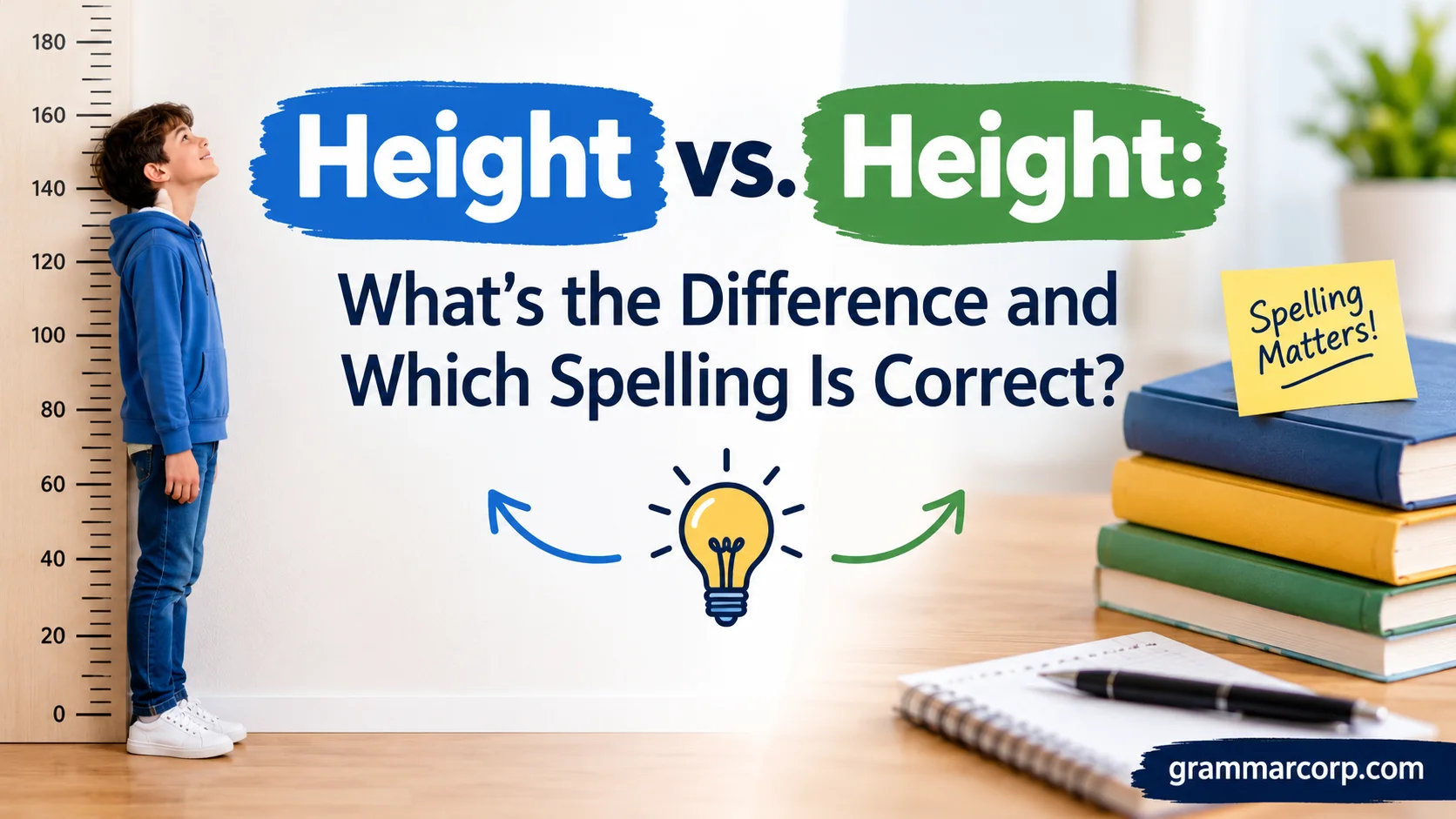
Height is the standard spelling when describing how tall a person, building, or mountain is. Height vs. Height: What’s the Difference and Which Spelling? This question often arises because height and hight look similar, and some speakers pronounce them alike. The word height refers to a vertical distance measured from bottom to top, describing tallness, elevation, or the vertical dimension of an object.
For example, a person’s height, a building’s height, or a mountain’s height describes a measurement. Although high describes something that rises above the surrounding land, the correct noun spelling is height, not hight. Understanding these spelling differences, word meanings, and grammar rules helps you avoid commonly confused words and improve your English vocabulary and writing accuracy.
The difference also reflects the history of English and its changing spelling conventions. Over centuries, language has evolved, and the original form of a word has sometimes differed from its modern counterpart. In older English texts, hight appeared as an archaic word meaning to be called or named. This historical usage makes it a genuine historical word rather than an incorrect spelling in every context.
Quick Answer: Height or Hight?
Height is the correct spelling when you mean the measurement of how tall or high something is. It can describe a person’s stature, a building’s vertical measurement, an object’s elevation, or the peak of an activity or period.
Hight is an archaic English word associated with meanings such as “called” or “named.” It isn’t the standard modern spelling for a measurement and should not replace height in everyday writing.
Here are the essential differences:
- Height: The standard modern noun for vertical measurement, elevation, or a figurative peak.
- Hight: A rare, historical word found primarily in older literary or linguistic contexts.
- Pronunciation: Height is pronounced /haɪt/, which sounds like “hाइट” in a simplified pronunciation guide. The final gh is silent.
- Correct modern usage: Write “What is your height?” rather than “What is your hight?”
For example, “The height of the tower is 200 feet” is correct. If you encounter hight in an old poem, however, it may be an intentional historical word rather than a typographical error.
Comparison Overview
The easiest way to understand height vs. hight is to compare their meanings, grammatical roles, and modern usage.
| Feature | Height | Hight |
| Standard modern spelling for measurement | Yes | No |
| Main meaning | Vertical measurement, elevation, or figurative peak | Historically associated with being called or named |
| Part of speech | Primarily a noun | Historical usage varies by context |
| Pronunciation | /haɪt/ | May be pronounced /haɪt/ in historical usage |
| Frequency in modern English | Common | Rare or obsolete |
| Appropriate for measurements | Yes | No |
| Common contexts | Personal measurements, buildings, mountains, mathematics, and idioms | Older literature, historical texts, and discussions of archaic vocabulary |
| Example | The height of the wall is eight feet. | The character was hight Arthur. (Archaic) |
The main point is simple: use height for modern measurements and ordinary figurative expressions. Recognize hight only when the historical context supports it.
A dictionary may include obsolete words and unusual variants because dictionaries document language rather than simply list words recommended for everyday use. Finding a word in a dictionary doesn’t automatically make it suitable for contemporary writing.
What Does Height Mean?
The word height has several related meanings, but they all connect to the idea of vertical distance, tallness, elevation, or a peak. It is a common noun in everyday English and appears in technical, mathematical, architectural, and figurative contexts.
According to the word can refer to the distance from bottom to top, the condition of being tall, or the highest point of something. Its meaning depends on how you use it in a sentence.
Height as a Measurement
The most common use of height describes the distance from the bottom to the top of something. You can measure the height of a person, a tree, a building, a cabinet, or almost any object with a vertical dimension.
For example, imagine buying a bookshelf for your bedroom. You need to know its height to determine whether it will fit beneath a shelf or inside a particular space. In this situation, height identifies a measurable dimension rather than a general impression of tallness.
Consider these examples:
- The height of the bookshelf is six feet.
- Please enter your height on the registration form.
- The contractor measured the height of every doorway.
- The young tree gained several inches in height this year.
- The basketball hoop has a standard height of 10 feet.
In each sentence, height names a dimension that someone can measure or describe. Depending on the situation, the measurement may use inches, feet, centimeters, or meters.
Remember: When you want to describe how tall something is, height is the correct word.
Height as Elevation Above a Surface
Height can also describe how far an object sits above a particular level. That level might be the ground, a floor, the surface of a body of water, or another reference point.
For instance, an airplane may reach a height of several thousand feet above the ground. A shelf may sit five feet above the floor. A balloon may rise to a height of 20 meters during an experiment.
Here are a few examples:
- The drone reached a height of 100 feet above the field.
- The shelf’s height above the floor makes it difficult for young children to reach.
- The climbers recorded the height of the rock formation.
- The water reached a height of two feet above its usual level.
In technical writing, height and altitude can overlap, but they aren’t always interchangeable. Height often describes a vertical distance from a chosen reference point, while altitude commonly refers to elevation above sea level or another established datum.
The reference point matters. A measurement of 50 feet above the ground doesn’t necessarily mean the same thing as an elevation of 50 feet above sea level.
Height as a Figurative Peak or Highest Point
Not every use of height involves a ruler or measuring tape. English also uses the word figuratively to describe the peak of a career, the greatest degree of an experience, or an especially intense period.
For example, someone might reach the height of their career after winning a major award. A festival might take place at the height of summer. A person might describe an outrageous decision as the height of foolishness.
These expressions use height to suggest that something has reached its highest point or greatest degree.
Examples include:
- She reached the height of her career after winning the championship.
- The town becomes crowded at the height of the tourist season.
- Interrupting the ceremony was the height of bad manners.
- The company enjoyed considerable success at the height of its popularity.
The word also appears in familiar expressions such as “reach new heights” and “at the height of.” Both are standard expressions in modern English.
In these sentences, replacing height with hight would be incorrect in ordinary contemporary writing.
Height as a Plural Noun
The plural of height is heights. You can use it to discuss multiple measurements, elevated areas, or figurative achievements.
For example, an engineer might compare the heights of several buildings. A traveler might explore the heights surrounding a valley. A business writer might describe a company as reaching new heights.
Consider these sentences:
- The heights of the two towers differ by 20 feet.
- The hikers climbed into the surrounding heights.
- The athlete hopes to reach new heights next season.
- The report compares the heights of several mountain peaks.
Notice that the spelling changes by adding -s. The correct plural is heights, not hights.
What Does Hight Mean?
Unlike height, which remains common in modern English, hight belongs mainly to historical or archaic usage. Its meaning depends on the context in which it appears.
Historical dictionaries record hight as a word meaning “called” or “named.” Some dictionaries also list it as an obsolete variant of height. These records explain why the spelling exists, but they don’t make it the preferred form for modern measurements.
The identifies the word as archaic and defines it as “named or called.” Similarly, records both the historical meaning and a variant noun sense.
Hight as an Archaic Word Meaning Called or Named
In older English literature, hight could describe someone or something by name. It appeared in literary and poetic language, particularly in texts that used forms of English that sound unusual today.
For example:
- Archaic: The knight was hight Arthur.
- Modern English: The knight was called Arthur.
The older construction communicates the same basic idea as was called or was named. However, modern writers rarely use hight this way outside historical or literary contexts.
The word also appears in older poetry. The records historical uses in which hight means “called” or “named.”
When you encounter the word in a poem or an old story, look at the surrounding sentence before deciding what it means. A name following hight may indicate this archaic usage.
Hight as a Historical Variant of Height
The history of hight is more complicated than a simple spelling mistake. Older dictionaries have recorded it as a variant of height, and historical texts sometimes used spelling conventions that differ from today’s standards.
However, historical spelling and present-day standard spelling serve different purposes. A form that appears in an old book may be valid evidence of how people once wrote, but it doesn’t automatically belong in modern everyday English.
For contemporary writing, follow these distinctions:
- Use height for a person’s stature.
- Use height for a building’s vertical measurement.
- Use height for elevation and figurative peaks.
- Preserve hight when quoting an old text or discussing its historical meaning.
This distinction is especially important for editors, students, and anyone preparing educational material. The goal isn’t to erase historical forms; it’s to use them in the right context.
When Might You Encounter Hight Today?
You might encounter hight in several situations, even though it is rare in ordinary conversation.
Historical literature: Older poems, tales, and literary works may use hight to mean “called” or “named.”
Dictionary entries: Historical and etymological dictionaries document the word to explain its meaning and development.
Discussions of English history: A linguistics article might examine hight as an example of an archaic word or an older spelling variant.
Modern spelling mistakes: Someone might accidentally write hight when asking about a measurement. In that case, the intended word is usually height.
Context helps you distinguish these possibilities. An old literary passage containing hight may be using the word intentionally, while a modern form asking for your “hight” almost certainly contains a spelling error.
Main Differences Between Height and Hight
The difference between height and hight involves more than one letter. The words have different roles in modern writing, different levels of usage, and different meanings in historical contexts.
Meaning and Usage
Height is the standard modern noun for vertical measurement, elevation, and a figurative peak. It works naturally in everyday conversation, formal documents, academic assignments, technical reports, and published articles.
Hight, by contrast, is primarily associated with archaic language. Its historical meaning relates to being called or named. Although dictionaries also record an obsolete variant noun sense, that form isn’t the appropriate choice for ordinary modern measurements.
Compare the examples below:
| Sentence | Correct or incorrect? | Explanation |
| What is your height? | Correct | Height means a person’s stature. |
| What is your hight? | Incorrect in standard modern English | Use height for the measurement. |
| The tower’s height is 150 feet. | Correct | Height describes a vertical dimension. |
| The tower’s hight is 150 feet. | Incorrect in standard modern English | The historical variant isn’t the standard spelling. |
| The character was hight Arthur. | Historically valid | Hight means “called” or “named” in archaic usage. |
The key is to identify the meaning you want to express before choosing the spelling.
Spelling and Word Formation
The spelling height may seem unusual because English often forms nouns from adjectives in different ways. For example, high becomes height, while wide becomes width and deep becomes depth.
These changes reflect the history of English rather than a single spelling rule that works for every adjective.
| Adjective | Related noun | Example |
| High | Height | The wall is high. Its height is eight feet. |
| Wide | Width | The road is wide. Its width is 20 feet. |
| Deep | Depth | The pool is deep. Its depth is six feet. |
| Long | Length | The rope is long. Its length is 12 feet. |
| Strong | Strength | The material is strong. Its strength is impressive. |
These word pairs are useful reminders that English nouns don’t always form by adding a predictable ending to an adjective.
If you already know the adjective high, remember the standard noun as a complete word: height. Don’t try to create the noun by guessing how the adjective should change.
Pronunciation and Sound
In standard modern English, height is pronounced /haɪt/. It rhymes with words such as light, night, and right.
The letters gh don’t produce a separate sound in this word. That spelling can confuse learners because the same letter combination behaves differently across English vocabulary.
For example:
- High: Rhymes with sky.
- Height: Rhymes with light.
- Hight: When used in its archaic sense, it is also commonly pronounced like height.
Because height and hight can sound alike, pronunciation alone won’t help you identify the correct modern spelling. You need to consider meaning and context.
When writing a sentence about measurement, choose height regardless of how the word sounds.
Formality and Frequency
The word height is suitable for nearly every modern context. You can use it in a casual conversation, a school assignment, a construction specification, a scientific explanation, or a business report.
The word hight requires more care. Its archaic meaning may be appropriate when analyzing an old poem or explaining historical vocabulary, but it can confuse readers if you use it without explanation.
For example, a building specification should state, “The maximum permitted height is 40 feet.” A history article might explain that a character in an old poem “was hight Arthur,” meaning the character was called Arthur.
The difference isn’t simply formal versus informal. It is the difference between a standard modern word and a rare historical form.
Height vs. Hight: Examples in Sentences
Examples make the distinction easier to remember because they show how each word works in context. Most modern sentences about measurements require height, while hight belongs mainly in historical discussions.
Correct Examples of Height
Here are several examples of height used in different situations.
- Personal measurement: “Please write your height in inches on the form.”
- Construction: “The height of the new building is 120 feet.”
- Furniture: “We need to check the table’s height before buying the chairs.”
- Geography: “The hikers recorded the height of the mountain above the surrounding terrain.”
- Aviation: “The pilot maintained the required height above the ground.”
- Career achievements: “Winning the international award marked the height of her career.”
- Seasonal expression: “The streets become busy at the height of summer.”
- Figurative expression: “The team reached new heights after hiring an experienced coach.”
Each sentence uses height to express a vertical measurement, elevation, or figurative peak. The specific meaning changes with the context, but the spelling remains the same.
Incorrect Examples Using Hight for Measurement
The following sentences illustrate common spelling errors and their corrections.
| Incorrect sentence | Correct sentence |
| What is your hight? | What is your height? |
| The hight of the building is 100 feet. | The height of the building is 100 feet. |
| Please measure the hight of the table. | Please measure the height of the table. |
| The tree has grown considerably in hight. | The tree has grown considerably in height. |
| The airplane reached a great hight. | The airplane reached a great height. |
| We need to check the hight clearance. | We need to check the height clearance. |
The corrections follow one consistent principle: use height when referring to how tall something is or how far it extends vertically.
Historical Examples of Hight
Unlike the incorrect modern examples above, some sentences containing hight reflect genuine historical usage.
Consider these illustrative sentences:
- Archaic: “The knight was hight Arthur.”
- Modern: “The knight was called Arthur.”
Another example is:
- Archaic: “A maiden hight Elaine.”
- Modern: “A maiden named Elaine.”
These examples demonstrate the historical meaning of hight. They aren’t recommended models for ordinary modern writing.
If you’re writing a contemporary story, the natural choices are was called, was named, or simply named. If you’re analyzing an old poem, preserving hight may be necessary to explain the original language.
Why Do People Confuse Height and Hight?
The confusion between height and hight makes sense when you consider how English spelling works. The words look similar, share a pronunciation in common usage, and have a historical relationship in some dictionary records.
However, several specific factors make the mistake especially likely.
The Influence of the Word High
The adjective high is probably the biggest reason people expect hight to be correct. The noun height describes the quality or measurement associated with being high, so the spelling may seem inconsistent.
Compare these sentences:
- The ceiling is high.
- The ceiling’s height is ten feet.
- The shelf is high enough to reach the window.
- The height of the shelf is difficult to measure.
Both words belong to the same general word family, but they don’t share identical spelling patterns.
This isn’t unusual in English. Related words often develop different forms over time. Learning the pair high–height is more reliable than trying to predict the noun’s spelling from the adjective alone.
English Spelling Doesn’t Always Follow Simple Patterns
English includes words that change their spelling significantly when they take a related grammatical form. These changes can reflect historical sound patterns and the development of the language.
For example, deep becomes depth, not deepth. Likewise, strong becomes strength, not strongth.
The same principle applies to high and height. The correct noun is an established form that you need to learn rather than construct by analogy.
A useful comparison is:
- High → height
- Wide → width
- Deep → depth
- Long → length
These pairs show why guessing can lead to mistakes. Familiar spelling patterns are helpful, but they don’t explain every English word.
Typing Errors and Spell-Check Problems
Typing quickly can turn height into hight, especially when the writer already feels uncertain about the correct spelling. The error may survive proofreading because the two forms look so similar.
Spell-check tools can help, but they don’t replace an understanding of meaning. Some dictionaries recognize hight as an archaic word, so a spelling checker may not always flag it in every context.
For example, consider this sentence:
“The hight of the new office building is 15 stories.”
A reader can probably understand the intended meaning, but the spelling is still incorrect in standard modern English. The correct version is:
“The height of the new office building is 15 stories.”
A practical proofreading habit is to search your document for hight whenever you write about measurements. Check every occurrence to determine whether it should be height.
Height vs. High: Understanding the Related Words
Although height and hight are the main focus, the related word high deserves attention because it often causes confusion.
High usually functions as an adjective describing something elevated or tall. It can also function as an adverb describing an upward position or movement. Height is primarily a noun that identifies a measurement, condition, or peak.
Here’s how they differ:
| Word | Part of speech | Meaning | Example |
| High | Adjective | Tall or elevated | The wall is high. |
| High | Adverb | At or toward an elevated position | The kite flew high. |
| Height | Noun | Vertical measurement or elevation | The wall’s height is eight feet. |
| Hight | Archaic word | Called or named | The hero was hight Arthur. |
The distinction becomes clearer when you use the words together.
“The tree is high” describes the tree’s position or stature. “The height of the tree is 20 feet” identifies its measured vertical dimension.
You wouldn’t normally write “The tree is hight” to express either meaning. The correct choice depends on your sentence: use high to describe and height to name the measurement.
Read More : Later or Later On: What’s the Difference and Which Should?
How to Remember the Correct Spelling of Height
You don’t need to memorize a long list of complicated spelling rules to avoid this mistake. A few practical techniques can help you remember the standard form.
Remember the Pair High–Height
Learn high and height together as a related adjective-and-noun pair.
For example:
“The building is high, and its height is impressive.”
This sentence connects both words to the same subject. The adjective describes the building, while the noun identifies its vertical dimension.
Repeat the pattern with familiar objects:
- The shelf is high. Its height is five feet.
- The mountain is high. Its height attracts climbers.
- The wall is high. Its height provides privacy.
The goal is to become familiar with the standard noun rather than guess its spelling whenever you need it.
Ask Whether You Mean a Measurement
Before writing the word, consider what your sentence means.
If you’re discussing how tall something is, how far it extends upward, or the peak of an experience, choose height.
For example:
- “What is the height of the doorway?” — Correct.
- “The height of the doorway is seven feet.” — Correct.
- “She reached the height of her career.” — Correct.
If you’re examining a historical passage in which someone is described as hight a particular name, the archaic meaning may be relevant. Otherwise, height is the appropriate modern choice for measurement and figurative expressions.
Check Common Height Phrases
Certain expressions appear frequently in everyday and professional writing. Learning their standard spelling can help you catch errors more quickly.
Common examples include:
- Body height
- Building height
- Height measurement
- Height limit
- Height requirement
- Height clearance
- At the height of
- Reach new heights
- Height above sea level, when referring to a specified vertical measurement
Whenever you use one of these expressions, remember that height contains an e after the initial h.
Common Mistakes to Avoid
Even though the difference is small, several recurring mistakes can make a sentence look unpolished or create confusion.
Using Hight on Forms and Applications
Forms that request a person’s measurement should use height. The same applies when you’re entering information into a school record, sports registration form, or other document.
Incorrect: “Enter your hight in centimeters.”
Correct: “Enter your height in centimeters.”
Assuming High Must Become Hight
English spelling doesn’t always follow a simple pattern when an adjective becomes a noun. The correct relationship is high–height, just as the standard forms are deep–depth and wide–width.
Avoid creating a noun spelling based only on how its related adjective looks.
Treating Every Historical Use of Hight as a Typo
Although hight is usually an error when someone means a modern measurement, it has a legitimate place in discussions of historical English.
If an old poem uses the word to mean “called” or “named,” changing it automatically to height could alter the meaning. Historical texts should be interpreted in context.
Assuming Every Dictionary Word Is Suitable for Everyday Writing
Dictionaries document rare, archaic, obsolete, regional, and historical words as well as common modern vocabulary.
The inclusion of hight doesn’t mean it is interchangeable with height in contemporary English. Check the definition and usage label before using an unfamiliar word.
Confusing Height With Heighth
Another form worth recognizing is heighth. Some speakers use it, but height is the preferred spelling in standard modern English.
For example:
- Standard: The height of the fence is six feet.
- Nonstandard: The heighth of the fence is six feet.
When writing for a broad audience, choose height to avoid distracting readers or introducing a nonstandard form.
FAQs:
1. Is it height or hight?
Height is the correct spelling when referring to how tall something is. Hight is not the standard modern spelling for this meaning.
2. Why do people confuse height and hight?
People often confuse these words because they look similar and the adjective high seems to suggest the spelling hight. However, the correct noun is height.
3. What does height mean in older English?
Hight is an archaic English word that appeared in historical texts with meanings related to being called or named. It is rarely used in modern English.
4. How do you use height in a sentence?
You can use height to describe the vertical measurement of something. For example: “The height of the building is 150 feet.”
5. Is height the correct spelling in American English?
Yes. Height is the standard spelling in American English and modern standard English generally. Use it in academic writing, emails, professional documents, and everyday communication.
Conclusion:
The difference between height and hight comes down to spelling, meaning, and context. Height is the correct modern English spelling when referring to how tall a person, building, or mountain is.
Hight is an archaic English word that appeared in older texts with meanings related to being called or named. To avoid spelling mistakes in everyday writing, academic assignments, and professional documents, use height whenever you describe a measurement from bottom to top.











1 thought on “Height vs. Height: What’s the Difference and Which Spelling?”