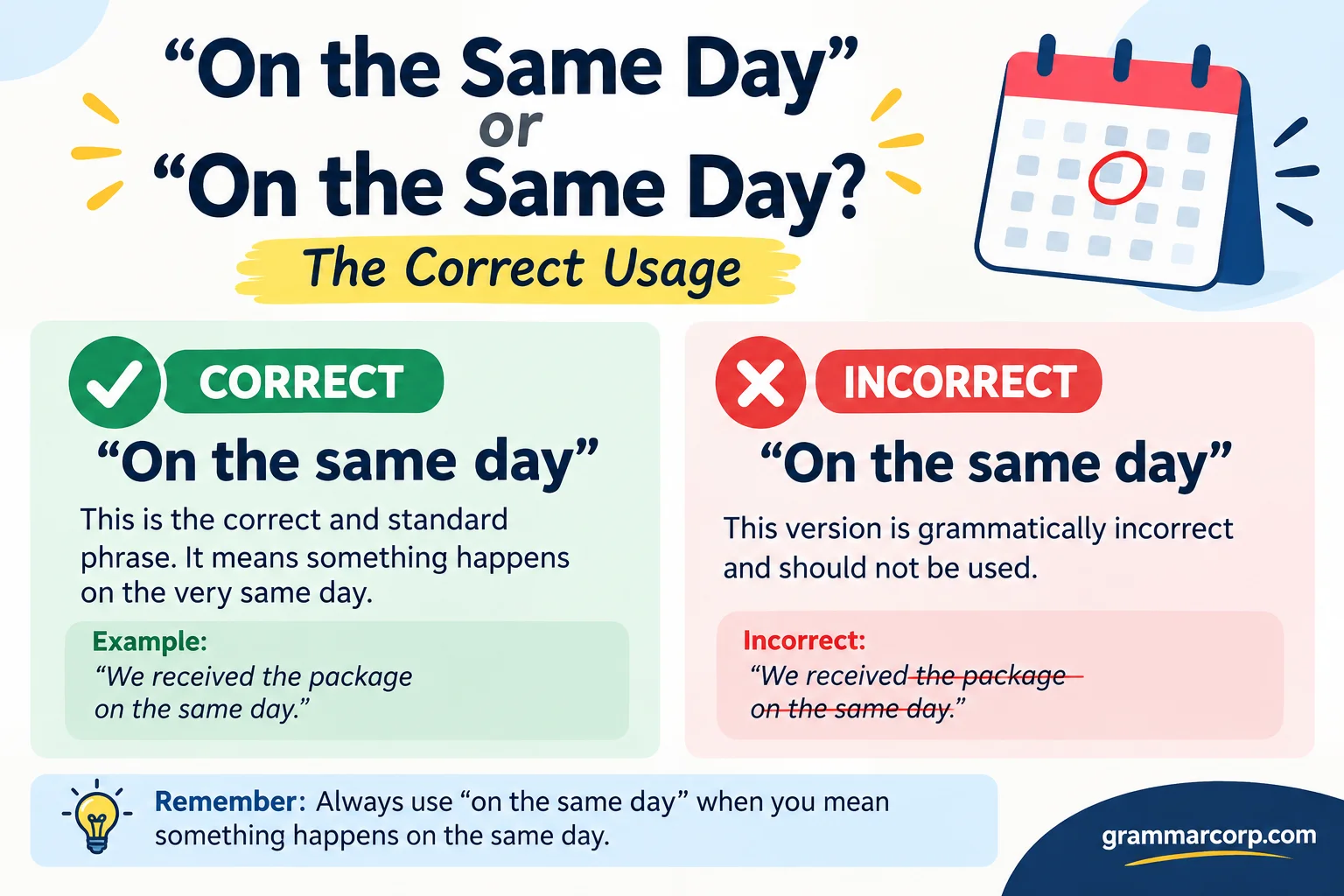
On the Same Day or On the Same Day? The Correct Usage explains how English learners choose prepositions for a shared calendar date in writing. A simple sentence can become a tricky grammar question when two expressions contain similar basic words. A common example is on the same day and in the same day, which may appear similar but serve different situations.
When two events happened on one particular calendar date, on the same day is usually the natural choice. If two meetings took place on a specific day, the phrase connects them to the same calendar date. In contrast, in the same day can sound like an incorrect phrase when the focus is a particular date, although it may work when something happens within the period of one day. The difference becomes clearer when English uses on, in, and at correctly. This guide also covers correct usage, practical examples, everyday English, grammar, and time.
The phrase in the same day is much less common when referring to a particular date, while on the same day remains the standard choice in writing and speaking. If you received a package on the day you placed an order, for example, you can describe both events with on the same day. The other hand of this comparison involves situations where in the same day may sound unnatural, especially when referring to a particular day. It can be useful when emphasizing what happens within a single day or discussing the amount of time available. The expression you select should match whether you are pointing to a date or describing activity completed during that day.
For English learners, choosing the right form prevents confusing wording and common grammar mistakes. The correct prepositions help English writing communicate ideas clearly, while spoken English should sound natural and precise. Although both phrases can describe a similar period, their uses are not identical. A calendar day, specific shared date, and intended meaning all matter in real use. Generally, on the same day is widely accepted when events share a date, while in the same day may describe multiple tasks completed within 24 hours. This approach makes the distinction easier to understand and helps you use each expression confidently without treating every instance of in the same day as automatically wrong.
Quick Answer:
On the same day is generally the correct and more natural expression when you mean that two events happened on the same calendar day.
For example:
We arrived on the same day.
They announced the results on the same day.
Use the same day when you want to emphasize what happens within the span of one day rather than simply identify a particular calendar date.
For example:
A lot can change on the same day.
So, as a simple rule:
- On the same day → focuses on a specific or identical calendar day.
- On the same day → focuses more on a period or span contained within a day.
- The same day → can sometimes work without a preposition.
- That same day → refers back to a particular day already established in the conversation or text.
If you’re unsure and you’re comparing two events that happened on one date, on the same day is usually the safest choice.
Comparison Overview
The easiest way to understand these expressions is to compare what each one emphasizes.
| Expression | Main meaning | Typical use | Example |
| On the same day | On an identical calendar day | Connecting or comparing events | We left on the same day. |
| In the same day | Within the period of one day | Emphasizing what happens during a day | A lot can happen in the same day. |
| The same day | The identical day | Informal or concise constructions | We arrived the same day. |
| That same day | A particular previously mentioned day | Referring back to a known day | She called that same day. |
| On that day | A specific day already identified | Referring to an established date/day | They met on that day. |
| Within the same day | Before the day has ended | Emphasizing a time limit | The issue was resolved within the same day. |
The important point is that on the same day and in the same day aren’t perfect substitutes.
When the sentence answers the question Which day?, on the same day will usually fit.
When the sentence emphasizes what can happen during a day’s period, in the same day may be appropriate.
Main Differences Between “In the Same Day” and “On the Same Day”
The biggest difference comes from the prepositions in and on.
English is commonly used on with particular days and dates. We say:
- on Monday
- on Friday
- on my birthday
- on July 4
- on the same day
- on that day
By contrast, in often describes a broader period or something occurring within a period.
We say:
- in the morning
- in the afternoon
- in the week ahead
- in the same month
- in the same year
- in one day
This doesn’t mean every use of in and on follows a perfectly mechanical rule. English has many established expressions. Context matters.
On the Same Day Focuses on a Calendar Day
The expression on the same day normally tells the reader that two events share the same calendar date.
Consider this sentence:
Sarah submitted her application on the same day that John submitted his.
The important information is that Sarah and John submitted their applications on one identical day.
The phrase works naturally because a day is being treated as a specific point on the calendar.
Another example:
The package arrived on the same day as the replacement order.
Here, the speaker isn’t emphasizing the number of hours that passed. The speaker is saying that both things happened on one calendar day.
In the Same Day Focuses on a Time Period
The same day can work when the idea is closer to within one day’s period.
For example:
The situation changed dramatically in the same day.
The sentence emphasizes how much happened during that day’s span. It doesn’t primarily identify the day as a calendar date.
A similar idea appears in:
You can travel to several places in the same day.
Here, in helps express what can happen within the available period of one day.
However, context can make some sentences sound more natural with within the same day or simply in one day. That’s why in the same day shouldn’t be treated as a universal replacement for on the same day.
The Choice Depends on What You Mean
Ask yourself what information you’re trying to communicate.
If you’re saying:
Event A and Event B happened on one identical date.
Use:
on the same day
If you’re saying:
Several things happened during one day’s period.
You may use:
in the same day, within the same day, or another construction depending on the sentence.
That small difference can make your writing much more precise.
Why “On the Same Day” Is Usually the Better Choice
When people search for the correct phrase in the same day or on the same day, they usually have a sentence involving two events.
That’s where on the same day is overwhelmingly the more natural construction.
For example:
We booked the tickets and received confirmation on the same day.
The phrase clearly connects two events to one date.
Another example:
The company released the announcement and updated its website on the same day.
Again, the writer is comparing two events that occurred on the same calendar day.
Specific Days Usually Take “On”
English normally uses on when referring to particular days.
| Correct expression | Meaning |
| on Monday | Monday |
| on Tuesday morning | A particular Tuesday morning |
| on my birthday | A particular birthday |
| on the same day | The identical day |
| on that day | A previously identified day |
| on the following day | The next day |
This pattern explains why on the same day feels natural in most sentences about matching dates.
Examples of Natural “On the Same Day” Sentences
- We started the project on the same day.
- They both arrived on the same day.
- The two stores opened on the same day.
- She submitted both forms on the same day.
- The announcement came on the same day as the launch.
- We received the invitations on the same day.
- Their exams were scheduled on the same day.
- The two flights landed on the same day.
- The decision was announced on the same day.
- Both events happened on the same day.
In each case, the phrase identifies a shared calendar day.
Read More : Conform With or Conform To: Which Is Correct?
When “In the Same Day” Can Be Correct
The phrase in the same day deserves a more careful explanation.
It isn’t helpful to tell learners that it is always wrong. English speakers can use it when the sentence focuses on the duration or span of a day.
For example:
A person’s plans can change in the same day.
The meaning is that changes can happen during that day’s period.
Another example:
Several important decisions were made in the same day.
Here, the speaker draws attention to the concentration of activity within one day.
Still, another expression may sound more natural depending on the intended meaning.
For example, if you’re emphasizing a deadline, you might say:
The problem was fixed within the same day.
If you’re simply comparing dates, you would normally say:
The problem was fixed on the same day.
These sentences are close in meaning but place emphasis on different aspects.
“In the Same Day” vs. “Within the Same Day”
This distinction is especially useful.
In the same day can emphasize events occurring during one day’s period.
Within the same day more strongly suggests a limit: something happened before that day ended.
Compare:
Several things happened in the same day.
with:
The issue was resolved within the same day.
The second sentence highlights the completion deadline.
“In the Same Day” vs. “In One Day”
Sometimes in one day is the better choice when you’re talking about the amount of activity that can happen during a 24-hour period.
For example:
You can visit several attractions in one day.
This doesn’t compare the day with another previously mentioned day. It simply describes what is possible during a single day.
By contrast:
The two events happened on the same day.
This compares two events against the same calendar date.
Examples of “On the Same Day” in Everyday English
The phrase appears naturally in many areas of everyday communication.
Work and Business
In professional writing, on the same day is useful when tracking meetings, decisions, deadlines, or announcements.
Examples:
- The two meetings took place on the same day.
- We received both approvals on the same day.
- The contract was signed on the same day.
- The company issued the announcement on the same day.
- Both teams submitted their reports on the same day.
This wording makes timelines easy to understand.
School and Education
Students often need to describe exams, assignments, classes, or results.
Examples:
- Our two exams are on the same day.
- The assignment and presentation are due on the same day.
- Both classes were canceled on the same day.
- The results were published on the same day.
If you’re referring to a particular school date, on is the natural preposition.
Travel
Travel plans often involve multiple events connected to one date.
Examples:
- Our flights leave on the same day.
- We arrived in the city on the same day.
- The train and bus departed on the same day.
- Both reservations were confirmed on the same day.
Personal Conversations
The expression also sounds completely normal in casual conversation.
Examples:
- We were born on the same day.
- We moved into the neighborhood on the same day.
- I got your message on the same day.
- They visited us on the same day.
- We found out about it on the same day.
The common thread is simple: the speaker is identifying one shared day.
“On the Same Day” vs. “The Same Day”
Another common question is whether you need one before the same day.
The answer is: sometimes you do and sometimes you don’t.
Consider:
We arrived on the same day.
This is completely natural.
You can also hear:
We arrived the same day.
The second version is also possible in certain contexts, especially in informal American English. Here, the same day functions naturally as a time expression without the preposition.
When “The Same Day” Works
For example:
She called me the same day.
This means she called on that same day.
Another example:
We left the same day.
The sentence is concise and conversational.
However, on the same day is often clearer when you’re learning English or writing more carefully.
Comparison
| Sentence | Meaning |
| We arrived on the same day. | We arrived on an identical calendar day. |
| We arrived the same day. | We arrived on that identical day. |
| We arrived that same day. | We arrived on a particular day already mentioned. |
All three can communicate closely related ideas, but their structures and emphasis differ.
“On the Same Day” vs. “That Same Day”
That same day points backward to a day already established.
For example:
The manager announced the decision on Monday. That same day, the team received an email.
The phrase that same day clearly refers to Monday.
By comparison:
The manager and assistant arrived on the same day.
Here, on the same day, compares the timing of two events.
A Simple Way to Remember the Difference
Think of it as making a comparison.
They arrived on the same day.
Think of that as pointing back.
They arrived that same day.
This distinction becomes especially useful in storytelling and formal writing.
Common Mistakes With “In the Same Day” and “On the Same Day”
Using “In” for a Specific Calendar Day
One of the most common mistakes is using in simply because the event occurred during a day.
For example, a learner might write:
We met in the same day.
If the intended meaning is that two people met on one particular calendar date, on the same day is more natural:
We met on the same day.
The problem isn’t the idea of being “inside” a day. It’s that English conventionally uses on for particular days.
Assuming “In” Always Means “Within”
It’s tempting to apply a simple rule:
In = inside
But English prepositions don’t always work through literal translations.
We say:
- in the morning
- on Monday
- at noon
- in January
- on my birthday
The correct preposition depends on the type of time expression and the meaning.
Confusing the Same Day With the Same Time
Two events can happen on the same day while occurring at completely different times.
For example:
The meeting was at 9 a.m., and the presentation was at 3 p.m. They happened on the same day.
The phrase doesn’t mean the events occurred simultaneously.
It only means their calendar dates matched.
Confusing “On the Same Day” With “That Day”
These expressions have different functions.
On the same day usually compares events.
That day refers to a particular day.
Compare:
The two incidents happened on the same day.
The police arrived that day.
The first sentence establishes a relationship between events. The second points to a known day.
Other Useful Alternatives
Sometimes neither in the same day nor on the same day is the best option.
Choosing a more precise expression can make your writing sound more natural.
Within the Same Day
Use within the same day when you want to emphasize a time limit.
The customer received a response within the same day.
The focus is on how quickly the response arrived.
During the Same Day
During the same day emphasizes activity occurring throughout a day’s period.
Several changes occurred during the same day.
This can be useful when discussing a sequence of events.
On That Day
Use on that day when referring to a specific day already mentioned.
The ceremony took place on Saturday. On that day, hundreds of people attended.
That Same Day
Use that same day when you want to stress that an event occurred on the very day being discussed.
The announcement was made in the morning. That same day, the company published additional information.
On the Same Date
Use on the same date when the calendar date itself matters.
Both documents were signed on the same date.
This sounds slightly more formal than on the same day.
A Practical Decision Guide
When you’re unsure about in the same day or on the same day, use this quick checklist.
Choose “On the Same Day” If:
- You’re comparing two events.
- Both events occurred on one calendar date.
- You’re referring to a particular day.
- You’re describing when an event happened.
- You could naturally replace the phrase with on that day.
Example:
They both graduated on the same day.
Consider “In the Same Day” If:
- You’re emphasizing a day’s time span.
- You’re describing several things happening during one day.
- The focus isn’t primarily on identifying a calendar date.
- The sentence naturally contrasts the amount of activity with the length of the day.
Example:
So much can happen in the same day.
Consider “Within the Same Day” If:
- You’re emphasizing a deadline.
- Something happened before the day ended.
- You’re describing a response or completion time.
Example:
The issue was resolved within the same day.
Case Study: Choosing the Right Expression
Imagine two coworkers, Maya and Daniel.
Maya submits her report on Tuesday morning. Daniel submits his report on Tuesday afternoon.
You could write:
Maya and Daniel submitted their reports on the same day.
That’s the best choice because the sentence compares two events and identifies Tuesday as their shared calendar day.
Now imagine you’re discussing everything that happened during Tuesday:
The team received three requests, held two meetings, solved a technical problem, and completed the report in the same day.
Here, the focus shifts toward the amount of activity that occurred during the day’s period.
If the writer wants to emphasize a deadline, a different version may be even clearer:
The team completed everything within the same day.
The three expressions therefore communicate related ideas while emphasizing different aspects of time.
Quick Examples to Remember
| Situation | Best expression |
| Two people arrived on Tuesday | They arrived on the same day. |
| Two events share one calendar date | They happened on the same day. |
| Something happened during a day’s period | It happened in the same day. |
| Something finished before the day ended | It finished within the same day. |
| Referring back to a known day | It happened that same day. |
| Referring to a previously mentioned date | It happened on that day. |
| Talking about one day’s capacity | It can happen in one day. |
FAQs:
Is “on the same day” correct?
Yes. On the same day is the standard and natural expression when you mean that two events happened on one particular calendar date.
Is “in the same day” grammatically correct?
On the same day can be grammatically possible when the emphasis is on something happening or being completed during a single day. However, it is less common when referring to a specific date.
Should I use “on the same day” in formal writing?
Yes. On the same day is the safer choice for formal and everyday English writing when you are connecting events to a particular date.
What is the difference between “in the same day” and “on the same day”?
On the same day focuses on a specific shared date, while in the same day emphasizes activity occurring within the period of one day.
Can “on the same day” be used in speaking?
Yes. On the same day sounds natural in both spoken English and written English. It is commonly used when explaining when two related events occurred.
Conclusion:
The main distinction is simple: use on the same day when you are talking about a particular date shared by two or more events. Use in the same day only when your meaning centers on what happens within a single day or the amount of time available.
Understanding this small difference can improve your grammar, clarity, and everyday communication. Once you notice whether your sentence focuses on a calendar date or activity within a day, choosing the correct preposition becomes much easier.














1 thought on “On the Same Day or On the Same Day? The Correct Usage”