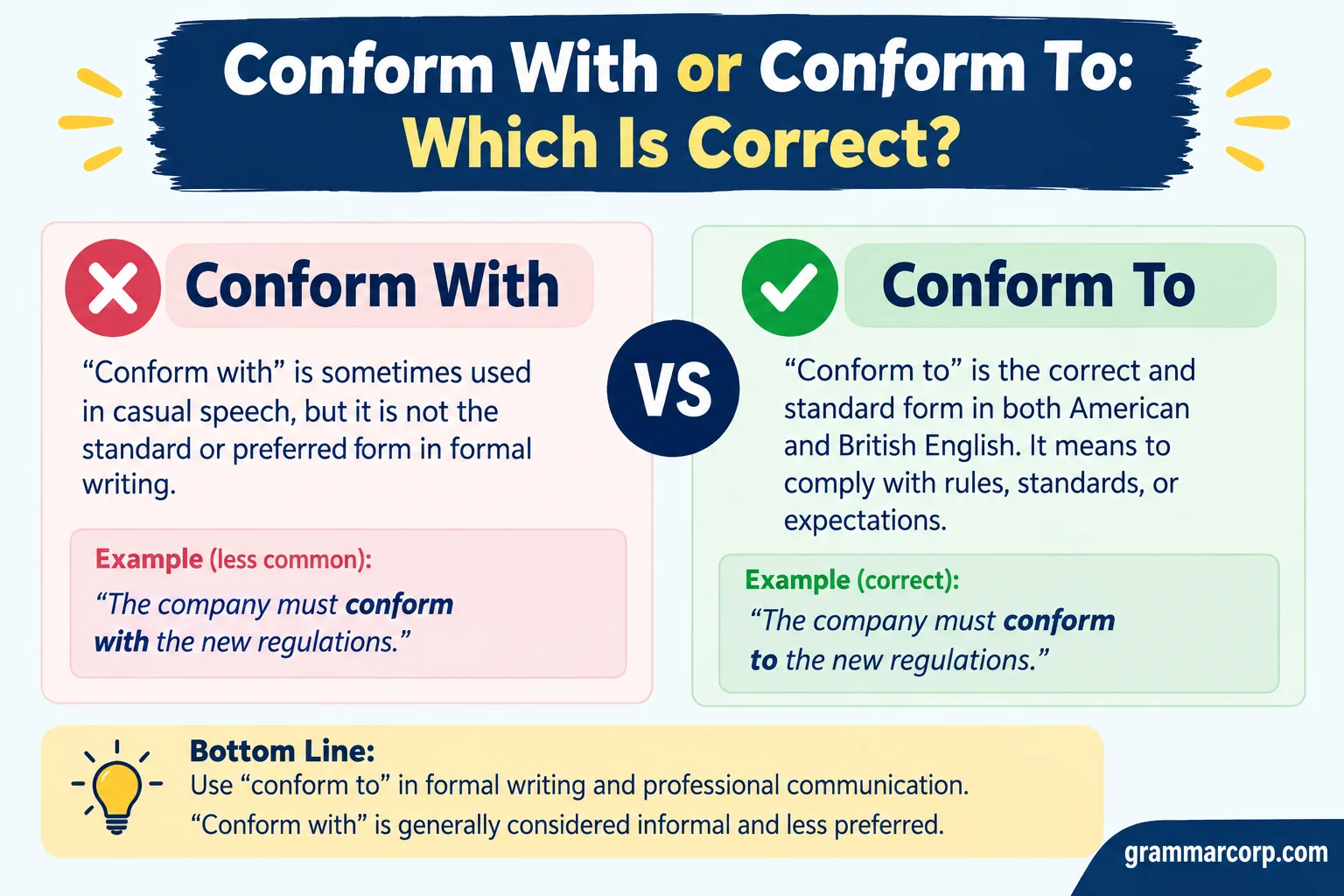
Conform With or Conform To: Which Is Correct? depends on whether you mean following a rule or showing agreement with an idea, fact, or standard.
The key grammar difference is the preposition that follows conform. Conform is normally used for compliance, obedience, or adherence to a rule, law, standard, requirement, regulation, or expectation. For example, a company may conform to regulations, while students may conform to school policies. Conform with, on the other hand, is commonly used when something agrees, matches, or remains consistent with another thing. For instance, research findings may conform with earlier evidence. Understanding this difference helps English learners choose the right preposition, improve writing clarity, and avoid common grammar mistakes.
The easiest way to remember the distinction is to consider the context. If something must follow an external authority, standard, or set of social norms, use conform to. If two things are being compared for agreement, consistency, or correspondence, conformity may be more suitable. In formal writing, academic writing, business English, and daily speech, this small distinction can make your sentences sound more natural and precise.
Quick Answer:
Both “conform to” and “conform with” are correct.
However, conform to is generally the clearer choice when you mean follow, obey, or meet a rule, standard, law, requirement, or expectation.
Use conform with when you mean agree with, correspond to, or be consistent with something. It can also be used for compliance with rules and standards, so the distinction isn’t absolute. Cambridge and Oxford both provide examples of conformity in contexts involving regulations and standards.
The easiest rule to remember
- Conform to → follow or meet a standard.
- Conform with → agree, match, or be consistent with something.
- Conform with can also mean comply with a rule or standard.
- If you’re writing about a law, regulation, specification, or formal requirement, conformity is often the safest and most direct choice.
For example:
The building must conform to local safety standards.
But:
The findings conform with the earlier research.
Merriam-Webster similarly describes conform as meaning to be similar or in agreement, with either to or with, while its definition of being obedient or compliant says it is usually used with to.
Comparison Overview
| Feature | Conform To | Conform With |
| Basic idea | Follow, meet, or act according to | Agree, correspond, or be consistent with |
| Common use | Rules, laws, standards, requirements | Evidence, facts, findings, descriptions |
| Compliance | Very common | Also possible |
| Agreement | Possible | Very common |
| Formal writing | Highly suitable | Highly suitable |
| Example | The product conforms to safety standards. | The results conform with previous findings. |
| Best quick interpretation | Follow the standard | Match or agree with something |
The important point is that this isn’t a simple right-versus-wrong grammar question. Both prepositions occur with conformity. Oxford explicitly lists conform to/with something for obeying a rule or law and also records uses involving agreement or matching.
Main Differences Between Conform With or Conform To
The difference becomes easier when you focus on the relationship between the subject and the thing that follows the preposition.
Conform To Usually Emphasizes Following a Standard
When something conforms to a rule, standard, expectation, or requirement, the emphasis is usually on bringing behavior or a thing into accordance with an established model.
Consider:
- The equipment must conform to safety regulations.
- The design conforms to industry standards.
- Employees are expected to conform to company policies.
- The building was designed to conform to local requirements.
In each sentence, something is being measured against a standard.
The standard already exists. The subject needs to meet it.
This makes conform to particularly natural in technical, legal, regulatory, and professional writing. Merriam-Webster describes this compliance sense as being “usually used with to.”
Conform With Often Emphasizes Agreement or Consistency
Conform with can emphasize that one thing agrees with or corresponds to another.
For example:
- The evidence conforms with the witness’s account.
- The results conform with earlier observations.
- The report conforms with the available data.
- Her explanation conforms with the facts.
Here, the sentence isn’t necessarily about obeying an external rule.
Instead, you’re comparing two things and saying that they fit together.
Oxford gives both meanings: conform can refer to obeying rules and can also mean agreeing with or matching something.
The Difference Is About Meaning, Not Just Grammar
It’s tempting to memorize a rigid formula:
to = rules
with = facts
That shortcut can help, but it isn’t a complete grammar rule.
Real English is more flexible.
Cambridge, for example, gives conform to and conform with in contexts involving standards, laws, and requirements.
So the better approach is to ask:
Am I emphasizing compliance with a standard, or agreement with something else?
If you’re emphasizing compliance, conformity will often be the most straightforward option.
If you’re emphasizing correspondence or agreement, conform may communicate the relationship more naturally.
What Does “Conform To” Mean?
Conform to means to act, behave, operate, or exist in accordance with a particular standard, rule, requirement, expectation, or pattern.
It can describe people, organizations, products, buildings, systems, behavior, designs, and ideas.
For example:
- The product must conform to federal standards.
- The company requires employees to conform to its safety procedures.
- The building does not conform to the current code.
- The design was changed to conform to the specifications.
- He refused to conform to traditional expectations.
The verb has a broader meaning than simply obey.
A person can conform to social expectations. A machine can conform to technical specifications. A building can conform to regulations. A design can conform to an established pattern.
Conform To Rules and Regulations
This is one of the clearest uses of conform to.
For example:
All contractors must conform to the site’s safety requirements.
The requirements provide the standard. The contractors must operate according to them.
You could also say:
The building must conform to local regulations.
This tells the reader that the building must meet the requirements established by those regulations.
Conform To Standards
Conform to standards is common in technical and professional English.
Examples include:
- conform to industry standards
- conform to safety standards
- conform to quality standards
- conform to technical standards
- conform to international standards
Cambridge uses conform to official safety standards as an example of this construction.
Conform To Expectations
The object doesn’t have to be a formal rule.
You can also conform to expectations, traditions, customs, or social norms.
For example:
The new design doesn’t conform to traditional expectations.
Here, conform means that the design does not fit the expected pattern.
Oxford likewise uses conformity to local customs to illustrate this broader social meaning.
What Does “Conform With” Mean?
Conform with can mean to be in agreement, harmony, or correspondence with something.
It often works well when two pieces of information, descriptions, findings, or ideas are being compared.
For example:
The new evidence conforms with the earlier findings.
The new evidence is consistent with what researchers previously found.
Another example:
His explanation conforms with the available evidence.
The explanation doesn’t conflict with the evidence. Instead, the two are compatible.
Conform With Evidence
This construction can be particularly useful when discussing evidence.
Examples:
- The results conform with previous observations.
- The testimony conforms with the available evidence.
- The explanation conforms with the known facts.
- The data conforms with the predicted pattern.
The focus is on consistency.
Conform With Facts
You can also use conform when describing whether information matches known facts.
For example:
The account does not conform with the facts presented in the report.
The meaning is close to does not agree with or is not consistent with.
This is different in emphasis from:
The company must conform to the reporting requirements.
The first sentence compares information. The second concerns an obligation.
Conform To vs. Conform With: Real-World Examples
The following examples show how context affects the choice.
Rules and Regulations
When discussing an established rule, conform to is often the most natural choice.
- The company must conform to environmental regulations.
- The building was modified to conform to fire-safety requirements.
- All employees must conform to workplace procedures.
- The vehicle must conform to current safety standards.
However, conform with isn’t automatically wrong in these contexts. Cambridge provides examples of conform with used with laws and regulations.
Standards and Specifications
Conform to is especially clear when discussing specifications.
- The device conforms to the manufacturer’s specifications.
- The materials must conform to the required standard.
- The design was adjusted to conform to the approved specifications.
The phrase tells readers that the subject meets a defined benchmark.
Evidence and Findings
When the focus shifts toward consistency, conform with can work naturally.
- The findings conform with previous research.
- The results conform with the original prediction.
- The evidence conforms with the available records.
- The report conforms with the data collected during the study.
Here, the two sides are being compared.
Social Behavior
Both constructions can occur when discussing social behavior, although conform to is very common.
- People often feel pressure to conform to social expectations.
- She refused to conform to traditional customs.
- Some students feel pressure to conform with their peers.
Cambridge specifically records conform with their peers as an example while also giving conform to social expectations.
Read More : Is It Grammatically Correct to Say “Dear All”? A Complete Guide
Is “Conform With” Grammatically Correct?
Yes. Conform with is grammatically correct.
This is important because some learners encounter advice suggesting that only conform to is acceptable. That is too broad.
Merriam-Webster explicitly says that conform can be used with to or with when it means being similar or in agreement. Oxford likewise lists both prepositions.
Cambridge also provides examples of conformity in both social and regulatory contexts.
The better question is whether conform expresses the meaning you want.
For example:
The evidence conforms with the report.
This is grammatically sound and expresses consistency.
Likewise:
The equipment conforms with safety regulations.
This is also possible. Cambridge gives similar regulatory usage.
Still, if you’re writing a sentence about compliance with a formal standard, conform to may be the more direct choice.
Is “Conform To” Grammatically Correct?
Yes. Conform to is fully standard English.
It is especially common when the object is a rule, law, standard, custom, requirement, expectation, or specification.
Examples include:
- conform to the law
- conform to the rules
- conform to regulations
- conform to standards
- conform to requirements
- conform to expectations
- conform to specifications
- conform to local customs
Oxford defines conform to/with as obeying a rule or law while also giving separate examples of conform to for social customs and matching a pattern.
If you’re unsure which preposition to use for a formal requirement, conform to is usually a strong choice.
Conform vs. Comply: What’s the Difference?
Another common source of confusion is conform versus comply.
Both can describe following requirements, but they aren’t identical in meaning.
Conform often focuses on being in accordance with a standard, pattern, or accepted way.
Comply more directly emphasizes obeying a request, rule, command, or requirement.
The prepositions are also different:
- conform to a standard
- comply with a requirement
For example:
The product must conform to safety standards.
You could also write:
The manufacturer must comply with safety regulations.
The meanings overlap, but the grammatical patterns differ.
Conform vs. Comply Comparison
| Expression | Typical Meaning | Example |
| conform to | Meet or follow a standard | The design conforms to the specifications. |
| conform with | Agree, match, or be consistent with | The findings conform with the evidence. |
| comply with | Obey or fulfill a requirement | The company complies with the regulation. |
| adhere to | Follow a rule, principle, or standard | Employees must adhere to the policy. |
One useful warning is that comply to is generally not the standard construction when you mean obey a rule. The normal phrase is comply with.
Common Mistakes With “Conform”
Understanding the prepositions becomes easier when you recognize the mistakes writers commonly make.
Mistake: Assuming “Conform With” Is Always Wrong
It isn’t.
Dictionaries explicitly recognize conform with.
Better:
The evidence conforms with the findings.
Mistake: Assuming “Conform To” Is Only Used for Rules
That’s also incorrect.
You can conform to customs, expectations, patterns, styles, and social norms.
Example:
The design doesn’t conform to the traditional style.
Mistake: Using “Comply To”
When you mean obeying a rule, use comply with.
Less standard:
The company must comply to the regulations.
Standard:
The company must comply with the regulations.
Mistake: Treating the Two Forms as Completely Identical
There is significant overlap, but context can affect which construction communicates the intended relationship more clearly.
Compare:
The building conforms to the safety standard.
This emphasizes meeting a standard.
The findings conform with earlier observations.
This emphasizes agreement or consistency.
That distinction isn’t an absolute rule. It’s a useful guide to meaning and natural usage.
When Should You Use “Conform To”?
Choose conform to when the sentence centers on a standard that something must meet.
A quick checklist:
- Is it a rule? → conform to
- Is it a law? → conform to
- Is it a regulation? → conform to
- Is it a technical standard? → conform to
- Is it a specification? → conform to
- Is it a requirement? → conform to
- Is it a custom or expectation? → conform to
Examples:
The software must conform to industry standards.
The building was constructed to conform to local regulations.
The organization expects its members to conform to its code of conduct.
This is not because with is impossible. It’s because to makes the compliance relationship especially clear.
When Should You Use “Conform With”?
Choose conform with when the sentence emphasizes agreement, consistency, or correspondence.
A useful checklist:
- Is it evidence? → conform with can fit.
- Is it data? → conform with can fit.
- Is it a finding? → conform with can fit.
- Is it a description? → conform with can fit.
- Is it an account or explanation? → conform with can fit.
- Are two things being compared for consistency? → conform with can fit.
Examples:
The new evidence conforms with the earlier findings.
Her description conforms with the available records.
The results conform with the predicted pattern.
Again, this is a usage guide rather than an unbreakable grammatical law.
A Practical Case Study: Choosing the Right Preposition
Imagine a company has developed a new piece of equipment.
The company needs to demonstrate that the equipment meets an official safety standard.
The clearest sentence is:
The equipment conforms to the required safety standard.
Why?
Because the standard acts as a benchmark. The equipment is being judged against it.
Now imagine engineers compare test results with earlier laboratory findings.
They might write:
The test results conform with the earlier findings.
Why?
Because the sentence focuses on whether the new results agree with existing findings.
What the Two Sentences Show
| Situation | Natural Choice | Reason |
| Equipment meets a safety standard | conform to | Compliance with a benchmark |
| Test results match earlier findings | conform with | Consistency between information |
| Employee follows a company policy | conform to | Following an established requirement |
| Evidence supports an earlier account | conform with | Agreement between information |
| Building meets legal requirements | conform to | Compliance with requirements |
This is the practical distinction that helps most writers.
Does “Conform With” Mean the Same as “Conform To”?
Sometimes, yes.
The two constructions overlap enough that replacing one with the other won’t always produce a major change in meaning.
For example, both of these can communicate compliance:
The equipment conforms to safety standards.
The equipment conforms with safety standards.
Cambridge’s dictionary evidence demonstrates that conform with can be used in regulatory contexts.
However, the expressions can carry different shades of meaning.
Conform to often presents the standard as something being followed or met.
Conform with can highlight harmony, agreement, or correspondence.
That’s why choosing between them should depend on the sentence rather than a simplistic rule that says one is always correct.
How to Choose Between “Conform To” and “Conform With”
When you’re editing your sentence, ask what you’re actually trying to say.
If You Mean “Follow”
Use conform to.
The organization must conform to the new requirements.
If You Mean “Match”
Either may sometimes work, but conform with can clearly express correspondence.
The results conform with the earlier data.
If You Mean “Meet a Standard”
Use conform to as the straightforward option.
The product conforms to international standards.
If You Mean “Agree With the Evidence”
Conform with is a natural choice.
The explanation conforms with the available evidence.
If You’re Still Unsure
Replace conform with a more precise verb.
For example:
- comply with → obey a requirement
- adhere to → follow a rule or principle
- agree with → be in agreement
- match → correspond closely
- meet → satisfy a standard or requirement
- follow → act according to instructions
Sometimes the best way to fix a preposition problem is to choose a verb that expresses the intended relationship more directly.
FAQs:
Is “conform to” grammatically correct?
Yes, conform to is grammatically correct and is the more common choice when you mean follow, obey, or comply with a rule, standard, law, or requirement.
Is “conform with” correct English?
Yes. Conform with is also correct, especially when you mean that something agrees with, matches, or is consistent with another thing, such as evidence, facts, or an idea.
What is the difference between “conform to” and “conform with”?
Conform to usually refers to compliance or adherence, while conform usually emphasizes agreement or consistency. The context determines which preposition sounds appropriate.
Can “conform” be used without “to” or “with”?
Yes. In some sentences, conform can stand alone when the thing being followed or matched is already clear from the context. However, adding the appropriate preposition often makes the meaning clearer.
Which is more common: “conform to” or “conform with”?
Conform to is generally more common in modern English, particularly when discussing rules, regulations, standards, policies, and requirements. Conform with remains useful when describing agreement or consistency.
Conclusion:
The answer to Conform With or Conform To: Which Is Correct? depends on what you want to express. Use conform to when something follows or complies with a rule, standard, law, requirement, or expectation.
Use conform with when something agrees or remains consistent with another idea, fact, finding, or statement. Once you focus on the intended relationship, choosing the correct expression becomes much easier.














1 thought on “Conform With or Conform To: Which Is Correct?”