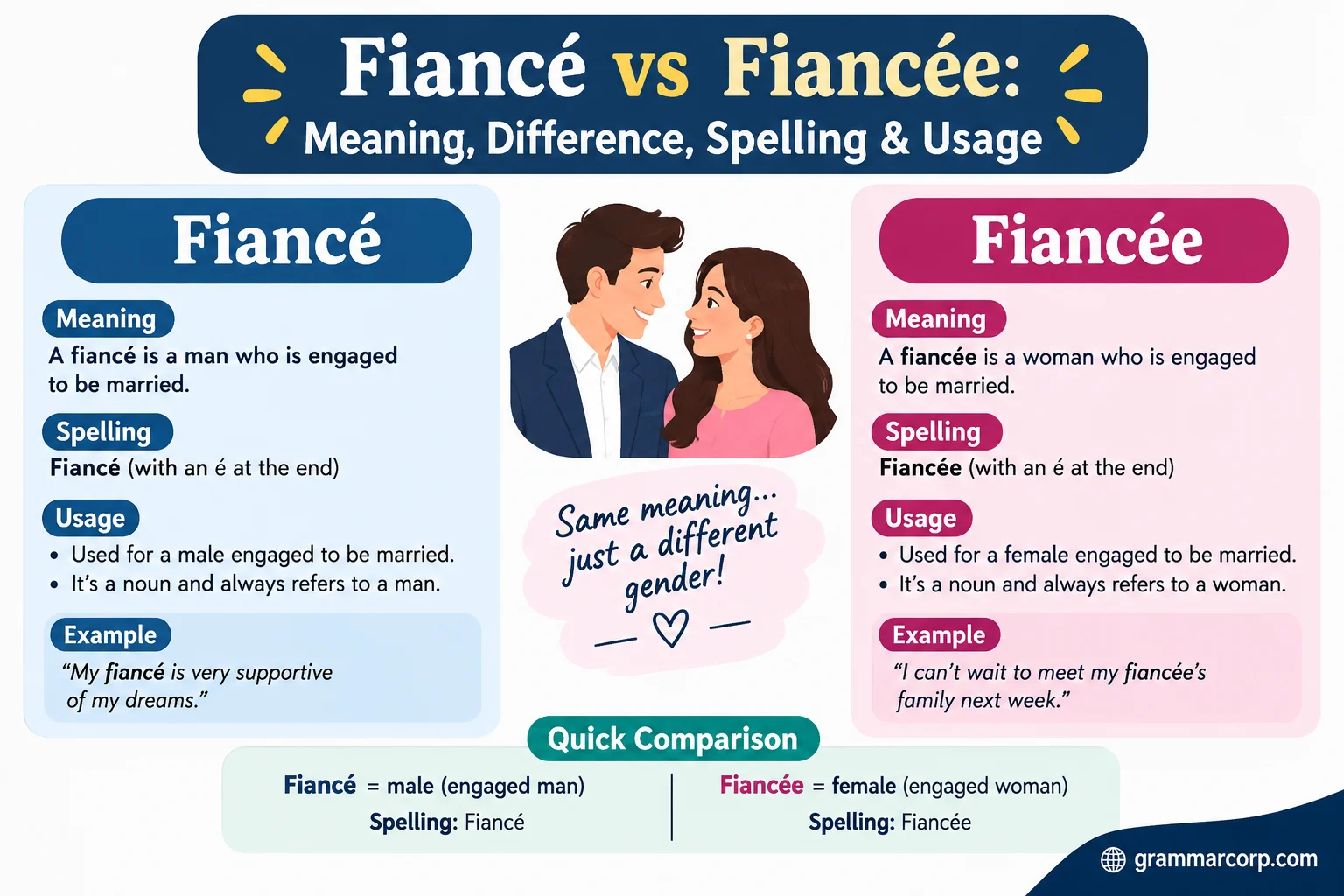
Fiancé vs Fiancée: Meaning, Difference, Spelling & Usage explains how these French terms differ in spelling, gender, meaning, and modern usage. Both terms come from French origins and are used in standard English to describe someone who is engaged and plans to be married.
Traditionally, fiancé means an engaged man, while fiancée means an engaged woman. The main difference is the extra e in fiancée, which creates a one-letter spelling distinction even though their pronunciation is almost the same. These terms can appear in both speaking and writing, so knowing which word to use can improve clarity, accuracy, and communication.
The fiancé vs fiancée distinction mainly depends on gender and context, although modern usage may include gender-neutral alternatives when gender is not relevant. English learners can become confused because the terms look and sound similar, which can lead to common mistakes, such as leaving out the extra e or using the wrong term.
Choosing the correct form depends on the person being described and the situation. Understanding these meanings, spelling patterns, and common usage rules helps learners communicate more naturally in spoken English, written English, and everyday English while avoiding unnecessary grammar mistakes.
Quick Answer:
Fiancé traditionally means a man who is engaged to be married.
Fiancée traditionally means a woman who is engaged to be married.
The easiest way to remember the distinction is:
- Fiancé → traditionally an engaged man
- Fiancée → traditionally an engaged woman
The two words are pronounced the same in English. The additional e in fiancée comes from the traditional French feminine form. Merriam-Webster and Cambridge both distinguish the terms this way in their standard definitions.
For example:
Maria introduced her fiancé to her family.
Here, the engaged person is a man.
Daniel introduced his fiancée to his family.
Here, the engaged person is a woman.
If you don’t want to specify gender, partner is a straightforward modern alternative.
Comparison Overview
The core difference between fiancé vs fiancée is grammatical gender inherited from French.
| Feature | Fiancé | Fiancée |
| Traditional meaning | An engaged man | An engaged woman |
| Relationship status | Engaged | Engaged |
| Part of speech | Noun | Noun |
| French form | Masculine | Feminine |
| Extra final letter | No extra e | Extra e |
| Pronunciation | Usually the same | Usually the same |
| Example | Her fiancé arrived early. | His fiancée arrived early. |
| Married equivalent | Husband | Wife |
| Gender-neutral alternative | Partner | Partner |
Both words describe someone who has made a formal promise to marry another person. They do not mean husband or wife because those terms describe a married relationship rather than an engagement.
Main Differences Between Fiancé vs Fiancée
The most important distinction is simple: fiancé is traditionally masculine and fiancée is traditionally feminine.
Fiancé Means an Engaged Man
Fiancé is traditionally used for a man who is engaged to be married.
For example:
- Her fiancé proposed during their vacation.
- I met Sarah’s fiancé last weekend.
- Her fiancé is helping plan the wedding.
- She introduced her fiancé to her coworkers.
Cambridge defines fiancé as the man someone is engaged to be married to. Oxford gives essentially the same definition.
Fiancée Means an Engaged Woman
Fiancée is traditionally used for a woman who is engaged to be married.
For example:
- His fiancée chose the wedding venue.
- I met James’s fiancée yesterday.
- His fiancée is visiting her family.
- He introduced his fiancée at the party.
Cambridge and Oxford both define fiancée as the woman someone is engaged to.
The Extra E Is the Key
The spelling difference is small but meaningful under traditional usage.
Fiancé has one final é.
Fiancée has ée at the end.
That extra e represents the traditional feminine form inherited from French. Dictionary.com explains that English borrowed the masculine and feminine forms even though English generally doesn’t mark gender through noun endings in this way.
A useful memory trick is:
Fiancé = no extra E → traditionally a man
Fiancée = extra E → traditionally a woman
This isn’t a pronunciation trick because the two words normally sound alike. It’s a spelling trick.
What Does Fiancé Mean?
The noun fiancé refers traditionally to a man who is engaged to be married.
It describes his relationship status before the marriage takes place.
Consider this sentence:
Emma told everyone that her fiancé would attend the dinner.
The word fiancé identifies Emma’s male partner who is engaged to her.
You can use the word with possessive determiners such as:
- my fiancé
- your fiancé
- his fiancé
- her fiancé
- their fiancé
The possessive word doesn’t determine whether you use fiancé or fiancée. The traditional gender of the engaged person does.
For example:
She called her fiancé.
The person being called is a man.
His sister called his fiancée.
The person being called is a woman.
This point can prevent a common mistake. Some writers look at her or his and choose the spelling based on the person speaking. Instead, focus on the person who is engaged.
Fiancé in Everyday Sentences
Here are natural examples:
- My fiancé starts his new job next month.
- Her fiancé helped choose the invitations.
- I haven’t met your fiancé yet.
- Their fiancé will join us later.
- She said her fiancé loves cooking.
- My sister’s fiancé is from Chicago.
The word can appear in casual conversation, personal writing, wedding announcements, and other contexts where someone’s engagement is relevant.
What Does Fiancée Mean?
Fiancée traditionally refers to a woman who is engaged to be married.
The word works in the same grammatical way as fiancé, but the traditional gender distinction changes the spelling.
For example:
Michael introduced his fiancée to his friends.
The word fiancée tells us that Michael’s engaged partner is a woman.
Common possessive forms include:
- my fiancée
- your fiancée
- his fiancée
- her fiancée
- their fiancée
Again, the possessive doesn’t determine the spelling.
Compare these sentences:
He introduced his fiancée.
The engaged person is a woman.
She introduced her fiancé.
The engaged person is a man.
Fiancée in Everyday Sentences
You might see fiancée used in sentences such as:
- My fiancée is choosing the flowers.
- His fiancée works at the hospital.
- Have you met John’s fiancée?
- Her fiancée will arrive after work.
- I spoke with my fiancée this morning.
- Their fiancée is helping with the arrangements.
The word is especially common when discussing engagements, weddings, families, or future marriage plans.
Why Are Fiancé and Fiancée Spelled Differently?
The explanation begins with French.
English borrowed both terms from French. The French language distinguishes masculine and feminine forms. In traditional French usage, fiancé is masculine and fiancée is feminine.
The words ultimately connect to the French verb fiancer, meaning to promise or betroth. Merriam-Webster traces the word further through Old French and ultimately to Latin roots associated with trust.
This history explains why English has two spellings even though English itself doesn’t normally change a noun simply because the person is male or female.
The Meaning Behind the Original Word
The history is particularly interesting because the word is connected with the idea of a promise.
Merriam-Webster explains that the related French-derived forms ultimately connect with the idea of a person who has been promised in marriage.
So while modern speakers usually think of fiancé and fiancée simply as relationship terms, their history reflects the older concept of a marriage promise.
How to Pronounce Fiancé and Fiancée
One of the most confusing things about fiancé vs fiancée is that the spelling difference usually doesn’t create a pronunciation difference.
In American English, both are commonly pronounced approximately:
fee-ah(n)-SAY
Cambridge gives the US pronunciation as approximately /ˌfiː.ɑːnˈseɪ/ for both forms. Its UK pronunciation is approximately /fiˈɒn.seɪ/.
That means you generally cannot hear the extra e.
| Word | Common US pronunciation | Traditional meaning |
| fiancé | fee-ah(n)-SAY | Engaged man |
| fiancée | fee-ah(n)-SAY | Engaged woman |
This is why the distinction matters most when writing.
If someone says the word aloud, you may need the surrounding context to know which spelling would traditionally be appropriate.
Fiancé vs Fiancée Examples in Sentences
Seeing the words in realistic sentences makes the difference easier to remember.
Wedding Planning
Fiancé:
- Her fiancé booked the reception hall.
- My fiancé wants a small wedding.
- Her fiancé is handling the music.
Fiancée:
- His fiancée selected the invitations.
- My fiancée chose the wedding date.
- His fiancée is meeting the photographer tomorrow.
Introducing Your Partner
When introducing an engaged man:
This is my fiancé, Alex.
When introducing an engaged woman:
This is my fiancée, Maya.
These are among the most natural ways to use the terms.
Casual Conversation
You might say:
- Have you met her fiancé?
- Have you met his fiancée?
- My fiancé is coming with me.
- My fiancée will be here soon.
- Their fiancé is studying abroad.
Formal Writing
The terms can also appear in formal or semi-formal contexts:
- The couple announced their engagement, and the bride-to-be introduced her fiancé.
- He attended the event with his fiancée.
- The invitation was addressed to the couple and their fiancé.
- She discussed the upcoming ceremony with her fiancé.
The important point isn’t whether the sentence sounds formal. The traditional spelling depends on the gender of the person being described.
Common Mistakes With Fiancé and Fiancée
The most common errors aren’t difficult once you understand the rule.
Mistake: Using Fiancée for Every Engaged Person
Some writers remember that fiancée means an engaged person but forget the gender distinction.
Under traditional usage:
Wrong: She introduced her fiancée when referring to an engaged man.
Correct: She introduced her fiancé.
Mistake: Using Fiancé for Every Engaged Person
The reverse mistake happens too.
Under traditional usage:
Wrong: He introduced his fiancé when referring to an engaged woman.
Correct: He introduced his fiancée.
However, modern English usage is more flexible than the traditional distinction. Some sources note broader use of fiancé as a general term.
Mistake: Thinking They Sound Different
They generally don’t.
The final e in fiancée doesn’t give the word a noticeably different pronunciation from fiancé in ordinary English.
Mistake: Confusing Engagement With Marriage
A fiancé or fiancée is engaged.
A husband or wife is married.
For example:
Before marriage:
She is his fiancée.
After marriage:
She is his wife.
The relationship status changes the appropriate word.
Is Fiancé or Fiancée Gender-Specific?
Traditionally, yes.
Major English dictionaries continue to define the words differently by gender. Merriam-Webster defines fiancé as a man engaged to be married and fiancée as a woman engaged to be married. Cambridge and Oxford follow the same traditional distinction in their main English definitions.
However, English usage can evolve.
Some English speakers use fiancé more broadly as a general term for an engaged person. Dictionary.com notes this broader modern usage as a growing trend.
That doesn’t make the traditional distinction meaningless. It simply means readers may encounter different conventions.
What Should You Use?
If you want to follow the traditional dictionary distinction, use:
- fiancé for an engaged man
- fiancée for an engaged woman
If gender isn’t relevant, you can avoid the issue completely with:
- partner
- engaged partner
- person I’m engaged to
The best choice depends on the audience, context, and the terminology the person uses for themselves.
Read More : On the Same Day or On the Same Day? The Correct Usage
Fiancé vs Fiancée vs Spouse
The words describe different stages or roles in a relationship.
| Term | Meaning | Relationship status |
| Fiancé | Traditionally an engaged man | Engaged |
| Fiancée | Traditionally an engaged woman | Engaged |
| Husband | A married man | Married |
| Wife | A married woman | Married |
| Spouse | A married partner | Married |
| Partner | A broad relationship term | Depends on context |
The distinction between fiancé and spouse is particularly important.
An engagement means the couple has agreed or formally promised to marry. It doesn’t mean the marriage has already happened.
For example:
They announced their engagement in June.
At this stage, one person may be the other’s fiancé or fiancée.
After the wedding:
They got married in October.
The traditional terms then become husband and wife, while spouse can describe either married partner.
How to Remember Fiancé vs Fiancée
The simplest memory trick focuses on the extra letter.
Remember the Extra E
Think:
Fiancé → one final e
Fiancée → two final e’s
Then connect the extra e with the traditionally feminine form.
A simple mental shortcut is:
Fiancé = engaged man
Fiancée = engaged woman
It’s not a perfect English grammar rule because these are French-derived forms. Still, it’s an effective way to remember the conventional distinction.
Another Easy Trick
Look at the endings:
-é → fiancé
-ée → fiancée
The second form contains an additional e because it represents the traditional feminine French form.
Fiancé vs Fiancée in Modern English
Modern English presents an interesting complication.
English doesn’t generally require masculine and feminine forms for ordinary nouns. We normally say friend, teacher, student, or neighbor without changing the word based on gender.
That’s why fiancé and fiancée can feel unusual.
They are borrowed forms that retained a grammatical distinction from French. Dictionary.com specifically notes that English doesn’t typically use gendered noun endings in this way.
Merriam-Webster also recognizes that fiancé and fiancée are traditionally gendered French-derived terms while noting that English usage can be broader in some contexts.
This creates three practical choices for modern writers:
- Follow the traditional distinction.
- Follow the terminology preferred by the person involved.
- Use a gender-neutral term such as partner when appropriate.
There isn’t a need to make every situation more complicated than it is. In most everyday writing, the traditional rule remains easy to apply.
When Should You Use Partner Instead?
Partner can be useful when the person’s gender isn’t relevant to the sentence.
For example:
I invited my partner to the event.
This tells the reader about the relationship without requiring a gendered term.
You could also say:
- my engaged partner
- the person I’m engaged to
- my future spouse
The best option depends on context.
If a person specifically describes themselves or their partner as a fiancé or fiancée, respecting that terminology is generally the clearest approach.
Fiancé vs Fiancée: A Practical Decision Guide
When you’re unsure, ask one question:
Who is the engaged person?
If the person is traditionally described as a man:
Use fiancé.
If the person is traditionally described as a woman:
Use fiancée.
If gender isn’t relevant or you want neutral wording:
Use partner or another suitable neutral expression.
Quick Decision Table
| Situation | Best traditional choice |
| An engaged man | Fiancé |
| An engaged woman | Fiancée |
| Gender isn’t relevant | Partner |
| A married man | Husband |
| A married woman | Wife |
| A married partner of any gender | Spouse |
This approach keeps the distinction practical instead of turning it into a complicated grammar lesson.
FAQs:
1. What is the difference between fiancé and fiancée?
Fiancé traditionally refers to an engaged man, while fiancée traditionally refers to an engaged woman. The extra e in fiancée is the main spelling difference.
2. Is fiancé or fiancée correct?
Both are correct. Use fiancé for an engaged man and fiancée for an engaged woman when following the traditional gender distinction.
3. Are fiancé and fiancée pronounced differently?
They are generally pronounced almost the same in English. The main difference is their spelling and traditional gender-based meaning.
4. Can fiancé be used for a woman?
Traditionally, fiancé refers to a man and fiancée refers to a woman. However, some modern writers may prefer gender-neutral alternatives when gender is not important.
5. How can I remember the spelling of fiancée?
A simple way to remember it is that fiancée has an extra “e” for a woman. The shorter fiancé traditionally refers to a man.
Conclusion:
Understanding Fiancé vs Fiancée: Meaning, Difference, Spelling & Usage becomes easier when you remember the extra e in fiancée. Both words describe a person who is engaged to be married, but traditional English usage uses them according to gender.
Knowing this small spelling difference can help you choose the correct term and communicate more clearly in everyday and formal writing.







1 thought on “Fiancé vs Fiancée: Meaning, Difference, Spelling & Usage”