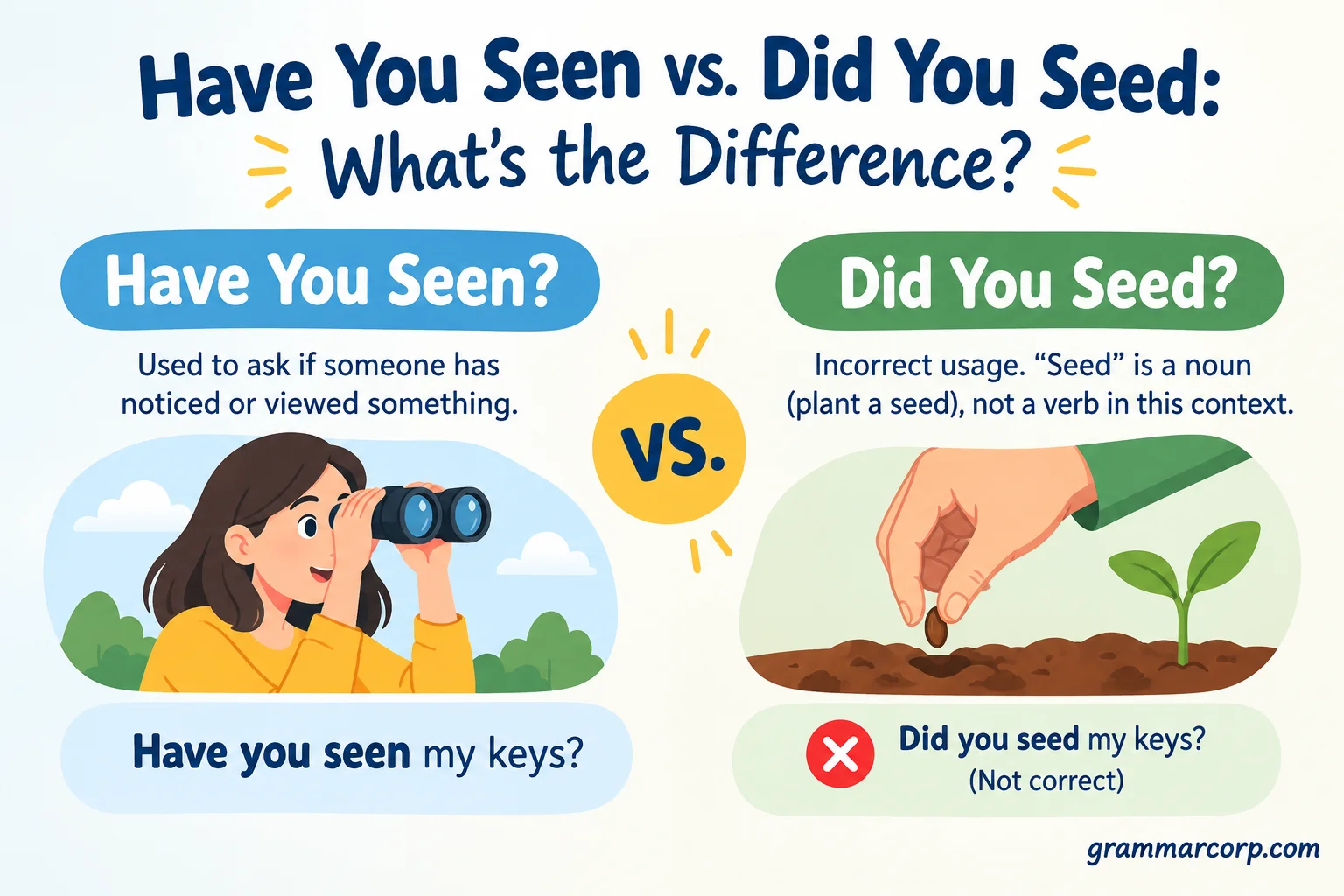
Have You Seen vs. Did You Seed: What’s the Difference? helps English learners understand small differences in verb tenses and everyday expressions. When learning English, small differences in verb tenses can be confusing, especially when phrases sound alike. Have seen and did you seed may, when spoken quickly, mean different things and create confusion. Their pronunciation can sound similar because of the long ee sound, but the final sounds are different. Seen comes from the verb see, while seed is a noun that can function as a verb meaning to plant or distribute seeds.
The common question have you seen is useful when looking for information about something someone has viewed, noticed, encountered, or experienced without an exact time being important. If you are looking for your phone now, for example, you can ask, “Have you seen my phone?” This connects a past action with the present and uses the present perfect tense. Did you see, on the other hand, is used for a specific time in the past, such as “Did you see John yesterday?” This refers to a completed past time.
The practical use of these expressions becomes easier when you compare their meaning, grammar, and examples. When you use have you seen, you usually ask about something connected with the present; when you use did you see, you ask about a completed event in the past; and did you seed asks whether someone planted or distributed seeds in the past. The correct expression depends on what you expect the other person to understand. Similar words can cause a hurdle, and learners may get tripped up, but regular using English correctly can build confidence and reduce common English grammar mistakes in everyday situations while you speak the language.
Quick Answer:
Have you seen and did you seed aren’t interchangeable?
- Have you seen? asks whether someone has viewed, noticed, encountered, or experienced something.
- Did you seed? asks whether someone planted or distributed seeds.
- Did you see? asks whether someone viewed or noticed something during a past event.
For example:
Have you seen my backpack?
Here, seen comes from see. The speaker wants to know whether the listener has encountered or noticed the backpack.
Compare that with:
Did you seed the garden yesterday?
Here, seed means to plant seeds. The speaker asks about a specific action in the past.
There’s also an important grammar rule:
Have + seen
Did + see
Did + seed
You wouldn’t normally say have you seed when you mean have you seen, and you wouldn’t say did you seen when you mean did you see.
Comparison Overview
The easiest way to understand the difference between have you seen vs. did you seed is to compare their meanings and grammatical structures directly.
| Phrase | Verb | Grammar | Basic meaning | Example |
| Have you seen? | see → seen | Present perfect | Have you viewed or encountered something? | Have you seen my phone? |
| Did you see? | see → see | Simple past | Did you view something at a past time? | Did you see the accident? |
| Did you seed? | seed → seed | Simple past | Did you plant or distribute seeds? | Did you seed the lawn? |
The first major difference involves meaning.
Seen relates to seeing. It can involve looking at something, noticing something, watching something, or experiencing something.
Seed has an entirely different meaning. As a verb, it can describe planting seeds or distributing something in a way that resembles sowing.
The second difference involves grammar.
The word seen is the past participle of see. It commonly appears after auxiliary verbs such as have, has, or had.
The word seed is the base form of the verb seed. When did introduces a question, the main verb stays in its base form.
That gives you a useful pattern:
| Auxiliary | Correct verb form | Example |
| Have | seen | Have you seen it? |
| Has | seen | Has she seen it? |
| Had | seen | Had they seen it before? |
| Did | see | Did you see it? |
| Did | seed | Did you seed the lawn? |
Main Differences Between Have You Seen vs. Did You Seed
The difference between have you seen vs. did you seed comes down to three things: meaning, grammar, and context.
They use different verbs
See means to perceive something with your eyes or to experience or encounter something.
Seed means to put seeds into soil or another growing medium. It can also have specialized meanings in areas such as agriculture, sports, computing, and other fields.
Consider these two questions:
Have you seen the new garden?
Did you seed the new garden?
They look similar, but they ask completely different questions.
The first asks whether someone looked at or noticed the garden.
The second asks whether someone planted seeds in the garden.
A single letter can change the entire meaning.
They use different grammatical structures
The phrase have you seen uses the present perfect.
Its structure is:
Have + subject + past participle
So:
Have + you + seen
The phrase did you seed uses the simple past.
Its structure is:
Did + subject + base verb
So:
Did + you + seed
This distinction explains why the following combinations don’t work when you’re trying to express these meanings:
- ❌ Have you seed?
- ❌ Did you seen?
- ❌ Did you saw?
- ✅ Have you seen?
- ✅ Did you see?
- ✅ Did you seed?
The auxiliary verb does much of the grammatical work. Once did appears, the main verb returns to its base form.
Context separates the meanings
Even when pronunciation causes temporary confusion, context usually clears things up.
Imagine someone asks:
Have you seen Alex?
They’re probably asking whether you’ve encountered or spoken to Alex.
Now imagine someone asks:
Did you seed the vegetable patch?
They’re asking about gardening.
The surrounding conversation provides a strong clue. People don’t usually discuss planting seeds when they’re asking whether someone watched a movie.
What Does “Have You Seen” Mean?
Have you seen is a present-perfect question built from the verb see.
The verb see has several meanings beyond simply using your eyes. Depending on context, it can mean notice, watch, meet, encounter, understand, or experience something.
For example:
- Have you seen my keys?
This asks whether someone has noticed or found your keys. - Have you seen that movie?
This asks whether someone has watched the movie. - Have you seen Maria today?
This asks whether someone has encountered or spoken with Maria. - Have you seen the new store downtown?
This asks whether someone has visited or noticed it. - Have you seen how quickly this plant grows?
This asks whether someone has observed the growth.
Why does “have” appear before “seen”?
English uses have + past participle to form the present perfect.
The verb see has an irregular past participle:
- Base form: see
- Past tense: saw
- Past participle: seen
That’s why you get:
I see it.
I saw it.
I have seen it.
The form seen normally needs an auxiliary verb in standard constructions.
When should you use “Have You Seen”?
Use have you seen when the question focuses on someone’s experience or whether something has happened before now.
For example:
Have you seen the new episode?
The exact time isn’t the main point. The speaker wants to know whether the listener has watched it.
Similarly:
Have you seen my notebook?
The question asks whether the person has encountered or noticed it.
This makes the phrase particularly common when asking about things that remain relevant in the present.
What Does “Did You Seed” Mean?
Did you seed is a simple-past question using the verb seed.
As a verb, seed most commonly means to plant seeds.
For example:
- Did you seed the lawn?
- Did you seed the garden?
- Did you seed the field before the rain?
- Did you seed those flower beds yesterday?
In each case, seed refers to putting seeds into an area so plants can grow.
Why is it “did you seed” instead of “did you seeded”?
This follows one of the most useful grammar rules in English.
When did appears in a question, the main verb uses its base form.
So:
Did + seed
Not:
Did + seeded
The same pattern appears with ordinary verbs:
- Did you walk?
- Did you finish?
- Did you plant?
- Did you seed?
You don’t say:
- ❌ Did you walked?
- ❌ Did you finished?
- ❌ Did you planted?
- ❌ Did you seeded?
The word did already marks the past.
Specialized Uses of “Seed”
The verb seed isn’t limited to gardening.
In agriculture, it can refer to planting an area with seeds.
In sports competitions, a person or team can receive a seed that represents their placement in a tournament. However, the phrase did you seed isn’t normally how people ask about someone’s tournament ranking.
In computing and peer-to-peer systems, seeding can describe sharing or distributing data after downloading. The exact meaning depends on the technical context.
The important point remains the same: seed doesn’t mean see.
“Have You Seen” vs. “Did You See”
Before moving on, it’s worth separating have you seen from did you see.
These two phrases use the same verb but different grammatical structures.
Have you seen?
Have you seen uses the present perfect.
It often asks about an experience or event connected to the present.
Example:
Have you seen the new library?
The speaker is interested in whether the person has visited or viewed it.
Did you see?
Did you see uses the simple past.
It often focuses on a particular past event or time.
Example:
Did you see the new library yesterday?
Now the question focuses on a specific past occasion.
The difference becomes clearer when you add time expressions:
| Present perfect | Simple past |
| Have you seen it yet? | Did you see it yesterday? |
| Have you seen her before? | Did you see her last week? |
| Have you seen that movie already? | Did you see that movie on Friday? |
A specific finished past time generally calls for the simple past rather than the present perfect.
Why Do “Seen” and “Seed” Sound Similar?
At first glance, seen and seed look and sound almost identical.
Both begin with the long ee vowel sound. The crucial difference appears at the end.
Pronunciation of “seen”
Seen is commonly represented in pronunciation guides as /siːn/.
The word ends with the n sound.
Think:
see + n
Pronunciation of “seed”
Seed is commonly represented as /siːd/.
The word ends with the d sound.
Think:
see + d
That final consonant matters.
Seen → ends in n
Seed → ends in d
Why fast speech can cause confusion
In everyday conversation, people don’t pronounce every sound with exaggerated clarity.
Speech flows. Sounds connect. Final consonants can become less noticeable, especially when someone speaks quickly or from a distance.
Accent also plays a role.
For that reason, a listener might briefly mistake one word for another. Usually, however, the surrounding words reveal the intended meaning.
For example:
Have you seen the new restaurant?
The grammatical structure and context make seen obvious.
By contrast:
Did you seed the lawn?
The gardening context makes seed clear.
Common Mistakes With Have You Seen and Did You Seed
These phrases create several predictable grammar mistakes.
Mistake: “Have you seed?”
If you mean have you seen, this is incorrect.
The verb see has the past participle seen.
Correct:
Have you seen my jacket?
Incorrect:
Have you seed my jacket?
Mistake: “Did you seen?”
This mistake reverses the problem.
Because did already expresses the past, the verb following it should use its base form.
Correct:
Did you see the message?
Incorrect:
Did you seen the message?
Mistake: “Did you saw?”
This follows the same rule.
Saw is the simple past form of see. It doesn’t follow did.
Correct:
Did you see it?
Incorrect:
Did you saw it?
Compare:
You saw it.
Did you see it?
The auxiliary did changes the verb structure.
Mistake: Treating “seed” as a form of “see”
This is the biggest vocabulary misunderstanding.
See and seed aren’t different forms of the same verb.
The forms of see are:
- See
- Saw
- Seen
- Seeing
The verb seed follows a regular pattern:
- Seed
- Seeded
- Seeded
- Seeding
So seed belongs to its own verb family.
When Should You Use “Have You Seen” or “Did You Seed”?
A quick context check can solve the problem.
Use “Have You Seen” when you mean:
- Have you viewed something?
- Have you noticed something?
- Have you watched something?
- Have you encountered someone?
- Have you experienced something?
- Have you observed something?
Examples:
Have you seen the latest announcement?
Have you seen John today?
Have you seen that documentary?
Use “Did You Seed” when you mean:
- Did you plant seeds?
- Did you sow an area?
- Did you distribute seeds?
- Did you carry out a seeding process?
Examples:
Did you seed the flower bed?
Did you seed the field before the storm?
The context should involve seed in its verb sense.
Practical Examples: Have You Seen vs. Did You Seed
Seeing these phrases in realistic situations makes the distinction easier to remember.
At home
Have you seen my headphones?
You’re asking whether someone has noticed or encountered them.
Did you seed the backyard yesterday?
You’re asking whether someone planted seeds.
At school
Have you seen the new notice?
You’re asking whether someone has read or noticed it.
Did you seed the garden plot?
You’re asking about a gardening activity.
At the movies
Have you seen that film?
You’re asking whether someone has watched it.
Did you seed the garden?
That question would make little sense unless the conversation suddenly moved to gardening.
At work
Have you seen the updated report?
You’re asking whether someone has viewed it.
Did you seed the test environment?
This could make sense in a technical context where seed has a specialized meaning.
The context changes everything.
A Simple Grammar Formula to Remember
If grammar rules usually feel slippery, keep this one formula nearby:
Have + past participle
Have you seen…?
Examples:
- Have you seen it?
- Have you seen her?
- Have you seen the report?
- Have you seen this before?
Did + base verb
Did you see…?
Examples:
- Did you see it?
- Did you see her?
- Did you see the report?
- Did you see this yesterday?
Did + seed
Did you seed…?
Examples:
- Did you seed the lawn?
- Did you seed the garden?
- Did you seed the field?
This small pattern prevents most errors.
Have You Seed or Have You Seen?
Another common search-style question is whether to write have you seed or have you seen.
If you’re talking about the verb see, the correct expression is:
Have you seen?
For example:
Have you seen my phone?
Have you seen this video?
Have you seen the new building?
The phrase have you seed could technically appear in a specialized context if seed were being used in an appropriate verb construction. However, it wouldn’t mean have you seen.
For example, in a technical or agricultural discussion, someone might ask whether a person has completed a seeding process. The meaning would come from seed, not see.
So don’t choose between them based only on how they sound. Choose based on what you mean.
Did You Seen or Did You Seed?
This comparison can cause even more confusion because both phrases contain did.
Here’s the rule:
Did + see is correct when you’re talking about seeing.
Did + seed is correct when you’re talking about planting or distributing seeds.
Did + seen is not correct for standard simple-past questions.
| Intended meaning | Correct phrase |
| Ask about seeing something | Did you see? |
| Ask about planting seeds | Did you seed? |
| Ask about seeing something using present perfect | Have you seen? |
| Use “did” with the past participle of see | ❌ Did you seen? |
This distinction is worth remembering because did you seen often appears when someone tries to combine two correct forms incorrectly.
Read More : Jewel vs Joule: Meaning, Difference, Pronunciation, and Correct Usage
A Real-World Case Study: One Sound, Three Meanings
Imagine three friends are talking about a community garden.
One asks:
Have you seen the new greenhouse?
They’re asking whether someone has looked at or visited it.
Another asks:
Did you see the greenhouse yesterday?
Now the question refers to a specific past occasion.
Finally, the gardener asks:
Did you seed the greenhouse beds?
This question has nothing to do with looking at the greenhouse. It asks whether someone planted seeds in its beds.
The three questions sound related because they share similar words. Yet each one performs a different grammatical and communicative job.
That’s why learning the phrase as a whole works better than memorizing individual spellings.
How to Choose the Correct Phrase
When you’re unsure, ask yourself what action you’re describing.
If the action is seeing
Use a form of see.
- Have you seen…?
- Did you see…?
- I saw…
- I have seen…
If the action is planting or distributing seeds
Use seed.
- Did you seed…?
- You seeded…
- They have seeded…
- The field was seeded…
If you’re still unsure
Look at the noun or situation around the phrase.
If you’re talking about a:
- Movie → Have you seen it?
- Message → Have you seen it?
- Person → Have you seen them?
- Garden → Did you seed it? if asking about planting
- Lawn → Did you seed it? if asking about planting grass seed
- Field → Did you seed it? if discussing agricultural planting
The surrounding subject often gives you the answer immediately.
Quick Comparison: Seen, See, and Seed
| Word | Part of speech | Meaning | Example |
| See | Verb | Perceive or notice | I can see the house. |
| Saw | Verb | Past tense of see | I saw the house yesterday. |
| Seen | Past participle | Used with auxiliary verbs | I have seen the house. |
| Seed | Noun/verb | A plant seed; to plant or distribute seeds | We need to seed the lawn. |
| Seeded | Verb | Past tense/past participle of seed | They seeded the field. |
Notice how seen and seeded belong to completely different verb systems.
That distinction matters more than their similar spelling.
FAQs:
1. What is the difference between “Have you seen” and “Did you see”?
Have you seen usually asks about an experience or event connected to the present, while did you see usually asks about something that happened at a specific time in the past.
2. When should I use “Have you seen”?
Use have you seen when the exact time is not important or when the past event has a connection to the present. For example, “Have you seen my phone?”
3. When should I use “Did you see”?
Use did you see when you are asking about a completed event at a specific past time. For example, “Did you see John yesterday?”
4. What does “Did you seed” mean?
Did you seed is grammatically possible when seed is used as a verb. It asks whether someone planted or distributed seeds in the past.
5. Are “Have you seen” and “Did you seed” pronounced the same?
No. They contain different words and have different meanings. Seen comes from see, while seed refers to a seed when used as a noun or to planting or distributing seeds when used as a verb.
Conclusion:
Understanding Have You Seen vs. Did You Seed: What’s the Difference? becomes easier when you focus on the meaning and grammar of each expression.
Have you seen connects a past experience with the present, did you see refers to a completed event in the past, and did you seed refers to planting or distributing seeds.
Recognizing these differences can help you choose the correct expression and communicate more clearly in everyday English.









1 thought on “Have You Seen vs. Did You Seed: What’s the Difference?”