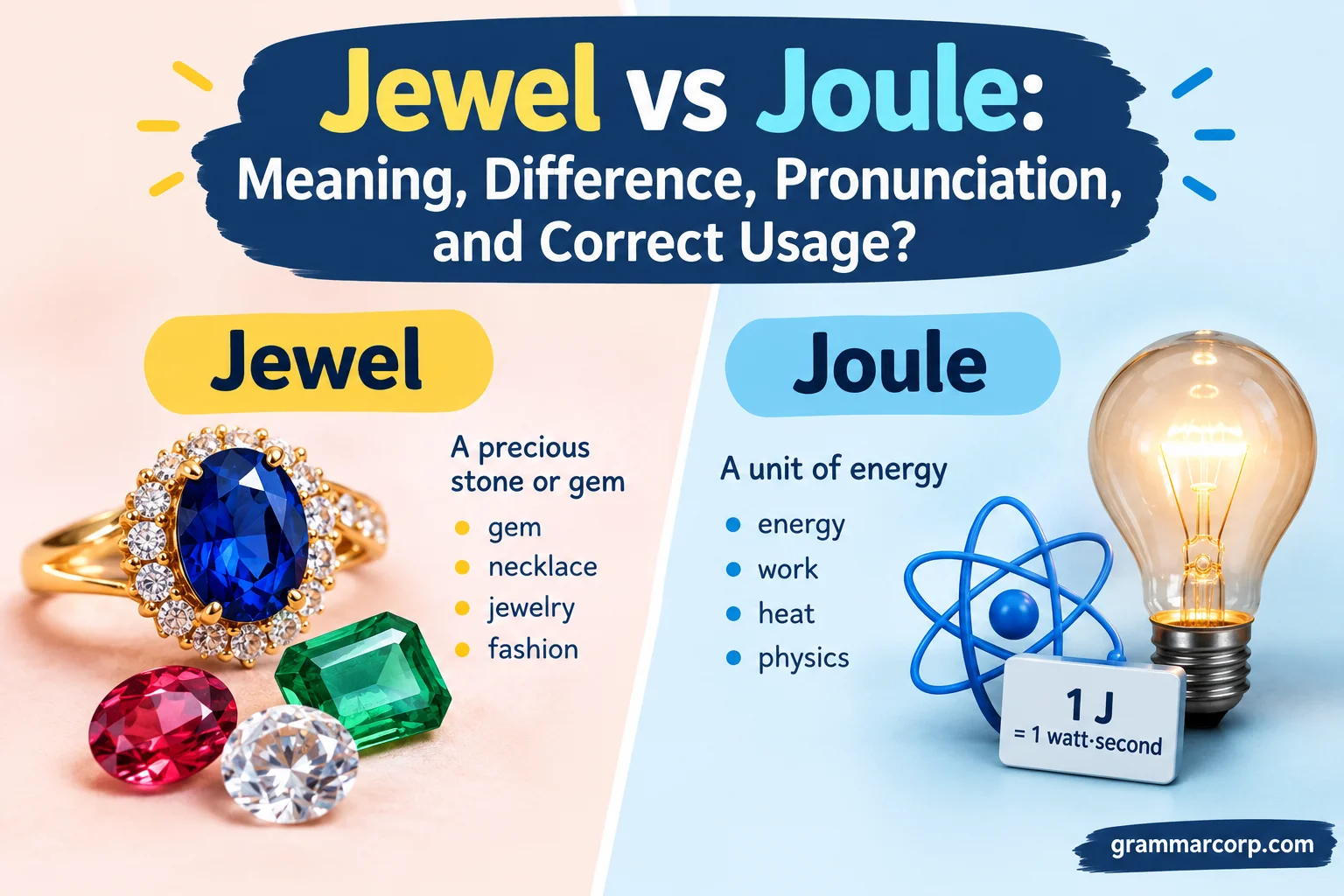
Jewel vs Joule: Meaning, Difference, Pronunciation, and Correct Usage spelling question can cause confusion because a jewel means precious stones or valuable objects, while a joule is a unit of energy in physics. Their pronunciations can sound similar, but their meanings, spellings, and uses are different. A diamond or necklace may be a jewel, while heat and work can be measured in joules. In my experience with education and editing, I have seen students, writers, and learners make this mistake when they overlook context. Understanding the difference helps people avoid common mistakes and improve communication in English.
A useful way to remember the distinction is to focus on grammar, vocabulary, practice, correct usage, and contextual meaning. An assignment or sentence can change its overall meaning because of one tiny spelling difference. Comparing the words through semantic and linguistic study, review, and examples can support accurate writing, better interpretation, and stronger skills. Paying attention to terminology and context also helps create clear sentences, reduce errors, and make learning and clarification easier.
Another helpful method is comparing jewel and joule with classic homophones such as to, too, and two, or ate and eight. Writers and editors can memorize a list of these examples and use charts for practice. Merriam-Webster’s Dictionary, spell-check, and autocorrect can provide useful support, although spell-check may not catch every slip-up when a word is spelled correctly but used in the wrong context. Studying Silent Letters and the Sound system of American English can make lessons easier, while jokes, puns, and playful plays can add a bonus to everyday conversations.
Quick Answer:
Jewel is a noun that usually means a precious stone, a valuable ornament, or something highly valued.
Joule is a scientific unit used to measure energy or work. Its symbol is J.
The easiest way to remember the difference is:
- Jewel → a gem, ornament, or valuable thing
- Joule → a unit of energy or work
- Jewel belongs to everyday language, jewelry, and figurative descriptions.
- Joule belongs mainly to physics, engineering, electricity, and other scientific contexts.
For example:
- The necklace contains a rare jewel.
- The machine requires 500 joules of energy.
So, jewel and joule aren’t interchangeable. Even when they sound alike, their meanings are entirely different.
Comparison Overview
The quickest way to understand jewel vs joule is to put the words side by side.
| Feature | Jewel | Joule |
| Word type | Noun and verb | Noun |
| Main meaning | Precious stone, ornament, or highly valued thing | Unit of energy or work |
| Field | Everyday language, jewelry, figurative language | Physics, engineering, science |
| Symbol | None | J |
| Common pronunciation | /ˈdʒuː.əl/; also /dʒuːl/ | /dʒuːl/ |
| Example | The ring has a beautiful jewel. | The motor uses 200 joules of energy. |
| Plural | Jewels | Joules |
| Related words | Gem, ornament, treasure | Energy, work, watt, newton |
| First known use | 14th century as a noun | 1882 |
Merriam-Webster defines jewel as a precious stone, an ornament often made with precious metal and stones, or something highly esteemed. It also records jewel as a verb.
A joule, meanwhile, is a unit of work or energy equal to the work done when a force of one newton moves an object one meter in the direction of that force.
That gives you the central distinction:
A jewel is something valuable or decorative. A joule measures energy or work.
Main Differences Between Jewel vs Joule
The spelling difference is only one letter, but the conceptual difference is enormous.
Jewel Refers to Something Valuable
A jewel normally refers to a precious stone or an ornament containing precious stones.
For example:
- The crown was decorated with several jewels.
- She received a sapphire jewel as a gift.
- The museum displays an ancient jewel.
- The necklace contains several colorful jewels.
The word also has a figurative meaning. You can call something a jewel when you consider it especially valuable, beautiful, or important.
For example:
- The old theater is a jewel of the city.
- The small library is a jewel in the community.
- That painting is the jewel of the collection.
This figurative use appears in standard dictionary definitions as well. Merriam-Webster includes “one that is highly esteemed” among the meanings of jewel.
Joule Measures Energy or Work
A joule has nothing to do with gemstones.
It’s a unit in the International System of Units, commonly called the SI. Scientists use joules to express quantities of energy and work.
The symbol is J.
For example:
- The device stores 500 joules of energy.
- The experiment produced 25 joules of heat.
- The motor performed 1,000 joules of work.
The Bureau International des Poids et Mesures includes the joule among SI derived units. The SI framework is the international measurement system used across science, technology, industry, and trade.
So if your sentence contains concepts such as energy, force, work, heat, electricity, or mechanical motion, joule is probably the word you need.
Their Contexts Are Completely Different
Context usually makes the correct spelling obvious.
| If you’re talking about… | Use |
| Diamonds | Jewel |
| Rings | Jewel |
| Necklaces | Jewel |
| Precious stones | Jewel |
| Something highly valued | Jewel |
| Energy | Joule |
| Work in physics | Joule |
| Heat | Joule |
| Mechanical energy | Joule |
| Electrical energy | Joule |
Think of it this way: jewel describes a thing, while joule measures a quantity.
That distinction won’t solve every sentence by itself, but it works remarkably well as a quick mental check.
What Does Jewel Mean?
The word jewel has several related meanings, which makes it more versatile than joule.
Jewel as a Precious Stone
The most familiar meaning refers to a valuable or beautiful stone.
A diamond, ruby, emerald, or sapphire can be described as a jewel.
For example:
- The jeweler examined the jewel under a bright light.
- The crown contains several precious jewels.
- The blue jewel caught everyone’s attention.
However, jewel and gem aren’t always perfect substitutes in every sentence. Gem commonly refers to a gemstone, while jewel can also describe an ornament or something metaphorically valuable.
Jewel as an Ornament
A jewel can also mean an ornament made from precious metal and decorated with stones or enamel.
This meaning focuses more on the finished decorative object rather than just the stone.
For example:
- The necklace was an elaborate jewel.
- The royal collection contains several historic jewels.
- The museum acquired a rare gold jewel.
This is one reason the word has a broader meaning than simply gem.
Jewel as Something Highly Valued
You don’t always need a gemstone for the word jewel to work.
People often use the word metaphorically for something they consider exceptionally valuable or special.
For example:
- The garden is a jewel in the middle of the city.
- The historic building is an architectural jewel.
- Her research became a jewel of the university’s collection.
This use gives the word a sense of admiration. You’re not saying the object literally contains diamonds or rubies. You’re saying its value or beauty makes it comparable to a jewel.
Jewel as a Verb
There’s another detail that often gets overlooked in a simple jewel vs joule comparison: jewel can function as a verb.
To jewel something means to adorn or equip it with jewels. It can also mean to make something beautiful as though decorated with jewels.
For example:
- Craftsmen jeweled the ceremonial object.
- The artist jeweled the costume with decorative stones.
The spelling can vary in some forms between American and British English. American English commonly uses jeweled and jeweling, while British English may use jewelled and jewelling.
Jewel in a Watch
There’s also a specialized meaning of jewel.
In watchmaking, a jewel can refer to a small bearing made from crystal, glass, or a gemstone. These components can reduce friction around moving parts.
So even within technical language, jewel can appear. But its meaning remains connected to the physical material or bearing rather than energy measurement.
What Does Joule Mean?
A joule is a scientific measurement unit.
It measures energy and work, and you will encounter it frequently in physics, engineering, electricity, thermodynamics, and related subjects.
The Basic Definition of Joule
One joule represents the amount of work done when a force of one newton moves an object through one meter in the direction of the force.
In simple form:
1 J = 1 N·m
The joule can also be expressed in SI base units as:
1 J = 1 kg·m²/s²
The SI system identifies the joule as a derived unit. The BIPM’s SI documentation lists the joule and gives its relationship to other SI units.
Joule and Energy
Energy describes the capacity to do work or cause physical change.
When scientists quantify energy, they often use joules.
For example:
- A battery can store chemical energy.
- A moving object has kinetic energy.
- A heated object contains thermal energy.
- Electrical systems transfer energy.
These quantities can be expressed in joules.
The U.S. National Institute of Standards and Technology describes the joule as the preferred SI unit for heat, energy, or work. It also notes that a watt is a joule per second.
That last relationship is particularly useful:
1 watt = 1 joule per second
So watts describe how quickly energy is transferred, while joules describe how much energy is involved.
Joule in Electricity
You’ll often see joules when discussing electrical energy.
Suppose a device transfers energy at a rate of 10 joules per second. That’s a power level of 10 watts.
The relationship can be written as:
Power = Energy ÷ Time
or:
1 W = 1 J/s
This distinction helps explain why a sentence such as The appliance uses 500 joules can make sense in one context while The appliance uses 500 watts answers a different question.
The first concerns an amount of energy. The second concerns the rate of energy transfer.
Joule Is Named After James Prescott Joule
The scientific unit joule takes its name from English physicist James Prescott Joule.
Merriam-Webster records the first known use of joule in its unit sense as 1882 and identifies the word’s etymology with James P. Joule.
That’s another clue that joule is a scientific term rather than an alternative spelling of jewel.
Jewel vs Joule Pronunciation
Pronunciation is where this comparison gets genuinely interesting.
At first glance, you might expect jewel and joule to sound different because they have different spellings. But English doesn’t always make spelling and pronunciation line up neatly.
How Is Jewel Pronounced?
Cambridge gives jewel as:
/ˈdʒuː.əl/
The pronunciation has two syllabic parts, roughly like JOO-uhl.
However, Merriam-Webster also lists a pronunciation of jewel as /ˈjül/. That pronunciation effectively matches the pronunciation of joule.
This means jewel can be pronounced like joule, depending on the speaker and pronunciation used.
How Is Joule Pronounced?
Cambridge gives joule as:
/dʒuːl/
A simple approximation is JOOL.
The word is generally treated as one syllable.
Are Jewel and Joule Homophones?
They can be.
A homophone is a word that sounds the same as another word while having a different meaning or spelling.
Because jewel has an accepted pronunciation matching joule, these words can function as homophones for speakers who use that pronunciation.
This explains why people sometimes spell one word when they mean the other.
The key lesson is simple:
Similar pronunciation doesn’t mean identical meaning.
English contains many words that sound alike but require completely different spellings. Jewel vs joule is a particularly clear example because the meanings are so far apart.
Jewel vs Joule in Sentences
Seeing the words in context makes the distinction much easier.
Examples With Jewel
- The crown contains a rare jewel.
- The necklace was decorated with several jewels.
- The museum displayed an ancient jewel.
- The ruby is the largest jewel in the collection.
- The historic theater is a jewel of the neighborhood.
- The painting became the jewel of the exhibition.
- She wore a small jewel on her bracelet.
Notice that every sentence involves something precious, decorative, valuable, or highly regarded.
Examples With Joule
- The experiment released 300 joules of energy.
- The motor performed 2,000 joules of work.
- The battery transferred 500 joules during the test.
- The heater produced 1,500 joules of thermal energy.
- The machine consumed 800 joules during the measurement period.
- The system stored 10,000 joules of energy.
- The device transferred energy at a measured rate of several joules per second.
Here, the context involves measurement, energy, work, or physics.
Incorrect vs Correct Examples
| Incorrect | Correct | Why? |
| The battery stored 500 jewels. | The battery stored 500 joules. | Energy is measured in joules. |
| The necklace contains three joules. | The necklace contains three jewels. | A precious object is a jewel. |
| The experiment produced 100 jewels of heat. | The experiment produced 100 joules of heat. | Heat is measured in joules. |
| The crown contains several joules. | The crown contains several jewels. | Decorative precious objects are jewels. |
| The motor performed 50 jewels of work. | The motor performed 50 joules of work. | Work is measured in joules. |
These errors usually happen because the writer remembers the sound but not the spelling.
That’s why understanding meaning and context is more reliable than trying to memorize the spellings alone.
A Simple Case Study: When One Letter Changes the Meaning
Imagine a student writing a physics report.
The student wants to explain that a small motor transferred 250 joules of energy. While typing quickly, the student writes:
The motor transferred 250 jewels of energy.
At first glance, the sentence may look harmless because jewels and joules can sound the same.
But the meaning is wrong.
A jewel is a precious stone, ornament, or something highly valued. A joule is the unit used to express energy or work.
The corrected sentence is:
The motor transferred 250 joules of energy.
Now the scientific meaning is precise.
This example demonstrates an important writing principle: when two words sound alike, context doesn’t always protect you from a spelling error. A spell-checker might not flag jewels because it is a perfectly valid English word.
The only way to catch the mistake is to understand what the sentence actually means.
How to Remember the Difference Between Jewel and Joule
You don’t need a complicated memory trick.
Try this:
Jewel = Jewelry
Both words start with jew-.
Think:
jewel → jewelry → precious stones
When you’re describing diamonds, gemstones, ornaments, or something valuable, choose jewel.
Joule = Physics
Think:
joule → J → energy
The symbol for the joule is J, and the unit appears in physics and engineering.
You can also remember the equation:
1 joule = 1 newton-meter
That instantly places joule in the world of physics.
Use the Context Test
Ask yourself one question:
Am I talking about something valuable, or am I measuring energy?
If you’re talking about something valuable:
→ Jewel
If you’re measuring energy or work:
→ Joule
This test is fast enough to use while writing.
Jewel vs Joule: Common Mistakes to Avoid
Several mistakes appear repeatedly because the two words can sound alike.
Using Jewel for Energy
Incorrect:
The device consumed 400 jewels of energy.
Correct:
The device consumed 400 joules of energy.
The unit is joule.
Using Joule for Jewelry
Incorrect:
The necklace contains a beautiful joule.
Correct:
The necklace contains a beautiful jewel.
The object is a jewel.
Assuming Similar Pronunciation Means Similar Meaning
This is the biggest trap.
English has many words whose spelling doesn’t directly reveal their pronunciation. Even more importantly, words with the same pronunciation can have unrelated meanings.
In this case, the connection between jewel and joule is primarily sound, not meaning.
Forgetting the Capital J in the Symbol
The SI symbol for joule is J.
When you’re writing a unit symbol, don’t turn it into jewel or j simply because the words sound similar.
For example:
- 500 J = correct symbol for 500 joules
- 500 joules = correct written-out form
- 500 jewels = wrong when referring to energy
How the Joule Relates to Other Units
Understanding a few related units can make the meaning of joule even clearer.
| Unit | What it measures | Relationship |
| Joule (J) | Energy/work | 1 J = 1 N·m |
| Newton (N) | Force | 1 N = 1 kg·m/s² |
| Watt (W) | Power | 1 W = 1 J/s |
| Kilowatt-hour (kWh) | Electrical energy | 1 kWh = 3.6 million J |
| Calorie | Energy | 1 cal = 4.184 J |
NIST notes that 1 calorie equals 4.184 joules and that 1 British thermal unit equals approximately 1,055 joules.
These relationships show why joule appears in many scientific calculations. It’s not simply another word for energy. It’s a unit used to quantify energy or work.
Read More : Years of Experience or Years’ Experience: Which Is Correct?
Jewel vs Joule: Which Word Should You Use?
Choosing the correct word becomes easy once you focus on the subject.
Use jewel when discussing:
- Precious stones
- Gemstones
- Jewelry
- Decorative ornaments
- Valuable objects
- Highly admired places or things
- Figurative descriptions of exceptional value
Use joule when discussing:
- Energy
- Work
- Heat
- Electrical energy
- Mechanical energy
- Physics
- Engineering
- Scientific measurements
Here’s the simplest decision table:
| Your sentence is about… | Choose |
| A diamond | Jewel |
| A ruby | Jewel |
| A necklace | Jewel |
| A precious ornament | Jewel |
| A treasured building | Jewel |
| Energy in physics | Joule |
| Mechanical work | Joule |
| Heat | Joule |
| Electrical energy | Joule |
| A scientific measurement | Joule |
Can Jewel and Joule Be Used Interchangeably?
No.
Even when they sound the same, their meanings are not interchangeable.
You can’t replace joule with jewel in a physics equation. Likewise, you can’t describe a gemstone as a joule.
The spelling carries the meaning in written English.
Is Joule Always Used for Energy?
Not exactly.
The joule is used for energy and work, and it also appears in measurements of quantities related to energy.
For example, scientific expressions can involve:
- Joules per kilogram
- Joules per mole
- Joules per kelvin
- Joules per cubic meter
The BIPM’s SI documentation lists these kinds of derived units and relationships.
So it’s better to remember joule as a unit associated with energy and work rather than reducing it to only one type of measurement.
FAQs:
1. What is the difference between jewel and joule?
A jewel is a precious stone or valuable object, while a joule is a scientific unit used to measure energy or work.
2. Do jewels and joules sound the same?
They can have very similar pronunciations in English, which is one reason learners sometimes confuse them. Their meanings and spellings are different.
3. When should I use jewels?
Use jewel when talking about a precious stone, gem, piece of jewelry, or another valuable object.
4. When should I use joules?
Use joule when discussing energy, work, heat, or physics. The joule is an SI unit of energy.
5. How can I remember the difference between jewel and joule?
Think of jewel as something valuable that you can own or wear, and joule as a measurement used in science and physics.
Conclusion:
Jewel and joule may sound similar, but they have completely different meanings and uses. Jewel relates to precious stones and valuable objects, while joule belongs to science and measures energy or work.
Paying attention to spelling and context is the simplest way to choose the correct word and avoid confusion in writing.











2 thoughts on “Jewel vs Joule: Meaning, Difference, Pronunciation, and Correct Usage”