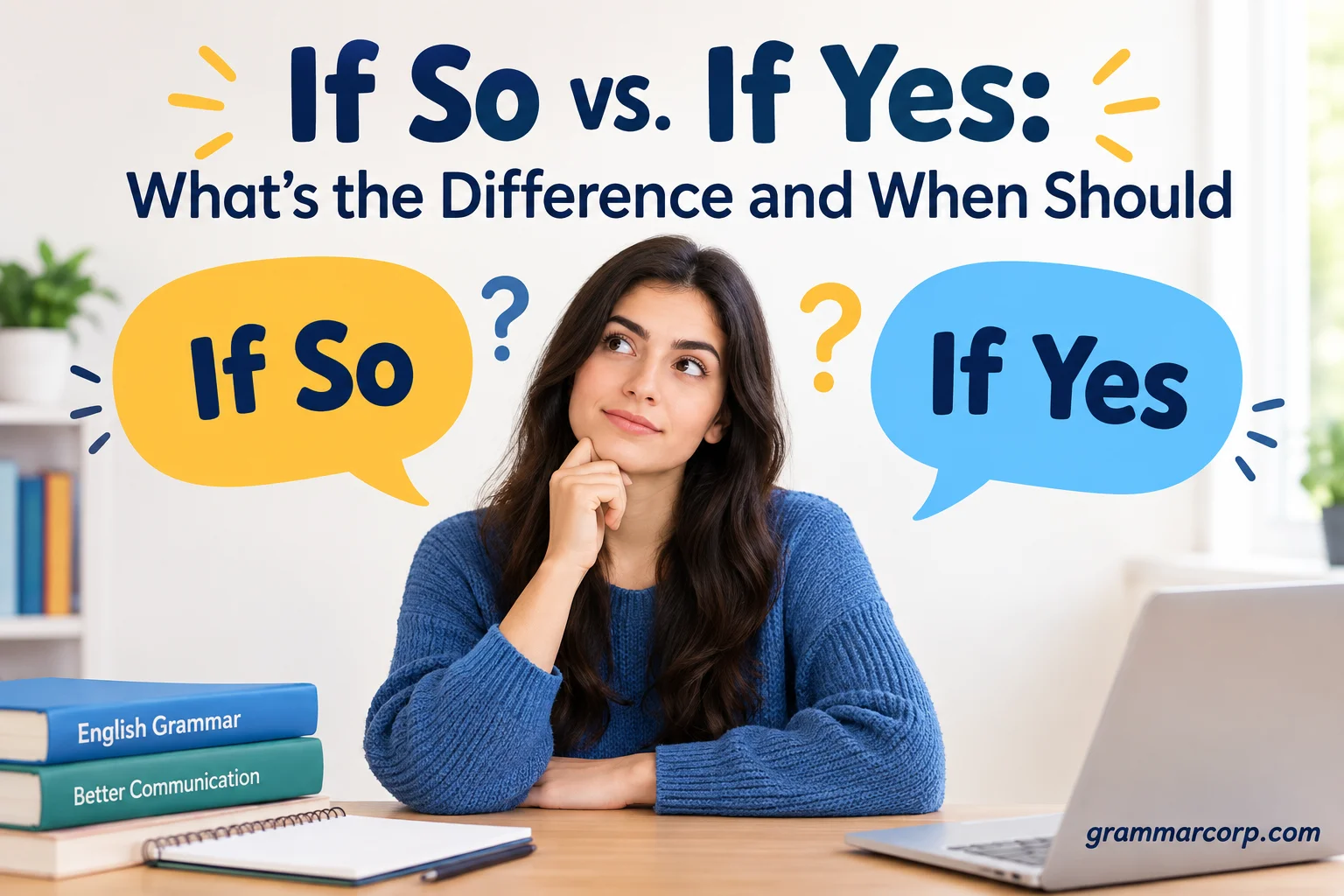
If So vs. If Yes: What’s the Difference and When Should helps learners choose the right phrase when writing or speaking in different situations.
In English grammar, both are conditional phrases, but their conditional usage, conditional structure, and grammatical correctness depend on the context and purpose. If so is commonly used in everyday conversations, emails, professional writing, and formal writing because native speakers often prefer it for smoother sentence connections. If yes is more direct and often appears in forms, surveys, questionnaires, instructions, and instructional writing.
These subtle differences matter in English writing, English speaking, spoken English, email writing, and daily communication skills. For example, “Are you interested in the course? If so, register today” refers to a situation, while “Did you complete the payment? If yes, upload the receipt” expects a clear answer. In my experience, learners understand this distinction more easily when they connect exact meaning, sentence structure, sentence flow, context clues, word choice, and expression choice with the type of question or statement they are responding to.
For language learning, language development, language improvement, and language mastery, practising these phrases in real-life situations can strengthen writing skills, speaking skills, and communication confidence. English learners may become confused because both expressions introduce a conditional idea, but their purpose and response can differ. Regular learning, developing, and mastering language can help create natural expression, clear communication, and effective writing while reducing confusion, misunderstandings, awkward writing, and unnecessary repetition. The correct choice should match the situation, audience, and register. Whether you use professional, formal, informal, authentic, or effective communication, understanding these expressions can help your meaningful messages resonate naturally with your audience and improve overall fluency.
Quick Answer:
If so and if yes are both correct expressions, but they have slightly different uses.
- If so means if that is the case or if that is true.
- If yes means if the answer is yes.
- Use if so when referring to a previous statement, fact, condition, or situation.
- Use if yes when referring specifically to an affirmative answer.
- After a direct yes-or-no question, either expression can sometimes work.
- If so often sounds more natural in general prose.
- If yes can sound more direct and is especially useful in instructions, forms, surveys, and procedural questions.
For example:
The meeting may be canceled. If so, we’ll need a new plan.
Here, if so means if the meeting really is canceled.
Compare that with:
Did you cancel the meeting? If yes, please let everyone know.
Here, if yes means if the answer to my question is yes.
The easiest rule is this:
Situation or condition → if so.
Yes/no answer → if yes.
Comparison Overview
The two expressions overlap, but their grammatical reference differs.
| Feature | If so | If yes |
| Basic meaning | If that is the case | If the answer is yes |
| Main reference | A statement, fact, situation, or condition | A yes/no answer |
| Common equivalent | If that is the case | If the answer is yes |
| Can follow a statement? | Yes | Usually not naturally |
| Can follow a question? | Yes | Yes, especially a yes/no question |
| Tone | Natural and concise | Direct and explicit |
| Common in prose | Very common | Common in instructions and direct communication |
| Main focus | The situation being true | The affirmative answer |
The distinction becomes clearer when you expand each phrase.
If so can usually become if that is the case.
The train might be delayed. If so, we’ll take a taxi.
This means:
The train might be delayed. If that is the case, we’ll take a taxi.
If yes can usually become if the answer is yes.
Are you staying for dinner? If yes, we’ll order more food.
This means:
Are you staying for dinner? If the answer is yes, we’ll order more food.
That replacement test is one of the easiest ways to understand the difference.
Main Differences Between If So and If Yes
Although if so and if yes can sometimes appear in similar sentences, they don’t have identical meanings.
If So Refers to a Situation or Proposition
The word so points backward to something already mentioned.
It can refer to an entire statement rather than one simple word.
The package may have arrived already. If so, check the front desk.
Here, so represents the idea that the package has arrived already.
Another example:
She might already know about the change. If so, there’s no need to explain it again.
The phrase doesn’t mean simply if yes. It means if the situation described is true.
If Yes Refers to an Affirmative Answer
The word yes directly represents an affirmative response.
Did you complete the application? If yes, submit the confirmation page.
The meaning is straightforward:
If the answer to that question is yes, submit the confirmation page.
This makes if yes particularly useful when you want to make the logical connection completely explicit.
The Core Difference
Think of the two expressions this way:
If so = if the previous idea is true.
If yes = if the previous question has a yes answer.
That’s the central distinction behind almost every example you’ll encounter.
What Does “If So” Mean?
If so is a conditional expression that refers back to something previously stated or implied.
The word so acts as a substitute for the earlier idea.
Instead of repeating the entire statement, you can use so to keep the sentence short.
Consider:
The office might close early today. If so, call before you visit.
The second sentence doesn’t need to repeat if the office closes early today. The word so carries that meaning.
You could expand it:
The office might close early today. If that is the case, call before you visit.
Both versions are grammatically sound.
What Can “So” Refer To?
In if so, the word so can refer to:
- A fact
- A situation
- A possibility
- A condition
- An assumption
- A previously mentioned claim
- The truth of a statement
For example:
The weather could get worse tonight. If so, the event may move indoors.
Here, so refers to the possibility that the weather gets worse.
Another example:
You believe the information is incorrect. If so, explain which part needs changing.
Here, so refers to the idea that the information is incorrect.
“If So” After a Question
You can also use if so after a question when so refers to the situation described by that question.
Is the store still open? If so, let’s go now.
The meaning is roughly:
Is the store still open? If that is the case, let’s go now.
Notice that if so doesn’t necessarily mean the speaker has received a literal yes.
The focus rests on the condition being true.
Why “If So” Is So Useful
English speakers often use if so to avoid repetition.
Instead of writing:
The delivery may arrive today. If the delivery arrives today, someone needs to receive it.
You can write:
The delivery may arrive today. If so, someone needs to receive it.
The second version is shorter and smoother.
What Does “If Yes” Mean?
If yes means if the answer is yes.
It normally connects to a question that can receive a yes-or-no response.
For example:
Have you submitted the form? If yes, keep the confirmation email.
The phrase if yes refers directly to the answer.
You can expand it to:
Have you submitted the form? If the answer is yes, keep the confirmation email.
That makes the meaning obvious.
When “If Yes” Works Best
You’ll often see if yes in:
- Surveys
- Questionnaires
- Application forms
- Instructions
- Workplace communication
- Customer service
- Checklists
- Technical procedures
- Direct questions
For example:
Do you need additional assistance? If yes, contact the support team.
The structure works because the first sentence presents a yes-or-no question.
“If Yes” Is More Explicit
One advantage of if yes is clarity.
Suppose someone asks:
Have you received the documents?
You can answer:
If yes, please forward them to me.
The reader immediately understands that the next instruction applies only when the answer is affirmative.
You could also say:
If so, please forward them to me.
That can work too. However, if yes makes the connection to the answer more explicit.
When Should You Use “If So” Instead of “If Yes”?
Choose if so when you’re referring to a condition, situation, fact, or possibility.
A useful test is to replace if so with:
if that is the case
If the sentence still makes sense, if so probably works well.
Example: A Possible Situation
The manager may have changed the schedule. If so, check the latest notice.
The expanded version is:
The manager may have changed the schedule. If that is the case, check the latest notice.
That works naturally.
Example: A Statement
The files are already backed up. If so, we don’t need another copy.
Here, so refers to the entire statement that the files are already backed up.
Example: An Assumption
He may already have the information. If so, there’s no reason to send it again.
Again, the phrase refers to the possibility described in the first sentence.
Why “If Yes” Doesn’t Fit as Well
Consider:
The files are already backed up. If yes, we don’t need another copy.
A reader can understand what you mean. However, the construction feels less natural because the first sentence isn’t explicitly framed as a yes-or-no question.
A better version is:
The files are already backed up. If so, we don’t need another copy.
Or:
Are the files already backed up? If yes, we don’t need another copy.
The first version focuses on the situation. The second focuses on the answer.
When Should You Use “If Yes” Instead of “If So”?
Use if yes when the previous question calls for a clear affirmative or negative response.
The easiest replacement test is:
if the answer is yes
If that substitution works naturally, if yes is a strong choice.
Example: Asking About Completion
Did you finish the assignment? If yes, submit it today.
The expanded form is:
Did you finish the assignment? If the answer is yes, submit it today.
That works perfectly.
Example: Asking About Availability
Are you available tomorrow? If yes, let me know what time works.
The phrase directly refers to the person’s answer.
Example: Asking About Permission
Do you have permission to use the room? If yes, you can begin setting up.
Here, if yes clearly means if you have permission because the preceding question asks for confirmation.
Example: Asking About Preferences
Would you like a copy of the report? If yes, send me your email address.
This makes the response condition clear.
Can “If So” and “If Yes” Be Used Interchangeably?
Sometimes, but not in every context.
They can overlap when the previous question has a clear yes-or-no answer.
Consider:
Are you ready to start? If so, we can begin.
And:
Are you ready to start? If yes, we can begin.
Both sentences communicate essentially the same practical message.
However, the emphasis differs slightly.
If so focuses on the condition:
If you are ready, we can begin.
If yes focuses on the response:
If your answer is yes, we can begin.
The difference is subtle in everyday conversation. Context usually makes the intended meaning clear.
A Case Where “If So” Is Better
The project may already be complete. If so, we can close the task.
Using if yes here would sound awkward because the first sentence presents a possibility rather than a direct question.
A Case Where “If Yes” Is Better
Did the customer approve the proposal? If yes, schedule the meeting.
Here, if yes fits naturally because the first sentence explicitly asks for a yes-or-no answer.
You could use if so, but if yes makes the connection to the response more direct.
“If So” vs. “If Yes” in Formal and Informal Writing
Both expressions can appear in formal and informal English.
The choice depends more on context and meaning than on strict formality.
In Business Emails
If so works well when discussing a possible situation:
The deadline may have changed. If so, please send the updated schedule.
If yes works well when asking for confirmation:
Have you received the revised contract? If yes, please confirm.
In Academic Writing
If so often fits analytical writing because it refers efficiently to a preceding claim.
The results suggest that the two methods produce similar outcomes. If so, the difference between them may not be significant.
Here, if so prevents unnecessary repetition.
In Forms and Surveys
If yes is often clearer:
Do you have previous experience in this field? If yes, describe it below.
This structure tells the reader exactly what response controls the next instruction.
In Everyday Conversation
Both are common:
Is everyone here? If so, let’s start.
Did everyone arrive? If yes, let’s start.
The first sounds slightly more focused on the situation. The second emphasizes the answer.
Common Mistakes With “If So” and “If Yes”
Understanding the difference also means knowing where people commonly go wrong.
Using “If Yes” After Any Statement
If yes normally points to an affirmative answer.
So this structure can sound awkward:
The store might be closed. If yes, come back later.
A clearer version is:
The store might be closed. If so, come back later.
Or:
Is the store closed? If yes, come back later.
The problem isn’t that the reader can’t understand the sentence. The issue is that yes normally responds to a question.
Using “If So” Without a Clear Reference
The reader should be able to identify what so means.
Consider:
The situation could be different. If so, we need to reconsider everything.
This is grammatically correct. However, the phrase the situation could be different remains vague.
A more precise sentence might say:
The delivery time could be different this week. If so, update the schedule.
Now the reference is clear.
Treating “So” as a Direct Synonym for “Yes”
This is an important distinction.
In if so, so doesn’t simply mean yes.
It refers back to a proposition or situation.
Compare:
Are you coming? If yes, I’ll wait.
with:
You may already be on your way. If so, I’ll wait.
The meanings overlap in some contexts. Yet the grammatical relationship differs.
Forgetting the Context
Neither phrase should be selected in isolation.
Look at the sentence immediately before it.
Ask yourself:
What exactly does this phrase refer to?
If it refers to a situation or statement, if so usually works.
If it refers to a yes-or-no response, if yes usually works.
If So vs. If Yes: A Simple Decision Guide
When you’re unsure, use this quick process.
Choose “If So” When:
- You’re referring to a previous statement.
- You’re referring to a situation.
- You’re referring to a condition.
- You’re discussing whether something is true.
- If that is the case makes sense as a replacement.
Example:
The train may be late. If so, we’ll take another route.
Choose “If Yes” When:
- You’re responding to a yes/no question.
- You’re referring specifically to an affirmative answer.
- You want to make the response condition explicit.
- If the answer is yes makes sense as a replacement.
Example:
Did the train leave? If yes, we’ll take another route.
The One-Minute Test
Ask:
Am I referring to a situation or an answer?
If you’re referring to a situation, choose if so.
If you’re referring to an answer, choose if yes.
This simple distinction handles most everyday cases.
Examples of “If So” and “If Yes” in Real Sentences
Seeing the two expressions side by side makes the distinction easier.
| Context | With if so | With if yes |
| Work | The deadline may have changed. If so, update the calendar. | Did the deadline change? If yes, update the calendar. |
| School | The assignment may be optional. If so, you don’t need to submit it. | Is the assignment optional? If yes, you don’t need to submit it. |
| Travel | The road could be closed. If so, we’ll use another route. | Is the road closed? If yes, we’ll use another route. |
| Planning | The event may start earlier. If so, arrive by six. | Is the event starting earlier? If yes, arrive by six. |
| Documents | The file might already be uploaded. If so, don’t upload another copy. | Did you upload the file? If yes, don’t upload another copy. |
| Customer service | The order may have shipped. If so, check the tracking page. | Has the order shipped? If yes, check the tracking page. |
Notice the pattern.
The if so examples generally begin with a statement or possibility.
The if yes examples generally begin with a question that expects a yes-or-no response.
“If So” vs. “If Yes” in Questions
Questions create some of the most confusing examples because both phrases can sometimes work.
Consider:
Are you finished? If so, you can leave.
This means:
If you are finished, you can leave.
Now compare:
Are you finished? If yes, you can leave.
This means:
If your answer is yes, you can leave.
The practical result is almost identical.
Still, the speaker’s focus differs.
If so emphasizes the condition of being finished.
If yes emphasizes the person’s response.
This is why native English usage often depends on rhythm, context, and intended emphasis rather than grammar alone.
“If So” vs. “If Yes” in Instructions
Instructions often benefit from precise conditional wording.
Suppose you’re writing a form:
Do you have a valid membership? If yes, enter your membership number below.
This works extremely well because the next step depends on an affirmative response.
Now consider an instruction based on a possible condition:
Your account may already be verified. If so, you can skip this step.
Here, if so is more natural because you’re referring to the situation of the account already being verified.
A Useful Rule for Instructions
Use if yes when the reader has just answered a question.
Use if so when the instruction follows a stated condition or possibility.
Is “If So” More Formal Than “If Yes”?
Not necessarily.
Both expressions are standard English. Neither is inherently informal or incorrect.
However, if so often feels smoother in continuous prose because it efficiently refers back to a complete idea.
For example:
The company may change its policy. If so, customers will receive an announcement.
That sounds natural in professional writing.
If yes can feel more direct because it explicitly identifies an affirmative answer:
Did the company change its policy? If yes, customers should check the announcement.
In forms, instructions, and questionnaires, that directness can be useful.
So rather than thinking:
If so = formal
If yes = informal
it’s better to think:
If so = condition or situation
If yes = affirmative response
Read More : Sounds Like a Plan, Stan: Meaning, Origin, and How to Use It
Alternatives to “If So” and “If Yes”
Sometimes neither phrase provides the clearest wording.
Alternatives to “If So”
Depending on context, you can use:
- If that is the case
- If that is true
- In that case
- Under those circumstances
- If this is the situation
For example:
The deadline may have changed. If that is the case, contact the coordinator.
This version is longer than if so, but it can make the reference clearer.
Alternatives to “If Yes”
You can use:
- If the answer is yes
- If you agree
- If you have
- If that’s the case
- If your answer is yes
For example:
Do you need assistance? If the answer is yes, contact the help desk.
In most everyday situations, however, if yes is shorter and perfectly clear.
FAQs
1. What is the difference between “if so” and “if yes”?
If so usually refers back to a previous statement, condition, or situation. If yes usually refers to a yes answer to a direct yes-or-no question. The main difference is what each phrase refers to.
2. When should I use “if so”?
Use if so when you mean “if that is the case” or “if that is true.” It works naturally when the previous context describes a situation or condition.
3. When should I use “if yes”?
Use if yes when you are responding directly to a question that can be answered with yes or no. It is especially common in forms, surveys, questionnaires, and instructions.
4. Is “if so” more natural than “if yes”?
In many everyday conversations and areas of English writing, if so can sound more natural because it connects smoothly to a previous idea or situation. If yes is also correct when a direct yes-or-no response is intended.
5. Can “if so” and “if yes” mean the same thing?
Sometimes their meanings can overlap, particularly when the previous statement is itself a yes-or-no question. However, if so focuses on whether the stated condition is true, while if yes focuses specifically on a positive answer.
Conclusion
Understanding if so and if yes becomes easier when you focus on the context before choosing an expression. Use if so to refer back to a previous situation, statement, or condition, and use if yes when directly referring to a positive answer to a yes-or-no question.
Practising both forms in real-life situations, everyday communication, formal writing, and spoken English can improve your grammar, sentence structure, and overall fluency.