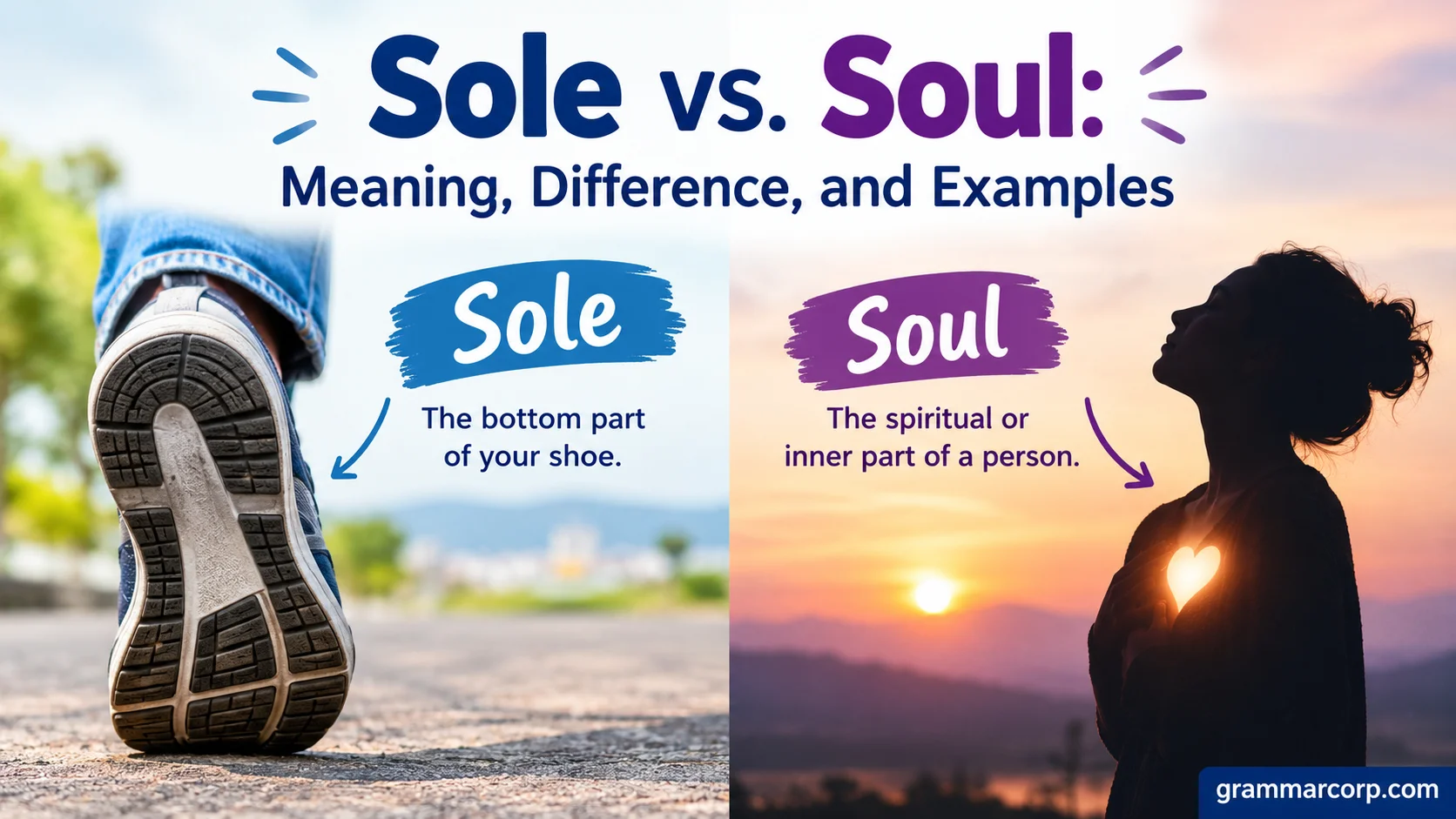
Sole vs. Soul: Meaning, Difference, and Examples explains why these English homophones cause confusion despite having identical pronunciation. In English grammar, sole means the only one or one of its kind, while soul refers to a person’s spirit. Many learners experience these learning difficulties during the initial stages of language learning because the words sound the same but have different meanings and spelling differences.
The word sole can describe the bottom of a foot, the bottom of your foot, the bottom of a shoe, or the sole of a shoe. In foot anatomy, it means the underside of the foot; in footwear, it refers to the part that touches the ground. Sole can also mean a flatfish or the act of putting a new sole on footwear. These word definitions demonstrate the different grammatical roles of the word and explain why context matters when deciding which spelling to use.
On the other hand, soul refers to a person’s spirit, spiritual essence, or the essence of your being. It can describe someone’s inner nature, emotional character, emotional qualities, and the human qualities that make a person as an individual unique. Its spiritual meaning connects with spirituality, feelings, and the deeper parts of human life. Understanding the difference between sole and soul is key to better word choice, correct spelling, and correct usage.
Quick Answer: Sole vs. Soul
Sole and soul are homophones. They have the same pronunciation but different spellings and meanings. Merriam-Webster defines a homophone as a word that sounds like another word while differing in meaning, spelling, or origin.
Use sole when you mean:
- Only or single — She was the sole winner.
- The bottom of a foot — The sole of my foot hurts.
- The bottom of a shoe — The sole of the boot is worn.
- A type of flatfish — They served grilled sole.
- To put a new sole on footwear — The repair shop will sole the shoes.
Use soul when you mean:
- A person’s spirit — She believes the soul continues after death.
- A person’s inner nature — He has a kind soul.
- A person or individual — Not a soul was there.
- Emotional or spiritual depth — The song has soul.
- Soul music or related cultural expressions — They listened to soul music.
A quick memory trick works well:
Sole = only, foot, shoe, or fish.
Soul = spirit, person, or inner nature.
Comparison Overview
Although sole and soul have the same pronunciation, they developed with different meanings and serve different grammatical purposes.
| Feature | Sole | Soul |
| Pronunciation | /soʊl/ | /soʊl/ |
| Type | Homophone | Homophone |
| Main meaning | Only or single | Spirit or inner self |
| Foot-related meaning | Yes | No |
| Shoe-related meaning | Yes | No |
| Fish meaning | Yes | No |
| Can mean a person | No | Yes |
| Can describe inner character | No | Yes |
| Common phrase | sole purpose | kind soul |
| Common grammatical role | Adjective, noun, verb | Noun |
The pronunciation is the biggest source of confusion. Both words are pronounced /soʊl/ in American English. Cambridge gives the same American pronunciation for both words.
However, their meanings quickly separate once you look at the sentence.
Consider these two examples:
- She was the sole owner of the business.
- She was a kind soul.
The first sentence uses sole because it means the person was the only owner. The second uses soul because it describes the person’s character.
Main Differences Between Sole vs. Soul
The simplest way to understand sole vs. soul is to group their meanings by context.
Sole Means Only or Single
One of the most common uses of sole is as an adjective meaning only, single, or exclusive.
For example:
- He was the sole survivor.
- That was her sole purpose.
- She has sole responsibility for the project.
- The company became the sole provider.
- He was the sole owner of the property.
When sole appears before a noun, ask whether it means only one or not shared with anyone else.
If it does, sole is the correct word.
Cambridge specifically defines this adjective use as being one only or single. It also gives examples involving sole responsibility and sole charge.
Soul Refers to Spirit or Inner Nature
Soul has a very different meaning.
It can refer to the spiritual or nonphysical part of a person. The exact idea varies among religious and philosophical traditions. In everyday English, however, soul can also refer more broadly to a person’s deepest emotional or moral nature.
For example:
- She believes every person has a soul.
- He has a generous soul.
- The experience touched her soul.
- The poem speaks to the human soul.
Here, soul has nothing to do with being the only person or with footwear.
Sole Can Refer to a Foot or Shoe
Sole also has a physical meaning. It refers to the underside of a foot or the bottom part of footwear that touches the ground.
Examples include:
- The sole of my foot was sore after the long walk.
- The boots have thick rubber soles.
- The shoe’s sole needs replacing.
- Water leaked through the damaged sole.
Cambridge and Merriam-Webster both identify the bottom of the foot and the bottom of footwear as meanings of sole.
Sole Can Also Mean a Type of Fish
There is another meaning that surprises some readers.
A sole is also a type of flatfish. You might see the word on a restaurant menu or in a discussion about seafood.
For example:
- The restaurant served lemon sole.
- The fisherman caught several sole.
- Dover sole appears on many traditional menus.
This meaning has no connection to feet, shoes, or the word soul. Cambridge identifies sole as a flat, round fish eaten as food.
Soul Can Mean a Person
In some expressions, soul means a person or individual.
For example:
- There wasn’t a soul in the building.
- Not a soul knew what had happened.
- Every soul deserves kindness.
- The poor soul looked exhausted.
Merriam-Webster includes person as one of the established meanings of soul.
This use often appears in expressions such as not a soul. In that phrase, soul does not specifically describe someone’s spiritual nature. It simply means a person.
What Does Sole Mean?
The word sole has several established meanings. Understanding all of them makes the sole vs. soul distinction much easier.
Sole as an Adjective
As an adjective, sole means only, single, or exclusive.
It commonly appears directly before a noun.
Examples:
- sole purpose
- sole reason
- sole owner
- sole responsibility
- sole survivor
- sole source
- sole authority
- sole provider
Consider the sentence:
Her sole objective was to finish the project.
Here, sole means that finishing the project was her only objective.
Another example:
He became the sole owner of the company.
This means he was the only owner.
Merriam-Webster also lists meanings involving something being the only one, having no sharer, or belonging exclusively to a specified person or group.
Sole as a Noun: The Bottom of the Foot
As a noun, sole can refer to the underside of your foot.
For example:
The sole of his foot touched the ground.
This is a physical meaning. You can usually identify it immediately because words such as foot, walking, shoe, or ground appear nearby.
Sole as a Noun: The Bottom of a Shoe
The same word describes the bottom part of a shoe.
Examples:
- The sole of the sneaker is damaged.
- These boots have thick soles.
- The leather sole needs repair.
- The rubber sole provides traction.
This is probably the easiest meaning to remember because sole and shoe often appear together.
Sole as a Noun: A Fish
A sole can also refer to certain flatfish.
This meaning is especially common in food and fishing contexts.
For example:
The chef prepared lemon sole with vegetables.
The surrounding words make it obvious that sole refers to fish rather than a foot or shoe.
Sole as a Verb
Sole can also function as a verb.
To sole a shoe means to put a new sole on it.
For example:
The cobbler will sole my old boots.
Merriam-Webster and Cambridge both recognize this verb meaning.
What Does Soul Mean?
Unlike sole, the word soul is primarily used as a noun.
Its meanings often relate to spirit, identity, emotion, character, or people.
Soul as a Spiritual Concept
One important meaning of soul refers to the spiritual or nonphysical part of a person.
Different religions and philosophies have different views about what a soul is and what happens to it. English uses the word broadly enough to discuss these ideas without requiring one particular religious interpretation.
For example:
The story explores the relationship between the body and the soul.
Cambridge describes this sense as the spiritual part of a person that some people believe continues to exist in some form after physical death.
Soul as a Person’s Inner Nature
In everyday English, soul often describes someone’s deepest character or emotional nature.
You might hear:
- kind soul
- gentle soul
- generous soul
- creative soul
- restless soul
- troubled soul
For example:
She is a kind soul who always helps others.
The speaker isn’t referring to a physical body part. Instead, soul highlights the person’s character.
Soul as a Person
English also uses soul to mean an individual person.
The phrase not a soul is especially common.
For example:
There wasn’t a soul at the station.
This simply means:
There wasn’t anyone at the station.
Merriam-Webster lists person as one of the established meanings of soul.
Soul and Emotional Depth
The word soul can also describe something that feels deeply emotional, sincere, or expressive.
For example:
She put her heart and soul into the project.
Here, soul emphasizes complete emotional commitment.
Another example:
The performance had real soul.
In this sentence, soul suggests emotional depth, feeling, or expressive power.
Sole vs. Soul Examples in Real Sentences
Seeing the two words in context is one of the fastest ways to understand the difference.
Examples of Sole Meaning Only
- She was the sole winner of the award.
- His sole goal was to finish the race.
- The manager has sole responsibility for the decision.
- This is the company’s sole source of income.
- She became the sole owner of the property.
In each sentence, sole means only or exclusive.
Examples of Sole Meaning Foot or Shoe
- The sole of my shoe is coming loose.
- He injured the sole of his foot.
- These boots have a thick rubber sole.
- The cobbler replaced the worn sole.
- The dirt covered the soles of their shoes.
Examples of Sole Meaning Fish
- The restaurant serves grilled sole.
- The chef prepared Dover sole.
- Fresh sole was available at the market.
Examples of Soul Meaning Spirit
- The poem explores the human soul.
- She believes the soul has a spiritual nature.
- The story examines the relationship between body and soul.
Examples of Soul Meaning Character
- He has a generous soul.
- She is a kind soul.
- That artist has a deeply creative soul.
- He is a gentle soul who cares about everyone around him.
Examples of Soul Meaning Person
- There wasn’t a soul in the room.
- Not a soul knew where they had gone.
- Every soul in the community heard the news.
Read More : More Smart vs Smarter: Which One Is Correct?
Sole vs. Soul: Side-by-Side Examples
| Meaning | Correct sentence |
| Only | She was the sole candidate. |
| Only | His sole purpose was to help. |
| Foot | The sole of her foot touched the ground. |
| Shoe | The sole of the boot was damaged. |
| Fish | We ordered grilled sole. |
| Spirit | The experience touched his soul. |
| Character | She is a compassionate soul. |
| Person | Not a soul was outside. |
| Emotional depth | The song has real soul. |
The important point is that pronunciation cannot help you distinguish these words when you hear them. Meaning and context do the work.
Common Sole vs. Soul Mistakes
Mistake: Writing Soul Reason Instead of Sole Reason
The correct phrase is:
My sole reason for leaving was the schedule.
Why? Because sole means only.
The phrase soul reason doesn’t make sense in standard usage.
Mistake: Writing Sole When You Mean Inner Character
Consider:
She is a kind soul.
Using sole here would change the meaning and produce an incorrect expression.
The word soul works because the sentence describes the person’s inner character.
Mistake: Confusing the Sole of the Foot With the Soul
The correct expression is:
the sole of the foot
Not:
the soul of the foot
The foot has a sole because sole refers to its underside.
Mistake: Thinking Sole Only Relates to Shoes
This is another common misunderstanding.
Sole has several meanings. It can mean only, refer to the underside of a foot, describe a shoe’s bottom, name a type of fish, or function as a verb related to footwear.
Mistake: Assuming Identical Pronunciation Means Identical Meaning
English contains many homophones.
Words can sound identical while having different spellings and meanings. Sole and soul are a clear example.
When you’re writing, don’t choose between them based on pronunciation. Instead, ask what the sentence actually means.
How to Remember Sole vs. Soul
A few simple associations can make this distinction almost automatic.
Remember Sole With Shoes
Think:
Sole → shoe
The sole is the part of a shoe that touches the ground.
This connection also helps you remember that sole can refer to the bottom of the foot.
Remember Sole With Only
Think:
Sole → single
If something is the only one, sole is usually the correct word.
For example:
- sole owner = only owner
- sole reason = only reason
- sole purpose = only purpose
- sole survivor = only survivor
Remember Soul With Spirit
Think:
Soul → spirit
When you’re talking about someone’s inner self, emotions, spiritual nature, or deep character, choose soul.
Examples include:
- kind soul
- human soul
- troubled soul
- soul of a person
Use the Context Test
When you’re unsure, ask yourself a few quick questions.
Does the word mean only or single?
→ Use sole.
Does it refer to a foot or shoe?
→ Use sole.
Does it refer to a fish?
→ Use sole.
Does it refer to someone’s spirit or inner nature?
→ Use soul.
Does it mean a person in an expression such as not a soul?
→ Use soul.
This simple test covers most everyday uses.
Sole vs. Soul Grammar Guide
Understanding grammar makes the difference even clearer.
How Sole Works as an Adjective
As an adjective, sole normally appears before a noun.
Examples:
- sole purpose
- sole responsibility
- sole owner
- sole survivor
- sole authority
It describes something that is only, single, or exclusive.
How Sole Works as a Noun
As a noun, sole can refer to:
- The underside of a foot
- The bottom of footwear
- A flatfish
For example:
The sole of the shoe is damaged.
How Sole Works as a Verb
As a verb, sole means to put a new sole on footwear.
Example:
The repair shop will sole the boots.
This use is less common in everyday conversation than the adjective and noun forms.
How Soul Works as a Noun
Soul is primarily a noun.
It can refer to:
- A spiritual or nonphysical aspect of a person
- A person’s inner character
- A person
- Emotional or moral depth
- Soul music and related cultural meanings
Merriam-Webster includes these different senses in its dictionary entry for soul.
Sole vs. Soul: A Simple Decision Guide
When you’re writing a sentence, don’t overthink the spelling.
Use this checklist:
| If you mean… | Use |
| Only one | sole |
| Exclusive responsibility | sole |
| Bottom of the foot | sole |
| Bottom of a shoe | sole |
| A type of flatfish | sole |
| Putting a new bottom on a shoe | sole |
| Spirit | soul |
| Inner nature | soul |
| A person in certain expressions | soul |
| Emotional depth | soul |
| Soul music | soul |
The context usually gives you the answer immediately.
FAQs:
1. What is the main difference between sole and soul?
Sole refers to the bottom of a foot or shoe, something that is the only one, or a type of flatfish. Soul refers to a person’s spirit, inner nature, or spiritual essence.
2. Are sole and soul homophones?
Yes, sole and soul are homophones because they have the same pronunciation but different spellings and meanings.
3. How do you use sole in a sentence?
You can use sole to describe the bottom of a shoe or something that is the only one. For example: “The sole of my shoe needs repair.” Another example is, “She was the sole owner of the business.”
4. How do you use soul in a sentence?
Soul often describes a person’s spirit, emotions, or inner nature. For example: “Music touches my soul.” It can also describe someone’s character or emotional depth.
5. How can I remember the difference between sole and soul?
Connect the sole with the sole of your shoe and soul with your spirit and feelings. Practicing sentences and paying attention to context can help you remember the correct spelling.
Conclusion:
Understanding sole vs. soul becomes easier when you remember that these homophones sound alike but have different meanings. Sole usually refers to the bottom of a foot or shoe, something unique or the only one, while soul describes a person’s spirit and inner nature.
Regular practice, clear examples, and attention to context can improve your spelling, vocabulary, and writing skills. By learning how to use both words correctly, you can communicate more clearly and avoid common English spelling mistakes.














1 thought on “Sole vs. Soul: Meaning, Difference, and Examples”