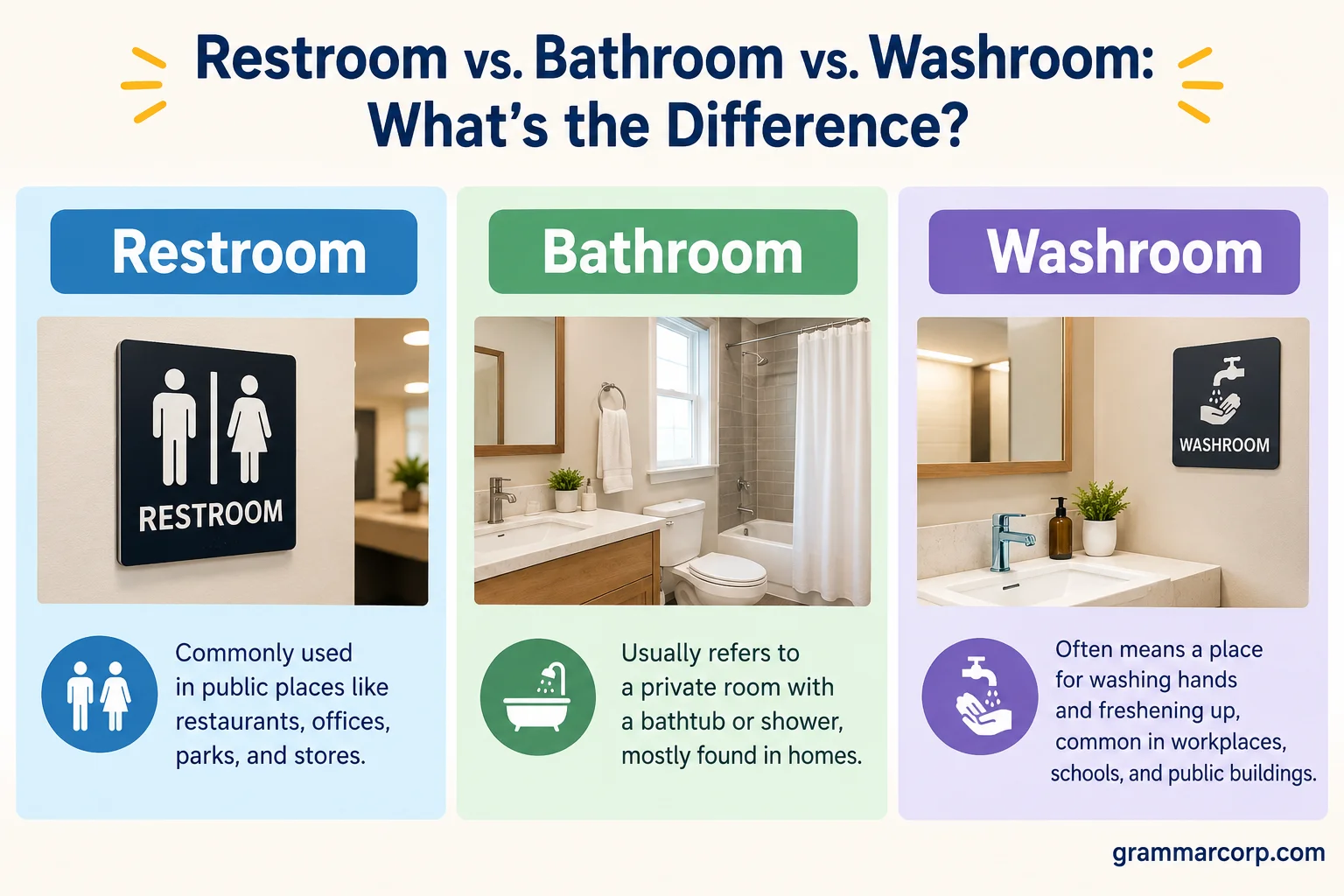
Restroom vs. Bathroom vs. Washroom: What’s the Difference? explains how regional English shapes everyday word choice in different countries. The difference between restroom, bathroom, and washroom becomes clearer when we consider how English speakers choose words differently according to where they live and the situation.
In the United States, bathroom is a normal, everyday word for a room containing a toilet and sink, while restroom is especially common in public places, including restaurants, theaters, and stores. In Canada, washroom is particularly common, while British English generally uses toilets. Although these terms describe similar facilities, their usage is shaped by regional English, context, and established usage, rather than by the physical room itself.
The correct choice often depends on where you are, who you are talking to, and whether the facility is private or public. When traveling, especially through a foreign airport, you may see signs pointing to a restroom, bathroom, or washroom. Different labels can seem confusing even when they lead to the same place, but they do not necessarily indicate a real difference in the facility.
At home, bathroom is usually the standard choice, because the room may contain a bath or shower, while public restrooms mainly provide toilets, hygiene facilities, and areas for hand washing. In American English, restroom sounds natural in formal and public places, while Canadian English often prefers washroom. These regional differences support better understanding when speaking with people from different regions.The main key differences relate to country, regional preference, official spaces, preferred term, meanings, distinctions, and local cleanliness expectations rather than strict definitions.
Quick Answer:
Restroom, bathroom, and washroom can all refer to a room containing toilet facilities, but their usual contexts differ.
- Bathroom: The most common general term in American English, including for facilities at home and in many public places.
- Restroom: Mainly used in American English for a public room containing toilets, such as in a restaurant or theater.
- Washroom: Especially common in Canadian English, particularly for public facilities.
- Toilet/toilets: The usual term in much of British English for the room or public facilities.
Oxford notes that North American English uses bathroom for a room containing a toilet, sink, and sometimes a bath or shower. It also identifies restroom as a North American term for a room with a toilet in a public place.
Cambridge similarly describes a restroom as a public room containing toilets and identifies washroom as a term for a room with a toilet and a place to wash your hands.
The simplest rule is this:
Use the word that sounds natural in the variety of English you’re speaking.
Comparison Overview
The fastest way to understand restroom vs. bathroom vs. washroom is to compare their typical meanings and settings.
| Term | Common Meaning | Most Typical Setting | Strongest Regional Association |
| Bathroom | A room with a toilet and washing facilities, often with a bath or shower | Homes and everyday conversation | U.S. and Canada |
| Restroom | A public room containing toilets | Restaurants, stores, theaters, airports | United States |
| Washroom | A room with toilet and washing facilities | Public buildings and facilities | Canada |
| Toilet / toilets | A toilet or a room containing toilets | Homes and public places | United Kingdom |
These categories aren’t absolute. A word can cross regional or situational boundaries.
For example, an American can say bathroom when asking for a public facility in a restaurant. Oxford specifically gives this kind of North American usage in its definition of bathroom.
Likewise, washrooms aren’t exclusively Canadian in every historical or dictionary context. Oxford describes it as especially Canadian English and also notes an older U.S. use.
The important distinction is what sounds natural to speakers in a particular place.
Main Differences Between Restroom vs. Bathroom vs. Washroom
The biggest differences involve regional preference and context, rather than completely different physical facilities.
Bathroom Usually Has the Broadest Everyday Use
In American English, bathroom has a broad meaning. It can describe a room at home, a hotel, a school, a restaurant, or another building.
You might say:
- The bathroom is upstairs.
- I need to use the bathroom.
- Where’s the bathroom?
- The hotel room has a private bathroom.
Oxford’s North American definition describes a bathroom as a room containing a toilet and sink and sometimes a bath or shower.
This explains an interesting point: despite the word bath in bathroom, a North American bathroom does not have to contain a bathtub.
A room with a toilet and sink can still commonly be called a bathroom in American English.
Restroom Usually Points to a Public Facility
The restroom has a narrower everyday association.
In American English, it commonly refers to a room containing toilets in a public or commercial building. Cambridge gives restaurants as one example, while Oxford mentions places such as theaters and restaurants.
For example:
- Where’s the restroom?
- The restrooms are near the entrance.
- The restaurant has two restrooms.
- The airport restroom was crowded.
The word doesn’t mean that people literally go there to “rest.” Its modern meaning is simply a conventional term for public toilet facilities.
Washroom Is Strongly Associated With Canadian English
Washroom is another general term for toilet facilities, but its regional identity is particularly important.
Oxford labels it Canadian English or old-fashioned U.S. English, while its American Dictionary describes it as especially Canadian English.
Cambridge defines a washroom as a room with a toilet and a place to wash your hands in a public setting such as a restaurant or school.
So a Canadian speaker might naturally ask:
Where’s the washroom?
An American speaker might be more likely to ask:
Where’s the restroom?
Both people are communicating the same basic idea.
What Does “Bathroom” Mean?
The word bathroom has two closely related patterns of use.
In a broad English sense, it can mean a room associated with bathing and washing. In North American English, however, it commonly means a room containing a toilet and sink, with a bath or shower sometimes included.
That regional distinction matters.
Bathroom in American English
American English uses the bathroom in both private and public contexts.
At home, it might refer to:
- A family bathroom
- A guest bathroom
- A master bathroom
- A small bathroom
- A bathroom connected to a bedroom
In public, Americans can also say:
- Where’s the bathroom?
- Is there a bathroom nearby?
- Can I use the bathroom?
Oxford specifically gives Where’s the bathroom? as an example of North American usage in a restaurant.
That means it would be inaccurate to claim that Americans only use bathrooms for private rooms.
Does a Bathroom Need a Bathtub?
No.
This is one of the most common misunderstandings surrounding the word.
A North American bathroom may contain:
- A toilet
- A sink
- A shower
- A bathtub
- A combination of these fixtures
The presence of a bathtub isn’t what makes the room a bathroom in everyday American English.
Cambridge’s American definition similarly describes a bathroom as a room with a toilet and place to wash your hands, often with a bathtub and shower.
Bathroom Examples
Consider these situations:
At home:
The bathroom is next to the bedroom.
At a hotel:
Our room has a private bathroom.
At a restaurant:
Excuse me, where’s the bathroom?
At school:
I need to use the bathroom.
In all four cases, the bathroom can sound completely natural in American English.
What Does “Restroom” Mean?
Restroom is primarily a North American term for a public room containing toilets.
Cambridge labels it mainly U.S. English and defines it as a room with toilets in a public place.
Oxford likewise labels restrooms as North American English and gives examples involving theaters, restaurants, and gas stations.
Where Do Americans Say “Restroom”?
You’re most likely to encounter the word in places such as:
- Restaurants
- Airports
- Shopping centers
- Theaters
- Museums
- Gas stations
- Offices
- Public buildings
- Sports venues
Signs may say:
- Restrooms
- Men’s Restroom
- Women’s Restroom
- Family Restroom
The word can therefore feel especially natural in public-facing language.
Restroom vs. Bathroom in the United States
Here’s where the distinction becomes useful.
Imagine you’re visiting a friend.
You might ask:
Where’s the bathroom?
Now imagine you’re at a restaurant.
You might ask:
Where’s the restroom?
But you could also say:
Where’s the bathroom?
That second sentence isn’t wrong. American English allows both depending on the speaker and setting.
The distinction is therefore a preference, not an unbreakable grammar rule.
What Does “Washroom” Mean?
Washroom refers to a room containing toilet and washing facilities. Its strongest modern regional association is Canadian English.
Washroom in Canada
Canadian speakers commonly use washroom in situations where Americans may choose restroom.
For example:
- Where’s the washroom?
- The washrooms are downstairs.
- The restaurant has clean washrooms.
- The washroom is beside the elevator.
This doesn’t mean Canadians never say bathroom. They certainly do.
Instead, washroom is an especially recognizable Canadian choice for public facilities.
Why Does “Washroom” Sound Different to Americans?
English develops differently in different places.
Americans grew accustomed to terms such as bathroom and restroom. Canadians commonly use washroom as well.
Neither choice is inherently more correct.
It’s similar to other regional differences in English. Vocabulary can reveal where a speaker learned or regularly uses the language.
Restroom vs. Bathroom vs. Washroom by Country
Regional English makes this comparison much easier to understand.
United States
The typical pattern is:
- Bathroom — common at home and widely used in everyday speech
- Restroom — especially common for public facilities
- Washroom — understood but less common
Oxford explicitly describes bathroom as the North American term for a room containing a toilet and identifies restroom as a public-place term.
Canada
The pattern is somewhat different:
- Bathroom — widely understood and commonly used
- Washroom — especially common for public facilities
- Restroom — understood but less strongly associated with Canadian English
Oxford’s American Dictionary specifically marks washroom as especially Canadian English.
United Kingdom
British English uses a different vocabulary pattern.
The everyday term is commonly:
- Toilet
- Toilets
You may also encounter:
- Lavatory
- Loo
- WC
- Gents
- Ladies
Oxford explains that British English commonly refers to a room containing a toilet as the toilet, whereas North American English normally uses a bathroom.
Cambridge also labels restrooms mainly U.S. English and notes that British English usually uses toilets.
Regional Comparison Table
| Situation | United States | Canada | United Kingdom |
| Bathroom at home | Bathroom | Bathroom | Bathroom / toilet |
| Public facility | Restroom / bathroom | Washroom / bathroom | Toilets |
| Common public sign | Restrooms | Washrooms | Toilets |
| Informal term | Bathroom | Washroom / bathroom | Loo |
| Formal term | Restroom | Washroom | Lavatory |
These are usage patterns, not laws. Individual speakers may choose different words.
Restroom vs. Bathroom: Which One Should Americans Use?
If you’re writing or speaking American English, you don’t need to worry about choosing the “correct” word every time.
Instead, think about the setting.
Use “Bathroom” When Talking About a Home
Examples:
- My bathroom is upstairs.
- The bathroom needs cleaning.
- There’s a bathroom next to the kitchen.
This is the most straightforward choice.
Use “Restroom” for Public Facilities
Examples:
- The restroom is near the lobby.
- Where are the restrooms?
- The theater has several restrooms.
This wording fits signs, customer service, and public spaces especially well.
Use Either When Asking a Casual Question
At a restaurant, both of these can sound natural in American English:
- Where’s the bathroom?
- Where’s the restroom?
The second emphasizes the public setting. The first is simply broader.
Bathroom vs. Washroom: Which One Should You Use?
The answer depends heavily on location.
If you’re speaking American English, the bathroom will generally sound more familiar than the washroom.
If you’re speaking Canadian English, a washroom can sound completely ordinary, especially when referring to public facilities.
For example:
| Situation | American English | Canadian English |
| Asking in a restaurant | Where’s the restroom? | Where’s the washroom? |
| Talking about home | Where’s the bathroom? | Where’s the bathroom? |
| Reading a public sign | Restrooms | Washrooms |
Again, these aren’t rigid rules.
A Canadian can say bathroom. An American can understand washroom. The difference is mainly one of regional preference and familiarity.
Restroom vs. Washroom: Are They the Same?
For most practical purposes, yes.
Both words can describe a public room containing toilet facilities.
The biggest distinction is regional usage.
Restroom strongly points toward American English.
Washroom strongly points toward Canadian English.
Cambridge defines restroom as a public room with toilets and washroom as a room with a toilet and a place to wash your hands, particularly in public settings.
So the physical difference isn’t necessarily significant. The linguistic difference is.
Read More : Shed Some Light On: Meaning, Examples, Origin, and Usage
Restroom, Bathroom, Washroom, and Toilet
The word toilet deserves special attention because British and North American English handle it differently.
In British English, toilet can refer to the room itself.
In North American English, speakers generally use bathroom for that room and toilet more specifically for the fixture. Oxford highlights this British/American distinction directly.
A Simple Comparison
| Word | What It Commonly Refers To |
| Bathroom | The room, especially in North American English |
| Restroom | A public toilet facility, especially in U.S. English |
| Washroom | A public toilet/washing facility, especially in Canada |
| Toilet | The fixture; also the room in British English |
This distinction prevents a common mistake: assuming that toilet always means exactly the same thing everywhere English is spoken.
Real-Life Examples of Restroom vs. Bathroom vs. Washroom
Context makes these words much easier to remember.
At Home
Natural American English:
The bathroom is at the end of the hallway.
A speaker isn’t usually concerned with whether the room contains a bathtub. The word simply identifies the household room.
At a Restaurant in the U.S.
Natural options:
Where’s the restroom?
or
Where’s the bathroom?
Both work. Restroom emphasizes the public setting.
At a Canadian Restaurant
A natural choice:
Where’s the washroom?
That’s a strong example of regional vocabulary in action.
At a British Hotel
A natural question:
Where are the toilets?
British English commonly uses toilet or toilets where American English might use bathroom or restroom.
A Practical Case Study: One Room, Three Names
Imagine the same physical facility exists inside three restaurants.
The room contains toilets, sinks, mirrors, and handwashing supplies.
The American restaurant might put up a sign saying:
Restrooms
The Canadian restaurant might use:
Washrooms
The British restaurant might use:
Toilets
The facility hasn’t fundamentally changed.
The vocabulary has.
That’s the key idea behind restroom vs. bathroom vs. washroom.
Language doesn’t always classify objects by their physical characteristics. Sometimes it reflects regional convention, social setting, and historical usage.
Common Mistakes to Avoid
Mistake: Saying “Bathroom” Always Means a Room With a Bathtub
That’s too narrow for North American English.
American dictionaries and learner dictionaries recognize bathroom as a room with a toilet and sink that may also contain a bath or shower.
Mistake: Saying “Restroom” Is Only Used in America
It’s more accurate to say that restroom is mainly associated with American English. Other English speakers may understand it perfectly well. Cambridge labels it mainly U.S. English.
Mistake: Saying Canadians Never Say “Bathroom”
That’s incorrect.
Canadians use the bathroom too. Washroom simply has a particularly strong Canadian association.
Mistake: Saying “Washroom” Is the British Term
It isn’t the standard everyday British choice.
British English commonly uses toilet/toilets, while washroom is particularly associated with Canadian English.
Mistake: Treating the Terms as Completely Different Rooms
Usually, they aren’t.
The same basic facility can be called a bathroom, restroom, washroom, or toilet depending on the speaker and region.
Which Word Is Best for a Public Sign?
If you’re creating signage, the intended audience matters.
In the United States
Restrooms is a natural public-facing choice.
You may also see:
- Men’s Restroom
- Women’s Restroom
- Family Restroom
In Canada
Washrooms is a natural choice, particularly for public facilities.
In the United Kingdom
Toilets is the straightforward choice.
You may also encounter:
- Gents
- Ladies
- WC
- Accessible Toilet
Oxford notes that British public signs can use toilets, Gents, Ladies, WC, and other related labels.
FAQs:
1. Are restrooms and bathrooms the same thing?
In everyday American English, restroom and bathroom can refer to the same basic facility. However, the bathroom is more common for private spaces at home, while the restroom is often used for public facilities.
2. Is washroom more common in Canada?
Yes. Washroom is a common term in Canadian English, particularly when referring to public facilities. The term is also understood in other English-speaking regions.
3. Why do Americans say restroom instead of toilet?
In American English, restroom is often considered a more polite and appropriate term for public facilities. Toilet can refer specifically to the fixture, although British English commonly uses toilet to mean the entire facility.
4. Should I say bathroom or restroom in public?
Both can be understood in the United States, but restroom is especially common for public places such as restaurants, stores, theaters, and airports. Bathroom is also widely used in casual speech.
5. Which word should English learners use?
The best word depends on the country and setting. Bathroom is widely understood, while restroom is common in American English and washroom is particularly common in Canadian English. Paying attention to local usage can help you communicate naturally.
Conclusion:
The difference between restroom, bathroom, and washroom is mainly connected to regional English, context, and everyday usage rather than major differences in the facilities themselves.
Bathroom is common for private spaces and is widely used in American English, restroom is especially common for public facilities in the United States, and washroom is strongly associated with Canadian English.
Understanding these regional preferences can help you choose the appropriate term when traveling, studying English, or communicating with people from different regions.













1 thought on “Restroom vs. Bathroom vs. Washroom: What’s the Difference?”