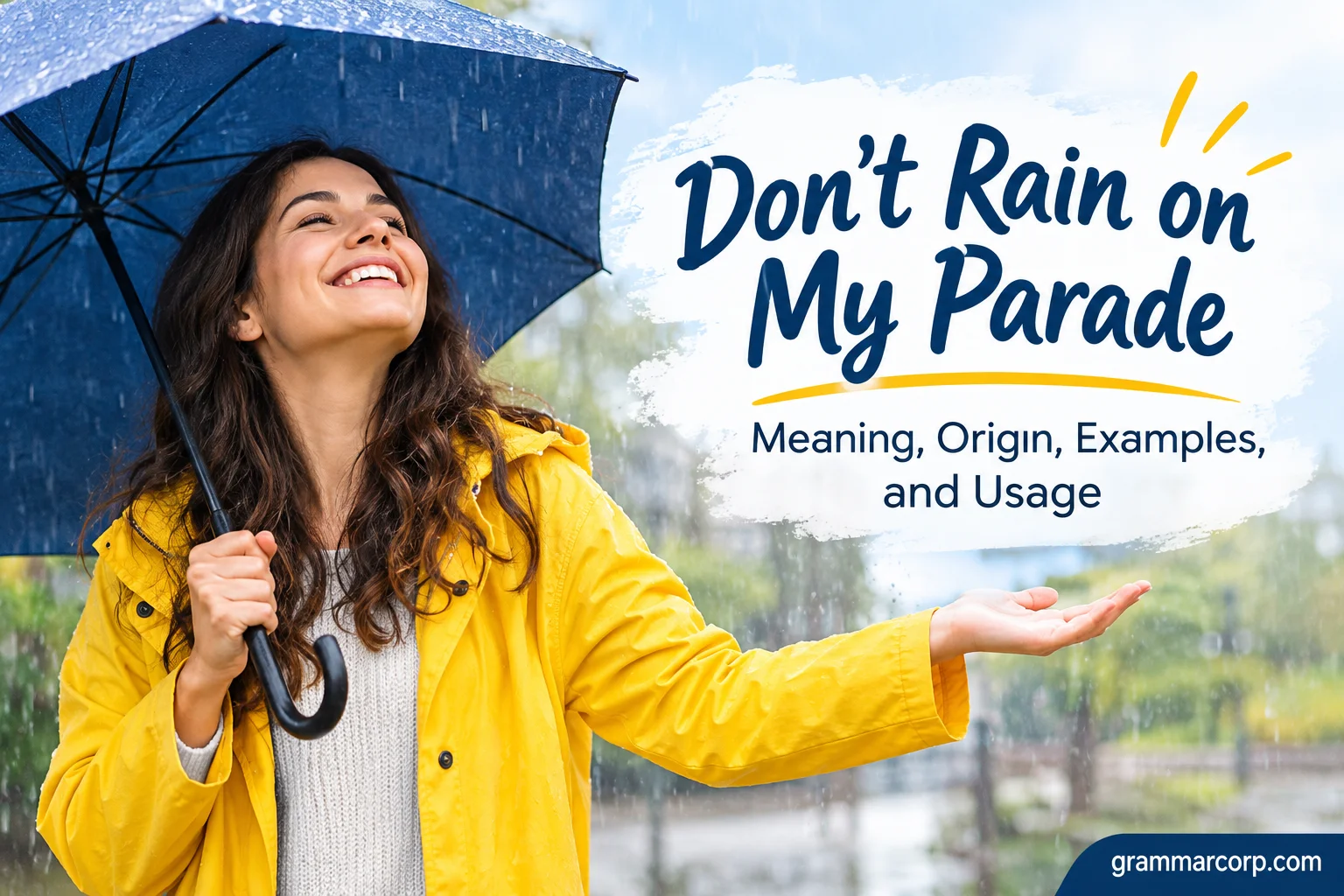
Don’t Rain on My Parade: Meaning, Origin, Examples, and Usage explains how this common English expression works in daily life and everyday conversations. The English idiom and popular phrase are used when someone or another person is asked not to spoil happiness, plans, a positive mood, or a positive feeling.
Its meaning comes from the idea of rain ruining a parade, while parades represent a joyful event, celebration, and fun. In ordinary situations, people may use it when they are excited, happy, proud, or hopeful, especially while celebrating a new job, planning a trip, or sharing good news. It can respond to someone who immediately points out a long commute, bad weather, or a list of problems and starts ruining the mood.
That moment helped me understand meaning and see how the phrase relates to protecting happiness from anything that might spoil plans or fun. Movies and songs, along with casual talking and using it in sentences, can help learners understand natural use. For learners, the phrase may feel like one of the secret codes of English, a vast language full of idioms, because its literal meaning differs from the whole expression and real meaning and has nothing to do with actual rain falling on a parade.
Quick Answer:
Don’t rain on my parade means don’t spoil my happiness, excitement, plans, or enjoyment by being negative or pointing out problems.
The phrase uses a simple picture: imagine preparing for an exciting parade only for heavy rain to ruin it. In the figurative sense, another person’s negativity becomes the rain that threatens to spoil your good moment.
For example:
I know there might be a few challenges, but don’t rain on my parade. I’m excited about the opportunity.
The speaker isn’t necessarily saying that the other person is wrong. Instead, they’re asking them to stop focusing on the negative right now.
The expression can carry different tones:
- Playful: Don’t rain on my parade! Let me enjoy this.
- Annoyed: Seriously, don’t rain on my parade right now.
- Defensive: I understand your concern, but don’t rain on my parade.
- Humorous: Don’t rain on my parade. I’ve already planned my victory speech.
So, context matters.
Comparison Overview
Don’t rain on my parade belongs to a large group of English expressions about protecting your happiness from negativity. However, similar phrases don’t always carry exactly the same meaning.
| Expression | Basic meaning | Tone | Best use |
| Don’t rain on my parade | Don’t spoil my happiness or plans | Playful to annoyed | Everyday conversation |
| Don’t burst my bubble | Don’t destroy my excitement or optimism | Casual | Good news and excitement |
| Don’t kill my vibe | Don’t ruin my mood | Very casual | Friends and social settings |
| Don’t spoil my fun | Don’t stop me from enjoying myself | Direct | Casual situations |
| Don’t put a damper on it | Don’t reduce the enjoyment | Neutral | Broader situations |
| Don’t be a downer | Stop bringing negativity | Casual | Friends and informal talk |
| Let me enjoy this | Give me space to enjoy the moment | Direct | Most situations |
The important distinction is that don’t rain on my parade often focuses on someone’s attempt to spoil an otherwise positive situation.
Main Differences Between Don’t Rain on My Parade Expressions
Not every phrase about negativity works in exactly the same situation.
Understanding these small differences helps you sound more natural.
Don’t Rain on My Parade vs. Don’t Burst My Bubble
These expressions are close cousins.
Don’t rain on my parade usually refers to someone interfering with your happiness, plans, or celebration.
Don’t burst my bubble often focuses more specifically on destroying someone’s excitement, optimism, or pleasant belief.
For example:
- I finally booked the vacation. Don’t rain on my parade.
- I know the hotel has mixed reviews, but don’t burst my bubble yet.
The second example suggests that the speaker wants to preserve their excitement or optimism.
Don’t Rain on My Parade vs. Don’t Kill My Vibe
Don’t kill my vibe sounds more modern and highly casual.
It usually means don’t ruin my mood or positive energy.
For example:
We’re having a great time, so don’t kill my vibe.
Meanwhile:
Don’t rain on my parade. I’m celebrating tonight.
The first focuses on mood. The second can involve mood, plans, excitement, or celebration.
Don’t Rain on My Parade vs. Don’t Put a Damper on It
Don’t put a damper on it sounds slightly more neutral and less playful.
You might use it when something threatens to reduce the enjoyment of an event.
For example:
The unexpected delay put a damper on the party.
You can also tell someone:
Don’t put a damper on things.
This sounds less personal than don’t rain on my parade.
Don’t Rain on My Parade vs. Don’t Be a Downer
A downer is someone or something that makes a situation less enjoyable or cheerful.
For example:
Don’t be a downer. We just got here.
This phrase focuses strongly on someone’s negative attitude.
Don’t rain on my parade puts more emphasis on the effect that negativity has on your happiness, plans, or celebration.
What Does Don’t Rain on My Parade Mean?
At its heart, don’t rain on my parade means:
Please don’t spoil this positive moment for me.
The phrase works because its imagery is easy to understand. A parade represents something lively, exciting, colorful, and worth celebrating. Rain can interrupt or ruin an outdoor event.
The idiom transfers that physical image into an emotional situation.
Your parade might represent:
- A personal achievement
- A new opportunity
- A celebration
- A vacation
- A relationship milestone
- A fun plan
- Exciting news
- A personal decision
- A moment of optimism
- Something you’ve worked hard to accomplish
The rain represents the criticism, negativity, doubt, complaint, or bad news that threatens to spoil the experience.
Why the Phrase Is So Effective
English has many idioms based on weather because weather provides an easy way to describe emotions and circumstances.
Think about expressions such as:
- Under the weather
- A storm is brewing
- Every cloud has a silver lining
- Save it for a rainy day
- Come rain or shine
Don’t rain on my parade fits naturally into this family of metaphorical expressions.
The phrase creates a small mental picture. You can almost see someone preparing for a celebration while another person walks over carrying a giant metaphorical rain cloud.
That’s why the expression feels more colorful than simply saying:
Stop being negative.
Both statements communicate frustration. The idiom adds personality.
What Does Parade Mean Figuratively?
In this expression, parade doesn’t have to mean an actual parade.
Instead, it represents something you’re enjoying or celebrating.
Your parade could be as small as getting your favorite dessert or as important as receiving a major opportunity.
For example:
I know the new job will be challenging, but don’t rain on my parade. I’m proud that I got it.
Here, the parade represents the speaker’s excitement about the new job.
Where Did Don’t Rain on My Parade Come From?
The expression draws on a straightforward metaphor: rain can spoil an outdoor celebration such as a parade.
The figurative idea is therefore easy to understand. If rain can interfere with a physical parade, negativity can interfere with someone’s emotional celebration.
The phrase became especially well known through popular culture in the 20th century.
One major milestone came in 1964, when Don’t Rain on My Parade became a well-known song from the musical Funny Girl. The musical starred Barbra Streisand in the role of Fanny Brice. Streisand later became strongly associated with the song through her performances and recordings.
The cultural popularity of Funny Girl helped make the expression even more recognizable to a broad audience.
However, it’s important to separate popularization from invention. The song title helped cement the phrase in popular culture, but that doesn’t mean the musical necessarily created the underlying idiomatic expression.
The Famous Musical Connection
In Funny Girl, the phrase appears as part of Fanny Brice’s determined attitude.
The title captures a powerful idea: don’t interfere with my plans or enthusiasm simply because you see obstacles.
That message fits the idiom’s everyday meaning remarkably well.
The phrase has since appeared in conversations, writing, entertainment, headlines, and humorous situations.
Why Weather Metaphors Work
Weather gives English speakers a convenient vocabulary for describing emotional changes.
Rain can suggest disappointment. Sunshine can suggest happiness. Storms can suggest trouble. Clouds can suggest uncertainty.
Because people already understand these physical experiences, the metaphors require little explanation.
That’s one reason don’t rain on my parade has such staying power.
How to Use Don’t Rain on My Parade in a Sentence
The phrase usually appears when someone introduces negativity into a situation that the speaker sees as positive.
You can use it at the beginning, middle, or end of a sentence.
Examples With Good News
I got accepted into the program, so don’t rain on my parade by telling me everything that could go wrong.
Here, the speaker wants to celebrate the acceptance before discussing possible problems.
I finally finished the project. Don’t rain on my parade with another list of changes.
The phrase signals frustration because the speaker expected recognition rather than more criticism.
Examples About Plans
We’re going to the beach tomorrow. Don’t rain on my parade with another weather warning.
This example can sound humorous if the weather concern isn’t serious.
I know the trip requires planning, but don’t rain on my parade. I’m excited to go.
The speaker acknowledges the practical issue while still protecting their excitement.
Examples With Friends
I found an amazing deal on these tickets. Don’t rain on my parade!
This sounds light and playful.
Don’t rain on my parade. I’ve been looking forward to this all week.
The second version sounds more emotionally direct.
Examples at Work
The expression can work at work, but you should consider your audience.
I know the new project has risks, but let’s not rain on the team’s parade before we get started.
This version softens the expression by applying it to the team’s mood rather than directly accusing one person.
However, you might choose a more professional alternative in a formal meeting:
Let’s focus on the opportunity first. We can discuss the risks afterward.
That communicates the same basic idea without sounding overly casual.
Is Don’t Rain on My Parade Rude or Offensive?
No, the phrase isn’t inherently rude or offensive.
Still, it can sound dismissive depending on how you say it.
Imagine a friend tells you that your exciting plan has one obvious problem. You laugh and say:
Don’t rain on my parade!
That will probably sound playful.
Now imagine someone is giving you serious advice about an important decision. You interrupt them with:
Don’t rain on my parade.
That could sound like you’re refusing to listen.
The words haven’t changed. The context has.
Tone Makes the Difference
| Tone | Example | Likely impression |
| Playful | Don’t rain on my parade! | Lighthearted |
| Excited | Don’t rain on my parade. I’m celebrating! | Enthusiastic |
| Annoyed | Stop raining on my parade already. | Irritated |
| Defensive | I hear you, but don’t rain on my parade. | Guarded |
| Sarcastic | Sure, don’t rain on my parade or anything. | Potentially confrontational |
When It Can Sound Dismissive
The phrase can become dismissive when someone uses it to reject every reasonable concern.
For example, imagine a person is about to make an important decision. A friend points out a genuine problem.
Responding with don’t rain on my parade might shut down a useful conversation.
In that case, a better response could be:
I appreciate the warning. Let me enjoy the good news first, then we can talk about the risks.
That’s a more balanced approach.
You don’t have to choose between celebrating good news and listening to useful advice.
Sometimes you can do both.
Common Situations Where People Say Don’t Rain on My Parade
The expression fits many everyday scenarios.
Celebrating an Achievement
You worked hard and finally reached your goal.
Someone immediately explains why the achievement isn’t as impressive as you think.
Don’t rain on my parade lets you push back without launching into a long argument.
Planning a Vacation
You’re excited about an upcoming trip.
A friend starts listing flight delays, hotel complaints, traffic, and possible weather problems.
You might jokingly say:
Don’t rain on my parade. I’ve already packed my bags.
Getting a New Job
You receive an offer you’ve wanted for months.
Someone immediately points out the commute and workload.
You could say:
I know it’ll be challenging, but don’t rain on my parade. I’m really happy about it.
Winning a Competition
You win something and want to enjoy the moment.
A friend starts explaining how the competition wasn’t particularly difficult.
A playful response might be:
Hey, don’t rain on my parade. Let me enjoy the win.
Making a Personal Plan
You’ve decided to try something new.
Someone immediately predicts failure.
The idiom gives you a short way to defend your enthusiasm.
Don’t rain on my parade before I’ve even started.
Don’t Rain on My Parade: Synonyms and Alternatives
Sometimes you want the same message without using an idiom.
The best alternative depends on how strongly you want to respond.
Friendly Alternatives
- Let me enjoy this.
- Don’t spoil the fun.
- Let me have my moment.
- I’m just enjoying the good news.
- Give me a minute to celebrate.
These work well when you don’t want to sound confrontational.
Playful Alternatives
- Don’t burst my bubble.
- Don’t be a downer.
- Don’t kill my vibe.
- Let me enjoy my victory lap.
- Save the negativity for later.
These expressions fit casual conversations with friends.
More Direct Alternatives
- Don’t ruin this for me.
- Stop putting a negative spin on it.
- I don’t need the negativity right now.
- Please don’t turn this into a problem.
- Let me enjoy the moment before we discuss the issues.
These choices make your meaning clearer.
More Professional Alternatives
If you’re speaking in a workplace or formal setting, consider:
- Let’s focus on the positive for a moment.
- Let’s celebrate the achievement before discussing the challenges.
- I’d like to enjoy the good news before we focus on the risks.
- We can address the concerns after we acknowledge the success.
- Let’s not overlook the positive side of this opportunity.
These versions preserve the underlying message without relying on casual idiomatic language.
Read More : Prove vs Proof: Meaning, Differences, and How to Use
Common Mistakes When Using Don’t Rain on My Parade
The expression is simple, but a few mistakes can make it sound unnatural.
Taking It Literally
Someone unfamiliar with idioms might picture an actual parade.
In everyday English, the phrase is usually figurative.
It normally means someone is threatening to spoil your happiness or plans.
Assuming It Always Means Anger
The phrase doesn’t automatically indicate anger.
A person might say it with a laugh.
Don’t rain on my parade! I finally got the last slice of pizza.
The statement is obviously playful.
However, the same phrase can express genuine irritation in a serious conversation.
Using It in Formal Writing Without Considering Tone
Idioms aren’t automatically inappropriate in professional writing. However, don’t rain on my parade has a distinctly conversational flavor.
In a formal report, a clearer phrase may work better.
Instead of:
The criticism could rain on our parade.
You might write:
The criticism could undermine the team’s enthusiasm.
Assuming the Phrase Means Nobody Can Disagree
This is one of the most important points.
Don’t rain on my parade expresses a speaker’s desire to protect a positive moment. It doesn’t prove that the criticism is wrong.
Someone can be excited about an opportunity while still benefiting from honest feedback.
The phrase describes the speaker’s emotional response. It doesn’t settle the underlying argument.
Real-World Tone Case Study: How Context Changes the Meaning
Consider the same phrase in three different conversations.
Case One: Friends
Friend: You finally finished your exam!
You: Yes! Don’t rain on my parade. I’m celebrating tonight.
Tone: Playful and celebratory.
There’s little risk of offense because the context is clearly positive.
Case Two: Workplace
Coworker: The new project could have several serious problems.
You: Don’t rain on my parade. I’m excited about it.
Tone: Potentially defensive.
The speaker may sound as though they don’t want to hear legitimate concerns.
A better version might be:
I’m excited about it. Let’s go through the risks after we’ve looked at the opportunity.
Case Three: Sarcasm
Friend: Your team won by one point.
You: Wow, don’t rain on my parade.
Tone: Sarcastic or humorous.
Here, the phrase may imply that the friend is deliberately minimizing the victory.
The same five words can therefore communicate very different emotions.
What Is the Opposite of Don’t Rain on My Parade?
There isn’t one exact opposite idiom.
However, several expressions communicate the opposite idea.
They focus on supporting someone’s happiness rather than spoiling it.
Examples include:
- Celebrate with me.
- Share my excitement.
- Support my idea.
- Let me enjoy this.
- Encourage me.
- Cheer me on.
- Help me celebrate.
- Look on the bright side.
The contrast is simple:
Don’t rain on my parade = Don’t spoil my positive moment.
Celebrate with me = Join me in enjoying the positive moment.
Is Don’t Rain on My Parade Still Common?
Yes. The expression remains recognizable and useful in modern English, particularly in informal conversation.
Its staying power comes partly from its strong imagery. You don’t need to explain what rain can do to an outdoor celebration.
The phrase also remains culturally familiar because of its association with Funny Girl and the famous song of the same name.
At the same time, everyday speakers have many newer alternatives.
Someone might say:
- Don’t kill my vibe.
- Don’t burst my bubble.
- Don’t be a downer.
- Let me have my moment.
- Don’t ruin this for me.
So, not raining on my parade isn’t the only option. It remains a colorful one.
FAQs:
1. What does “Don’t Rain on My Parade” mean?
Don’t rain on my parade means “don’t spoil my happiness, plans, excitement, or positive mood.” It is commonly used when someone makes negative comments about something that another person is enjoying or looking forward to.
2. Where did “Don’t Rain on My Parade” come from?
The expression is based on the image of rain ruining a parade, an event usually connected with celebration and happiness. The phrase later developed into a colorful English idiom about protecting someone’s positive feelings or plans.
3. Is “Don’t Rain on My Parade” rude?
It depends on the tone and context. With friends, it can sound playful or humorous. In a more serious conversation, it can sound direct or mildly annoyed, especially when someone repeatedly criticizes your choices or plans.
4. How can I use “Don’t Rain on My Parade” in a sentence?
You can use it when someone is making negative comments about something that makes you happy. For example: “I know the trip may be difficult, but don’t rain on my parade—I’m really excited about it.”
5. Is “Don’t Rain on My Parade” used in everyday English?
Yes. It is a familiar and colorful expression that can appear in casual conversations, movies, songs, friendly chats, and other everyday situations. Understanding the context helps you use it naturally.
Conclusion:
Don’t Rain on My Parade is a useful and memorable English idiom for talking about happiness, excitement, plans, and unwanted criticism. Its connection with a real parade makes the expression easy to understand: just as rain can spoil a joyful event, negative comments can spoil someone’s positive mood.
Whether you use it in everyday conversations, friendly chats, or informal writing, paying attention to the tone and context will help you use this phrase naturally and confidently.














1 thought on “Don’t Rain on My Parade: Meaning, Origin, Examples, and Usage”