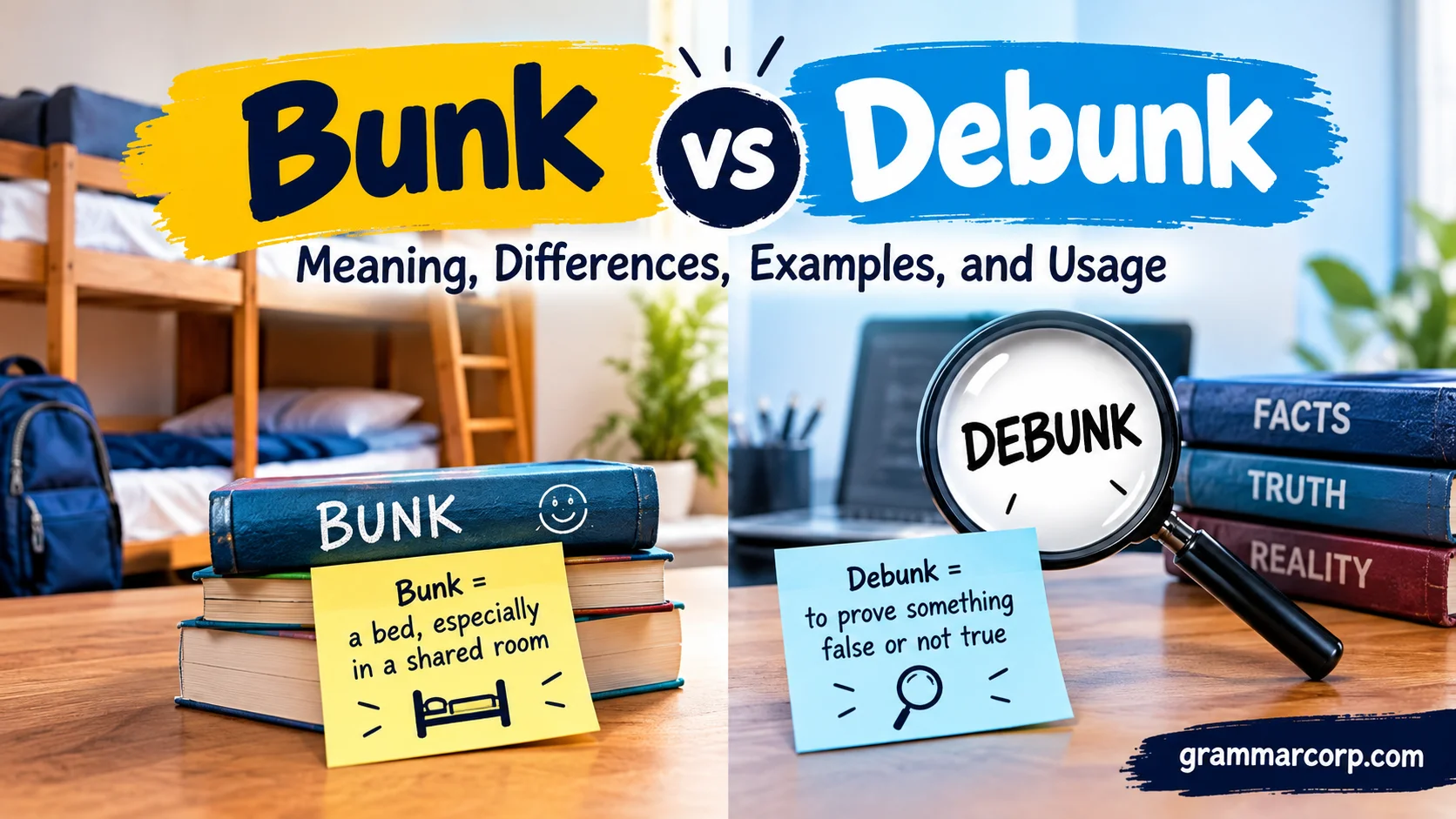
Bunk vs Debunk: Meaning, Differences, Examples, and Usage explains why these English words are closely related but have different roles and mean different things. If you have ever wondered whether they are the same, you are not alone. Their meaning, differences, examples, usage, and spelling become clearer through context and common usage. Bunk can describe nonsense, foolishness, untrue statements, empty talk, false information, a misconception, or misleading, exaggerated claims that are a sham. It can also mean a sleeping place or narrow bed. In my experience, knowing this background makes the word easier to remember and use correctly.
The small de- in debunk changes the job the word performs. You can call a claim, myth, theory, or belief bunk, but to debunk it means to prove something false, expose it, challenge it, or show that it does not hold up. The difference in their meanings also explains their grammatical roles. Evidence, proof, facts, logic, careful analysis, critical thinking, and factual accuracy can help correct misunderstandings and determine whether a claim has credibility.
This distinction is especially important in today’s digital world, where social media can help misinformation, fake news, and unverified content spread quickly among users. Fact checking, truth verification, and logical reasoning are essential for responsible communication and strong critical thinking skills. Journalists, researchers, and educators often work to debunk myths, examine claims that lack evidence, and improve public understanding through accurate information.
Quick Answer:
Bunk usually means nonsense, foolish talk, or something that isn’t true. It can also mean a bed or sleeping place, especially in a ship, train, camp, or bunk bed.
Debunk means to expose something as false, misleading, exaggerated, or sham. It works as a verb.
The simplest way to remember the difference is:
Bunk is nonsense. Debunk is the act of exposing it.
For example:
- The rumor is bunk.
- The journalist debunked the rumor.
- His theory sounds like bunk.
- Researchers debunked the theory.
Merriam-Webster defines debunk as exposing the “sham or falseness” of something and records its first known use as 1923.
Comparison Overview
The easiest way to understand bunk vs debunk is to compare their basic functions.
| Feature | Bunk | Debunk |
| Main meaning | Nonsense or something untrue | Expose something as false or misleading |
| Common grammatical role | Noun; also verb for sleeping | Verb |
| Pronunciation | /bʌŋk/ | /diːˈbʌŋk/ |
| Example | That story is bunk. | She debunked the story. |
| Typical objects | Claims, ideas, stories, theories | Myths, rumors, claims, theories, legends |
| Tone | Informal | Informal but widely used |
| Related idea | Nonsense | Removing or exposing the nonsense |
| Other meaning | Bed or sleeping place | No unrelated everyday meaning comparable to “bed” |
Cambridge Dictionary describes bunk as informal language for complete nonsense or something untrue. It also lists its separate meaning as a bed or sleeping place. Cambridge defines debunk as showing that something isn’t true or isn’t as important, good, or true as people have made it appear.
So while the two words share a linguistic connection, you cannot normally substitute one for the other.
Main Differences Between Bunk vs Debunk
The biggest difference between bunk vs debunk comes down to description versus action.
Bunk describes something as nonsense.
Debunk describes the action of exposing that nonsense or showing that a claim is false.
Consider this pair:
- The rumor is bunk.
- The reporter debunked the rumor.
The first sentence describes the rumor.
The second sentence describes what the reporter did.
Bunk Describes the Claim
When you use bunk to mean nonsense, you’re making a judgment about an idea, statement, story, or claim.
For example:
His explanation is complete bunk.
Here, bunk describes the explanation as nonsense.
You could also say:
- The theory is bunk.
- That excuse sounds like bunk.
- The advertisement contains a lot of bunk.
- She dismissed the story as bunk.
The word often carries a dismissive tone. It tells the reader or listener that the speaker considers something foolish, unreliable, or untrue.
Debunk Describes the Process
Debunk focuses on what someone does to a claim.
For example:
The scientist debunked the popular myth.
The scientist didn’t merely dislike the myth. The sentence says the scientist exposed its falseness.
You can debunk:
- A myth
- A rumor
- A theory
- A legend
- A misconception
- A false claim
- A misleading story
- A supposed fact
- A conspiracy claim
- An exaggerated belief
Cambridge gives debunk as a verb meaning to show that something is not true or is less important, less good, or less true than it has been made to appear.
What Does Bunk Mean?
Bunk has several meanings in English. Context determines which meaning a reader understands.
The two most important meanings are nonsense and a sleeping place.
Bunk Meaning Nonsense
In informal English, bunk can mean complete nonsense or something that isn’t true.
For example:
The claim that one simple trick can solve every problem is bunk.
Here, bunk means the claim is nonsense or unreliable.
You might hear the word in expressions such as:
- That’s bunk.
- What a load of bunk.
- His argument is pure bunk.
- The whole story sounds like bunk.
- They dismissed the report as bunk.
Cambridge labels this meaning informal and old-fashioned while Merriam-Webster continues to list it as a current sense of the word.
Bunk Meaning a Bed
The same word has a completely different meaning when it refers to sleeping arrangements.
A bunk can mean a narrow bed, especially one built into a ship, train, or similar space. It also appears in bunk bed, where one bed sits above another.
For example:
I slept in the top bunk.
Or:
The train compartment had two bunks.
This meaning has nothing to do with nonsense.
Merriam-Webster dates the bed-related noun bunk to 1758, while the verb meaning to sleep in a bunk dates to 1840.
Bunk as a Verb
Bunk can also function as a verb meaning to sleep in a bunk or bed.
Examples include:
- We bunked together during the trip.
- The workers bunked in a small cabin.
- Everyone had somewhere to bunk for the night.
This meaning developed from the bed-related noun rather than from the “nonsense” sense.
Bunk in British Informal English
You may also encounter do a bunk, an older British informal expression meaning to leave suddenly or unexpectedly.
For example:
They did a bunk before anyone could question them.
Cambridge lists this as an old-fashioned British slang expression.
This gives bunk several distinct meanings:
| Meaning | Example |
| Nonsense | That explanation is bunk. |
| Sleeping place | I took the lower bunk. |
| Sleep or stay somewhere | We bunked at a friend’s house. |
| Leave suddenly, in “do a bunk” | They did a bunk. |
The context usually makes the intended meaning obvious.
What Does Debunk Mean?
Debunk is a verb that means to expose something as false, misleading, exaggerated, or sham.
For example:
The investigation debunked the rumor.
The investigation showed that the rumor didn’t stand up to the evidence.
You can use debunk when someone challenges a claim with evidence, investigation, analysis, or reliable information.
Debunk a Myth
One of the most common combinations is debunk a myth.
For example:
The article debunks several common myths about language learning.
The phrase works because a myth can involve a widely repeated belief that lacks a factual basis.
Debunk a Rumor
You can also debunk a rumor.
For example:
The official statement debunked the rumor.
The statement provided information that contradicted the rumor.
Debunk a Theory or Claim
The word also works with theories and claims:
- Researchers debunked the claim.
- The evidence debunked the theory.
- The investigation debunked the story.
- The report debunked the misconception.
Merriam-Webster notes that debunk can suggest more than simply proving something incorrect. It can also imply exposing something as a sham or deceptive claim.
Bunk vs Debunk Examples
Seeing the two words side by side makes their difference much easier to understand.
Examples of Bunk
Here are natural examples where bunk means nonsense:
- That explanation is bunk.
- The advertisement makes several claims that sound like bunk.
- She dismissed the rumor as bunk.
- His argument was nothing but bunk.
- The supposed miracle cure turned out to be bunk.
- They refused to waste time on such bunk.
- The story sounded convincing at first but was ultimately bunk.
- Most of his explanation was bunk.
Notice what these sentences have in common. Bunk describes the information itself.
Examples of Debunk
Now compare those sentences with examples using debunk:
- The researchers debunked the claim.
- The journalist debunked the rumor.
- The article debunks a popular myth.
- New evidence debunked the theory.
- The investigation debunked the story.
- The expert explained why the claim was false and debunked it.
- The documentary attempts to debunk several misconceptions.
- The report debunked the exaggerated figures.
Here, debunk describes an action.
Bunk and Debunk in the Same Sentence
You can even use both words together:
The claim was bunk, so the researchers worked to debunk it.
This sentence shows the relationship perfectly.
The claim is bunk because it is nonsense or false.
The researchers debunk it because they expose that falseness.
Bunk vs Debunk in Different Contexts
The right word can depend on what you’re trying to say.
In Everyday Conversation
Bunk works well when you want to dismiss something.
That’s bunk. I don’t believe it.
The word sounds informal and direct.
Debunk works when you describe the process of proving or exposing the claim as false.
She debunked the rumor with a simple explanation.
In Journalism
Journalists often use debunk when reporting on misinformation or false claims.
For example:
The newspaper published an investigation to debunk the rumor.
You could call the rumor bunk, but debunk focuses on the journalist’s work.
In Science and Research
Debunk can describe the process of challenging a false or unsupported belief.
For example:
Researchers conducted experiments to debunk the claim.
However, writers should use the word carefully. A scientific study doesn’t automatically “debunk” every idea it fails to support. Scientific conclusions depend on the quality of the evidence, study design, replication, and the exact claim being tested.
That’s an important distinction because debunk is stronger than simply saying “question,” “challenge,” or “investigate.”
In Casual Arguments
You might hear:
That’s complete bunk.
This simply dismisses the argument.
You could also say:
The evidence debunks that argument.
The second version makes a stronger claim because it identifies evidence as the reason the argument fails.
Bunk vs Debunk: Disprove, Refute, and Rebut
One common mistake is treating debunk, disprove, refute, and rebut as perfect synonyms.
They overlap, but they aren’t identical.
| Word | Basic idea |
| Bunk | Nonsense or something untrue |
| Debunk | Expose something as false, misleading, exaggerated, or sham |
| Disprove | Show that something is false |
| Refute | Prove that an argument or claim is wrong |
| Rebut | Respond to an argument or claim with opposing evidence or reasoning |
For example:
The researcher disproved the prediction.
This emphasizes the falsity of the prediction.
The researcher debunked the supposed breakthrough.
This can suggest that the supposed breakthrough involved exaggerated or misleading claims.
Merriam-Webster specifically distinguishes debunk from words such as disprove and rebut because debunk can carry the additional sense of exposing a sham or deceptive claim.
That nuance matters when you’re choosing a precise word.
Read More : Ardor or Ardour: Meaning, Difference, Spelling
Common Mistakes With Bunk and Debunk
The similarity between these words can encourage incorrect usage.
Mistake: Treating Bunk and Debunk as Synonyms
You shouldn’t write:
The journalist bunked the rumor.
If your intended meaning is that the journalist exposed the rumor as false, debunked is the correct word.
Better:
The journalist debunked the rumor.
Mistake: Assuming Debunk Means Simply Disagree
Disagreement isn’t necessarily debunking.
If someone says:
I don’t believe your theory.
They have expressed disagreement.
They haven’t necessarily debunked the theory.
A stronger claim would require evidence or reasoning that exposes a problem with the theory.
Mistake: Confusing Bunk With Bunk Bed
The sentence:
I slept on the bunk.
usually refers to a sleeping place.
But:
His explanation was bunk.
uses bunk to mean nonsense.
The surrounding words usually make the meaning clear.
Mistake: Using Debunk for Every Correction
Not every correction qualifies as a debunking.
If someone says:
The meeting starts at 3 p.m.
and another person says:
Actually, it starts at 4 p.m.
the second person has corrected the information.
Calling that a “debunking” would sound unnecessarily dramatic unless the original statement involved a false claim that needed exposing.
The Origin of Bunk
The history of bunk helps explain why bunk and debunk are connected.
The “nonsense” meaning of bunk comes from bunkum, which is associated with Buncombe County, North Carolina.
The commonly told story connects the expression with U.S. Representative Felix Walker, who represented Buncombe County during the congressional debates over Missouri statehood around 1820. According to the traditional account, Walker wanted to give a speech largely for the benefit of people back home even though it wasn’t useful to the immediate debate.
The resulting association between Buncombe and empty political talk eventually produced bunkum, meaning meaningless or insincere talk.
The shorter form bunk later developed from bunkum.
Merriam-Webster gives 1900 as the first known use of the “nonsense” noun bunk. Etymonline also traces the word to bunkum and connects that form to Buncombe County.
There is an important historical caveat: dictionary sources describe the Walker story as the traditional explanation rather than an unquestionable historical fact. The word’s development is well documented, but individual details of the origin story have been debated.
The Origin of Debunk
Debunk appeared much later.
Merriam-Webster gives 1923 as its first known use.
Etymonline traces the word to de- + bunk and explains the basic idea as taking the bunk out of something. It attributes the early use to American novelist William Woodward, whose 1923 book Bunk helped popularize the term.
The construction makes intuitive sense:
bunk → nonsense
debunk → remove or expose the nonsense
The word quickly became useful for describing efforts to challenge exaggerated claims, myths, and misleading ideas.
This history explains why bunk and debunk feel like linguistic relatives. They are.
How to Remember Bunk vs Debunk
You don’t need to memorize a complicated grammar rule.
Use this simple distinction:
Bunk = The Nonsense
Think:
The claim is bunk.
You’re describing the claim.
Debunk = Expose the Nonsense
Think:
Someone debunked the claim.
You’re describing what someone did.
The One-Sentence Memory Trick
Remember this:
The story was bunk, so the reporter debunked it.
That sentence contains the entire distinction.
Bunk describes the false or nonsensical story.
Debunked describes the action taken against it.
Bunk vs Debunk Grammar Guide
Understanding the grammar also makes these words easier to use.
Bunk as a Noun
When bunk means nonsense, it normally acts as a noun.
Examples:
- That’s bunk.
- His argument is bunk.
- We shouldn’t believe this bunk.
You don’t normally need an article before this sense when you’re using it as an uncountable noun.
Bunk as a Verb
When bunk refers to sleeping, it can act as a verb.
Examples:
- We bunked at the campsite.
- They bunked together.
- The crew bunked aboard the ship.
Debunk as a Verb
Debunk is a transitive verb. That means it normally takes an object.
Examples:
- She debunked the myth.
- Researchers debunked the claim.
- The report debunked the rumor.
Its common forms include:
- debunk
- debunks
- debunked
- debunking
Cambridge identifies debunk as a transitive verb.
A Practical Case Study: How One Claim Uses Both Words
Imagine a website publishes a claim that a particular everyday habit guarantees a dramatic result.
A reader might say:
That claim sounds like bunk.
The reader is judging the claim.
Later, a researcher examines the evidence and publishes a detailed analysis showing why the claim doesn’t work.
You could then write:
The researcher debunked the claim.
The distinction becomes clear:
Stage one: Someone calls the claim bunk.
Stage two: Someone investigates the claim.
Stage three: Evidence exposes problems with the claim.
This pattern applies to rumors, myths, advertising claims, historical misconceptions, and many other types of information.
Quick Examples to Test Your Understanding
Try choosing bunk or debunk in each sentence.
Example One
The newspaper investigation helped the rumor.
Answer: debunk
The investigation performs an action. Therefore, debunk fits.
Example Two
The rumor was complete .
Answer: bunk
Here, the word describes the rumor as nonsense.
Example Three
The researcher published evidence to the myth.
Answer: debunk
The researcher is exposing the myth as false.
Example Four
I don’t believe that explanation. It’s .
Answer: bunk
The speaker is dismissing the explanation as nonsense.
Example Five
The documentary the popular misconception.
Answer: debunked
The documentary exposed the misconception as false or misleading.
FAQs:
1. What does bunk mean?
Bunk can mean nonsense, foolishness, false information, or an untrue claim. It can also refer to a narrow bed or sleeping place.
2. What does debunk mean?
Debunk is a verb meaning to prove something false, expose a misleading claim, or show that a myth, theory, or belief is not supported by facts or evidence.
3. Are bunk and debunk the same?
No. Bunk describes something considered false, misleading, or nonsensical, while debunk describes the act of exposing or disproving it.
4. What is an example of debunk?
A journalist may debunk a fake news story by checking reliable evidence, examining the claim carefully, and presenting accurate information.
5. Where does the word bunk come from?
Bunk is associated with bunkum, also spelled buncombe, a term linked to Buncombe, North Carolina. The word later developed its meaning of empty or nonsensical talk.
Conclusion:
Understanding bunk vs debunk is easier when you remember their different grammatical roles. Bunk refers to nonsense, false information, or an unreliable claim, while debunk means to examine and expose that claim as false.
Using facts, evidence, logic, and critical thinking helps make the distinction clear, especially when evaluating information online.










1 thought on “Bunk vs Debunk: Meaning, Differences, Examples, and Usage”