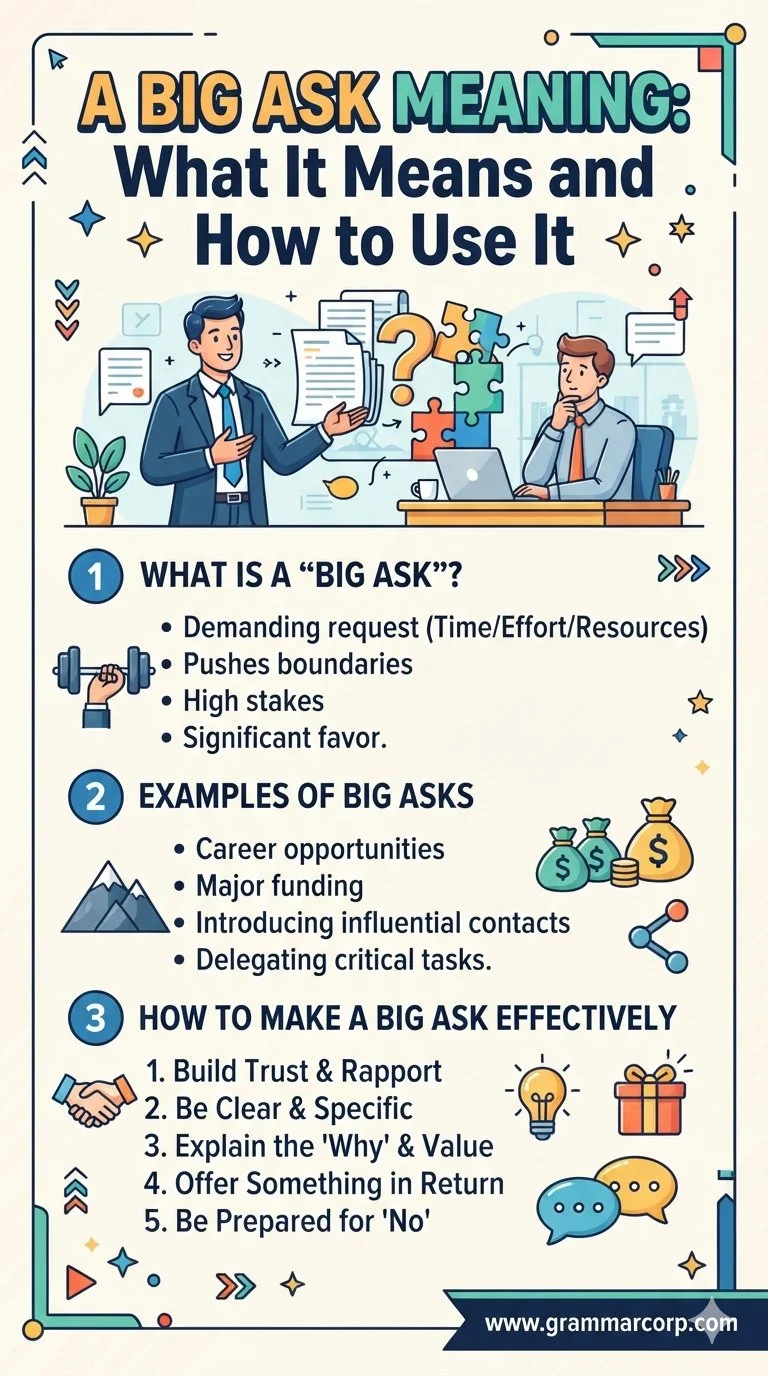
A Big Ask Meaning: What It Means and How to Use It explains how a phrase describes a difficult request, task, or expectation in everyday English. In everyday English, a big ask has a specific meaning and describes something difficult, demanding, or challenging to fulfill. It may not be impossible, but it usually needs extra effort, time, ability, or resources. For example, asking a coworker to finish a small task before lunch may be normal, while asking the same person to complete an entire week’s work in two hours is clearly a bigger expectation.
In a workplace, the phrase can describe a difficult task, large favor, serious demand, or urgent request. Imagine John at a table during a project meeting, with looming deadlines, tight schedules, and growing pressure filling the room. With the deadline around the corner, he might propose that the project team double our efforts to meet our target. Such a request can cause mixed reactions during workplace meetings and discussions, especially when it involves sacrifice, extra effort, and teamwork.
Good leaders and strong leaders rely on strategy, management, and careful planning when presenting a significant challenge. They give a clear explanation, make a realistic assessment, encourage honest accountability, and support maintaining cooperation and initiative inside the team. This approach helps people embrace complexity, overcome challenges, manage expectations, and achieve success through a shared accomplishment.
Quick Answer:
A big ask means a difficult, demanding, or challenging request or expectation.
When someone says “That’s a big ask,” they usually mean that the request will take considerable effort or may be difficult to achieve.
For example:
- Asking a friend to drive you across town at midnight could be a big ask.
- Asking a team to finish a major project in one day could be a big ask.
- Asking an athlete to perform better than their previous record could be a big ask.
- Asking someone to change carefully arranged plans at the last minute may be a big ask.
The phrase doesn’t automatically mean the request is unreasonable. It mainly emphasizes difficulty or the size of the demand.
Collins Dictionary similarly defines the expression as something someone has been asked to do that is very difficult or demanding.
Comparison Overview
The easiest way to understand a big ask is to compare it with expressions that carry similar meanings.
| Expression | Meaning | Typical tone | Example |
| A big ask | A difficult or demanding request | Informal | Finishing this today is a big ask. |
| A lot to ask | More than someone may reasonably expect | Informal | It’s a lot to ask on such short notice. |
| A tall order | Something difficult to accomplish | Informal | Winning three games in a row is a tall order. |
| A tough ask | A particularly difficult request or task | Informal | Beating the defending champions is a tough ask. |
| A difficult request | A request that’s hard to fulfill | Neutral | That’s a difficult request to complete. |
| A major demand | A substantial requirement | More formal | The proposal creates a major demand on staff. |
These expressions overlap, but they aren’t identical.
A big ask focuses on the size or difficulty of what someone is requesting. A tall order often focuses more broadly on a difficult task or expectation. A difficult request sounds more direct and neutral.
What Does “A Big Ask” Mean?
The meaning of a big ask meaning is straightforward: it describes something that someone has requested or expects that will be difficult to accomplish.
Cambridge also uses big ask as a noun in business English. Its definition covers something someone asks for or hopes will happen when achieving it would be difficult.
The important word here is ask.
In ordinary English, ask usually works as a verb:
Can I ask you a question?
However, ask can also work as a noun. In a big ask, it means a request or expectation.
So the structure works like this:
a + big + ask
Here:
- A = article
- Big = adjective describing the scale or difficulty
- Ask = noun meaning a request or expectation
The phrase therefore doesn’t describe the physical size of anything.
A request isn’t “big” because it takes up more space. It’s big because it demands more effort, time, ability, money, flexibility, or commitment than a normal request.
Simple Examples of the Meaning
Consider these situations:
- Can you send me that file? Usually a small task.
- Can you organize the entire event by tomorrow? A big ask.
- Can you help me carry one box? Usually not a big ask.
- Can you help me move an entire house this weekend? A big ask.
- Can you stay ten minutes later? Usually a small request.
- Can you work an additional six hours tonight? A big ask.
The difference comes from the burden created by the request.
Main Differences Between “A Big Ask” and Similar Expressions
Although several English expressions describe difficult requests, their emphasis can change.
A Big Ask vs. A Lot to Ask
A big ask emphasizes the difficulty or scale of a request.
A lot to ask often emphasizes how much you’re expecting from another person.
Compare:
- Finishing the report in two hours is a big ask.
- Asking you to cancel your plans is a lot to ask.
Both sentences communicate difficulty. However, the second can carry more awareness of the personal burden placed on someone.
A Big Ask vs. A Tall Order
A tall order describes something difficult to accomplish or achieve.
For example:
Winning against the tournament favorite will be a tall order.
You could sometimes use a big ask in the same situation:
Winning against the tournament favorite will be a big ask.
The difference is subtle. A tall order focuses strongly on the challenge itself. A big ask can sound more like an acknowledgment that someone is requesting or expecting something difficult.
A Big Ask vs. A Tough Ask
A tough ask is very close to a big ask.
Collins lists a tough ask as an alternative expression and identifies the phrase as informal in British, Australian, and New Zealand English.
For example:
- Beating this team will be a tough ask.
- Beating this team will be a big ask.
Both sentences suggest that success won’t come easily.
A Big Ask vs. A Difficult Request
A difficult request communicates the idea more literally.
It works well in formal or neutral writing:
The client made a difficult request.
Meanwhile, a big ask sounds more conversational:
The client made a big ask.
If you’re writing a formal report, difficult request may sound more appropriate. In a conversation or informal workplace message, a big ask often sounds more natural.
How to Use “A Big Ask” in a Sentence
Learning the definition is only half the job. To use the phrase naturally, you need to understand common sentence patterns.
“That’s a Big Ask”
This is one of the simplest patterns.
That’s a big ask.
Use it when someone has made a difficult request or expectation.
For example:
Can you finish all 30 pages tonight?
That’s a big ask.
The response doesn’t necessarily mean no. It simply acknowledges that the task will be difficult.
“It’s a Big Ask to…”
This structure places the difficult action after to.
It’s a big ask to finish everything before noon.
More examples:
- It’s a big ask to expect everyone to arrive that early.
- It’s a big ask to complete the entire project overnight.
- It’s a big ask to improve the result without additional resources.
“I Know It’s a Big Ask, But…”
This construction is especially useful when making a request yourself.
It acknowledges the difficulty before explaining what you need.
For example:
I know it’s a big ask, but could you help me finish the presentation tonight?
This approach can sound more considerate because you’re showing that you recognize the effort involved.
Cambridge gives a similar workplace-style example in which the speaker acknowledges that completing a project by a certain deadline will be difficult.
“That Would Be a Big Ask”
This construction works when discussing a possible request or outcome.
Examples include:
- That would be a big ask for a new employee.
- That would be a big ask given the deadline.
- That would be a big ask without additional help.
- That would be a big ask for any team.
It can sound softer than saying “That’s unrealistic.”
“A Big Ask” Examples in Everyday English
The phrase becomes easier to understand when you see it in realistic situations.
Everyday Life
Imagine your friend asks you to drive them to another city early the next morning.
You could say:
That’s a big ask. I’ve got an early appointment myself.
The expression recognizes that the request requires considerable time and effort.
Another example:
I know it’s a big ask, but could you help me move this weekend?
Here, the speaker knows the favor will require significant effort.
School
A student might say:
Finishing this entire assignment tonight is a big ask.
The phrase communicates that the workload is substantial.
Another example:
Asking everyone to prepare a full presentation by tomorrow is a big ask.
The problem isn’t necessarily that the assignment is impossible. The issue is the short deadline.
Workplace
Work provides some of the clearest examples.
Completing the project by Friday is a big ask.
This sentence tells the listener that the deadline is demanding.
You might also hear:
It’s a big ask for a small team to handle that many clients.
The expression works particularly well when people discuss deadlines, workloads, budgets, or ambitious goals.
BBC Learning English also uses a workplace-related situation to demonstrate the expression. Its 2026 lesson explains that a big ask describes a request that the speaker knows will be difficult for the other person.
Sports
Sports commentary often involves difficult targets.
Examples include:
Winning four matches in a week would be a big ask.
Coming back from that deficit is a big ask.
Expecting a young team to win the championship immediately is a big ask.
The phrase works because sports frequently involve ambitious expectations and difficult outcomes.
Family and Social Situations
You can also use a big ask when discussing personal commitments.
Asking everyone to change their plans at the last minute is a big ask.
It would be a big ask for my family to travel that far on short notice.
Again, the expression doesn’t automatically criticize the request. It simply recognizes its scale.
What Tone Does “A Big Ask” Have?
Context matters.
The phrase usually sounds informal, conversational, and relatively diplomatic. Cambridge explicitly labels the expression informal.
However, speakers can use it with different attitudes.
| Tone | What the speaker may mean |
| Neutral | This will be difficult. |
| Polite | I understand that I’m asking for a lot. |
| Hesitant | I’m not sure this can be done. |
| Diplomatic | This request may be unreasonable. |
| Playful | This is difficult, but I’m saying it lightly. |
| Firm | The expectation is too demanding. |
When “A Big Ask” Sounds Polite
Suppose someone says:
I know it’s a big ask, but could you stay a little longer?
The speaker recognizes the inconvenience before making the request.
That acknowledgment can make the request feel more considerate.
When “A Big Ask” Sounds Critical
Now consider:
Expecting one person to finish all of that today is a big ask.
Here, the speaker may be indirectly criticizing the expectation.
The words haven’t changed much. The context changes the tone.
Is “A Big Ask” Always Negative?
No.
That’s an important distinction.
A big ask can describe something difficult without saying that the request is bad or unreasonable.
For example:
Winning the final will be a big ask, but the team has a chance.
The speaker recognizes the challenge while remaining optimistic.
Similarly:
Getting everyone together this weekend will be a big ask, but it would be worth it.
The phrase acknowledges difficulty without rejecting the idea.
So big doesn’t automatically mean bad.
It simply signals that the request or goal carries significant difficulty.
When Should You Say “A Big Ask”?
Use the phrase when the request involves a noticeable level of difficulty.
Common reasons include:
- Limited time
- Heavy workload
- Significant effort
- High expectations
- Limited resources
- Personal inconvenience
- Unusual circumstances
- A demanding performance goal
- A major compromise
For example, if someone asks you to complete a five-minute task, calling it a big ask may sound exaggerated.
But if they ask you to complete five hours of work before lunch, the phrase makes sense.
A Useful Test
Ask yourself:
Would this request require noticeably more effort, flexibility, or commitment than normal?
If the answer is yes, a big ask may fit naturally.
When Should You Choose Another Expression?
Sometimes another phrase communicates your meaning more precisely.
| If you mean… | Better choice |
| The request is difficult | A big ask |
| The task is extremely challenging | A tall order |
| Someone expects too much from you | A lot to ask |
| The request is hard but specific | A difficult request |
| The requirement is substantial | A major demand |
| The goal seems beyond normal limits | A stretch |
| The situation is especially challenging | A tough ask |
Formal writing deserves particular attention.
Instead of:
The proposed deadline is a big ask for the department.
A formal report might say:
The proposed deadline would place significant demands on the department.
The first sounds conversational. The second sounds more professional and precise.
Neither is inherently better. The right choice depends on the audience.
Is “A Big Ask” Formal or Informal?
A big ask is generally informal.
Cambridge identifies it as an informal idiom and also lists big ask as an informal noun in its Business English entry.
That doesn’t mean you can never hear it in professional environments.
In fact, people use the expression in workplace conversations, business discussions, journalism, sports, and other settings.
The key distinction is between professional conversation and highly formal writing.
Natural in Conversation
I know it’s a big ask, but can we move the deadline?
This sounds natural.
Natural in an Informal Work Message
Getting this done by Friday is a big ask.
This can work well among colleagues.
More Formal Alternative
Completing the project by Friday would place considerable pressure on the team.
That version suits a formal report better.
Is “Ask” a Noun in “A Big Ask”?
Yes.
This point often causes confusion because most learners first encounter ask as a verb.
Consider:
I asked him to help.
Here, asked is a verb.
Now compare:
That’s a big ask.
Here, ask is a noun.
It means request or expectation.
You can see the difference clearly:
| Sentence | Role of “ask” |
| I asked her for help. | Verb |
| Can I ask you something? | Verb |
| That’s a big ask. | Noun |
| It was a reasonable ask. | Noun |
| They made a difficult ask. | Noun |
Collins also lists ask as a noun in connection with the expression a big ask.
This noun usage explains why you can place adjectives such as big, reasonable, or difficult before ask.
Common Mistakes With “A Big Ask”
Understanding the phrase also means knowing how not to misuse it.
Taking “Big” Literally
A big ask isn’t a physically large question.
It describes the difficulty or demand involved.
Using It for Every Request
Not every favor qualifies as a big ask.
Asking someone to pass you a pen usually doesn’t require enough effort to justify the expression.
Using it for trivial requests can make your language sound exaggerated.
Confusing It With “Ask a Lot”
These phrases have different structures.
A big ask means a difficult or demanding request.
Ask a lot can mean requesting many things or asking questions frequently.
For example:
That’s a big ask.
means:
That’s a difficult request.
Meanwhile:
She asks a lot of questions.
means:
She asks questions frequently or in large numbers.
Assuming It Means Impossible
A big ask isn’t necessarily impossible.
Something can be difficult while remaining completely achievable.
For example:
Winning the tournament will be a big ask.
That doesn’t mean the team cannot win.
It means winning will be very difficult.
Assuming It Always Means Unreasonable
The phrase can imply that a request is unreasonable, but it doesn’t have to.
Consider:
I know it’s a big ask, but I think we can make it work.
Here, the speaker recognizes the challenge without calling the request unreasonable.
Case Study: Understanding “A Big Ask” Through a Workplace Example
Imagine a small marketing team has three days to prepare a major campaign.
Their manager asks them to create:
- A complete campaign strategy
- Several promotional graphics
- Social media content
- Email copy
- A presentation
- Performance projections
The team already has other deadlines.
Someone might say:
Finishing all of that in three days is a big ask.
Why does the phrase fit?
First, the workload is substantial. The team has several separate responsibilities.
Second, the deadline is short. Three days leaves limited room for revisions.
Third, existing commitments increase the burden. The team isn’t starting with an empty schedule.
Notice what the speaker doesn’t say.
That distinction captures the practical meaning of a big ask.
Read More : Bunk vs Debunk: Meaning, Differences, Examples, and Usage
“A Big Ask” in Professional Communication
The expression can be useful at work because it allows people to discuss difficult expectations without sounding unnecessarily blunt.
Compare these statements:
That’s unreasonable.
and:
That’s a big ask.
The first directly criticizes the request.
The second focuses on the difficulty of the request.
That difference can matter during a conversation.
For example:
I know it’s a big ask, but could we get the first draft by Thursday?
This wording recognizes the challenge before proposing a deadline.
However, don’t use the phrase simply to avoid clear communication. If a deadline genuinely cannot work, explain why.
For example:
That’s a big ask because the team still needs two days for testing.
Now the phrase provides useful context rather than acting as vague criticism.
“A Big Ask” in Sports and Competition
Sports provide another natural setting for this expression.
A commentator might describe a comeback as a big ask when the team faces a substantial disadvantage.
For example:
Scoring three goals in the final ten minutes would be a big ask.
The sentence doesn’t claim that the result is impossible. It highlights the difficulty.
The same logic applies to individual performance:
Breaking the record again will be a big ask.
The previous achievement creates a high standard. Repeating or surpassing it therefore becomes demanding.
This is one reason the expression works well when discussing goals, targets, deadlines, and expectations.
A Big Ask vs. A Small Ask
The natural opposite of a big ask is often a small ask.
A small ask requires relatively little effort.
For example:
Could you send me the document?
That might be a small ask.
Meanwhile:
Could you rewrite the entire report tonight?
That’s clearly a bigger request.
The contrast helps show that big describes the scale of the demand.
| Type | Example | Likely description |
| Small request | Send me the file | Small ask |
| Moderate request | Help me prepare for an event | Reasonable ask |
| Demanding request | Complete a major task overnight | Big ask |
| Extremely demanding request | Complete a major project in a few hours | Very big ask |
The exact boundary depends on the situation.
A request that seems small to one person could be a big ask for another person because of differences in time, ability, resources, or circumstances.
Synonyms for “A Big Ask”
If you want to avoid repeating the same phrase, several alternatives can work.
Difficult Request
This is the most direct alternative.
That’s a difficult request.
It sounds neutral and clear.
A Tall Order
This is an idiomatic alternative for something difficult to achieve.
Winning against that opponent will be a tall order.
A Tough Ask
This closely matches a big ask.
Getting the work done by tomorrow will be a tough ask.
A Lot to Ask
This emphasizes the burden placed on another person.
Asking you to work all weekend is a lot to ask.
A Stretch
This works when something pushes beyond normal expectations.
Finishing it today might be a stretch.
The best synonym depends on what you want to emphasize.
FAQs:
1. What does “a big ask” mean?
“A big ask” means a difficult, demanding, or challenging request. It usually requires extra effort, time, resources, or responsibility from someone.
2. Is “a big ask” an idiom?
Yes. A big ask is an informal idiom commonly used in everyday English, especially when someone is making a request that may be difficult to fulfill.
3. How do you use “a big ask” in a sentence?
You can say, “Finishing the entire project by tomorrow is a big ask.” Here, the phrase shows that the request is difficult or demanding.
4. Is “a big ask” always an impossible request?
No. A big ask does not have to be impossible. It simply means that something requires more effort, time, ability, or resources than usual.
5. Where is “a big ask” commonly used?
The phrase is common in conversations, workplaces, business discussions, sports, news reports, and informal writing when people want to describe a challenging request.
Conclusion:
A Big Ask Meaning: What It Means and How to Use It becomes easy to understand when you remember that the phrase describes a request that requires considerable effort or commitment.
Whether the situation is professional or personal, calling something a big ask shows that it may be challenging but not necessarily impossible.














1 thought on “A Big Ask Meaning: What It Means and How to Use It”