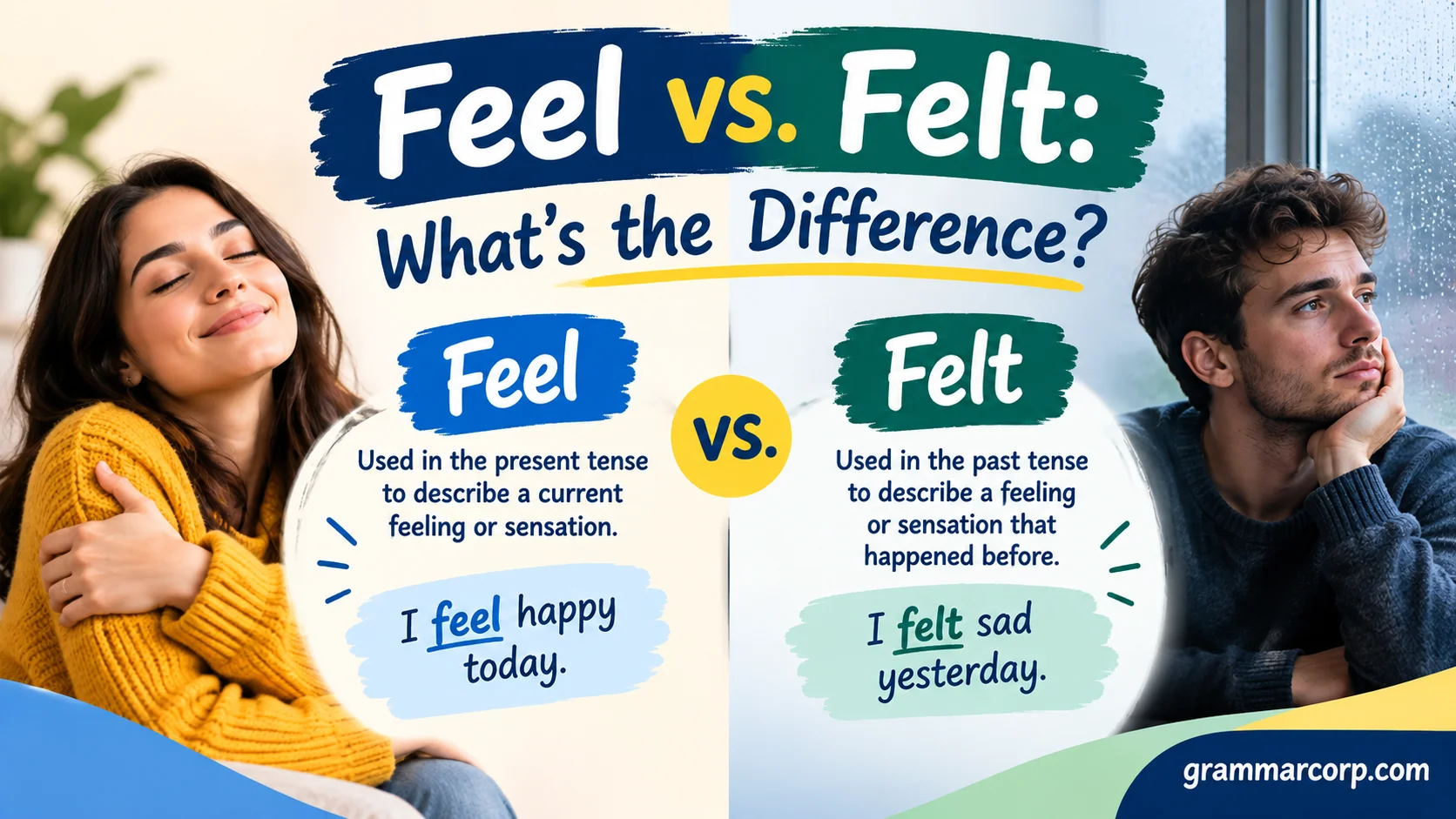
Feel vs. Felt: What’s the Difference? It becomes clearer when you compare present and past forms, sentence structure, helping verbs, and everyday usage.
The words feel and felt come from the same verb, but they are not used in exactly the same situations. Choosing between them depends on time, sentence structure, and any helping verb in front of them. When talking about something happening now, or describing a current experience, we normally use feel, as in “I feel tired today.” When describing a previous experience that happened yesterday, we use felt. This difference is simple, although mistakes can appear in questions, negative sentences, and other words that enter a sentence, especially did, didn’t, does, has, have, and had.
A useful guide to feel vs. felt starts with the basics and then moves to trickier grammar patterns. Did and didn’t normally take the base form, so “Did you feel tired?” is correct instead of “Did you felt tired?” The same rule works when you use feel after does, while has, have, and had can appear with felt in perfect tenses. In my own editing and grammar work, I find that focusing on the time of the action first makes choosing the right word less confusing.
The present forms of feel can describe emotions, sensations, and opinions happening now, while felt describes experiences and feelings that already happened in the past. The past participle felt also appears in perfect structures, so knowing how the forms fit together can improve writing, clarity, and everyday communication. Once you understand this main distinction, the key differences become clearer, and you can use each form more grammatically.
Quick Answer:
Feel is the base form of the verb. It commonly describes something happening now, something that happens regularly, or a general feeling.
Felt is the simple past form and past participle of feel. It normally describes a feeling, sensation, opinion, or experience connected to the past.
| Sentence | Correct form | Why |
| I feel tired today. | Feel | Present |
| I felt tired yesterday. | Felt | Past |
| Did you feel nervous? | Feel | Did takes the base form |
| I didn’t feel well. | Feel | Didn’t takes the base form |
| She feels happy. | Feels | Present with she |
| She felt happy. | Felt | Past |
| I have felt this before. | Felt | Past participle after have |
| He had felt nervous earlier. | Felt | Past participle after had |
The easiest rule is:
Use feel for the base or present form. Use felt for the past form or past participle.
One important exception to watch for is a sentence containing did or didn’t. Even though these words refer to the past, they must be followed by feel, not felt.
Comparison Overview
Understanding the forms of the verb makes the feel vs. felt difference much easier.
The verb has four main forms:
| Verb form | Word | Example |
| Base form | feel | I feel happy. |
| Third-person singular | feels | She feels happy. |
| Past simple | felt | She felt happy. |
| Past participle | felt | She has felt happy. |
| Present participle | feeling | She is feeling happy. |
Unlike many English verbs, feel changes to felt rather than adding -ed.
For example:
- walk → walked
- work → worked
- feel → felt
The past and past participle forms are identical:
- I felt tired yesterday.
- I have felt tired recently.
The grammar around the word tells you which function felt performs.
Feel vs. Felt in One Simple Pattern
Consider the same sentence across different time frames:
- Present: I feel nervous.
- Past: I felt nervous.
- Present perfect: I have felt nervous.
- Past perfect: I had felt nervous.
- Continuous: I am feeling nervous.
The underlying idea stays the same. What changes is the verb form and the relationship to time.
Feel vs. Felt vs. Feeling
These three forms often appear together when learners study this verb.
Feel works as the base form:
I feel better today.
Felt works as the simple past and past participle:
I felt better yesterday.
I have felt better recently.
Feeling works as the present participle:
I am feeling better now.
This distinction becomes especially useful when you start building longer sentences.
Main Differences Between Feel vs. Felt
The biggest difference between feel vs. felt is their relationship to time.
Feel Refers to the Present or General Situations
Use feel when the sentence describes a current state or a general experience.
Examples include:
- I feel tired.
- You feel nervous.
- We feel ready.
- They feel excited.
- I feel that this is the right choice.
You can also use feel for something that happens regularly.
I usually feel tired after a long day.
The sentence doesn’t describe one completed moment in the past. It describes a recurring experience.
Felt Refers to the Past
Use felt when the experience belongs to an earlier point in time.
For example:
- I felt tired yesterday.
- She felt nervous before the exam.
- We felt cold during the night.
- They felt relieved after the problem ended.
- He felt that something was wrong.
The feeling might have lasted for a few seconds or several hours. The important point is that the sentence places the experience in the past.
The Same Feeling Can Use Both Forms
The emotion or sensation doesn’t decide whether you use feel or felt.
Time does.
Compare:
- I feel nervous before important exams.
- I felt nervous before yesterday’s exam.
The first sentence describes a general pattern. The second describes a specific past event.
Here’s another example:
- I feel sick today.
- I felt sick yesterday.
The physical sensation stays similar. The time changes.
Feel Can Also Express an Opinion
The verb feel doesn’t only describe emotions or physical sensations.
It can introduce an opinion or personal judgment:
I feel that we need more time.
When reporting that opinion as something held in the past, felt can be appropriate:
At the time, I felt that we needed more time.
The difference again comes from the time frame.
What Does Feel Mean?
Feel has several common meanings in English. Understanding these meanings helps you recognize why the word appears in so many different sentence structures.
Feel as an Emotion
You can use feel to describe your current emotional state.
Examples:
- I feel happy today.
- I feel nervous about the test.
- You feel confident now.
- They feel excited about the trip.
Here, feel describes an experience happening in the present.
Feel as a Physical Sensation
You can also use feel for physical sensations.
Examples:
- I feel cold.
- My legs feel tired.
- She feels sick.
- The room feels warm.
The word doesn’t necessarily mean that you physically touched something. It can describe how something affects your senses or body.
Feel as a Sense of Touch
Feel can describe what you experience through physical contact.
For example:
The fabric feels soft.
The subject here is the fabric. The sentence describes the quality that you notice when you touch it.
In the past, you could say:
The fabric felt soft.
Feel as an Opinion
English speakers also use feel to introduce a personal view.
For example:
I feel that the decision was fair.
The word doesn’t mean you physically touched the decision. Instead, it introduces your personal judgment.
A past version would be:
I felt that the decision was fair.
Feel as an Impression or Intuition
You may also use feel when describing an impression.
Examples:
- I feel something is missing.
- She feels that something has changed.
- We feel this plan could work.
When discussing that impression from an earlier point in time, felt can replace feel.
What Does Felt Mean?
Felt is the simple past and past participle form of feel.
It can describe an earlier emotion, sensation, opinion, or experience.
Felt for Past Emotions
Use felt when an emotional experience occurred in the past.
Examples:
- I felt nervous before the presentation.
- She felt happy after hearing the news.
- We felt disappointed after the result.
- He felt confident during the interview.
The sentence can include an obvious past-time expression such as yesterday or last week. However, it doesn’t have to.
Felt for Past Physical Sensations
You can also use felt for physical sensations.
- I felt cold last night.
- She felt sick after lunch.
- He felt tired after the journey.
- We felt the heat immediately.
The context can establish that the event happened in the past.
For example:
We walked outside and felt the cold air.
There’s no need to add yesterday because walked already establishes a past context.
Felt for Past Opinions
Felt can describe a previous opinion or judgment.
I felt that the explanation wasn’t clear.
This tells the reader that the opinion belonged to an earlier time.
Compare it with:
I feel that the explanation isn’t clear.
The first focuses on a past judgment. The second presents the judgment as current.
Feel vs. Felt After Helping Verbs
This is where many otherwise simple sentences become confusing.
A helping verb can determine which form of feel belongs in the sentence. The most important rule involves do, does, and did.
Do + Feel
Use feel after do.
- Do you feel okay?
- Do they feel ready?
- Do we feel confident about this?
Don’t add an extra ending to the main verb.
Does + Feel
Use feel, not feels, after does.
Correct:
Does she feel better?
Incorrect:
Does she feels better?
Why?
Because does already carries the third-person present-tense marking. The main verb returns to its base form.
The same pattern appears with many English verbs:
- Does he work here?
- Does she know him?
- Does it look right?
- Does he feel better?
Did + Feel
This is one of the most important rules in the entire feel vs. felt discussion.
After did, use feel.
Correct:
Did you feel nervous?
Not:
Did you felt nervous?
Although did refers to the past, it already carries the past-tense marking.
Think of the structure like this:
Did + base verb
Therefore:
- Did you feel?
- Did you go?
- Did you see?
- Did you know?
- Did you hear?
Not:
- Did you felt?
- Did you went?
- Did you saw?
- Did you knew?
- Did you heard?
Didn’t + Feel
The same rule applies to didn’t.
Correct:
I didn’t feel well.
Incorrect:
I didn’t felt well.
More examples:
- She didn’t feel ready.
- We didn’t feel comfortable.
- They didn’t feel confident.
- He didn’t feel tired.
A useful shortcut is:
Did or didn’t + feel.
Never use felt directly after did or didn’t.
Feel vs. Felt With Have, Has, and Had
The word felt becomes important again when you use perfect tenses.
Have + Felt
Use felt after have.
Examples:
- I have felt this way before.
- We have felt more confident lately.
- They have felt tired all week.
Here, felt functions as the past participle.
The present perfect connects a past experience to the present in some way. The exact meaning depends on context.
Has + Felt
Use felt after has with a singular third-person subject.
Examples:
- She has felt better recently.
- He has felt nervous about the test.
- The patient has felt stronger this week.
The structure is:
has + felt
Not:
has + feel
Had + Felt
Use felt after had when forming the past perfect.
Examples:
- I had felt nervous before the interview began.
- She had felt tired before she went home.
- They had felt uncertain about the plan.
The past perfect helps show that one past experience happened before another past event.
Comparing Felt in Different Tenses
Consider these three sentences:
| Sentence | What it shows |
| I felt tired yesterday. | A past experience |
| I have felt tired lately. | Past experience connected to the present |
| I had felt tired before the meeting. | An earlier past experience |
This is one reason simply memorizing feel = present and felt = past isn’t enough. Felt also functions as a past participle.
Feel vs. Felt in Different Real-Life Situations
The easiest way to master the distinction is to see how it works in normal conversation.
Talking About Emotions
Present:
I feel excited about the competition.
Past:
I felt excited before the competition started.
General:
I often feel nervous before speaking in public.
The tense changes according to the intended meaning.
Talking About Health
Present:
I feel better today.
Past:
I felt terrible yesterday.
Present perfect:
I have felt better recently.
These sentences demonstrate three different time relationships.
Talking About Touch
Present:
This blanket feels soft.
Past:
The blanket felt soft when I touched it.
Notice that the subject is the blanket. That’s why the present form becomes feels rather than feel.
Talking About Opinions
Present:
I feel that this approach works.
Past:
I felt that the old approach worked better.
Again, the key difference isn’t the type of opinion. It’s the time frame.
Talking About Intuition
Present:
I feel like something is missing.
Past:
I felt like something was missing.
The second version places that impression in the past.
Feel vs. Felt Sentence Examples
Examples become more useful when you group them by grammar pattern.
Present-Tense Examples With Feel
- I feel much better today.
- We feel ready for the challenge.
- They feel excited about the opportunity.
- I feel cold in this room.
- You feel different after a good night’s sleep.
- I feel that this is the right decision.
- Do you feel okay?
- They don’t feel ready yet.
Past-Tense Examples With Felt
- I felt nervous before the exam.
- She felt better after resting.
- We felt cold outside.
- They felt disappointed by the result.
- He felt confident during the presentation.
- I felt that something was wrong.
- She felt happy about the decision.
- We felt relieved when it ended.
Question Examples
Correct:
- Do you feel tired?
- Does she feel better?
- Did you feel nervous?
- Did they feel comfortable?
- How did you feel after the meeting?
Notice the pattern:
Do/Does/Did + feel
Negative Examples
Correct:
- I don’t feel tired.
- She doesn’t feel ready.
- We didn’t feel comfortable.
- He didn’t feel well.
- They don’t feel confident.
The word felt doesn’t appear after didn’t because did already marks the past.
Common Mistakes With Feel and Felt
Knowing the rules is useful. Knowing the mistakes makes them easier to avoid.
Mistake: Using Felt With Now
Incorrect:
I felt tired now.
Correct:
I feel tired now.
The word now establishes a present situation.
Mistake: Using Feel With a Finished Past Time
Incorrect:
I feel tired yesterday.
Correct:
I felt tired yesterday.
Yesterday places the experience in the past.
Mistake: Saying Did You Felt
Incorrect:
Did you felt nervous?
Correct:
Did you feel nervous?
The structure is did + base verb.
Mistake: Saying Didn’t Felt
Incorrect:
I didn’t felt well.
Correct:
I didn’t feel well.
Again, didn’t + base verb controls the structure.
Mistake: Forgetting Feels
Incorrect:
She feel tired.
Correct:
She feels tired.
In a simple present statement, he, she, and it normally take feels.
Compare:
- I feel tired.
- You feel tired.
- We feel tired.
- They feel tired.
- He feels tired.
- She feels tired.
- It feels cold.
Mistake: Using Feels After Does
Incorrect:
Does she feels okay?
Correct:
Does she feel okay?
The word does takes the third-person marking. The main verb stays in its base form.
Mistake: Confusing Felt and Fell
Felt comes from feel.
Fell is the past tense of fall.
Compare:
- I felt tired.
- I fell down.
These words sound different and have completely different meanings.
A useful memory trick is to connect the forms:
feel → felt → felt
fall → fell → fallen
Feel vs. Felt in Questions and Answers
Questions deserve special attention because helping verbs often change the verb form.
Consider this short exchange:
Question: Did you feel nervous?
Answer: Yes, I felt nervous.
The question uses feel because it contains did. The answer uses felt because it is a simple past statement.
This pattern can seem strange at first.
Why the Forms Change
The question:
Did you feel nervous?
contains the past marker did.
The answer:
I felt nervous.
has no helping verb. Therefore, felt itself carries the past tense.
The same principle applies elsewhere:
- Did you go? → I went.
- Did you see it? → I saw it.
- Did you feel sick? → I felt sick.
This is a general English grammar pattern, not something unique to feel.
A Practical Feel vs. Felt Case Study
Imagine someone describing an important exam.
Before the exam, they say:
I feel nervous about the exam.
That’s a present feeling.
After the exam, they say:
I felt nervous before it started.
That’s a past feeling.
Later, they might say:
I have felt nervous about exams before.
Now they’re connecting previous experiences with their current perspective.
If someone asks:
Did you feel nervous?
The answer becomes:
Yes, I felt nervous.
One short situation demonstrates four important structures:
| Situation | Correct form | Example |
| Current feeling | Feel | I feel nervous. |
| Past feeling | Felt | I felt nervous. |
| Question about past | Feel | Did you feel nervous? |
| Past experience connected to now | Felt | I have felt nervous before. |
The important lesson is that sentence structure matters just as much as time.
When to Use Feel, Felt, or Feeling
Sometimes the real question isn’t just feel vs. felt. You may need to choose between feel, felt, and feeling.
Use Feel
Use feel as the base form and in simple present structures.
Examples:
- I feel fine.
- Do you feel okay?
- You may feel tired later.
Use Felt
Use felt as the simple past or past participle.
Examples:
- I felt tired yesterday.
- She has felt better lately.
- We had felt uncertain about the decision.
Use Feeling
Use feeling in continuous constructions and some noun-like expressions.
Examples:
- I am feeling better.
- She is feeling nervous.
- How are you feeling today?
The choice depends on the grammar around the verb.
Read More : Ladder or Latter: Meaning, Difference, and Correct Usage
A Simple Decision Guide for Feel vs. Felt
When you’re unsure which form to use, ask yourself a few questions.
Is the sentence about the present?
Use feel or feels, depending on the subject.
- I feel tired.
- She feels tired.
Is the sentence a simple statement about the past?
Use felt.
- I felt tired yesterday.
- She felt tired earlier.
Does the sentence contain Did or Didn’t?
Use feel.
- Did you feel tired?
- I didn’t feel tired.
Does the sentence contain Have, Has, or Had?
Use felt.
- I have felt tired.
- She has felt tired.
- They had felt tired.
This four-question check solves most feel vs. felt problems.
Feel vs. Felt Practice Quiz
Choose feel, feels, or felt in each sentence.
- I much better today.
- She nervous before the interview.
- Did you tired after the trip?
- He doesn’t ready yet.
- We cold last night.
- They weren’t comfortable.
- She happy when she received the news.
- I have this way before.
- Does he confident?
- I that the decision was unfair at the time.
- The fabric soft.
- The fabric rough when I touched it.
Answers
I feel much better today.
The word today places the feeling in the present.
She felt nervous before the interview.
The sentence describes a past experience.
Did you feel tired after the trip?
Use the base form after did.
He doesn’t feel ready yet.
Use the base form after doesn’t.
We felt cold last night.
The phrase last night establishes a past time.
They didn’t feel comfortable.
Use feel after didn’t.
She felt happy when she received the news.
The sentence describes a past event.
I have felt this way before.
Use the past participle felt after have.
Does he feel confident?
Use the base form after does.
I felt that the decision was unfair at the time.
The phrase at the time refers to a past opinion.
The fabric feels soft.
The subject is singular and the sentence uses the simple present.
The fabric felt rough when I touched it.
The sentence describes a past experience involving touch.
Feel vs. Felt: Quick Reference Table
| Situation | Correct form | Example |
| Present with I/you/we/they | Feel | They feel ready. |
| Present with he/she/it | Feels | She feels ready. |
| Simple past | Felt | She felt ready. |
| After did | Feel | Did she feel ready? |
| After didn’t | Feel | She didn’t feel ready. |
| After have | Felt | She has felt ready before. |
| After has | Felt | She has felt better. |
| After had | Felt | She had felt nervous earlier. |
| Continuous present | Feeling | She is feeling better. |
| After a modal | Feel | She may feel better. |
FAQs:
1. What is the difference between feel and felt?
Feel is the present form of the verb, while felt is the past tense and past participle. Use feel for current situations and felt for past experiences.
2. Is it correct to say “Did you feel”?
No. After did, use the base form. The correct sentence is “Did you feel tired?” rather than “Did you felt tired?”
3. Can felt be used with have or has?
Yes. Felt can be used with have or has in perfect tenses. For example, “I have felt better” and “She has felt nervous before.”
4. Can feel describe emotions and physical sensations?
Yes. Feel can describe emotions, physical sensations, opinions, or conditions. For example, you can say, “I feel happy,” “I feel cold,” or “I feel this is correct.”
5. Is felt always used for the past?
Usually, felt refers to something experienced in the past, but it can also function as a past participle in perfect tenses. The surrounding helping verb and sentence structure determine its exact use.
Conclusion:
Understanding feel vs. felt becomes easier when you first identify the time of the action. Use feel for present experiences, emotions, sensations, and opinions, and use felt for past experiences or as a past participle.
Remember that helping verbs such as did, has, have, and had can affect which form belongs in a sentence. With regular practice, choosing between these two forms becomes natural and helps make your everyday conversations and writing clearer and more grammatically correct.











1 thought on “Feel vs. Felt: What’s the Difference?”