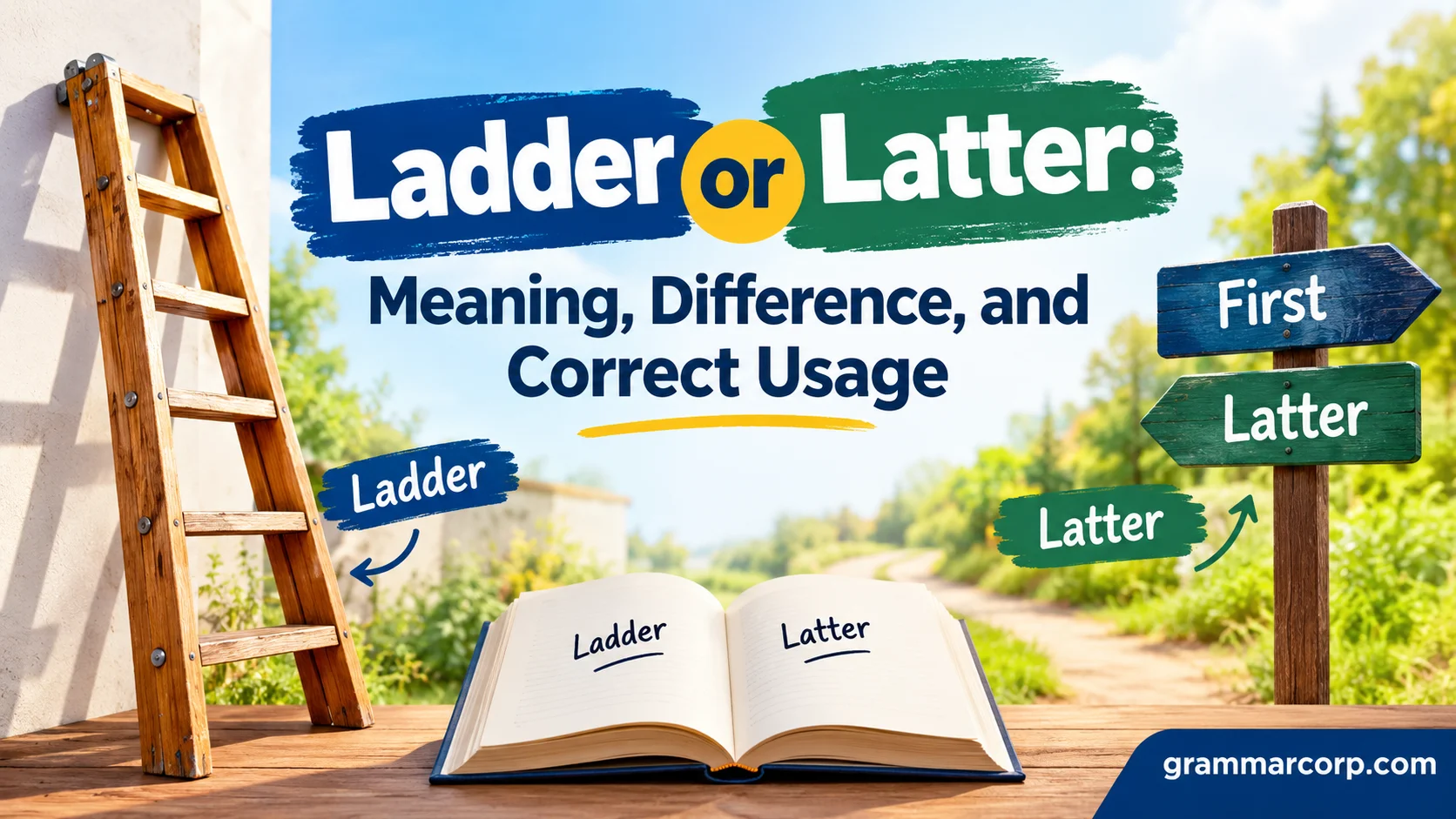
Ladder or Latter: Meaning, Difference, and Correct Usage can clear up confusion when writers, students, and English learners wonder which word belongs in a sentence. If you have ever scratching head, typed ladder when you meant latter, or paused to wonder about the correct word, you are not alone.
These words are remarkably similar and differ by one letter, but their meanings are completely different. A ladder is a noun, tool, and piece of equipment with rungs, steps, and two long sides for climbing. It can help you reach a higher place or a top shelf. In my experience, connecting ladder with this physical object makes its meaning easier to remember. The idea of a language ladder can also represent figurative progress, advancement, or a metaphorical structure.
This distinction is especially useful in academic writing and professional writing, where correct grammatical functions and sentence meaning help prevent embarrassing mistakes. A small mix-up may look like a tiny slip, but it can cause a big tumble in meaning and affect communication. A ladder has steps for physical climbing, while latter helps you compare two choices and two items.
This detailed breakdown offers a simple resolve to a common discussion about correctness and usage. Once you understand the former, latter, physical climbing, figurative progress, and metaphorical structure, you can compare the words with greater confidence. Regular writing and speaking practice can strengthen your understanding and help you use both words correctly.
Quick Answer
The correct word depends on what you mean.
- Ladder = a structure used for climbing or a series of stages.
- Latter = the second of two people, things, or choices already mentioned.
- Later = something happening afterward or at a future time.
For example:
- She climbed the ladder to reach the roof.
- I was offered tea or coffee, and I chose the latter.
- I’ll finish the project later.
A simple way to remember the difference is:
Ladder = climb. Latter = second of two. Later = time.
Cambridge defines ladder as equipment used for climbing and also uses it for a series of increasingly important jobs or stages. It defines latter as the second of two previously mentioned people, things, or groups and also as something near or toward the end of a period.
Comparison Overview
The easiest way to understand ladder or latter is to compare their meanings directly.
| Word | Main Meaning | Part of Speech | Common Context | Example |
| Ladder | Equipment used for climbing | Noun | Physical objects | He carried the ladder outside. |
| Ladder | A series of stages or levels | Noun | Career, competition, progress | She moved up the corporate ladder. |
| Latter | The second of two things mentioned | Noun | Choices and comparisons | I prefer the latter. |
| Latter | Near the end of something | Adjective | Periods, stages, parts | The latter part of the year was busy. |
| Later | At a subsequent time | Adverb/Adjective | Time | We can discuss it later. |
The important point is that ladder and latter aren’t alternative spellings of the same word. They represent different meanings.
Main Differences Between Ladder or Latter
The biggest difference between ladder or latter is their meaning and grammatical function.
Ladder Refers to Climbing or Levels
A ladder is commonly a physical object with steps or rungs that allow someone to climb up or down.
For example:
- The painter placed the ladder against the wall.
- She climbed the ladder carefully.
- The broken ladder needs to be replaced.
The word also has a figurative meaning. A ladder can represent a sequence of levels or stages that someone moves through.
For example:
- He climbed the corporate ladder.
- She worked her way up the career ladder.
- The tournament uses a ranking ladder.
Cambridge specifically recognizes both the physical meaning and the figurative meaning involving a series of increasingly important jobs or stages.
Latter Refers to the Second of Two
Latter works differently. When two people, things, or groups have already been mentioned, the latter refers to the second one.
Consider this sentence:
I can study biology or chemistry. I prefer the latter.
The two subjects are biology and chemistry.
Because chemistry appears second, the latter means chemistry.
The opposite term is the former, which refers to the first of two things mentioned. Cambridge defines former in this specific use as the first of two people, things, or groups.
So:
- Biology = the former
- Chemistry = the latter
Latter Can Also Mean Near the End
There’s another legitimate use of latter that doesn’t involve choosing between two things.
You can use latter to describe something near the end of a period, process, event, or sequence.
Examples include:
- The latter part of the year was unusually busy.
- He became more confident during the latter stages of the project.
- The latter half of the book contains the most important developments.
This meaning is different from the latter as a reference to the second of two things. Cambridge recognizes both uses.
What Does Ladder Mean?
Ladder is primarily a noun. Its most familiar meaning describes equipment designed to help people climb.
A traditional ladder has two long vertical sides connected by horizontal rungs or steps. Different ladder designs serve different purposes, but the basic idea remains the same: a ladder provides a route between different heights.
Ladder as a Physical Object
Here are some natural examples:
- The ladder is leaning against the house.
- We need a taller ladder.
- He carried the ladder into the garage.
- The worker moved the ladder to another position.
- That ladder has a damaged rung.
In every example, ladder refers to a physical object.
Ladder as a Figurative Idea
English also uses ladder metaphorically to describe progress through levels.
The phrase corporate ladder is a common example. It describes movement through increasingly important positions within an organization.
For example:
- She hopes to climb the corporate ladder.
- He worked his way up the management ladder.
- Experience helped her move higher on the career ladder.
The underlying idea is simple: just as someone can climb from one rung to another on a physical ladder, someone can move from one professional level to another.
Other Uses of Ladder
The word has additional meanings in English. For example, Cambridge also records ladder as a term for a long vertical hole or run in tights or stockings in British English. It can also function as a verb in that context.
However, that meaning is less relevant to the common ladder or latter spelling question. For everyday writing, the climbing and progression meanings are the ones most readers encounter.
What Does Latter Mean?
Latter has two important meanings.
The first refers to the second of two previously mentioned things. The second refers to a position near the end of a period or sequence.
Latter as the Second of Two
This is the meaning people usually have in mind when they ask about ladder or latter.
Consider:
We could travel by train or bus. I prefer the latter.
The two options are:
- Train
- Bus
The latter means bus because bus appears second.
Here are more examples:
- I enjoy both novels, but I prefer the latter.
- She offered me a morning or evening appointment. I chose the latter.
- The company sells laptops and tablets. The latter are becoming more popular.
- He considered football and basketball, but he selected the latter.
The word works as a shortcut. Instead of repeating the second noun, you can refer to it as the latter.
Latter as the Later Part
The second major meaning appears in expressions such as:
- latter half
- latter part
- latter stages
- latter years
For example:
The latter half of the movie was more exciting.
Here, latter doesn’t identify one of two previously mentioned objects. Instead, it means the part closer to the end.
Another example:
The company experienced rapid growth in the latter years of the decade.
The phrase refers to the later portion of that period.
This use is established in standard English and is separate from the former/latter construction.
Ladder vs. Latter vs. Later
Adding later to the comparison makes the distinction even clearer.
| Word | Meaning | Example |
| Ladder | Something used for climbing or a series of stages | He climbed the ladder. |
| Latter | The second of two things or the later part of something | I chose the latter. |
| Later | At a subsequent time | I’ll call you later. |
Ladder
Think about rungs and climbing.
The ladder is in the shed.
Latter
Think about the second of two.
We discussed tea and coffee. I chose the latter.
Later
Think about time.
I’ll finish the report later.
The spelling difference is small, but the meanings aren’t interchangeable.
How to Use Ladder in a Sentence
Use ladder when your sentence refers to a climbing structure or a sequence of levels.
Physical Ladder Examples
- The ladder is too short.
- Please move the ladder closer to the wall.
- He stored the ladder in the garage.
- The old ladder has several damaged parts.
- She used a ladder to reach the high shelf.
Figurative Ladder Examples
- She hopes to climb the corporate ladder.
- His promotion helped him move up the career ladder.
- The ranking ladder changed after the competition.
- Education can create opportunities for upward mobility.
The figurative examples still retain the basic idea of movement from one level to another.
How to Use Latter in a Sentence
Use latter when you need to identify the second of two previously mentioned things.
Examples With Two Choices
I could order pizza or pasta. I chose the latter.
The latter = pasta.
We can meet Tuesday or Wednesday. The latter works better for me.
The latter = Wednesday.
She considered studying history or economics. She eventually selected the latter.
The latter = economics.
Examples With Two People
Maria and Daniel attended the meeting. The latter presented the report.
The latter = Daniel.
This construction can make writing shorter. Instead of repeating the second person’s name, the writer uses the latter.
However, clarity matters. If several people or ideas appear between the original nouns and the latter, readers may struggle to identify what the word refers to.
Former and Latter: How They Work Together
Former and latter form a useful pair.
- Former = first of two
- Latter = second of two
For example:
The company considered online advertising and television advertising. The former was cheaper, while the latter reached a different audience.
Here:
- The former = online advertising
- The latter = television advertising
Cambridge defines former as the first of two previously mentioned people, things, or groups and latter as the second.
Why This Pair Can Be Useful
Using former and latter prevents unnecessary repetition.
Instead of writing:
The first proposal was rejected because the first proposal was too expensive. The second proposal was accepted because the second proposal was more affordable.
You can write:
The first proposal was rejected because it was too expensive. The latter proposal was accepted because it was more affordable.
Still, don’t use these words simply to sound formal. If repeating a noun makes your sentence clearer, repeat it.
Clarity should come before sophistication.
Common Ladder and Latter Mistakes
The spelling confusion usually happens because the words look similar.
Mistake: Using Ladder for the Second Choice
Incorrect:
I prefer the ladder of the two options.
Correct:
I prefer the latter of the two options.
Why? The sentence refers to the second option rather than something used for climbing.
Mistake: Using Latter for a Climbing Object
Incorrect:
He climbed the latter to reach the roof.
Correct:
He climbed the ladder to reach the roof.
Why? The sentence describes physical climbing equipment.
Mistake: Confusing Latter With Later
Incorrect:
I’ll finish it latter.
Correct:
I’ll finish it later.
Why? The sentence refers to a future time.
Mistake: Using Latter Without Clear Context
Consider:
I prefer the latter.
That sentence is grammatically possible, but readers need to know what two things you’re talking about.
A clearer version might be:
I prefer tea and coffee, and I prefer the latter.
Now the reference is obvious.
Mistake: Using Latter for Several Unclear Options
Latter is most clearly used when exactly two options have been established.
If you list many possibilities, repeating the specific noun is often clearer.
For example:
We considered hiking, swimming, cycling, and camping. I chose camping.
This is clearer than trying to force latter into a sentence involving several options.
Ladder or Latter: A Simple Memory Trick
You don’t need a complicated mnemonic to remember these words.
Remember Ladder With “Climb”
Picture a physical ladder.
It has rungs.
You climb it.
So:
Ladder → climb → rungs → height
Remember Latter With “Second”
Think about a pair:
Former → first
Latter → second
For example:
Cats or dogs? I prefer the latter.
Dogs come second in the sentence, so latter means dogs.
Remember Later With “Time”
Think about something happening afterward.
Later → time
I’ll see you later.
That simple association handles most everyday cases.
A Practical Decision Test for Ladder or Latter
When you’re unsure which word to use, ask yourself a few questions.
Are You Talking About Something You Can Climb?
Use ladder.
The ladder is beside the house.
Are You Referring to the Second of Two Things?
Use latter.
I prefer the latter.
Are You Talking About a Future Time?
Use later.
We’ll discuss that later.
Are You Describing the End Portion of a Period?
Use latter.
Sales increased during the latter half of the year.
This four-question test covers most situations where these words cause confusion.
Real-World Examples of Ladder or Latter
The difference becomes easier when you see how each word behaves in ordinary writing.
| Situation | Correct Word | Example |
| Climbing onto a roof | Ladder | He brought a ladder. |
| Discussing career advancement | Ladder | She climbed the corporate ladder. |
| Choosing between two meals | Latter | I chose the latter. |
| Referring to the second person mentioned | Latter | The latter spoke first. |
| Discussing the final portion of a year | Latter | Sales rose in the latter half. |
| Talking about tomorrow or afterward | Later | I’ll respond later. |
These examples reveal an important pattern: the surrounding meaning determines the spelling.
A Closer Look at “The Latter”
The expression the latter deserves special attention because it’s the form most often used in comparisons.
Suppose you write:
The restaurant offers indoor seating and outdoor seating. I prefer the latter.
The reader knows that the latter means outdoor seating because it appears second.
Now reverse the order:
The restaurant offers outdoor seating and indoor seating. I prefer the latter.
The latter now means indoor seating.
That shows why latter doesn’t have a fixed meaning such as “outdoor” or “indoor.” Its meaning depends entirely on the order in which the two items appear.
The Order Matters
Consider:
Sarah and James joined the project. The latter handled the research.
The latter = James.
But:
James and Sarah joined the project. The latter handled the research.
The latter = Sarah.
Changing the order changes the meaning.
That’s one of the most important facts to remember when using latter.
When Should You Avoid “The Latter”?
Although the latter is grammatically useful, it isn’t always the clearest choice.
Avoid it when the reader may have trouble remembering which two things you’re comparing.
For example, a long paragraph might mention several people, companies, products, and ideas. Ending it with the latter could leave readers wondering what it refers to.
In such cases, simply repeat the noun.
Instead of:
The latter performed better.
Write:
The second product performed better.
Or even:
Product B performed better.
This approach improves clarity without changing the meaning.
Read More : What Does Deadbeat Mean? Definition, Examples, and Usage
Quick Practice: Ladder, Latter, or Later?
Test yourself with these sentences.
Practice Questions
- He used a ___ to reach the top shelf.
- I was offered tea or coffee, and I chose the ___.
- I’ll call you ___.
- The ___ half of the year was particularly busy.
- She hopes to climb the corporate ___.
- Between the two proposals, I prefer the ___.
- We can discuss the details ___.
- The worker carried the ___ into the garage.
- The company grew rapidly during the ___ stages of the project.
- The two options were expensive and affordable. I chose the ___.
Answer Key
- Ladder
- Latter
- Later
- Latter
- Ladder
- Latter
- Later
- Ladder
- Latter
- Latter
The pattern is consistent:
Climbing or levels → ladder
Second of two or near the end → latter
Key Facts About Ladder or Latter
Here are the most useful facts to keep in mind:
- Ladder is commonly a noun for climbing equipment.
- Ladder can also describe a progression through levels or stages.
- Latter can refer to the second of two previously mentioned things.
- Latter can describe something near the end of a period or sequence.
- Former means the first of two in the corresponding comparison.
- Later relates to time rather than the second item in a comparison.
- The meaning of the latter depends on the order in which two things were mentioned.
- Repeating a noun can sometimes be clearer than using the latter.
- Ladder and latter aren’t interchangeable spellings.
FAQs:
1. What is the difference between ladder and latter?
Ladder is usually a noun for a tool used for climbing. Latter refers to the second of two people or things that have already been mentioned.
2. How can I remember ladder and latter?
Think of a ladder as something you climb. Think of latter as the second choice when comparing two things.
3. Is the latter a noun or an adjective?
Latter can function as an adjective and, in some contexts, as a pronoun. It commonly identifies the second of two previously mentioned items.
4. Can ladder have a figurative meaning?
Yes. Ladder can describe a series of stages or levels, such as a career ladder, where each step represents progress or advancement.
5. Can ladder and latter be used interchangeably?
No. Although they look and sound similar, they have different meanings and grammatical uses. Replacing one with the other can change the meaning of a sentence.
Conclusion:
Understanding ladder vs. latter becomes much easier when you connect each word with its specific meaning. Ladder relates to climbing, steps, and progress, while latter identifies the second of two choices or items.
Remembering this simple difference can help you avoid common mistakes and use both words correctly in writing and speaking.










1 thought on “Ladder or Latter: Meaning, Difference, and Correct Usage”