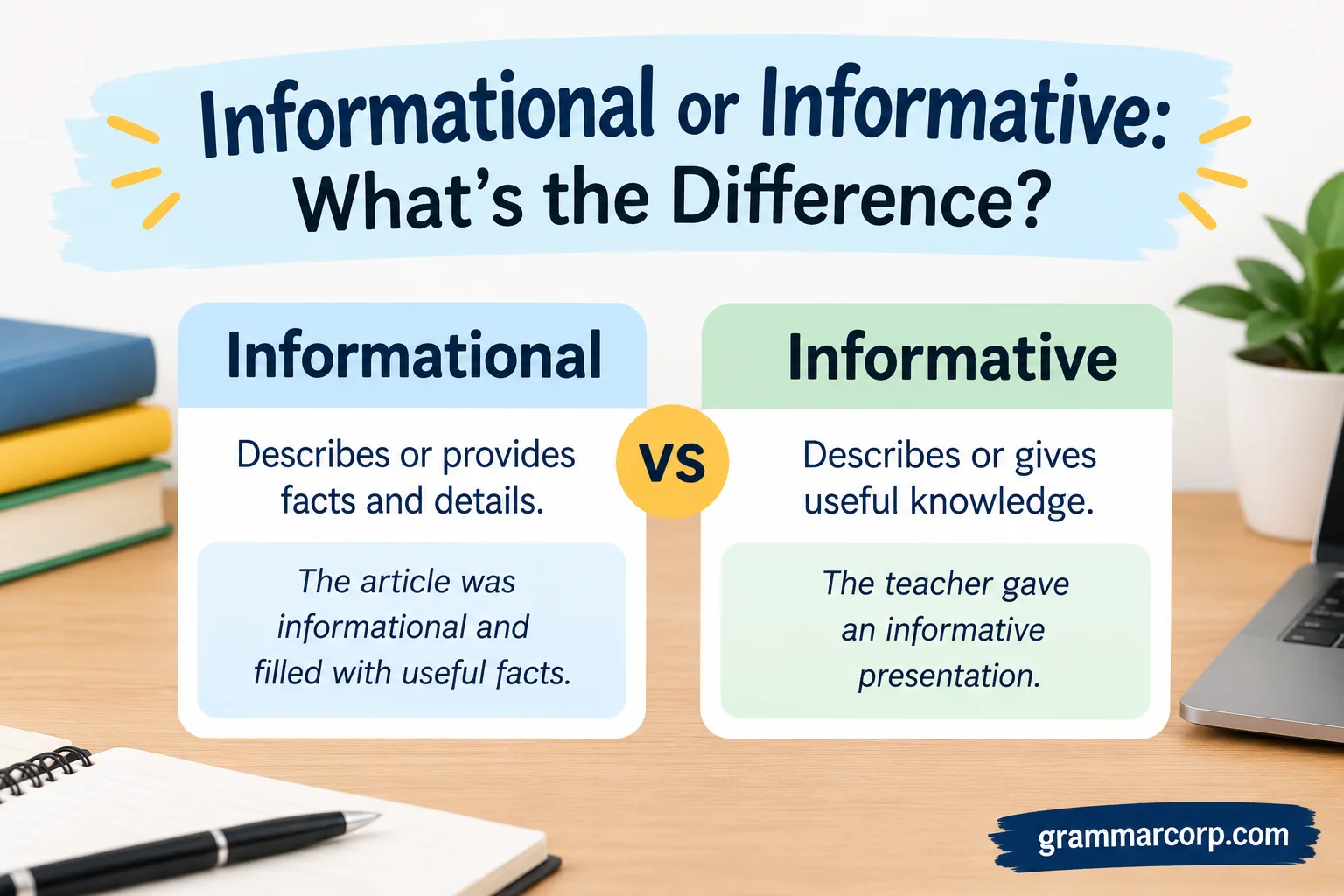
Informational or Informative: What’s the Difference? Learn how these words shape clear writing and help you choose the right term in context every day.
When I started exploring online content, I noticed that many beginner writers used informational and informative as if they were identical. However, their semantic difference matters in English grammar, language studies, and everyday communication. Informational usually describes websites, articles, resources, and presentations that provide facts or explain a subject. Informational or Informative: What’s the Difference? by contrast, emphasizes useful knowledge, understanding, and audience engagement.
For example, an informational brochure explains the purpose of a service, while an informative presentation helps an audience understand an idea through an engaging explanation. In my experience with educational blogs and writing techniques, the easiest way to understand these descriptive words is to compare their contextual meaning and consider which term best fits the message.
An informational resource often focuses on structured data, instructions, statistics, and plain facts, making knowledge delivery its main function. Informative writing, on the other hand, emphasizes reader comprehension, clear examples, and practical examples that improve understanding. Both approaches support digital content creation, content writing, and an effective content strategy. Paying attention to grammatical usage, natural phrasing, and phrase selection helps writers choose the right term and communicate with greater clarity.
Quick Answer:
Information generally means related to, containing, or intended to provide information.
Informative generally means providing useful information, knowledge, facts, or understanding.
For example:
- The hospital created an informational brochure about its services.
- The doctor’s presentation was highly informative.
- The website provides informational resources for new customers.
- The article was informative and explained the subject clearly.
A simple way to remember the distinction is:
Informational describes an information-related purpose or type. Informative describes the value or usefulness of the information provided.
That isn’t an absolute grammar rule. English usage allows considerable overlap between the two words. Context and established phrases still matter.
Comparison Overview
| Feature | Informational | Informative |
| Basic meaning | Related to or intended to provide information | Providing useful knowledge or understanding |
| Main emphasis | Purpose, function, or information-related nature | Learning, usefulness, or educational value |
| Common with | Resources, pages, materials, websites, brochures | Articles, speeches, books, presentations, discussions |
| Can you describe the content? | Yes | Yes |
| Can describe a website? | Yes | Yes |
| Can describe an article? | Yes | Yes |
| Often implies useful knowledge? | Not necessarily | Usually |
| Usually positive evaluation? | Not necessarily | Often |
| Always interchangeable? | No | No |
Consider the difference in these two sentences:
- The organization published an informational guide.
- The guide was informative.
The first sentence identifies the guide as a resource designed to provide information. The second comments on the guide’s usefulness or educational value.
That subtle shift explains why both words exist.
Main Differences Between Informational and Informative
The clearest way to understand informational vs. informative is to examine what each word emphasizes.
Informational Focuses on Information and Purpose
Information commonly describes something associated with providing information.
It often tells you what type of resource something is or what purpose it serves.
For example:
- Informational website
- Informational brochure
- Informational material
- Informational page
- Informational resource
- Informational document
An informational resource doesn’t necessarily promise that its content is especially insightful or comprehensive. It simply indicates that the resource provides information.
Imagine a city’s tourism office publishing a brochure listing museums, opening hours, transportation options, and visitor rules.
Calling it an informational brochure makes sense because the brochure exists to give visitors information.
Informative Focuses on What Someone Learns
Informative puts more attention on the knowledge or understanding that something provides.
If you say a lecture was informative, you’re usually saying that you learned something useful from it.
For example:
- The lecture was informative.
- She gave an informative presentation.
- We watched an informative video.
- He wrote an informative article.
- The book is extremely informative.
The word can carry an evaluative quality. Calling something informative often suggests that it successfully teaches, explains, or increases understanding.
The Difference in One Example
Suppose a university creates a webpage explaining its admission process.
You could call it an informational webpage because its purpose is to provide admission information.
If a student says the webpage clearly explained application deadlines, requirements, fees, and procedures, the student might describe it as informative.
So:
Informational → What kind of resource is it or what is it intended to do?
Informative → What useful knowledge does it give the reader or listener?
What Does Informational Mean?
Informational is an adjective formed from the noun information.
It generally describes something connected with information or intended to communicate information.
The word often appears when people classify a resource according to its function.
For instance, a website can be:
- Informational
- Commercial
- Educational
- Entertainment-focused
- Transactional
An informational website primarily gives visitors information rather than directly facilitating a transaction.
The same idea applies to an informational brochure. The brochure’s role is to communicate facts, instructions, details, or explanations.
Common Uses of Informational
You’ll often see informational before nouns such as:
- Informational website
- Informational content
- Informational resource
- Informational material
- Informational guide
- Informational brochure
- Informational page
- Informational document
- Informational sign
- Informational pamphlet
- Informational database
- Informational handout
The word works especially well when you want to identify something as an information resource.
Examples of Informational in a Sentence
The museum provides informational brochures for visitors.
Here, informational describes the purpose of the brochures. They give visitors useful facts about the museum.
The company created an informational page explaining its return policy.
The page exists to communicate information about returns.
Students received informational materials before the science fair.
The materials supplied relevant facts or instructions.
The website contains informational resources for first-time homeowners.
The resources are designed to provide information to homeowners.
The sign contains informational details about the trail.
The sign communicates useful details about the trail.
Does Informational Mean Useful?
Not necessarily.
Something can be informational without being especially useful, detailed, clear, or engaging.
That’s an important distinction.
An informational document might contain only basic facts. It still qualifies as informational because it provides information.
By contrast, describing something as informative usually suggests that the information helped someone learn or understand something.
What Does Informative Mean?
Informative is an adjective that describes something that gives useful information, knowledge, or understanding.
It often appears when someone evaluates communication.
If you say, The presentation was informative, you’re not merely identifying the presentation as something containing information. You’re saying the presentation taught the audience something worthwhile.
That’s why informative frequently appears in reviews and personal opinions.
Common Uses of Informative
Common combinations include:
- Informative article
- Informative speech
- Informative presentation
- Informative book
- Informative video
- Informative lecture
- Informative discussion
- Informative explanation
- Informative conversation
- Informative documentary
The adjective works particularly well with things people read, watch, hear, or experience for learning.
Examples of Informative in a Sentence
The article was informative and easy to understand.
The article gave the reader useful knowledge.
Her presentation was surprisingly informative.
The presentation helped the audience learn something valuable.
We watched an informative documentary about ocean ecosystems.
The documentary increased the viewers’ understanding of the subject.
The teacher gave us an informative explanation of the experiment.
The explanation supplied useful understanding.
The discussion was informative and answered several important questions.
The discussion gave participants knowledge they didn’t have before.
Does Informative Mean Educational?
Often, yes, but the two words aren’t identical.
Something can be informative without being formally educational.
A conversation with an experienced traveler could be informative. A product demonstration could be informative. A news report could be informative.
The central idea is that the information adds knowledge or understanding.
Informational vs. Informative: Are They Interchangeable?
Sometimes.
English doesn’t draw a hard boundary between the two adjectives in every situation. Some nouns can naturally take either word.
For example:
- Informational website
- Informative website
Both expressions are understandable and grammatically valid.
However, they can emphasize different things.
An informational website sounds like a description of the website’s purpose or category.
An informative website sounds more like an assessment of the website’s content.
The first tells you what the website does.
The second suggests how useful its information is.
Informational Article vs. Informative Article
Both phrases work.
An informational article emphasizes the article as a piece of content intended to provide information.
An informative article emphasizes the fact that the article teaches the reader something useful.
For example:
The company published an informational article about its new service.
The focus is on the article as an information resource.
The article provided an informative explanation of the new service.
The focus shifts toward the quality and usefulness of the explanation.
Informational Website vs. Informative Website
Again, both can work.
Informational website is especially useful when distinguishing an information-focused site from a site designed primarily for transactions.
For example, a local government website may provide forms, announcements, regulations, contact details, and public information. Calling it an informational website describes its function.
Informative website focuses more on the visitor’s experience.
If the website explains complicated subjects clearly and gives visitors valuable knowledge, calling it informative makes sense.
Informational Brochure vs. Informative Brochure
Informational brochure emphasizes the brochure’s role as an information resource.
Informative brochure emphasizes the quality or usefulness of the information.
Both are possible. The first often sounds more neutral and functional. The second can sound more evaluative.
Informational or Informative Examples
Real examples make the distinction easier to remember.
Example: A Company Website
A company creates a website explaining its services, pricing structure, policies, and contact information.
You might describe it as an informational website because it exists to provide customers with information.
If the website also explains complicated topics clearly and helps visitors understand their options, you could call it informative.
The two words highlight different aspects of the same website.
Example: A School Presentation
A student gives a presentation about climate systems.
Calling it an informative presentation emphasizes what the audience learned.
You could also describe the slides as informational materials if you’re referring to the supporting resources.
That difference is useful:
- The presentation can be informative.
- The materials can be informational.
Example: A Public Sign
A sign at a national park explains trail conditions, safety rules, distances, and local regulations.
An informational sign is a natural description because the sign exists to communicate information.
You might also say the sign was informative if it gave visitors useful knowledge.
Example: A Book
Suppose you read a book that explains how bridges are designed.
You could call it an informative book because it teaches you about bridge engineering.
Calling it an informational book is possible. However, informative often sounds more natural when you want to praise what you learned.
Example: A Conversation
Imagine talking with someone who knows a lot about photography.
After the conversation, you might say:
That was an informative conversation.
You’re describing the knowledge you gained.
Calling it an informational conversation would sound less natural in ordinary conversation.
Common Phrases With Informational and Informative
Certain word combinations occur more naturally than others.
Common Informational Phrases
- Informational content
- Informational website
- Informational resource
- Informational material
- Informational brochure
- Informational page
- Informational guide
- Informational document
- Informational sign
- Informational handout
These phrases tend to identify something according to its information-providing function.
Common Informative Phrases
- Informative article
- Informative speech
- Informative presentation
- Informative book
- Informative video
- Informative lecture
- Informative discussion
- Informative explanation
- Informative conversation
- Informative documentary
These phrases tend to emphasize the knowledge or understanding gained.
Informational or Informative in Formal and Academic Writing
Both words appear in formal and academic English.
The correct choice depends on the meaning rather than the level of formality.
Informational in Academic Contexts
Academic writers may use informational to describe resources or materials.
For example:
- Informational resources
- Informational materials
- Informational websites
- Informational documents
- Informational sources
A university library might provide informational resources about a research topic.
Here, the adjective identifies the resources as sources of information.
Informative in Academic Contexts
Informative commonly describes communication intended to teach or explain.
Examples include:
- Informative speech
- Informative essay
- Informative presentation
- Informative lecture
- Informative discussion
A student might deliver an informative speech about renewable energy.
The purpose is to explain a subject and increase the audience’s knowledge.
Informative Writing
Informative writing has a particularly important meaning in education.
It generally refers to writing that explains, describes, or presents information about a subject.
An informative piece should help readers understand its topic through relevant facts, explanations, examples, and organized ideas.
The goal isn’t simply to put information on a page. Clarity and understanding matter.
How to Choose Between Informational and Informative
When you’re unsure, don’t rely only on how the words look. Ask what you actually want to communicate.
Choose Informational When You Mean “Designed to Provide Information”
Use informational when the emphasis falls on the information-related purpose of something.
Examples:
- An informational brochure explains a service.
- An informational webpage provides instructions.
- An informational resource contains relevant facts.
- An informational sign communicates rules or details.
Think of informational as a classification.
Choose Informative When You Mean “Useful for Learning”
Use informative when you want to emphasize knowledge, understanding, or usefulness.
Examples:
- The article was informative.
- The lecture was informative.
- Her presentation was informative.
- The documentary was informative.
Think of informative as an evaluation of what someone learns.
A Simple Decision Table
| What you want to emphasize | Better choice |
| Something is intended to provide information | Informational |
| Something belongs to an information-related category | Informational |
| A resource contains information | Informational |
| Someone learned useful facts | Informative |
| Something improved understanding | Informative |
| A presentation taught the audience | Informative |
| A discussion gave useful knowledge | Informative |
| You want to praise the usefulness of content | Informative |
A Practical Case Study: One Resource, Two Adjectives
Consider a fictional city transportation department.
It creates a ten-page PDF explaining bus routes, fares, schedules, payment methods, and accessibility services.
The department could call the PDF an informational guide.
Why?
Because the guide functions as an information resource.
Now imagine a resident reads it and says:
The guide was very informative.
Why?
Because the resident found the information useful and gained a better understanding of the city’s transportation system.
The same document can therefore be informational and informative at the same time.
The adjectives aren’t necessarily competing descriptions. They can describe different characteristics of the same thing.
Read More : Deactivate or Inactivate: Which Word Is Correct?
Informational vs. Informative: Common Mistakes
Understanding the distinction also helps prevent awkward word choices.
Mistake: Treating Informational as a Synonym for Useful
Informational doesn’t automatically mean valuable, accurate, comprehensive, or helpful.
Something can provide information without doing those things particularly well.
If you want to praise the usefulness of content, informative usually communicates that idea more clearly.
Mistake: Assuming Informative Means Formal
Informative doesn’t have to describe academic or professional material.
A casual conversation can be informative.
A short video can be informative.
A friend’s explanation can be informative.
The key idea is useful knowledge, not formality.
Mistake: Thinking Only One Word Is Correct
Both informational and informative are legitimate English adjectives.
The question isn’t usually whether one word is grammatically correct and the other is wrong.
Instead, ask which word communicates your intended meaning more precisely.
Mistake: Ignoring Established Expressions
Some combinations have become conventional through widespread usage.
For example, informative speech is a well-established phrase in educational contexts.
Similarly, informational resources is common when describing materials designed to provide information.
Natural English depends on more than dictionary definitions. Collocation matters too.
Informational vs. Informative: A Grammar Perspective
Both words function as adjectives.
They modify nouns or describe qualities.
Examples include:
- An informational resource
- An informative article
- The resource is informational
- The article is informative
The suffixes help distinguish their forms but don’t provide a perfect rule for predicting every usage.
Information derives from information and commonly carries the sense of being related to or providing information.
Informative comes from inform and commonly carries the sense of imparting information or knowledge.
Their meanings overlap because both ultimately relate to communication and knowledge.
That’s why context remains essential.
Informational or Informative for Websites?
This question comes up often because websites can perform several different roles.
Use Informational for Website Type or Purpose
If you’re describing a site that mainly exists to provide facts, details, instructions, or resources, informational website is a strong choice.
For example:
The organization operates an informational website about local services.
The phrase tells readers what kind of website it is.
Use Informative for Website Quality
If you’re evaluating the content, informative website can work well.
For example:
The website is informative and explains the application process clearly.
Here, the adjective tells readers something about the site’s usefulness.
The distinction is subtle but meaningful.
Informational or Informative for Articles?
Both expressions can be correct.
Informational article focuses on the article as a source of information.
Informative article focuses on the article’s ability to educate or inform the reader.
Compare:
The company added an informational article to its help center.
The sentence classifies the article as part of an information resource.
The company published an informative article explaining the issue.
The sentence emphasizes the article’s explanatory value.
For most situations where you’re praising an article for teaching the reader something, informative is the stronger choice.
Informational or Informative for Speeches?
Informative speech is generally the more natural expression when discussing a speech whose purpose is to explain or teach.
An informative speech gives an audience knowledge about a subject.
For example:
She delivered an informative speech about renewable energy.
The speaker isn’t merely providing random information. The speech helps the audience understand a topic.
You can encounter informational speech, but it isn’t usually the first choice when referring to this established speech category.
Informational or Informative: Which One Is Correct?
Both are correct.
The right choice depends on what you mean.
Use informational when you want to describe something as related to information or intended to provide information.
Use informative when you want to emphasize that something provides useful knowledge or improves understanding.
The distinction isn’t absolute. Native English speakers may use the two words in overlapping contexts.
The most reliable approach is to consider:
- Meaning
- Context
- The noun being modified
- Common word combinations
- What you want the reader to understand
When a resource simply exists to communicate information, informational often fits.
When you want to say that someone learned something valuable from it, informative often fits better.
FAQs:
1. What is the difference between informational and informative?
Informational describes something that provides or relates to information, while informative emphasizes how something gives readers useful knowledge, facts, or understanding.
2. Is informational content the same as informative content?
Not exactly. Informational content mainly shares facts, details, or instructions. Informative content focuses on helping the audience learn something useful or understand a subject better. However, both terms can overlap in certain contexts.
3. Should I use informational or informative when describing an article?
Use informational articles when emphasizing that the article provides information about a topic. Use informative articles when highlighting the useful knowledge or understanding readers gain from it. Both expressions can be correct.
4. Can informational and informative be used interchangeably?
Sometimes. Both adjectives relate to information, but they emphasize different aspects. The best choice depends on the sentence, intended meaning, audience, and context.
5. Which word is better for websites and educational content?
Both words work well. An informational website emphasizes providing information, such as facts, services, or instructions. Informative website highlights the knowledge and understanding visitors gain from its content.
Conclusion:
Understanding informational or informative helps you make better word choices in everyday communication, educational materials, and digital content.
Although both adjectives relate to information, informational emphasizes the purpose of providing information, while informative highlights the useful knowledge readers gain.
By considering context, audience expectations, and intended meaning, you can choose the most suitable word and create clear, engaging, and effective content.














1 thought on “Informational or Informative: What’s the Difference?”