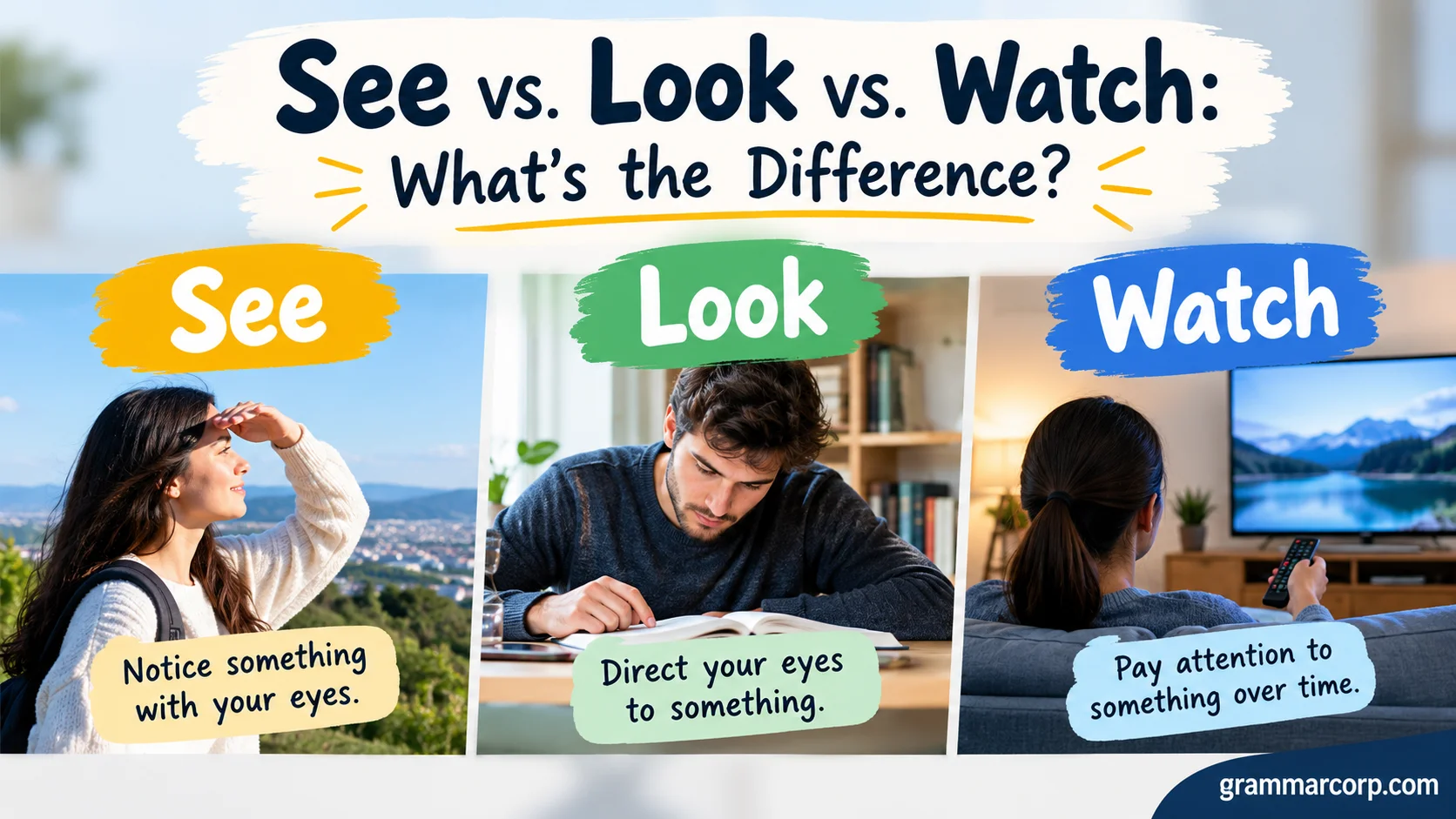
See vs. Look vs. Watch: What’s the Difference? helps English learners choose the right verb, avoid mistakes, and communicate clearly in everyday situations. These verbs describe using your eyes and vision, but they are not interchangeable. Understanding their meanings and key differences makes English grammar easier for everyone, from beginners to advanced learners. In my teaching and editing experience, I have found that focusing on intention, duration, and visual experience makes these words easier to understand.
See describes visual perception that often happens naturally and without effort. Your eyes perceive something even when you are not trying to notice it. For example, you might see a bird outside your window while working. Look involves intentionally directing your eyes toward something. It is a deliberate action that requires attention and focus. If someone points out a bird, you may look at it to notice its color or shape. See vs. Look vs. Watch: What’s the Difference? observation and sustained attention when you want to follow an action, movement, or change. If you stay by the window and observe a bird flying from branch to branch, you watch it.
Knowing these differences helps you choose the correct word in different situations and avoid making an English sentence sound unnatural. Your choice depends on the context and whether you simply perceive something, deliberately examine it, or continue observing it. These semantic and contextual differences are essential parts of verb usage, grammar rules, sentence construction, and effective communication. For language learning, connect each verb with a simple action: see something, look at it, or watch something happen.
Quick Answer:
The basic difference between see vs. look vs. watch is simple:
- See means to perceive something with your eyes, often without deliberately trying.
- Look means to intentionally direct your eyes toward something.
- Watch means to look at something for a period of time, usually while following movement, activity, or change.
| Verb | Basic meaning | Intention | Typical use |
| See | Perceive with your eyes | Usually not emphasized | I can see a bird. |
| Look | Direct your eyes | Intentional | Look at that bird. |
| Watch | Observe over time | Intentional | Watch the bird fly. |
A useful memory trick is:
See = notice. Look = direct your eyes. Watch = observe over time.
This rule works in many everyday situations. Still, English has exceptions and special expressions that you need to understand.
Comparison Overview
The three verbs describe different stages of visual attention.
Imagine walking through a park. You suddenly see a dog because it enters your field of vision. Your friend says, Look at that dog! You then turn your eyes toward it. If the dog starts running and you follow its movement for several minutes, you watch it.
The difference becomes clearer when you compare the verbs directly.
| Situation | Natural sentence | Why? |
| You notice a person across the room | I see John. | You perceive him visually. |
| You intentionally turn toward John | I look at John. | You direct your eyes toward him. |
| You observe John playing a game | I watch John play. | You follow his activity over time. |
| You notice a painting | I see a painting. | You perceive it. |
| You examine the painting | I look at the painting. | You intentionally focus on it. |
| You observe a moving scene | I watch the scene. | You follow what happens. |
The important point is that see, look, and watch don’t simply represent different levels of looking. They also have different grammatical patterns.
For example, look commonly needs at before the thing receiving your visual attention:
- Look at the picture.
- Look at me.
- Look at the sky.
With see and watch, you normally put the object directly after the verb:
- I see the picture.
- I watch the game.
That grammatical difference makes these verbs easier to recognize in real sentences.
Main Differences Between See vs. Look vs. Watch
See Means to Perceive Something
See describes visual perception. Your eyes receive visual information and you become aware of something.
You don’t usually need to make a conscious effort to see something. If an object appears in front of you and your vision is working normally, you may simply see it.
Consider these examples:
- I see a car outside.
- She saw her teacher in the hallway.
- Can you see the mountain?
- I couldn’t see anything in the dark.
- Did you see that bird?
In these sentences, the focus falls on perception rather than the physical action of directing the eyes.
See can also mean “understand”
English often uses see in a non-visual sense.
For example:
- Now I see what you mean.
- I see your point.
- I see why you’re worried.
Here, see means something close to understand or recognize.
This meaning has nothing to do with physical vision. Context tells you which meaning applies.
See can describe meetings and experiences
The verb see also appears in common expressions where its meaning extends beyond visual perception.
Examples include:
- I need to see a doctor.
- I’ll see you tomorrow.
- We went to see a movie.
- She went to see her grandparents.
These uses cannot always be explained with the simple rule that see means notice. Instead, they are established meanings and patterns in English.
Look Means to Direct Your Eyes
Look focuses on the deliberate action of directing your eyes toward something.
You decide where to look.
For example:
- Look at the board.
- Look at this picture.
- Look at that building.
- Look over there.
- He looked out the window.
The person speaking usually wants someone to shift their visual attention.
That’s why look appears frequently in instructions:
- Look at the map.
- Look at the example.
- Look over here.
- Look carefully.
The word doesn’t necessarily mean that the person sees the object. It tells them where to direct their attention.
Why “look at” matters
When look has a direct object, English commonly uses the preposition at.
The natural sentence is:
- Look at the picture.
Not:
- Look at the picture.
The same pattern appears in:
- Look at me.
- Look at the screen.
- Look at the stars.
- Look at that car.
However, look can appear without at when the sentence focuses on the direction of your gaze:
- Look here.
- Look there.
- Look outside.
- Look up.
- Look down.
Watch Means to Observe Over Time
Watch normally involves sustained visual attention.
You don’t simply notice something. You follow it as something happens.
Examples include:
- We watched a movie.
- They watched the soccer game.
- She watched the children play.
- He watched the bird fly away.
- I watched the rain fall.
Movement often makes watch especially natural. However, movement isn’t an absolute requirement.
The central idea is continued observation.
You can watch:
- a movie
- television
- a sports game
- a performance
- a person
- an animal
- an event
- a process
- something happening
For example, watch the cake could mean observing the cake while something happens to it. The focus isn’t simply on noticing the cake. You’re paying attention to what happens next.
See vs. Look: Understanding the Difference
The difference between see and look becomes easier when you separate perception from intention.
See describes what reaches your visual awareness.
Look describes where you intentionally direct your eyes.
Compare these sentences:
- I saw a cat in the garden.
- I looked at the cat in the garden.
The first sentence tells us that the speaker noticed the cat.
The second sentence tells us that the speaker intentionally directed their eyes toward the cat.
You can even use both verbs in the same situation:
I saw a strange object on the ground, so I looked at it.
First, the speaker notices the object. Then the speaker deliberately examines it.
This distinction explains many everyday conversations.
Example: Finding a Lost Phone
Imagine someone walks into a room and notices a phone on a table.
They might say:
I see your phone on the table.
The speaker simply reports what they perceive.
If the other person can’t find it, they might say:
Look at the table.
Now the speaker wants the other person to direct their eyes toward the table.
The two verbs perform different jobs.
Look vs. Watch: Understanding the Difference
The difference between look and watch mainly involves duration and observation.
Look at something when you want to direct your eyes toward it.
Watch something when you want to keep observing it.
Compare:
- Look at the dog.
- Watch the dog.
The first sentence could be a quick instruction. Someone wants you to notice the dog.
The second suggests continued attention. You may want to see what the dog does.
This difference becomes particularly clear with activities.
Look at a Soccer Game vs. Watch a Soccer Game
You might look at a soccer game if you’re briefly directing your attention toward the field.
However, if you sit down and follow the match from beginning to end, you watch the game.
That’s why English naturally uses:
- watch soccer
- watch football
- watch basketball
- watch tennis
- watch a match
- watch a tournament
The word watch fits because sporting events involve ongoing action.
See vs. Watch: Understanding the Difference
See often focuses on noticing or experiencing something. Watch focuses on continued observation.
Compare:
- I saw the movie yesterday.
- I watched the movie yesterday.
Both can sound natural. The difference comes from what the speaker wants to emphasize.
See a movie can describe the experience of going to see a film. It often works naturally when discussing whether someone has experienced a particular movie.
Watch a movie focuses more directly on the act of viewing the film.
For example:
- Have you seen that movie?
- Do you want to watch a movie tonight?
The first asks about your experience with the movie.
The second suggests sitting down and viewing a movie.
Why “watch a movie” is common
A movie lasts for a period of time. You follow its scenes and events as they unfold.
That makes watch a natural choice when describing the viewing activity.
However, see a movie remains completely standard English. The two expressions aren’t interchangeable in every sentence because they can emphasize different aspects of the experience.
When to Use See
Use see when the main idea involves perception, recognition, understanding, or certain established meanings.
Common examples
- I can see the ocean.
- Did you see that?
- I saw Sarah yesterday.
- Can you see the difference?
- I see what you mean.
- We went to see a movie.
- I need to see a doctor.
Common patterns
See + object
- I see the house.
- She saw the problem.
See + someone + verb
- I saw him cross the street.
See + someone + -ing
- I saw him running.
The difference between these patterns can depend on whether you perceive an action as a complete event or observe someone during an ongoing action.
When to Use Look
Use look when someone intentionally directs their eyes somewhere.
Common examples
- Look at this.
- Look at the screen.
- Look over there.
- Look outside.
- Look up.
- Look down.
Common patterns with look
Look at + object
- Look at the picture.
- Look at the sky.
Look + direction
- Look here.
- Look there.
- Look outside.
Look + adjective
- You look tired.
- That looks interesting.
- The room looks clean.
Look like + noun
- You look like your brother.
- It looks like a storm.
Notice that look doesn’t always describe vision. In sentences such as You look tired, it describes appearance.
When to Use Watch
Use watch when you observe something continuously or follow an activity as it develops.
Common examples
- Watch the game.
- Watch the movie.
- Watch the children.
- Watch the road.
- Watch the performance.
- Watch the bird.
- Watch what happens.
Common patterns with watch
Watch + object
- We watched the match.
Watch + person + verb
- I watched him open the door.
Watch + person + -ing
- She watched him running across the field.
Watch for + object
- Watch for cars.
- Watch for changes.
The expression watch for has a slightly different meaning. It means to stay alert because you expect something to appear or happen.
See, Look, and Watch in Everyday Situations
Understanding these verbs becomes easier when you apply them to real situations.
At school
Imagine a teacher points toward the board.
The teacher might say:
Look at the example on the board.
The instruction asks students to direct their eyes toward the example.
A student might then say:
I can see the answer now.
The student has perceived or understood it.
If the class watches a science demonstration, students might say:
We watched the experiment.
They observed the process as it happened.
At home
Consider television.
You normally say:
I watch TV.
You can also say:
I looked at the TV.
However, the second sentence usually means you directed your eyes toward the television or screen. It doesn’t necessarily mean you watched a program.
For example:
I looked at the TV because I heard a strange sound.
The person briefly directs their attention toward the television.
By contrast:
I watched TV for an hour.
This describes sustained viewing.
Outside
Suppose you’re walking down a street.
You might say:
I saw a dog.
You noticed it.
Then someone says:
Look at that dog!
They want you to direct your attention toward it.
If you stand there observing the dog play, you could say:
We watched the dog play.
The three verbs now form a clear sequence.
A Practical Case Study: One Event, Three Verbs
Consider this short situation.
Maya walks into a park. A cyclist suddenly passes in front of her.
She says:
I saw a cyclist.
She noticed the cyclist.
Her friend asks where the cyclist went. Maya points toward the path and says:
Look over there.
Now she wants her friend to direct their eyes toward the path.
The cyclist continues riding around the park. Maya follows the cyclist’s movement for several seconds.
She says:
I watched the cyclist ride away.
The meaning changes because the visual experience changes.
| Stage | Verb | Meaning |
| Initial perception | See | Maya notices the cyclist. |
| Deliberate attention | Look | Maya directs her eyes toward the path. |
| Continued observation | Watch | Maya follows the cyclist’s movement. |
This example shows why translating all three verbs as simply look can cause problems.
Common Mistakes With See, Look, and Watch
Mistake: “See at this picture”
This is incorrect when you want someone to direct their eyes toward a picture.
Use:
Look at this picture.
The verb look needs at in this structure.
Mistake: “Look a movie”
This is not the standard expression.
Use:
Watch a movie.
You can also say:
See a movie.
However, look a movie isn’t the normal construction.
Mistake: “I watched a bird” when you only noticed it
The sentence isn’t necessarily grammatically wrong. However, it can suggest that you observed the bird for some time.
If you simply noticed it, say:
I saw a bird.
If you intentionally directed your eyes toward it, say:
I looked at the bird.
If you followed its actions, say:
I watched the bird.
Mistake: “Look TV”
The natural expression is:
Watch TV.
If you’re talking about directing your eyes toward the television itself, you can use:
Look at the TV.
The difference is important.
Mistake: Thinking “watch” always requires movement
Movement often makes watch natural. However, the broader idea is sustained attention.
The important question is whether you are following what happens over time.
See vs. Look vs. Watch With Movies and Television
Movies and television cause some of the biggest problems for English learners.
See a movie
See a movie often emphasizes the experience of viewing a film.
Examples:
- Have you seen this movie?
- I haven’t seen that film yet.
- We went to see a movie.
Watch a movie
Watch a movie focuses on the viewing activity.
Examples:
- Let’s watch a movie tonight.
- I watched a movie yesterday.
- She likes to watch movies.
Watch TV
The standard expression is:
Watch TV.
For example:
- I watch TV after school.
- We watched TV last night.
- Do you watch TV often?
Look at the TV
This means something different:
Look at the TV.
It tells someone to direct their eyes toward the television.
For example:
Look at the TV. The screen is frozen.
The speaker isn’t necessarily telling the person to watch a program. They’re directing attention toward the device.
Read More : Please Advise or Please Advice? Which Is Correct?
See vs. Look vs. Watch With People
These verbs also create subtle differences when you use them with people.
See someone
See someone can mean visually notice them or meet them.
- I saw Alex at the store.
- I see my teacher every morning.
- I’ll see you tomorrow.
Look at someone
Look at someone means directing your eyes toward that person.
- Look at me.
- She looked at her friend.
- Don’t look at the screen. Look at me.
The meaning can change depending on context. Look at someone can sometimes feel intense or impolite if the situation makes prolonged eye contact uncomfortable.
Watch someone
Watch someone means observing that person’s actions or behavior over time.
- I watched him play basketball.
- She watched the children.
- We watched the performer on stage.
The focus is usually on what the person does rather than simply noticing their presence.
Grammar Patterns You Should Remember
Learning the three verbs becomes easier when you remember their common structures.
| Verb | Common structure | Example |
| See | see + object | I see the house. |
| See | see + person + verb | I saw him leave. |
| See | see + person + -ing | I saw him running. |
| Look | look at + object | Look at the picture. |
| Look | look + direction | Look outside. |
| Watch | watch + object | Watch the game. |
| Watch | watch + person + verb | I watched her open the box. |
| Watch | watch + person + -ing | I watched her working. |
These patterns are worth learning because grammar often tells you which verb belongs in a sentence.
Common Expressions With See
Some expressions use see in ways that learners should memorize as natural English.
- See you later — a way to say goodbye.
- See for yourself — check something personally.
- See what happens — wait and find out the result.
- See the difference — recognize how two things differ.
- See the point — understand the main idea.
- See what I mean — understand the speaker’s meaning.
These expressions demonstrate why vocabulary can’t always rely on one simple definition.
Common Expressions With Look
Look appears in many phrasal verbs and fixed expressions.
- look at — direct your eyes toward something
- look for — search for something
- look after — take care of someone or something
- look like — have a similar appearance
- look forward to — anticipate something positively
- look out — be careful
These expressions don’t all relate directly to physical vision.
For example:
I’m looking for my keys.
This doesn’t mean you’re simply directing your eyes at the keys. It means you’re trying to find them.
Common Expressions With Watch
The verb watch also appears in useful expressions.
- watch TV
- watch a movie
- watch a game
- watch someone
- watch what happens
- watch out
- watch for something
The phrase watch out means be careful.
For example:
Watch out!
This isn’t simply an instruction to observe something. It warns someone about possible danger.
A Simple Decision Guide
When you’re unsure which verb to use, ask yourself three questions.
Are you simply noticing something?
Use see.
I see a plane.
Are you intentionally directing your eyes toward something?
Use look.
Look at the plane.
Are you observing something over time?
Use a watch.
Watch the plane take off.
This three-question method works well for everyday English.
See vs. Look vs. Watch: Quick Reference Table
| If you mean… | Use | Example |
| Notice something | see | I saw a bird. |
| Perceive something | see | I can see the mountain. |
| Understand something | see | I see what you mean. |
| Direct your eyes | look | Look at the mountain. |
| Examine something visually | look at | Look at this picture. |
| Observe an activity | watch | Watch the game. |
| Follow movement | watch | Watch the bird fly. |
| View television | watch | We watch TV. |
| Experience a movie | see | Have you seen that movie? |
| View a movie as an activity | watch | Let’s watch a movie. |
FAQs:
1. What is the main difference between see, look, and watch?
See means noticing something with your eyes without trying. Look means directing your eyes toward something intentionally. Watch means observing something for a period of time, especially when it moves or changes.
2. When should I use see in a sentence?
Use see when you notice something through your vision, often without making a deliberate effort. For example, “I can see a bird outside my window.”
3. Is look always followed by at?
No, look does not always require at. You can say “Look at the picture” when directing attention toward something. However, you can also say “Look carefully” or “Look around” without using at.
4. When should I use watch instead of look?
Use a watch when you pay attention to an activity, movement, or change over time. For example, “We watched the children play in the park.” Use look when you direct your eyes toward something, such as “I looked at the children.”
5. Can see, look, and watch be used interchangeably?
No, they generally cannot be used interchangeably because they express different kinds of visual experiences. Choosing the correct verb depends on your intention, the context, and whether you notice, direct your gaze toward, or observe something over time.
Conclusion:
Understanding see vs. look vs. watch helps you communicate more naturally and accurately in English. Remember that see describes noticing something, look involves directing your eyes toward it, and watch means observing an action or change over time.
Learning these differences, practicing with everyday examples, and paying attention to context can help you avoid common grammar mistakes and improve your English vocabulary, fluency, and confidence.














1 thought on “See vs. Look vs. Watch: What’s the Difference?”