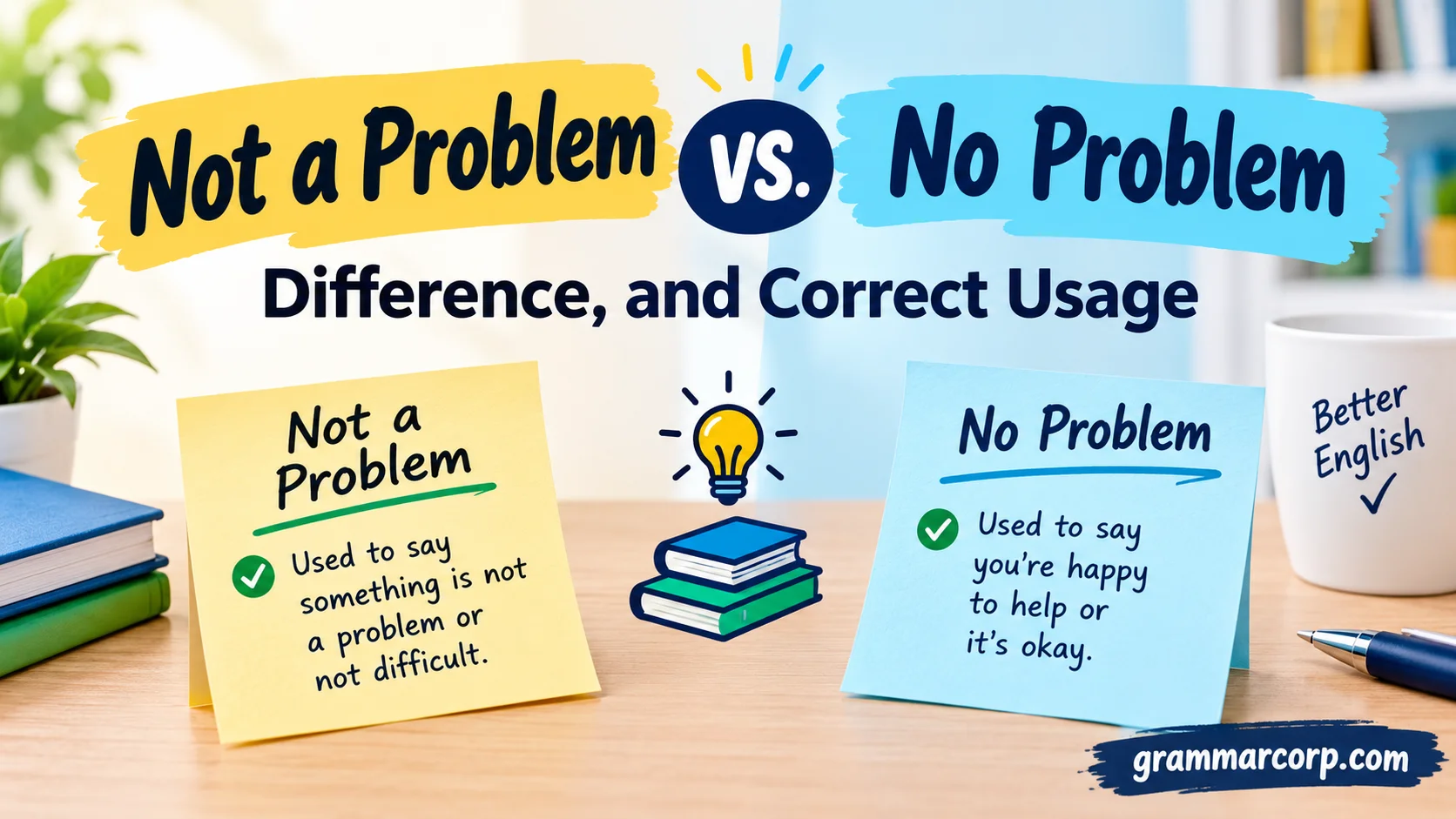
This guide to Not a Problem vs. No Problem: Difference, and Correct Usage explains how context, tone, and grammar shape each phrase in English.
Both expressions are common in everyday English, but their usage depends on the context and the speaker’s purpose. As an English teacher, I have noticed that English learners often experience confusion because the phrases have a similar meaning and look almost identical.
No problem is a common response to thank you, thanks, and apologies, especially in casual conversations, casual interactions, and casual speech. For example, a colleague might say, “Thank you for helping me,” and you can respond with “No problem!” This sounds natural, friendly, and relaxed.
In contrast, not a problem can be useful when explaining that a task, request, or situation is easy, acceptable, or not difficult. For example, “Finishing this task today is not a problem” shows that the task does not create an issue or cause inconvenience.
Quick Answer:
Not a problem and no problem are both correct English expressions, and they often mean the same thing.
The simplest distinction is:
- Not a problem means something isn’t an issue or difficulty.
- No problem means there is no difficulty or trouble.
- No problem is especially common as a casual response to thank you, sorry, or a request.
- Not a problem often sounds like reassurance that a particular situation or request isn’t troublesome.
- Neither expression is automatically more polite or professional than the other.
- In formal writing, alternatives such as you’re welcome, certainly, or I’m happy to help may fit better.
For example:
Can you help me move these boxes?
No problem.
You could also say:
Can you help me move these boxes?
Not a problem.
Both are natural.
However, if someone says:
Thanks for helping me!
No problem is a particularly natural casual response.
Comparison Overview
| Feature | Not a Problem | No Problem |
| Basic meaning | Something isn’t an issue | There is no difficulty or trouble |
| Grammatical structure | Negative + noun phrase | Negative determiner + noun |
| Common use | Reassurance and acceptance | Reassurance, acceptance, thanks, apologies |
| Casual conversation | Very common | Extremely common |
| Response to thanks | Possible | Very common |
| Response to apologies | Natural | Very common |
| Accepting a request | Natural | Natural |
| Professional conversation | Acceptable | Acceptable, depending on context |
| Formal writing | Usually replaced by more formal wording | Usually replaced by more formal wording |
| Tone | Reassuring, neutral, friendly | Casual, friendly, relaxed |
The biggest point to remember is that there isn’t a strict rule saying you must use one phrase instead of the other.
Their meanings overlap heavily.
The Grammar Behind the Difference
Consider these two sentences:
- It is not a problem.
- There is no problem.
The first sentence says that something does not qualify as a problem. The second says that no problem exists.
That grammatical difference becomes less noticeable when the expressions stand alone:
- Can you stay a little longer? — Not a problem.
- Can you stay a little longer? — No problem.
Both communicate essentially the same message.
Main Differences Between Not a Problem vs. No Problem
Although the expressions overlap, several useful differences can help you choose the more natural option.
Not a Problem Focuses on Whether Something Is Problematic
Not a problem often refers to a particular issue, request, task, or situation.
For example:
I need to change the meeting time.
That’s not a problem.
The speaker is directly saying that the requested change isn’t an issue.
You can also expand the phrase:
- It’s not a problem for me.
- That’s not a problem at all.
- Getting there early isn’t a problem.
- Missing the first five minutes isn’t a problem.
These constructions clearly connect problem with a particular situation.
No Problem Emphasizes the Absence of Difficulty
No problem can communicate that something doesn’t create trouble or inconvenience.
For example:
Could you send me the document tomorrow?
No problem.
The speaker means something like:
Sure. That won’t cause any difficulty.
The expression can also stand alone as a complete conversational response.
No Problem Has a Stronger Conversational Role
One major difference appears when somebody thanks you.
Thanks for your help!
No problem!
This is extremely common in informal English.
You can also say:
Thanks for your help!
Not a problem!
That’s understandable and natural too. However, no problem has become especially established as a quick conversational response.
The same pattern appears with apologies:
Sorry I interrupted you.
No problem.
Or:
Sorry about the delay.
Not a problem.
Both work.
The Difference Isn’t as Strict as Grammar Books Sometimes Suggest
It’s tempting to create a rigid rule such as:
Use not a problem for one situation and no problem for another.
Real English doesn’t work that neatly.
Native speakers use both expressions across many of the same situations. Context and tone often matter more than the small grammatical difference.
What Does “Not a Problem” Mean?
Not a problem is an informal expression that tells someone that something isn’t troublesome, difficult, or unacceptable.
It often appears as a shortened version of:
- It’s not a problem.
- That’s not a problem.
- This isn’t a problem.
- That wouldn’t be a problem.
For example:
Can we move the appointment to Friday?
Not a problem.
The complete idea is:
Moving the appointment to Friday isn’t a problem.
When to Use “Not a Problem”
You can use not a problem when you want to:
- Accept a request
- Reassure someone
- Dismiss a minor concern
- Say something won’t cause difficulty
- Tell someone their mistake isn’t serious
- Confirm that you’re willing to help
Examples:
- Not a problem. I can take care of it.
- That’s not a problem for me.
- Arriving ten minutes early is not a problem.
- Your change of plans is not a problem.
- Not a problem at all. Take your time.
“Not a Problem” in a Full Sentence
The expression can also function inside a longer sentence.
Working late tonight is not a problem.
Here, not a problem acts as part of the sentence rather than as a standalone response.
Compare that with:
Working late tonight will be no problem.
Both sentences work, but their structures differ.
What Does “No Problem” Mean?
No problem is a common informal expression meaning that something isn’t difficult, troublesome, or inconvenient.
It also works as a conversational response to gratitude or an apology.
Examples include:
- No problem! I’ll help you.
- No problem. Take your time.
- No problem at all.
- Thanks! — No problem.
- Sorry about that. — No problem.
The expression is particularly useful because it can handle several conversational situations with only two words.
“No Problem” After “Thank You”
This is one of its most recognizable uses.
Thanks for sending that file.
No problem.
The response reassures the other person that helping wasn’t an inconvenience.
You might also use:
- You’re welcome.
- Sure.
- Of course.
- My pleasure.
- Happy to help.
The best choice depends on the relationship and level of formality.
“No Problem” After an Apology
It can also reassure someone who has apologized.
Sorry I’m late.
No problem.
The intended meaning is:
Your being late hasn’t caused a significant issue for me.
Again, context matters. If the situation is serious, simply saying no problem could minimize the issue. In ordinary minor situations, though, it sounds natural.
“Not a Problem” vs. “No Problem” in Everyday Conversation
In casual conversation, the two phrases frequently substitute for each other.
Accepting a Request
Could you pick me up after school?
Not a problem.
or
No problem.
Both are natural responses.
Reassuring Someone
I might be five minutes late.
Not a problem.
or
No problem.
Both communicate that the delay isn’t troublesome.
Responding to an Apology
Sorry about the mistake.
Not a problem.
or
No problem.
Both can reassure the speaker.
The choice often comes down to personal speaking style rather than grammar.
Is “No Problem” More Casual?
Generally, yes.
No problem has a very conversational feel. You’ll often hear it between friends, classmates, coworkers, customers and service workers, and family members.
That doesn’t make it rude.
A common misconception is that saying no problem after someone says thank you somehow suggests that their request actually was a problem.
That’s not how the expression normally works.
In everyday English, no problem functions as an established informal way to say that something was fine or that helping wasn’t an inconvenience.
Still, some people prefer you’re welcome because it directly acknowledges the person’s thanks.
Is “Not a Problem” More Polite?
Not necessarily.
Not a problem can sound very warm and reassuring:
Don’t worry about changing the reservation. It’s not a problem.
But it can also sound brief or businesslike depending on delivery.
Likewise:
No problem!
can sound friendly and enthusiastic, while:
No problem.
could sound short if delivered without warmth.
Tone Matters
The words aren’t the whole message.
Consider these factors:
- Voice: A warm voice makes either phrase friendlier.
- Context: A serious situation may call for a more thoughtful response.
- Relationship: Friends can usually use casual expressions more freely.
- Delivery: A rushed response can sound dismissive.
- Additional wording: No problem at all sounds more reassuring than a bare no problem in some situations.
This is why it’s better to think about meaning plus context rather than trying to memorize one universal rule.
“Not a Problem” vs. “No Problem” in Professional Communication
Both expressions can appear in professional conversations, especially in workplaces where communication is relatively relaxed.
For example:
Could you update the spreadsheet before lunch?
No problem.
That’s perfectly normal in an informal workplace conversation.
You could also say:
Not a problem. I’ll update it before lunch.
The second version adds clarity and explicitly connects the response with the task.
With Coworkers
Both phrases work well for everyday workplace requests:
Can you cover the first part of the meeting?
No problem.
Or:
I need to move our meeting to Thursday.
Not a problem.
With Customers
Customer service situations require a little more awareness of tone.
Instead of simply saying:
No problem.
A representative might use:
I’d be happy to help.
or:
Certainly. I can take care of that.
These alternatives sound more deliberate and professional.
In Formal Emails
Neither no problem nor not a problem is grammatically wrong in an email. However, formal business writing often benefits from more specific wording.
Instead of:
No problem. I’ll make the changes.
You could write:
Certainly. I’ll make the requested changes.
Instead of:
Not a problem.
You could write:
I’m happy to help with that.
The important distinction is formality, not correctness.
Better Alternatives to “Not a Problem” and “No Problem”
The right alternative depends on what you’re trying to communicate.
| Situation | Natural Alternative |
| Responding to thanks | You’re welcome |
| Offering help | I’m happy to help |
| Accepting a request | Certainly |
| Confirming willingness | I’d be happy to do that |
| Reassuring someone | That’s perfectly fine |
| Responding professionally | I’ll be glad to take care of that |
| Casual conversation | No problem |
| Casual reassurance | Not a problem |
Don’t assume that every casual phrase needs to disappear from professional communication. Workplace culture varies considerably.
The goal is to choose wording that fits the audience, relationship, and situation.
Common Mistakes With “Not a Problem” and “No Problem”
Mistake: Assuming “No Problem” Is Incorrect
No problem is not bad English.
It’s a standard informal expression with well-established uses in everyday conversation.
The important point is that informal doesn’t mean incorrect.
Mistake: Assuming “Not a Problem” Is Always More Professional
Adding a doesn’t automatically make an expression formal.
Compare:
Not a problem.
with:
I’m happy to assist you with your request.
The second sentence sounds more formal because of its wording and context, not simply because it avoids no problem.
Mistake: Using “Not Problem”
One common learner error is leaving out the article.
❌ That’s not problem.
✅ That’s not a problem.
Because problem is a singular countable noun in this construction, standard English requires the article a.
Mistake: Confusing “No Problem” With “No Problems”
These forms can have different grammatical roles.
No problem.
This can function as an idiomatic response.
But:
We had no problems during the trip.
Here, no problems is simply a noun phrase referring to zero problems.
Compare:
- No problem! = That’s fine / I can do it.
- We experienced no problems = We experienced zero difficulties.
Real-Life Examples: Which Phrase Should You Choose?
| Situation | Best Natural Choice | Example |
| Someone thanks you casually | No problem | Thanks! — No problem! |
| Someone apologizes for a small mistake | Either | Sorry! — Not a problem. |
| Someone asks for help | Either | Can you help? — No problem. |
| Someone has a scheduling concern | Not a problem | Friday isn’t a problem. |
| You describe a manageable task | Either | It won’t be a problem. |
| Casual text | No problem | No problem, I’ll send it later. |
| Workplace conversation | Either | Both can sound natural. |
| Formal email | More explicit alternative | Certainly, I’d be happy to help. |
Example: Friends
Can you send me the notes later?
No problem.
This sounds relaxed and natural.
Example: Coworkers
Would it be okay if I finished this tomorrow?
Not a problem.
The response reassures the coworker that the delay is acceptable.
Example: Apology
Sorry I forgot to reply.
No problem.
This tells the person that their failure to respond hasn’t created a significant issue.
Example: Professional Request
Could you please send the updated report by Friday?
Instead of a very casual:
No problem.
you might write:
Certainly. I’ll send the updated report by Friday.
The latter removes ambiguity and sounds more polished.
Read More : To Use Your Loaf: Origin, Usage, Examples and Differences
A Useful Case Study: One Situation, Two Expressions
Imagine a coworker asks:
Could you switch your shift with me tomorrow?
You can respond:
No problem.
This sounds quick, casual, and cooperative.
You could also say:
Not a problem.
This sounds slightly more like reassurance that the requested change isn’t an inconvenience.
Now imagine the coworker says:
Thanks for switching with me!
The response:
No problem!
fits naturally.
You can still say:
Not a problem!
but the first version is especially common in casual conversation.
The difference isn’t about one being right and the other being wrong. It’s about which conversational function you’re emphasizing.
How the Meaning Changes With Extra Words
Small additions can make these expressions more precise.
“Not a Problem at All”
This adds reassurance.
Not a problem at all. I can handle it.
It strongly communicates that the speaker isn’t bothered.
“No Problem at All”
This does the same thing:
No problem at all. Take your time.
It can sound especially friendly when someone worries that they’ve caused an inconvenience.
“Not a Problem for Me”
This makes the speaker’s personal position explicit.
Staying a little longer is not a problem for me.
“No Problem With That”
This expresses acceptance of a particular idea or action.
No problem with that. We can use your suggestion.
These expanded forms show why the expressions aren’t completely interchangeable in every grammatical position.
Which One Should English Learners Use?
If you’re learning English, don’t worry about finding one phrase that works everywhere.
Instead, remember a few practical patterns.
Use “No Problem” for Common Casual Responses
It’s particularly useful after:
- Thank you
- Sorry
- Can you help?
- Could you do this?
- Is that okay?
Examples:
Thanks! — No problem.
Sorry! — No problem.
Can you help? — No problem.
Use “Not a Problem” When Reassuring Someone About a Specific Issue
Examples:
That’s not a problem.
The delay is not a problem.
Changing the date is not a problem.
It’s not a problem for me.
This structure makes the connection between the issue and the reassurance very clear.
Is “No Problem” Rude When Someone Says “Thank You”?
Usually, no.
In casual English, no problem commonly means that the speaker didn’t mind helping.
For example:
Thanks for carrying that for me.
No problem!
That’s normally friendly.
However, some speakers prefer you’re welcome, especially in more formal or traditional settings. If you’re unsure, you’re welcome is a safe and widely understood response to thank you.
The choice isn’t usually about right versus wrong. It’s about registration and personal preference.
FAQs:
1. What is the difference between “not a problem” and “no problem”?
“No problem” is commonly used to respond to thanks or apologies, while “not a problem” often emphasizes that a request or situation is acceptable or causes no difficulty. Both expressions can be correct, depending on the context.
2. Is “no problem” more casual than “not a problem”?
Yes, “no problem” is especially common in casual conversations because it sounds friendly and natural. However, both expressions can be used in everyday communication and informal workplace situations.
3. Can I use “not a problem” in professional communication?
Yes. “Not a problem” is suitable for many professional settings, including customer service and workplace conversations. For example, “Completing this task today is not a problem” reassures someone that the task can be handled without difficulty.
4. Is it correct to say “No problem” after someone says “Thank you”?
Yes. “No problem” is a natural and widely used response to “Thank you.” You can also say “You’re welcome” or “My pleasure,” depending on the situation and the tone you want to convey.
5. Are “not a problem” and “no problem” interchangeable?
They are interchangeable in many situations, but not always. “No problem” often works as a short response, while “not a problem” can fit more naturally into a complete sentence, such as “Rescheduling the meeting is not a problem.”
Conclusion:
Understanding “not a problem” vs. “no problem” helps you communicate more naturally and confidently in English. Although both expressions suggest that something is acceptable or causes no difficulty, their tone and purpose can vary.
Use “no problem” for friendly responses to thanks or apologies, and choose “not a problem” when explaining that a request or task is manageable. By considering the context, audience, and level of formality, you can use both expressions correctly in everyday conversations and professional communication.








1 thought on “Not a Problem vs. No Problem: Difference, and Correct Usage”