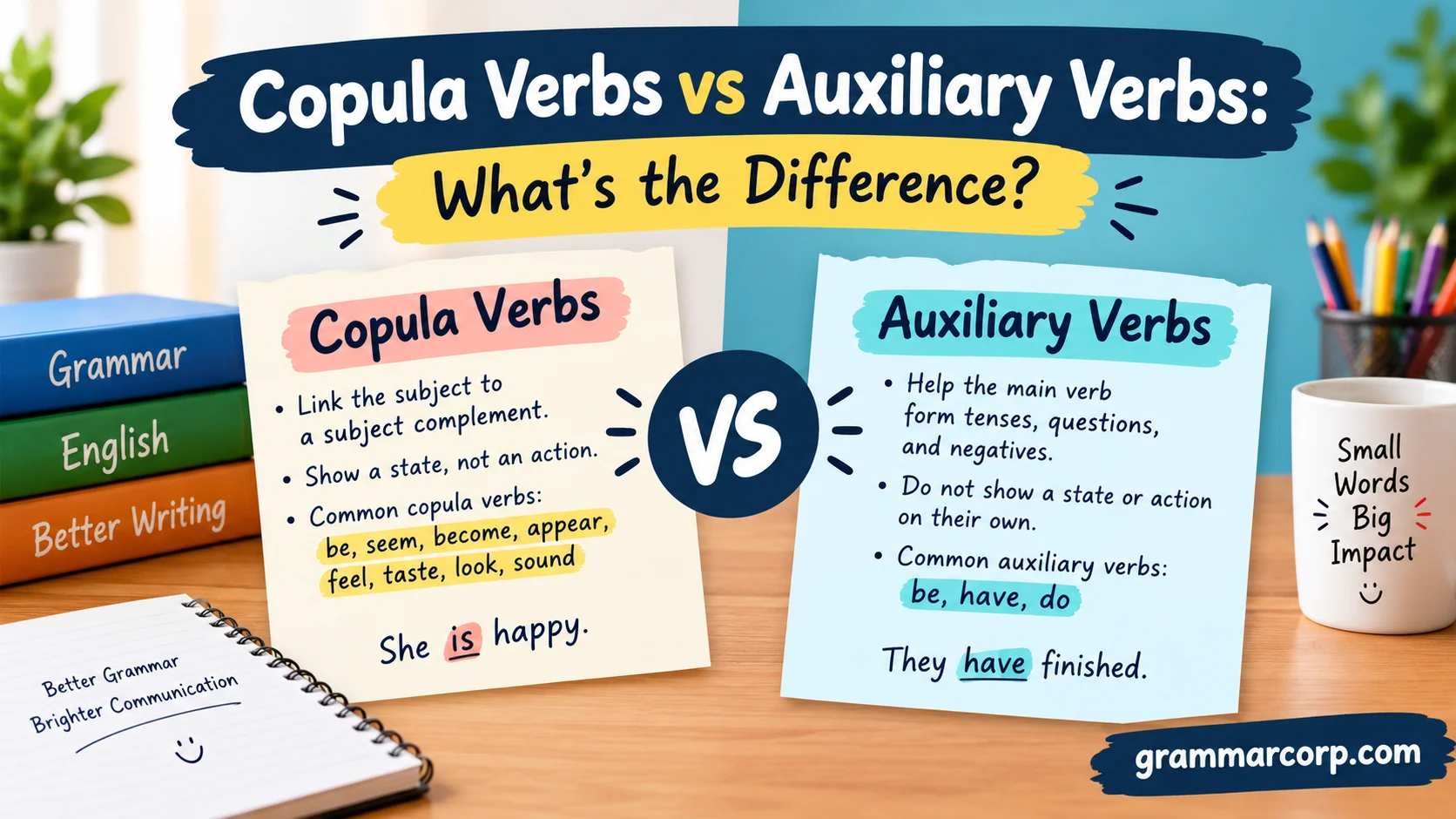
Copula Verbs vs Auxiliary Verbs: What’s the Difference? Learn how linking verbs describe subjects while auxiliary verbs help form verb phrases.
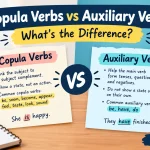
In English grammar, copula verbs are linking verbs that connect a subject to a complement to express a state, identity, or condition. For example, in “She is happy,” is links the subject “She” to the description “happy.” Other forms of the verb be include am, are, was, were, being, and been. Other copular verbs, such as appear, become, feel, get, grow, look, prove, remain, seem, smell, sound, stay, taste, and turn, can also describe a subject or link information to it. Their function depends on the context and the words around them.
Unlike copular verbs, auxiliary verbs are helping verbs that support a main verb in forming verb phrases. They help express tenses, moods, aspects, actions, questions, negation, and emphasis. Common primary auxiliaries include be, have, and do, with forms such as have, has, had, do, does, and did. Modal verbs include will, shall, would, should, can, could, may, might, and must. In “She is running,” is helps form a progressive verb phrase, and running is the present participle.
Here, is performs an auxiliary function, rather than a copular function. Auxiliary verbs also help with tense formation, mood formation, aspect formation, question formation, negative sentences, and possibility expression. For example, “Does she run?” forms a question, “She does not run” expresses negation, and “She might run” expresses possibility. Understanding how the same verb can perform different jobs improves verb identification, verb classification, sentence analysis, and knowledge of English syntax, syntactic structure, and grammatical rules.
Quick Answer:
A copula verb links the subject of a sentence to a subject complement that identifies or describes it. An auxiliary verb helps a main verb express grammatical information such as tense, aspect, voice, modality, questions, or negation.
Compare these two sentences:
- The child is tired. → is a copula because it links the child to the adjective tired.
- The child is sleeping. → is an auxiliary because it helps the main verb sleeping form the progressive construction.
The easiest rule is:
A copula link. An auxiliary helps.
However, the distinction depends on the verb’s function, not simply the word itself. Forms of be, for example, can serve as either copulas or auxiliaries.
Comparison Overview
| Feature | Copula Verb | Auxiliary Verb |
| Main purpose | Links a subject to a complement | Helps another verb |
| Also called | Linking verb | Helping verb |
| Takes a subject complement | Yes | Usually no |
| Helps form verb constructions | No, when functioning as a copula | Yes |
| Forms progressive aspect | No | Yes, with be |
| Forms passive voice | No | Yes, with be |
| Forms perfect constructions | No | Yes, with have |
| Supports questions and negatives | No | Yes, with do |
| Includes modal verbs | No | Yes |
| Example | She is happy. | She is working. |
The crucial point is that copula describes a grammatical function while auxiliary describes another grammatical function. A particular verb may belong to one category in one sentence and another category in a different sentence.
Main Differences Between Copula Verbs vs Auxiliary Verbs
The difference becomes clearer when you examine the structure and purpose of each verb.
A Copula Verb Connects the Subject to a Complement
A copula creates a relationship between the subject and a subject complement.
The complement doesn’t normally describe an action performed by the subject. Instead, it identifies the subject or gives information about its state or characteristics.
Consider:
Maria is a doctor.
Here, is connects Maria with a doctor. The noun phrase a doctor identifies Maria.
Now consider:
Maria is tired.
The verb is connects Maria with the adjective tired. The adjective describes Maria.
Common patterns include:
Subject + copula + adjective
- The water is cold.
- The room seems quiet.
- The flowers smell fresh.
Subject + copula + noun phrase
- Daniel became a teacher.
- My sister is an engineer.
- The animal remained a mystery.
The complement completes the meaning of the subject rather than functioning as another action verb.
An Auxiliary Verb Helps a Main Verb
An auxiliary verb works with a main verb to create a larger verb phrase.
For example:
She is reading.
The word is doesn’t connect she with a description. Instead, it helps the verb reading express the progressive aspect.
Similarly:
They have finished.
The auxiliary have combines with finished to form a perfect construction.
And:
He can swim.
The modal auxiliary can combines with swim to express ability.
The basic pattern looks like this:
Subject + auxiliary + main verb
Examples:
- She is studying.
- They have arrived.
- We will leave.
- You should listen.
- He can drive.
The auxiliary adds grammatical meaning to the main verb.
What Is a Copula Verb?
A copula verb links a subject to a complement. The complement typically provides an identity, description, classification, or state associated with the subject.
The most familiar copula is a form of be.
Forms of be include:
- am
- is
- are
- was
- were
- be
- being
- been
For example:
The house is large.
Here, large describes the house. The verb is links the two.
Common Copula Verbs
English has several verbs that can work as copulas.
| Copula | Example | Complement |
| be | The sky is blue. | blue |
| seem | She seems nervous. | nervous |
| become | He became a doctor. | a doctor |
| appear | The plan appears reasonable. | reasonable |
| remain | The door remained open. | open |
| stay | The children stayed quiet. | quiet |
| feel | The fabric feels soft. | soft |
| look | You look tired. | tired |
| sound | That sounds interesting. | interesting |
| smell | The bread smells fresh. | fresh |
| taste | The soup tastes salty. | salty |
| grow | The situation grew difficult. | difficult |
| turn | The leaves turned yellow. | yellow |
Not every verb in this table functions as a copula in every sentence. Look, for example, can also describe an ordinary action:
- She looks tired. → copular use
- She looks at the painting. → ordinary lexical verb
That distinction is important. Grammar depends on function and context.
What Is an Auxiliary Verb?
An auxiliary verb helps another verb express grammatical information.
English has three primary auxiliary verbs:
- be
- have
- do
English also has modal auxiliary verbs, such as:
- can
- could
- may
- might
- must
- shall
- should
- will
- would
Auxiliaries don’t normally carry the main lexical meaning of the complete verb phrase. Instead, they help build its grammatical structure.
The Primary Auxiliary “Be”
The auxiliary be appears in progressive and passive constructions.
Progressive aspect
- She is running.
- They were talking.
- We are studying.
Here, forms of be combine with a present participle ending in -ing.
Passive voice
- The letter was written yesterday.
- The house is being painted.
- The results were announced.
Here, be combines with a past participle to help form the passive construction.
The Primary Auxiliary “Have”
The auxiliary have helps form perfect constructions.
- She has finished her homework.
- They have arrived.
- He had left before noon.
The form of have changes according to tense and subject:
- have
- has
- had
Compare:
She has a bicycle.
Here, has expresses possession and functions as a main verb.
She has finished.
Here, has helps form the perfect construction and functions as an auxiliary.
The word is the same. The grammatical job changes.
The Primary Auxiliary “Do”
The auxiliary do plays an important role in English questions, negatives, and emphasis.
Questions
- Do you understand?
- Does she work here?
- Did they arrive?
Negatives
- I do not agree.
- He doesn’t know.
- They didn’t leave.
Emphasis
- I do understand.
- She does care about the result.
But do can also act as a main verb:
They do their homework every evening.
In this sentence, do carries the lexical meaning of performing an activity. It isn’t merely helping another verb.
Modal Auxiliary Verbs
| Modal | Common meaning | Example |
| can | Ability or possibility | She can swim. |
| could | Past ability or possibility | He could help. |
| may | Permission or possibility | You may leave. |
| might | Possibility | It might rain. |
| must | Necessity | You must listen. |
| shall | Formal future or suggestion | Shall we begin? |
| should | Advice or expectation | You should rest. |
| will | Future or willingness | She will come. |
| would | Hypothetical meaning or past willingness | He would help. |
Modal auxiliaries normally occur with a base-form verb:
- can go
- should study
- might arrive
- will help
- must leave
They don’t function as copulas simply because they occur before a complement-like expression.
When Is “Be” a Copula and When Is It an Auxiliary?
This is the most important distinction in copula verbs vs auxiliary verbs.
The form be can serve two completely different grammatical functions.
“Be” as a Copula
Look at:
The car is expensive.
The verb is connects the car with expensive. There is no separate main verb following is.
Therefore, is functions as a copula.
More examples:
- The children are happy.
- My brother is a teacher.
- The food was delicious.
- The windows were open.
In each case, the form of be links the subject with a complement.
“Be” as an Auxiliary
Now consider:
The car is moving.
Here, moving is the main verb. Is helps form the progressive construction.
So is functions as an auxiliary.
Compare:
| Sentence | Role of “be” | Reason |
| The car is expensive. | Copula | Links car with adjective |
| The car is moving. | Auxiliary | Helps form progressive |
| The door was open. | Copula | Links door with adjective |
| The door was opened. | Auxiliary | Helps form passive |
| They are students. | Copula | Links subject with identity |
| They are studying. | Auxiliary | Helps form progressive |
This is why memorizing be = copula doesn’t work.
A better rule is to ask:
What job is “be” performing here?
Copula Verb Examples
Copula verbs become easier to recognize when you look at complete sentences.
Adjective complements
- The coffee is hot.
- The sky became dark.
- She seems confident.
- The fabric feels smooth.
- The flowers smell wonderful.
The adjective describes the subject.
Noun phrase complements
- James is a musician.
- Her sister became a lawyer.
- That building is the library.
- He remained a friend.
The noun phrase identifies or classifies the subject.
More complex examples
The situation became increasingly difficult.
Here, became links the situation to the adjective phrase increasingly difficult.
The explanation seems reasonable.
The verb seems connects the explanation with the adjective reasonable.
The soup tastes too salty.
The verb tastes connects the soup with a description of its flavor.
Auxiliary Verb Examples
Auxiliary verbs appear in several major constructions.
Progressive Constructions
The auxiliary be combines with an -ing form.
- She is writing.
- They are playing.
- We were waiting.
The auxiliary helps indicate that the activity is ongoing.
Perfect Constructions
The auxiliary have combines with a past participle.
- I have finished.
- She has arrived.
- They had eaten.
The perfect construction connects an earlier event with a relevant reference point.
Passive Constructions
The auxiliary be combines with a past participle.
- The package was delivered.
- The building is being repaired.
- The documents were signed.
The construction places attention on the receiver of the action rather than simply the performer.
Questions and Negatives
The auxiliary do helps create many questions and negative statements.
- Do you like it?
- Does he know?
- Did she call?
- I don’t understand.
- She doesn’t agree.
- They didn’t wait.
Copula Verbs vs Auxiliary Verbs: A Practical Identification Method
You don’t need to memorize every grammatical label. Use a few simple steps.
Find the Verb or Verb Phrase
First, identify the verb.
Example:
The students are studying.
The verb phrase is are studying.
Ask What Follows the Verb
If the verb connects the subject with a description or identity, you probably have a copula.
The students are tired.
Tired describes the students.
If the verb helps another verb, you’re dealing with an auxiliary.
The students are studying.
Studying supplies the main verbal meaning.
Look for a Main Verb
A useful test involves checking whether another verb carries the action or event.
Compare:
She is happy.
There is no separate main lexical verb after is. Is links the subject to the adjective happy.
She is laughing.
Laughing is the main lexical verb. Is helps construct the progressive.
Check the Construction
Certain patterns strongly indicate auxiliary use.
Auxiliary + -ing form
- is running
- are working
- was sleeping
Usually indicates the progressive.
Auxiliary + past participle
- has finished
- have eaten
- was written
Can indicate perfect or passive constructions depending on the auxiliary and structure.
Modal + base verb
- can swim
- should leave
- might arrive
- will help
Indicates modal auxiliary use.
Read More : Not a Problem vs. No Problem: Difference, and Correct Usage
Copula Verbs vs Auxiliary Verbs: Common Confusions
Several verbs cause repeated problems for English learners.
Mistake: Treating Every “Be” Verb as an Auxiliary
This is probably the most common error.
She is intelligent.
Calling is an auxiliary here misses its function. Is connects she with intelligent, so it acts as a copula.
She is studying.
Now is is an auxiliary because it helps studying form the progressive.
Mistake: Treating Every Linking-Looking Verb as a Copula
Some verbs can act as copulas in one context and ordinary lexical verbs in another.
Compare:
The soup smells delicious.
Smells links the soup with the adjective delicious.
The chef smells the soup.
Here, smells describes an action performed by the chef. It isn’t functioning as a copula.
The same pattern occurs with verbs such as:
- look
- feel
- taste
- smell
- appear
Context determines the function.
Mistake: Confusing “Have” With a Copula
Have is generally not a copula.
Compare:
She has a new laptop.
Here, has is a main verb expressing possession.
She has finished her work.
Here, has is an auxiliary forming the perfect construction.
Neither use makes have a copula.
Mistake: Confusing “Do” With a Copula
Do isn’t a copula.
Do you know the answer?
Here, do is an auxiliary.
They do their homework.
Here, do is a main verb.
It doesn’t link the subject to a subject complement in either sentence.
Copula Verb vs Auxiliary Verb vs Main Verb
These three categories become easier when placed side by side.
| Sentence | Verb | Function |
| She is happy. | is | Copula |
| She is studying. | is | Auxiliary |
| She studies daily. | studies | Main verb |
| He has a car. | has | Main verb |
| He has arrived. | has | Auxiliary |
| They do the work. | do | Main verb |
| Do they work? | do | Auxiliary |
This table highlights an important grammatical principle:
A verb’s identity doesn’t always determine its function.
The surrounding structure matters.
Case Study: Why “Is” Changes Its Function
Consider three sentences:
Alex is a student.
Here, is links Alex with the noun phrase a student. It functions as a copula.
Alex is tired.
Again, it links Alex with an adjective. It functions as a copula.
Alex is studying.
Now studying is the main verb. It helps create the progressive construction. It functions as an auxiliary.
The spelling barely changes. The grammatical function changes significantly.
This makes it an excellent example of why grammar should focus on structure and function, not just memorized word lists.
Why the Difference Matters in English Grammar
Understanding copula verbs and auxiliary verbs helps with more than grammar terminology.
It helps you:
- Analyze sentence structure accurately.
- Identify the main verb in a verb phrase.
- Understand progressive constructions.
- Recognize passive constructions.
- Understand perfect constructions.
- Form questions correctly.
- Form negatives correctly.
- Identify subject complements.
- Explain why be behaves differently in different sentences.
- Avoid labeling every helping-looking verb as an auxiliary.
This knowledge also becomes useful when studying tense, aspect, voice, clauses, and verb phrases.
Copula Verbs vs Auxiliary Verbs in Questions and Negatives
The difference becomes especially interesting when sentences become questions or negatives.
Consider:
She is tired.
To make a question:
Is she tired?
No do is needed because be already has the required grammatical behavior.
Now consider:
She works here.
The question becomes:
Does she work here?
Here, does serves as the auxiliary while work remains the main verb.
The same principle applies to negatives:
She is tired. → She isn’t tired.
But:
She works here. → She doesn’t work here.
This distinction explains why English treats be differently from many ordinary lexical verbs.
A Detailed Comparison of Common Verb Functions
| Verb | Sentence | Function |
| be | He is calm. | Copula |
| be | He is running. | Auxiliary |
| be | The book was written yesterday. | Auxiliary |
| become | She became angry. | Copula |
| seem | They seem ready. | Copula |
| feel | I feel tired. | Copula |
| look | You look happy. | Copula |
| have | She has a dog. | Main verb |
| have | She has eaten. | Auxiliary |
| do | They do the work. | Main verb |
| do | Do they work? | Auxiliary |
| can | She can swim. | Modal auxiliary |
| should | You should study. | Modal auxiliary |
FAQs:
1. What is the main difference between copula verbs and auxiliary verbs?
Copula verbs connect a subject to a complement that describes its state, identity, or condition. Auxiliary verbs help main verbs form tenses, moods, aspects, questions, and negative sentences.
2. Can the same verb function as both a copula and an auxiliary?
Yes. The verb be can perform both functions depending on the sentence. In “She is happy,” is is a copula because it links the subject to a description. In “She is running,” is is an auxiliary because it helps form the progressive verb phrase.
3. What are some common examples of copula verbs?
Common copula verbs include is, am, are, was, were, be, being, and been. Other verbs that can function as copulas include seem, appear, become, feel, look, smell, sound, taste, and remain.
4. What are the main types of auxiliary verbs?
There are two main groups of auxiliary verbs: primary auxiliaries and modal auxiliaries. Primary auxiliaries include be, have, and do. Modal auxiliaries include can, could, may, might, must, shall, should, will, and would. They help express tense, possibility, obligation, questions, and other grammatical meanings.
5. How can I identify a copula verb or an auxiliary verb in a sentence?
Look at the verb’s function in the sentence. If it connects the subject to a description or identity, it acts as a copula. If it helps another verb form a tense, aspect, question, or negative construction, it acts as an auxiliary. For example, “They are ready” uses are as a copula, while “They are working” uses are as an auxiliary.
Conclusion:
Understanding copula verbs vs auxiliary verbs helps you recognize how verbs work in different sentence structures. Copula verbs connect subjects with descriptions or complements, while auxiliary verbs support main verbs to express tense, aspect, mood, questions, and negation.
Remember that the same verb can perform different grammatical functions depending on its context. By studying examples and practising sentence analysis, you can improve your English grammar, write clearer sentences, and communicate more confidently in both professional and everyday situations.








1 thought on “Copula Verbs vs Auxiliary Verbs: What’s the Difference?”