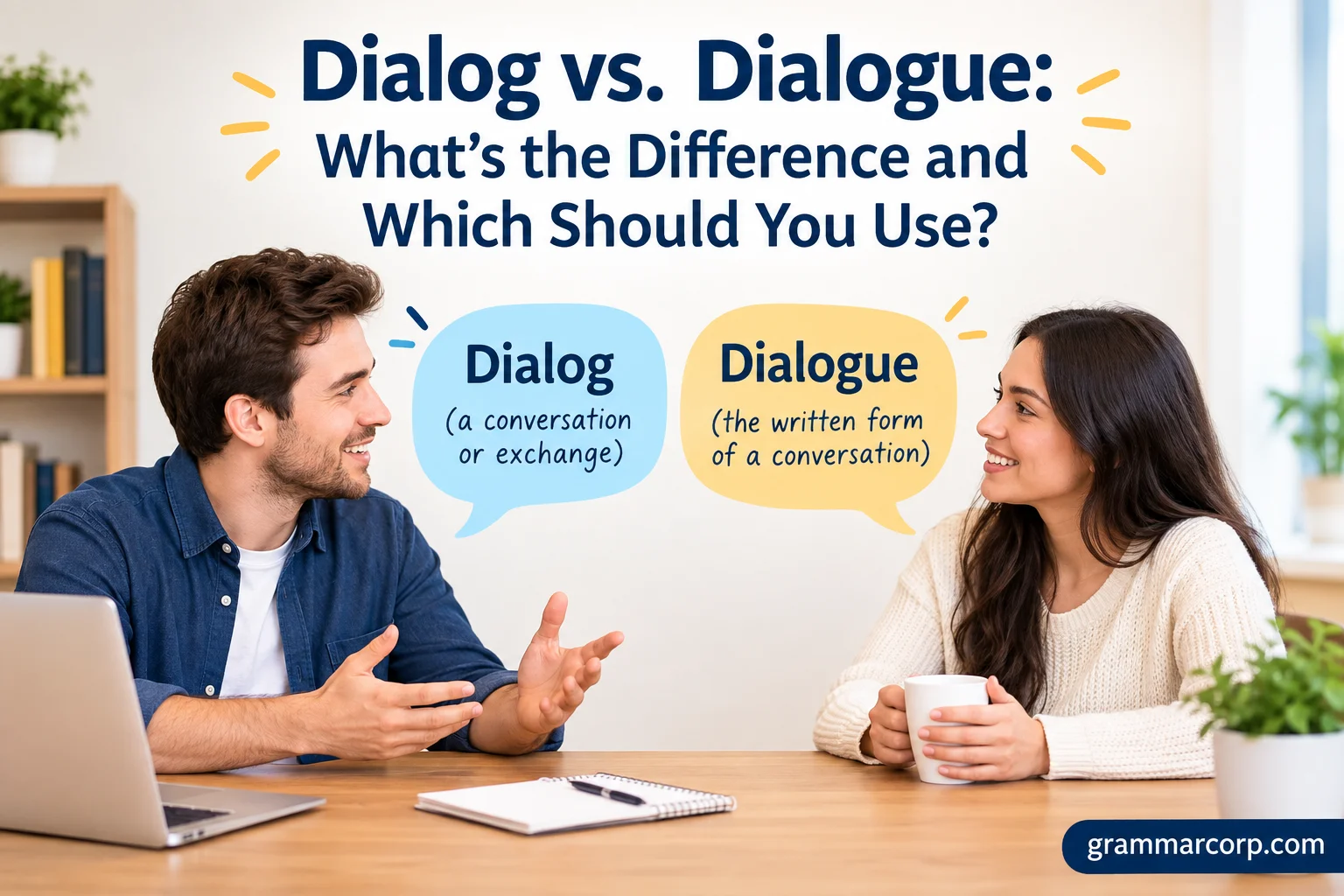
Dialog vs. Dialogue: What’s the Difference and Which Should You Use? explains how context, spelling, and usage shape the choice between these forms. At first glance, Dialog and Dialogue may look like a simple spelling question, with a tiny spelling variation created by three letters and the -ue ending. In the English language, both terms are used interchangeably in some contexts, but their distinct connotations can depend on forms of English, American English, British English, situation, and written context. Dialogue remains the standard spelling for a conversation between two or more people, appearing in books, novels, literature.
Writers, editors, bloggers, students, learners, readers, and professionals may still ponder the spelling issue, but dictionaries generally accept both forms, making spelling preference and usage important. Dialog, meanwhile, is a recognized spelling that is especially common in American English, technical writing, software development, technical documentation, software interfaces, and computing, where terms such as dialog box, dialog window, user prompts, gadget, and instructions are firmly established. A person discussing a conversation may wonder whether dialog is wrong, while a programmer may question.
Whether dialogue box should replace an established technical term. From my experience as a novelist and playwright, the distinction is easier to understand when the purpose, preference, and meaning are considered rather than spelling alone. American software interfaces may favor Dialog, while British literature, scripts, and academic discussions often favor Dialogue.
At a deeper level, the guide is about understanding meaning and interaction: Dialogue can describe an exchange or exchanges of ideas, including abstract and philosophical conversations, while Dialog can dominate computer terminology and practical settings. The history of usage also adds context, as computer terminology jumpstarted the use of dialog, which spiked around the turn of the century before dropping precipitously, causing some folks to wonder whether it remained legit.
Quick Answer:
Dialogue and dialog can refer to the same general word, but they don’t have equal usage in every context.
Use dialogue when you mean:
- A conversation between people
- Spoken exchanges in a book, movie, or play
- An exchange of ideas or opinions
- Discussions between groups or opposing sides
- Formal communication intended to reach understanding
Use dialog when:
- You’re writing about software or computing.
- You’re referring to a dialog box or related interface element.
- Your organization’s style guide specifically prefers dialog.
- You’re using an accepted spelling variant of dialogue in American English.
Major dictionaries recognize dialog as a variant of dialogue. Merriam-Webster lists dialog as a less common variant, while Oxford notes that American English also uses dialog.
So, if you write:
The characters have an interesting dialogue.
That is standard.
If you write:
Click OK to close the dialog.
That is standard technical usage.
The context makes the choice clear.
Comparison Overview
The easiest way to understand dialog vs. dialogue is to compare their most common applications.
| Feature | Dialogue | Dialog |
| General conversation | Common | Less common |
| Books and novels | Preferred | Uncommon |
| Movies and plays | Preferred | Uncommon |
| Exchange of ideas | Preferred | Possible variant |
| Formal discussions | Preferred | Less common |
| Software interfaces | Common in general English | Very common in technical contexts |
| Dialog boxes | Possible in general English | Standard technical term |
| American English | Standard | Accepted variant |
| British English | Standard choice | Less common |
| Formal general writing | Safest choice | Use according to context or style |
The important point is that dialog isn’t simply an incorrect version of dialogue.
It has dictionary recognition as a variant. At the same time, dialogue remains the safer and more widely recognizable choice for ordinary writing about human conversation.
Main Differences Between Dialog and Dialogue
The biggest difference comes from usage and context, rather than meaning alone.
Dialogue Usually Refers to Conversation
When people talk to one another, dialogue is normally the natural choice.
For example:
- The novel contains realistic dialogue.
- The two students had a long dialogue about the assignment.
- The movie relies heavily on witty dialogue.
- The government called for dialogue between the two groups.
Dictionaries define dialogue as conversation and also as an exchange of ideas or opinions. It can describe both fictional speech and real-world communication.
Dialog Has Strong Technical Usage
Dialog becomes particularly useful when you enter the world of software.
A dialog box is a secondary window that lets an application display information, request input, or ask the user to make a choice.
For example, when software asks whether you want to save a file, the small window containing options such as Save, Cancel, or Don’t Save can function as a dialog box.
Microsoft’s documentation uses dialog box as its established technical terminology. It describes dialog boxes as temporary windows that retrieve user input or prompt users for additional information.
This is why programmers and technical writers frequently use:
- Dialog box
- Dialog window
- Dialog control
- Dialog procedure
- Modal dialog
- Modeless dialog
In that environment, dialog isn’t a typo. It’s part of established computing vocabulary.
The Meaning Can Overlap
There isn’t always a sharp semantic wall between the two words.
Merriam-Webster gives dialogue meanings that include conversation, exchanges of ideas, discussions between opposing parties, and written conversations between characters. It also identifies dialog as a variant.
Therefore, the distinction often looks like this:
Dialogue = the usual general-English spelling.
Dialog = an accepted variant with especially strong technical usage.
That simple rule handles most situations.
What Does Dialogue Mean?
Dialogue is a noun that describes an exchange involving two or more people.
The word has several related uses. The most familiar one appears in fiction.
Dialogue in Books
Authors use dialogue to show characters speaking.
Consider a fictional scene in which two friends discuss an upcoming trip. Their spoken exchanges form the dialogue of the scene.
Dialogue can:
- Reveal personality
- Move the story forward
- Introduce conflict
- Provide information
- Show relationships
- Create humor
- Establish tone
- Make characters feel distinct
Strong dialogue usually does more than reproduce ordinary conversation. Writers shape it to serve the story.
A novel with compelling descriptions but lifeless dialogue can feel static. On the other hand, sharp dialogue can make a scene feel immediate and energetic.
Dialogue in Movies and Plays
The same concept applies to movies and theater.
You might say:
- The film has very little dialogue.
- The actors delivered the dialogue naturally.
- The play contains witty dialogue.
- The director wanted shorter dialogue in the final scene.
Oxford defines dialogue in this context as conversation in a book, play, or film.
Dialogue as an Exchange of Ideas
The meaning goes beyond fictional speech.
People also use dialogue to describe serious communication between individuals, organizations, or groups.
For example:
The two organizations opened a dialogue about the proposed changes.
Here, nobody is talking about a movie script. The word refers to an exchange of ideas and opinions.
Cambridge similarly describes dialogue as a serious exchange of opinions, especially between people or groups that disagree.
Dialogue in Conflict Resolution
The word can carry an even more specific meaning when opposing groups communicate with the goal of resolving a disagreement.
For example:
The two sides agreed to begin dialogue.
This doesn’t necessarily mean that they already reached an agreement. It means they have started communicating in an organized way.
That distinction matters.
Dialogue is communication. Agreement is a possible result of communication.
The two concepts shouldn’t be treated as synonyms.
What Does Dialog Mean?
Dialog has the same basic linguistic relationship to dialogue as a recognized spelling variant. However, its practical importance becomes clearer in technical contexts.
Dialog in Computing
In software, a dialog is commonly understood as an interface element through which an application communicates with a user.
A dialog may ask you to:
- Enter information
- Select an option
- Confirm an action
- Choose a file
- Change a setting
- Respond to a warning
- Provide additional information
Microsoft describes a dialog box as a temporary window that retrieves user input and can contain controls for entering text, choosing options, or directing an action.
For example, a file-selection window may let you choose a document before opening it.
A confirmation dialog may ask you to decide whether an action should continue.
The word dialog fits naturally into this technical vocabulary.
Modal and Modeless Dialogs
Technical writing also distinguishes between modal and modeless dialogs.
A modal dialog requires the user to deal with the dialog before continuing with the owner window.
A modeless dialog doesn’t impose that same restriction. The user can continue interacting with the surrounding application while the dialog remains available.
Microsoft’s documentation makes this distinction explicitly when explaining how dialog boxes behave.
This gives dialog a specialized meaning that goes beyond ordinary conversation.
Dialog as a General Variant
Outside computing, dialog can still function as a variant spelling of dialogue.
That doesn’t make it the best choice in every sentence.
For most readers, dialogue immediately signals conversation. Dialog can look more technical or less familiar depending on the audience.
Therefore, context should guide the decision.
Dialog vs. Dialogue in American and British English
Regional English adds another layer to the question.
Dialogue is widely recognized across English varieties. American English also accepts dialog as a variant. Oxford specifically identifies dialog as a US English form.
However, it’s misleading to say:
Americans use dialog. British people use dialogue.
Real usage isn’t that simple.
American writers still use dialogue constantly when discussing conversations, literature, film, and communication.
Likewise, technical terminology can influence spelling regardless of ordinary regional preferences.
Why Does Dialog Appear So Often in American Technical Writing?
Computing developed a large body of specialized terminology in American English.
Terms such as dialog box became established within software documentation and programming environments.
Microsoft’s technical documentation consistently uses dialog box, including terminology such as modal and modeless dialogs.
That doesn’t mean every American writer should replace dialogue with dialog.
Instead, it shows why dialog has a particularly strong position in technical English.
How to Use Dialogue in Sentences
The safest approach is to match dialogue with situations involving conversation or communication.
Dialogue in Everyday Writing
Examples include:
- Their dialogue helped clear up the misunderstanding.
- The teacher encouraged dialogue between the students.
- The article promotes open dialogue.
- Their conversation developed into a productive dialogue.
Here, dialogue means an exchange between people.
Dialogue in Literature
Use dialogue when discussing characters’ spoken words.
Examples:
- The author’s dialogue sounds natural.
- The novel uses dialogue to reveal character.
- The opening chapter contains little dialogue.
- The play depends on fast-paced dialogue.
This is one of the clearest cases where dialogue is the conventional choice.
Dialogue in Formal Discussions
You can also use dialogue for serious communication.
Examples:
- The groups entered into dialogue.
- The conference encouraged international dialogue.
- Continued dialogue may help both sides understand the issue.
- The organization wants constructive dialogue with its members.
The word often suggests communication rather than confrontation.
How to Use Dialog in Sentences
Use dialog naturally when discussing software or technical interfaces.
Examples of Technical Usage
- Click the button to open the dialog.
- Close the dialog after entering your information.
- The application displays a confirmation dialog.
- The settings dialog contains several options.
- The program opens a file-selection dialog.
- The modal dialog prevents interaction with the main window.
These examples follow established technical terminology.
Microsoft’s documentation uses dialog box for windows that obtain information from users and support actions such as entering text or selecting options.
Dialog Box vs. Dialogue Box
This distinction deserves special attention.
In general writing, someone might intuitively write dialogue box because dialogue is the usual spelling for conversation.
In computing, however, dialog box is the established technical term used in major software documentation.
Microsoft uses dialog box throughout its Windows documentation.
So if you’re writing technical documentation, dialog box is the better choice.
Read More : Waive vs. Wave: What’s the Difference?
Common Phrases With Dialogue
Some expressions strongly favor dialogue because they refer to communication.
| Phrase | Preferred Form | Meaning |
| Dialogue between two people | Dialogue | Conversation |
| Political dialogue | Dialogue | Formal exchange |
| Constructive dialogue | Dialogue | Productive communication |
| Dialogue in a novel | Dialogue | Character speech |
| Dialogue in a movie | Dialogue | Spoken lines |
| Open a dialogue | Dialogue | Begin communication |
| Enter into dialogue | Dialogue | Begin discussions |
| Dialogue between groups | Dialogue | Exchange of views |
These phrases work because the underlying meaning involves people communicating.
Common Phrases With Dialog
Technical language has its own established set of expressions.
| Phrase | Typical Context |
| Dialog box | Software |
| Modal dialog | User interface |
| Modeless dialog | User interface |
| Confirmation dialog | Software |
| Settings dialog | Software |
| File dialog | Software |
| Dialog window | Software |
| Dialog control | Programming |
| Dialog procedure | Programming |
Microsoft’s Win32 documentation uses terminology such as CreateDialog, DialogBox, and DialogProc when describing Windows dialog programming.
These aren’t casual variations. They’re established technical terms.
Dialog vs. Dialogue: Common Mistakes
Understanding the difference also means knowing what not to do.
Mistake: Treating Dialog as Always Wrong
This is incorrect.
Major dictionaries recognize dialog as a variant of dialogue. Oxford lists it as a US English form, while Merriam-Webster describes it as a less common variant.
So calling every use of dialog a spelling error oversimplifies the issue.
Mistake: Using Dialogue Box in Technical Documentation
Although readers will usually understand dialogue box, dialog box is the established technical term in many software contexts.
If you’re writing developer documentation, user-interface specifications, or programming material, follow the terminology used by the relevant platform or style guide.
Mistake: Assuming Dialog and Dialogue Always Have Different Meanings
They don’t.
In general English, dialog can function as a spelling variant of dialogue. The distinction often comes from convention and context, not from completely separate dictionary definitions.
Mistake: Assuming British vs. American English Explains Everything
Regional spelling helps explain usage, but it doesn’t explain the whole picture.
Technical vocabulary has its own conventions.
A software developer may write dialog because the platform’s documentation uses that form. A novelist in American English may still consistently write dialogue.
A Practical Case Study: One Word, Two Contexts
Consider two writers working on completely different projects.
Writer A: A Novel
The writer is describing a conversation between two characters.
The author revised the dialogue to make the scene more natural.
Here, dialogue is the obvious choice because the subject is character speech.
Writer B: Software Documentation
The writer is explaining how an application asks users to select a file.
Select a file in the dialog and click Open.
Here, dialog fits the technical context.
The spelling changes because the writing environment changes.
That’s the key lesson.
You don’t need to memorize dozens of exceptions. Ask what the word describes.
Are you talking about people communicating? Choose dialogue.
Are you talking about a software interface? Dialog is usually the natural technical term.
Is Dialog or Dialogue More Correct?
There isn’t one universal answer.
If you’re writing general English, dialogue is usually the safest choice.
If you’re writing technical documentation about software, dialog may be the expected terminology.
A useful hierarchy looks like this:
- Follow the established terminology of your field.
- Follow your publication or organization’s style guide.
- Use dialogue for ordinary conversation when no special convention applies.
- Use dialog for established technical terms such as dialog box.
- Stay consistent throughout the same document.
Consistency matters because readers quickly notice unexplained switches between spelling conventions.
Is Dialog a Correct Spelling of Dialogue?
Yes.
Dialog is a recognized spelling variant of dialogue. Merriam-Webster lists it as a less common variant, while Oxford identifies it as a US English form.
However, recognition doesn’t mean the two spellings are equally common in every situation.
For ordinary prose, dialogue remains the stronger default.
For software, dialog has a well-established technical role.
Should You Use Dialog or Dialogue for a Conversation?
Use dialogue.
For example:
The two friends had an honest dialogue about the problem.
That spelling is clear and conventional.
You could encounter dialog as a variant, particularly in American usage, but dialogue is the better default when your subject is a human conversation.
Is Dialog American English?
Dialog is used in American English, but it isn’t exclusively an American spelling.
American dictionaries recognize it as a variant of dialogue. Oxford also labels dialog as a US English form.
More importantly, technical usage can determine the spelling.
For example, American software documentation frequently uses dialog in terms such as dialog box.
Therefore, the better rule isn’t simply “American equals dialog.”
Instead:
American general English → dialogue is common.
American technical English → dialog is strongly established in computing.
Is a Dialog the Same as a Dialog Box?
Not exactly.
A dialog box is a specific type of user-interface window.
Microsoft describes it as a window that allows an application to retrieve information from a user or prompt the user for input.
The shorter word dialog can refer to that interface element when the context makes the meaning clear.
For example:
Close the dialog.
That can mean:
Close the dialog box.
The exact terminology depends on the software framework and documentation style.
What Is the Plural of Dialog?
The common plural of dialog is:
dialogs
For example:
The application uses several dialogs for different settings.
The plural of dialogue is:
dialogues
For example:
The book contains several important dialogues.
Merriam-Webster recognizes dialogs as a plural form associated with the variant spelling.
Which Spelling Should You Use in Formal Writing?
For ordinary formal writing, dialogue is usually the safest choice.
Use it when you’re discussing:
- Conversations
- Literature
- Film
- Theater
- Discussions
- Communication
- Exchanges of ideas
- Formal negotiations
Use dialog when you’re writing about a technical interface or following an established technical convention.
For example:
General formal writing:
The meeting encouraged constructive dialogue between the organizations.
Technical writing:
The confirmation dialog appears after the user selects Delete.
Both are correct because they serve different contexts.
Dialog vs. Dialogue: A Simple Decision Rule
Still unsure?
Use this quick test.
If You Mean Human Conversation
Choose dialogue.
The characters’ dialogue sounds natural.
If You Mean Conversation in Fiction
Choose dialogue.
The novel contains realistic dialogue.
If You Mean an Exchange of Ideas
Choose dialogue.
The discussion created an opportunity for dialogue.
If You Mean a Software Interface
Choose dialog.
The dialog asks users to confirm the action.
If You Mean a Technical Term
Check the terminology used by the relevant platform or style guide.
Established terminology should usually win over personal spelling preferences.
Why the Two Spellings Exist
The two forms share the same linguistic history.
Merriam-Webster traces dialogue through Middle English and Anglo-French to Latin dialogus and Greek dialogos. The Greek components relate to speaking or discourse.
English has retained the longer -logue form in dialogue. Over time, dialog developed as a shortened spelling.
This pattern isn’t unusual in English.
Language often develops competing spellings through regional usage, technical terminology, pronunciation, and attempts to simplify written forms.
The important point isn’t which spelling “looks better.”
It’s which form fits the context and audience.
Final Verdict: Dialog vs. Dialogue
The simplest answer is this:
Dialogue is the best general-purpose choice for conversation, fictional speech, discussions, and exchanges of ideas.
Dialog is a valid spelling variant that has a particularly strong role in American English and computing.
When you’re writing a novel, discussing a movie, describing a conversation, or talking about communication, dialogue is usually the right choice.
When you’re writing software documentation and referring to a dialog box, modal dialog, or similar interface element, dialog is the established technical choice.
Quick Reference
| If you’re writing about… | Use |
| A conversation | Dialogue |
| A novel’s character speech | Dialogue |
| Movie or theater speech | Dialogue |
| An exchange of ideas | Dialogue |
| Formal communication | Dialogue |
| Political or diplomatic discussion | Dialogue |
| A software window | Dialog |
| A dialog box | Dialog |
| A modal interface | Dialog |
| A programming term | Dialog, when that is the established terminology |
The best way to remember dialog vs. dialogue is to think about the setting.
People talk → dialogue.
Software asks → dialog.
That rule won’t cover every possible style choice, but it handles the overwhelming majority of everyday cases while leaving room for established regional and technical usage.
FAQs:
1. Is “dialog” or “dialogue” correct?
Both dialog and dialogue are correct spellings. Dialogue is more common for general conversations and discussions, while dialog is especially common in American English and technical contexts such as computing.
2. What is the difference between dialog and dialogue?
The main difference is usually usage and context, not meaning. Dialogue is widely used for conversations between people, while dialog often appears in technical writing, particularly in terms such as dialog box and dialog window.
3. Should I use “dialogue” in formal writing?
Yes. Dialogue is a widely accepted choice in formal writing, literature, academic writing, journalism, plays, and scripts. It is also the more familiar spelling when discussing conversations between people.
4. Why is “dialog” common in computing?
Dialog became established in computing and software development as part of technical terminology. Expressions such as dialog box, dialog window, and other software-interface terms are commonly used in technical contexts.
5. Is “dialogue” more common in British English?
Dialogue is widely used in British English, particularly in literature, journalism, academic writing, and discussions. Dialog is also a recognized spelling, so the choice can depend on the specific context and established style.
Conclusion:
Dialog and Dialogue are both legitimate spellings, but their typical uses are different. For conversations between people, dialogue is the natural choice in most general and formal writing.
Dialog is especially useful in American English and established technical contexts, particularly computing and software interfaces. When choosing between them, consider the context, audience, and style rather than treating one spelling as universally correct.














2 thoughts on “Dialog vs. Dialogue: What’s the Difference and Which Should You Use?”