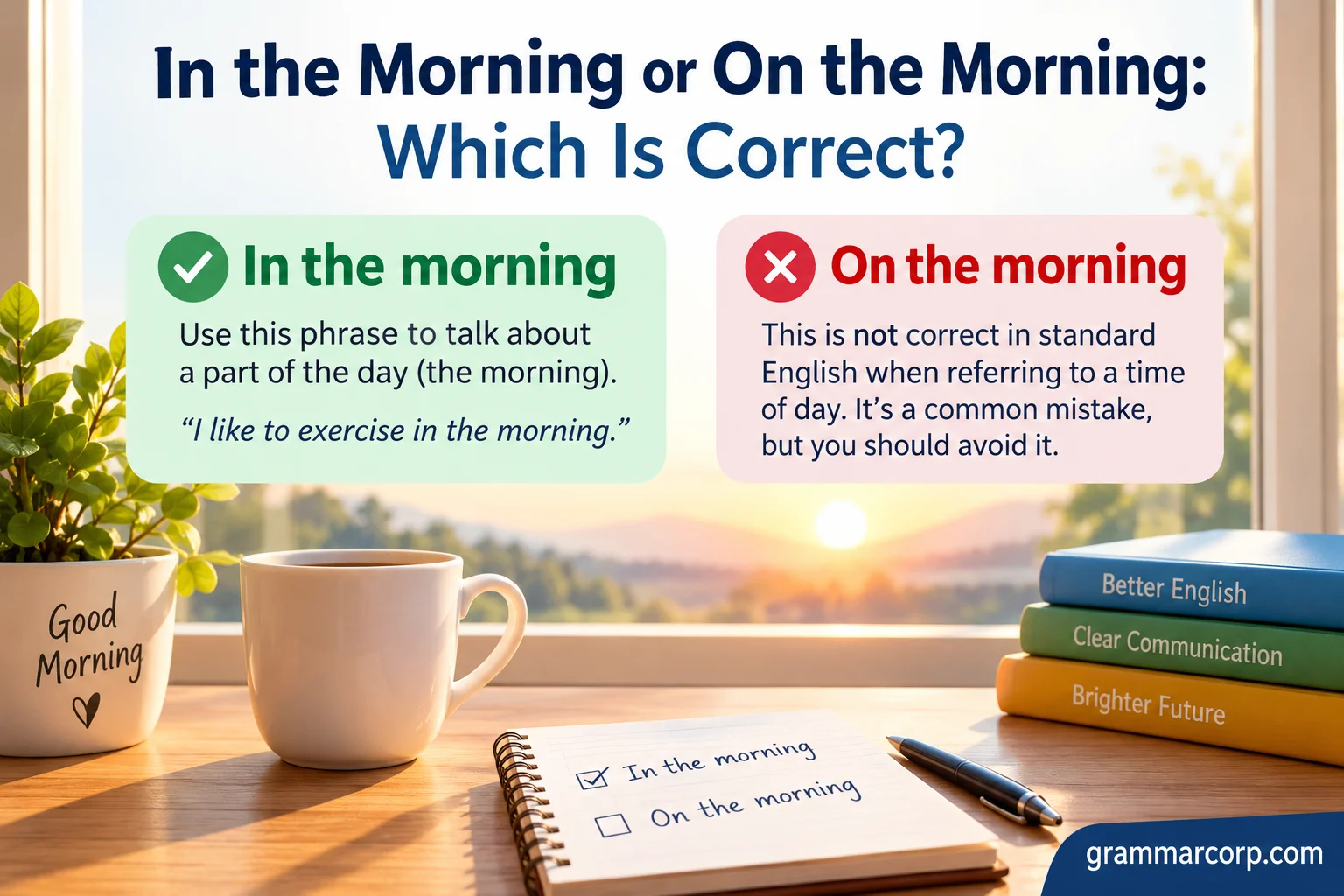
In the Morning or On the Morning: Which Is Correct? is a common question for English learners who want to improve their grammar. Both expressions are correct, but their usage depends on the context. We generally use in the morning to describe a general time of day, a daily routine, or regular activities. For example, “I exercise in the morning” and “I usually drink coffee in the morning” describe habits rather than specific events. The phrase on the morning of usually refers to a particular morning connected to an identified date, event, or special occasion. For instance, “I exercised on the morning of my graduation” identifies a specific occasion. Understanding this difference helps you choose the correct expression and communicate more clearly.
English prepositions such as in, on, and at follow different grammar patterns. We use in the morning for general morning activities, but on the morning of when referring to a particular day or date, as in “We left on the morning of Monday, August 17.” From my experience with English grammar, paying attention to the meaning of a sentence makes preposition usage easier to understand. Learning these rules can improve grammatical correctness, strengthen your writing and speaking skills, and help you avoid common English grammar mistakes. These expressions also appear in everyday conversations, written English, and spoken English, so knowing the distinction is useful in many situations.
You can also learn related expressions such as in the early morning, on a morning, that morning, and the morning of. Each phrase serves a slightly different purpose depending on the sentence and its context. For example, in the early morning emphasizes an early time of day, while that morning points to a morning already identified in the conversation. Practical examples help you recognize these distinctions and improve your sentence construction, writing clarity, and English communication. With regular practice, you’ll become more confident when choosing between these time expressions in everyday English.
Quick Answer:
“In the morning” is the standard expression when referring to the morning generally. Use “on the morning of” when you mean a particular morning connected to a date or event.
Consider these examples:
- Correct: I usually read the news in the morning.
- Correct: We arrived early on the morning of the wedding.
- Correct: She called me on the morning we left.
- Incorrect for the intended meaning: I exercise on the morning every day.
The last example sounds unnatural because the sentence describes a regular habit rather than identifying a particular morning. A better version is “I exercise in the morning every day.”
Remember this simple rule: Use “in” for the general time of day and “on” for a specific day or morning. The surrounding words and the intended meaning determine which expression fits best.
Comparison Overview
Although “in the morning” and “on the morning” both use the noun morning, they follow different patterns in English. The preposition changes how the reader understands the time being described.
“In the morning” treats morning as a general period of the day. “On the morning of” usually identifies one particular morning by linking it to an event, date, or other detail.
| Comparison point | In the Morning | On the Morning |
| Main purpose | Refers to a general time of day | Refers to a particular morning |
| Common usage | Routines, habits, schedules, and general timing | Specific events, dates, and occasions |
| Typical structure | In the morning | On the morning of + event |
| With a named day | Usually unnecessary if the day is already specified elsewhere | Often appears as “on Monday morning” |
| Example | I walk my dog in the morning. | I walked my dog on the morning of the festival. |
| Grammatical status | Standard and natural | Correct when the context identifies a specific morning |
One important point deserves attention: “on the morning” isn’t automatically wrong without the word “of.” For example, “On the morning we arrived, the streets were empty” is perfectly natural. The words “we arrived” identify the morning in question.
Similarly, “in the morning of the wedding” generally sounds unnatural when you mean the particular morning on which the wedding takes place. In that situation, use “on the morning of the wedding.”
Quick Examples at a Glance
- General routine: I take my medication in the morning.
- Specific occasion: I felt nervous on the morning of my interview.
- Named weekday: We met on Tuesday morning.
- Specific date: The storm began on the morning of October 12.
- Morning identified by a clause: She called on the morning we departed.
These examples show that English doesn’t choose prepositions randomly. The intended time reference helps determine which one belongs in the sentence.
Main Differences Between In the Morning and On the Morning
The main difference between “in the morning” and “on the morning” comes down to whether you’re referring to a general period or a particular morning. However, several related grammar patterns make the distinction clearer.
1. General Time vs. Specific Occasion
The first difference concerns how precisely you identify the time.
Use “in the morning” when the exact date doesn’t matter or when you’re describing something that happens during the morning in general.
For example:
- My classes begin in the morning.
- Birds often sing in the morning.
- I’ll finish the report in the morning.
- We usually eat breakfast in the morning.
In each sentence, the speaker focuses on the time of day rather than a particular date.
By contrast, “on the morning of” points to a specific occasion. The reader can identify the morning because the sentence supplies additional information.
For example:
- My classes began on the morning of the school opening ceremony.
- The birds were unusually quiet on the morning of the storm.
- I finished the report on the morning of the deadline.
- We ate breakfast together on the morning of our departure.
The key distinction is general timing versus a clearly identified morning. If the date or event matters to the sentence, “on the morning of” may be the better choice.
2. Daily Habits vs. One-Time Events
Another useful difference appears when you describe routines and individual events.
Daily habits usually take “in the morning” because you’re talking about something that happens regularly during that part of the day.
Consider these sentences:
- I check my email in the morning.
- My father reads the newspaper in the morning.
- The children catch the bus in the morning.
- Our team holds meetings in the morning.
Now compare them with sentences about individual occasions:
- I checked my email on the morning of the product launch.
- My father read the newspaper on the morning of the election.
- The children caught the bus on the morning of their field trip.
- Our team held a meeting on the morning of the inspection.
The verbs can remain the same while the time expression changes. What matters is the context.
For instance, “I work in the morning” describes a general schedule. “I worked on the morning of the conference” identifies one particular occasion.
3. The Role of “Of” in “On the Morning Of”
The word “of” often connects a specific morning to an event or date. This is one of the most recognizable patterns for the expression.
The structure is:
On + the morning + of + a specific event or date
Examples include:
- On the morning of the exam, I reviewed my notes.
- On the morning of Christmas, the children opened their presents.
- On the morning of July 4, the town held a parade.
- On the morning of the interview, she arrived early.
- On the morning of the accident, traffic was unusually heavy.
In these examples, the event or date helps the reader identify the morning. The phrase does more than say when something happened; it connects that time to a particular occasion.
However, “of” isn’t mandatory in every sentence containing “on the morning.” You can identify the morning through a clause instead.
For example:
- On the morning we left, it was raining.
- On the morning she arrived, nobody was home.
- On the morning the school reopened, parents gathered outside.
These sentences are also grammatically correct because the following words explain which morning the speaker means.
4. Why “On the Morning” Can Sound Incomplete
Have you ever seen the words “on the morning” and wondered whether something was missing? That reaction often comes from encountering the phrase without enough context.
For example, consider this fragment:
We met on the morning…
The sentence leaves the reader expecting more information. Which morning? The morning of the event, the morning someone arrived, or a morning already discussed?
Now compare it with these complete examples:
- We met on the morning of the conference.
- We met on the morning she arrived.
- We met on the morning after the storm.
Each sentence identifies the morning more clearly.
Still, context can make the shorter expression natural. Imagine that two people have already discussed a particular trip. One might say, “On the morning, we packed everything and left.” Depending on the surrounding conversation, this may work, although “that morning” would usually sound more natural in this example.
The practical lesson is simple: don’t judge the expression in isolation. Look at the whole sentence and consider whether the reader can identify the intended time.
When to Use “In the Morning”
Use “in the morning” when referring to the morning as a general period of the day. It’s one of the most common English time expressions and works naturally in everyday conversation, emails, instructions, and formal writing.
For Daily Routines and Habits
When you describe something you do regularly, “in the morning” is usually the natural choice.
Examples:
- I drink a glass of water in the morning.
- She practices the piano in the morning.
- We review our schedules in the morning.
- He walks to school in the morning.
- They listen to the radio in the morning.
These sentences don’t identify a particular date. They describe activities that take place during the morning as part of a routine.
You can also use the expression with frequency words such as usually, often, sometimes, and every day.
For example, “I usually study in the morning” sounds natural because it describes a repeated activity. The sentence “I study in the morning every weekday” works for the same reason.
For General Plans and Future Activities
“In the morning” also works when discussing future plans without emphasizing a particular date or occasion.
Consider these examples:
- I’ll call you in the morning.
- The technician will arrive in the morning.
- We can discuss the proposal in the morning.
- Your appointment is scheduled for the morning.
The expression tells the reader when to expect the activity. It doesn’t necessarily identify which morning, because the conversation may already establish the date.
For example, if you and a friend are discussing tomorrow’s plans, “I’ll call you in the morning” will usually be clear enough. You don’t need to say “on the morning of tomorrow,” which sounds unnecessarily awkward.
For General Statements About Morning Activities
You can also use “in the morning” to discuss ordinary events, habits, and observations.
Examples:
- The air often feels cooler in the morning.
- Traffic can become busy in the morning.
- I find it easier to concentrate in the morning.
- The bakery sells fresh bread in the morning.
These sentences describe general patterns rather than one specific date. That’s why “in” works naturally.
One helpful detail: the expression doesn’t require an exact clock time. You can say “in the morning” without specifying whether you mean 7 a.m. or 10 a.m. The context usually provides enough information.
When to Use “On the Morning”
Use “on the morning” when you need to identify a particular morning. In many sentences, the phrase appears as “on the morning of,” followed by a date, event, or occasion.
For Special Events and Important Occasions
Specific events provide a natural setting for this expression.
Examples:
- She received flowers on the morning of her wedding.
- We reviewed the instructions on the morning of the presentation.
- The family gathered on the morning of the reunion.
- He felt confident on the morning of his final exam.
Each example focuses on one morning connected to a recognizable occasion. The expression helps establish the timing and gives the sentence a more precise meaning.
For Dates and Historical Events
Writers often use “on the morning of” when describing a particular date, especially in historical accounts, news reports, biographies, and personal narratives.
Examples:
- The announcement came on the morning of October 19.
- The town woke to heavy rain on the morning of the parade.
- The expedition began on the morning of June 12.
- The team arrived on the morning of the championship.
The date or event makes the time reference specific. This construction is particularly useful when a sequence of events matters to the reader.
For a Morning Identified by Another Action
You don’t always need a date or a noun naming an event. A clause can identify the morning just as effectively.
Examples:
- In the morning we moved, the roads were clear.
- On the morning she returned, the office was unusually quiet.
- In the morning the results arrived, everyone felt anxious.
The words following “on the morning” identify which morning you’re describing. This structure works well in storytelling because it links the time directly to an action.
For Formal Reports and Narratives
“On the morning of” often appears in formal writing because it establishes a precise time reference.
For example:
On the morning of the inspection, the manager reviewed the safety records and checked the equipment.
This sentence gives readers a clear point in the timeline. It also makes the sequence of actions easier to follow.
In less formal conversation, you could simply say, “The manager checked everything that morning.” Both constructions are correct, but they emphasize different things.
“In the Morning” vs. “On Monday Morning”
Adding a weekday changes the construction. In standard US English, we generally use “on” before a named day, including when we specify the morning, afternoon, or evening.
For example:
- I have a doctor’s appointment on Monday morning.
- We traveled on Friday afternoon.
- The store opens late on Sunday morning.
- She called me on Tuesday evening.
Notice that we don’t normally say “in Monday morning.” The preposition “on” connects the activity to a particular day.
However, “in the morning” remains correct when the weekday isn’t part of the expression.
Compare these examples:
| Sentence | Why It Works |
| I’ll see you in the morning. | Refers to the morning generally or a morning understood from context. |
| I’ll see you on Monday morning. | Identifies a particular weekday. |
| I’ll see you on the morning of Monday’s event. | Connects the morning to a specific occasion. |
| I’ll see you Monday morning. | A natural US English alternative that omits “on.” |
The last example is especially useful in American conversation. People commonly say “Monday morning” without “on,” although “on Monday morning” is also correct.
What About “In Monday Morning”?
In standard US English, “in Monday morning” is generally incorrect when you mean that something happens on Monday morning.
Use one of these alternatives instead:
- In the morning
- On Monday morning
- Monday morning
For example, instead of writing “The meeting is in Monday morning,” write “The meeting is on Monday morning.”
The correction is straightforward: use “in” with the general time expression and “on” with the named weekday.
Common Mistakes With “In the Morning” and “On the Morning”
Even though the distinction is simple, a few common errors can make sentences sound unnatural. Recognizing them will help you write more clearly.
Mistake 1: Using “On the Morning” for Every Routine
Incorrect for the intended general meaning: “I go jogging on the morning every day.”
Better: “I go jogging in the morning every day.”
The first version treats the morning as though it were a particular day or occasion. The second correctly describes a recurring habit.
Mistake 2: Writing “In the Morning Of” for a Specific Event
Awkward: “We arrived in the morning of the ceremony.”
Better: “We arrived on the morning of the ceremony.”
When a particular event identifies the morning, “on the morning of” is the standard construction.
Mistake 3: Confusing “On the Morning” With “That Morning”
These expressions can refer to the same time, but they aren’t always interchangeable without changing the sentence.
For example:
- We left on the morning of the festival.
- We left that morning.
The first sentence explicitly connects the morning to the festival. The second relies on context to establish which morning the speaker means.
Both are correct. Choose the one that provides the right amount of detail.
Mistake 4: Using “In” Before a Named Weekday
Incorrect in standard US English: “We arrived in Thursday morning.”
Correct: “We arrived on Thursday morning.”
The named weekday determines the preposition. You can also omit “on” in ordinary American usage: “We arrived Thursday morning.”
Mistake 5: Assuming “On the Morning” Must Always Include “Of”
Incorrect assumption: “On the morning” is only correct when followed by “of.”
Actually, a clause can identify the morning instead.
For example, “On the morning we departed, the sky was clear” is grammatically correct. The clause “we departed” tells readers which morning the sentence describes.
The best way to avoid these mistakes is to check the meaning first. Ask whether you’re describing a general time, naming a weekday, or identifying a specific occasion.
Read More : Tomatoes or Tomatoes? The Correct Spelling Explained
Case Study: Choosing the Right Expression in Everyday Writing
Imagine that a student named Alex is writing about a school examination. Alex wants to explain a regular study routine and describe what happened on exam day.
Here are three sentences from the student’s draft:
| Original Sentence | Revised Sentence | Reason |
| I revise my notes in the morning every day. | I revise my notes in the morning every day. | The sentence describes a regular habit. |
| I felt nervous in the morning of my exam. | I felt nervous on the morning of my exam. | The exam identifies a particular morning. |
| I arrived on Monday morning. | I arrived on Monday morning. | The named weekday takes “on” in standard US English. |
These corrections don’t change Alex’s intended message. They simply make the grammar more natural.
Now imagine Alex expands the paragraph:
I usually revise my notes in the morning before school. On the morning of my final exam, however, I woke up earlier than usual. I ate breakfast, checked my supplies, and arrived at school on Monday morning.
Each expression serves a different purpose. The first sentence describes a routine. The second identifies a specific occasion. The final sentence names a weekday.
This example illustrates a useful principle: good grammar depends on the relationship between the words and the meaning you want to express. Memorizing a rule helps, but understanding the context helps you apply it correctly.
Related Time Expressions You Should Know
Understanding “in the morning” and “on the morning” becomes easier when you compare them with other common time expressions. English uses different prepositions for different types of time references.
“In the Morning” vs. “During the Morning”
Both expressions refer to activities that happen in the morning, but they can emphasize slightly different things.
- In the morning: Identifies the general time of day.
- During the morning: Emphasizes an activity or event occurring within that period.
Examples:
- I usually read in the morning.
- I received several calls during the morning.
- We can discuss the schedule in the morning.
- The technicians inspected the equipment during the morning.
The distinction is subtle. In everyday conversation, the expressions sometimes overlap. However, “during the morning” can draw more attention to the period in which something happens.
“In the Morning” vs. “That Morning”
Use “that morning” when the context already identifies a particular day. It’s common in storytelling and conversations about past events.
For example:
- I usually drink coffee in the morning.
- I drank coffee that morning before leaving home.
The first sentence describes a general habit. The second refers to a particular morning.
You could also write, “I drank coffee on the morning of the interview.” This version explicitly connects the morning to an event.
“On the Morning Of” vs. “In the Morning Of”
When referring to a specific date or occasion, “on the morning of” is generally the correct choice.
| Preferred Expression | Example |
| On the morning of the wedding | We took photographs on the morning of the wedding. |
| On the morning of the meeting | She reviewed the agenda on the morning of the meeting. |
| On the morning of July 4 | The parade began on the morning of July 4. |
“In the morning of the wedding” is generally awkward in standard US English when you mean the specific morning associated with the wedding. Use “on the morning of the wedding” instead.
FAQs:
1. Is “in the morning” or “on the morning” correct?
Both expressions are correct, but they have different uses. Use in the morning for general morning activities or daily routines. Use on the morning of when referring to a specific date, event, or occasion.
2. Why do we say “in the morning”?
We use in the morning to describe something that happens during the morning in general. For example, “I go for a walk in the morning” describes a regular activity without identifying a particular date.
3. When should I use “on the morning of”?
Use on the morning of when you identify a particular day, date, or event. For example, “We arrived on the morning of June 12” refers to a specific date.
4. Can I say “on Monday morning”?
Yes, Monday morning is grammatically correct because Monday identifies a particular day. For example, “I have a meeting on Monday morning.” You can also say “in the morning on Monday,” although the first version is more natural and concise.
5. What is the difference between “that morning” and “in the morning”?
That morning refers to a particular morning already known from the context. In the morning generally describes a time of day or a routine. For example, “I called her that morning” identifies a specific occasion, while “I call her in the morning” may describe a regular habit.
Conclusion:
Choosing between in the morning and on the morning of becomes easier when you consider whether you’re talking about a general time or a specific occasion. Use in the morning for daily routines and activities, such as drinking coffee or exercising.
Choose on the morning of when mentioning a particular date, event, or important occasion. By understanding these simple preposition rules and practicing with everyday examples, you can improve your English grammar, write clearer sentences, and communicate more naturally in both spoken and written English.













1 thought on “In the Morning or On the Morning: Which Is Correct?”