Formerly vs Formally: What’s the Difference? Both are English adverbs, but one refers to the past, while the other describes an official or proper manner. Formerly and formally often create common confusion because they look and sound remarkably similar, although they mean differently. Formerly refers to something true in the past, while formally describes something done in an official, proper, or formal way. One focuses mainly on time, while the other relates to manner, procedure, or status. For example, a person who formerly worked as a teacher worked in that role previously. Someone who was formally appointed as a teacher received the position through an official process or appointment. This small difference can completely change the meaning of a sentence, so the easiest rule to remember is simple: formerly means previously, while formally means officially or in a formal manner.
This difference is especially useful in everyday writing, including an email, article, resume, academic paper, or everyday message. Knowing the meanings helps you choose the right word with confidence. Formally can describe a polite or official manner, whereas formerly describes an earlier condition. The words have different meanings, are not interchangeable, and should be chosen according to what the writer intends. Learners, students, writers, and even native speakers may confuse them because they appear almost identical, with only one letter separating their spellings.
A useful way of untangling these two contenders is to stop at the first glance and look carefully at what each word expresses. Yes, their small visual difference can fool even confident writers, because a tiny difference can change everything, shift the meaning, and lead to a full mix-up. The distinction may feel tangled and easy to confuse, especially during the journey of mastering the language. Formerly deals with time and what something used to be, whereas formally deals with rules, structure, or an official style. The words are set apart by their different jobs: formerly connects an idea with the past, while formally describes usage in a more official way.
Quick Answer:
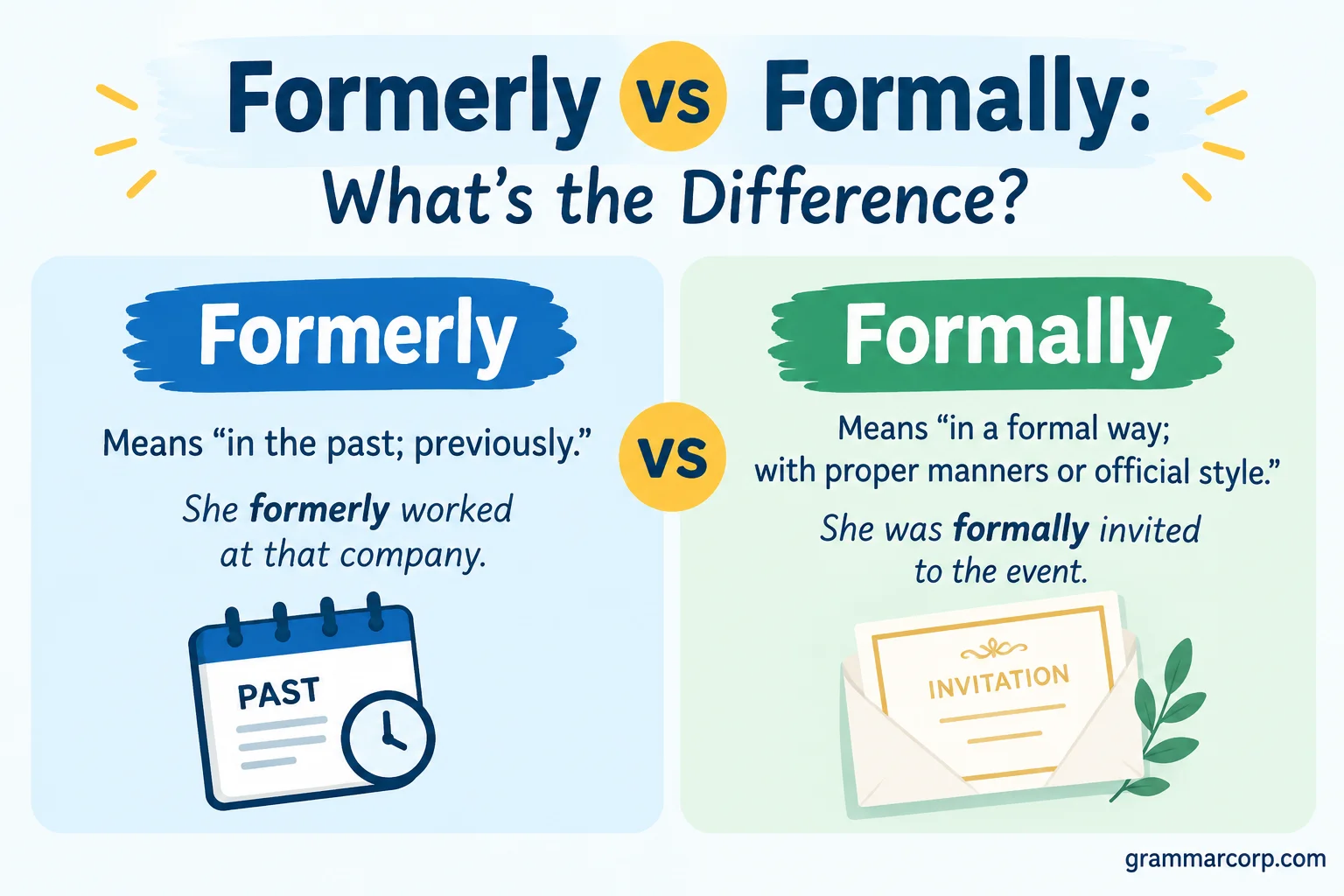
Formerly means previously, once, or in the past.
Formally means officially, properly, or in a formal manner.
| Word | Meaning | Simple substitute | Example |
| Formerly | Previously or in the past | Previously | She was formerly the director. |
| Formally | In an official or formal way | Officially | She was formally appointed as director. |
Here’s a quick test:
- If you can replace the word with previously, use formerly.
- If you can replace it with officially or in a formal manner, use formally.
Consider these two sentences:
- He was formerly the company president.
- He was formally introduced as the company president.
The first sentence tells you about his past position. The second tells you about an official introduction.
So while the words look nearly identical, their jobs in a sentence differ.
Comparison Overview
The clearest way to understand formerly vs formally is to compare what each word tells the reader.
| Feature | Formerly | Formally |
| Part of speech | Adverb | Adverb |
| Basic meaning | Previously or in the past | In a formal, official, or proper manner |
| Main idea | Time | Manner or official status |
| Related adjective | Former | Formal |
| Common phrase | Formerly known as | Formally announced |
| Useful replacement | Previously | Officially |
| Example | She formerly lived here. | She was formally introduced. |
Formerly focuses on the past
When you use formerly, you’re telling readers that something was true before but may no longer be true.
For example:
The building was formerly a school.
The sentence tells us about the building’s previous use. It doesn’t say that the building is a school now.
Likewise:
Maria was formerly the company’s manager.
This means Maria held that position in the past. The sentence doesn’t explain how she received the position or how anyone introduced her.
Formally focuses on how something happens
Formally, on the other hand, describes the way an action happens. It often carries the idea of something being official, proper, structured, or following accepted rules.
For example:
The committee formally approved the proposal.
The sentence focuses on the official approval.
Similarly:
The new director was formally introduced to the staff.
The word formally describes the manner of the introduction.
Main Differences Between Formerly vs Formally
The biggest difference between formally and formally comes down to one question: Are you talking about the past or the way something happens?
Formerly means previously
Formerly connects an idea to an earlier time.
It can describe:
- A previous name
- A previous position
- A previous location
- A previous condition
- A previous role
- A previous use
- A previous identity
For example:
- The company was formerly called GreenTech.
- She formerly worked at the university.
- This building was formerly a library.
- He was formerly the team’s captain.
- The restaurant was formerly a bookstore.
In each case, the word points backward in time.
Formally means officially or properly
Formally usually describes an action, procedure, announcement, introduction, or behavior.
For example:
- The board formally accepted the proposal.
- The school formally announced the new policy.
- The guests were formally introduced.
- The organization formally recognized her contribution.
- The two groups formally agreed to the terms.
Here, formally doesn’t mean something happened in the past. Instead, it explains that the action happened through an official or formal process.
A simple way to separate them
Think of the related adjectives:
former → formerly
formal → formally
If something is a former position, it was held in the past.
If something is formal, it follows a formal or official style or process.
That relationship makes the distinction much easier to remember.
What Does Formerly Mean?
Formerly is an adverb that means previously or at an earlier time.
It describes something that once existed, happened, or was true.
The word often appears when writers want to explain a change. That change could involve a person’s role, a company’s name, a building’s purpose, or another past condition.
Formerly in names
One of the most familiar uses appears in the phrase formerly known as.
For example:
The organization was formerly known as the National Arts Council.
This tells readers that the organization had a different name in the past.
The phrase works because formerly means that the earlier name existed before the current one.
Formerly in jobs and positions
You can also use formerly to describe a previous position.
For example:
Daniel was formerly the head of the department.
This means Daniel held that role previously.
It doesn’t necessarily tell us when he held it or why he left it. The important point is that the role belonged to him before.
Formerly in places and buildings
The word also works well when describing a building’s previous purpose.
For example:
The museum was formerly a railway station.
The building may now serve as a museum. Formerly tells us what it was used for before.
Formerly in historical writing
Historical writing is often uses formerly because historians frequently compare past and present conditions.
Examples include:
- The region was formerly part of another kingdom.
- The site was formerly used as a trading post.
- The institution was formerly located downtown.
The word helps establish a timeline without requiring a long explanation.
What Does Formally Mean?
Formally is an adverb that means in a formal, official, proper, or established manner.
It can describe actions, communication, procedures, ceremonies, or decisions.
Formally in official actions
Consider:
The board formally approved the plan.
The word tells us that the approval wasn’t merely casual or informal. The board took an official action.
Other examples include:
- The committee formally accepted the recommendation.
- The court formally issued the decision.
- The organization formally adopted the policy.
Formally in introductions
You might also encounter formally introduced.
For example:
The new principal was formally introduced at the staff meeting.
The sentence describes an official introduction rather than simply mentioning that someone met the principal.
Formally in communication
The word can describe a formal style of communication.
For example:
She formally requested permission to use the facility.
The request followed an official or proper process.
This differs from:
She formerly requested permission.
That sentence doesn’t make the same sense because formerly means previously. It would suggest that the request happened at an earlier time rather than explaining the manner of the request.
Formerly vs Formally Examples Side by Side
Seeing the words together makes their difference much clearer.
| Sentence | Correct word | What it means |
| He was formerly the manager. | Formerly | He held the job in the past. |
| He was formally appointed manager. | Formally | He received the position through an official process. |
| The company was formerly called Bright Star. | Formerly | Bright Star was its previous name. |
| The company formally announced its new name. | Formally | It officially announced the change. |
| She formerly lived in Boston. | Formerly | She lived there in the past. |
| She was formally welcomed by the committee. | Formally | The committee officially welcomed her. |
Case study: A company changes its name
Imagine a company called Northline Technologies changes its name to Northline Systems.
You could write:
Northline Systems was formerly known as Northline Technologies.
Here, formerly is correct because you’re talking about the company’s previous name.
Now imagine the company holds a press conference to announce the change:
The company formally announced its new name.
Here, formally works because the sentence describes an official announcement.
Both sentences discuss the same event, but each word highlights a different idea.
Case study: A former employee becomes a manager
Imagine Alex worked at a company as an assistant and later became a manager.
You could say:
Alex was formerly an assistant.
That sentence describes Alex’s previous position.
You could also say:
Alex was formally appointed manager.
That sentence describes the official process through which Alex received the new position.
The two words aren’t interchangeable because they answer different questions.
Formerly: What was true before?
Formally: How did the action happen?
Why Are Formerly and Formally So Easy to Confuse?
The confusion makes sense because formerly and formally share several visual and grammatical features.
Both words:
- Begin with form-
- End with -ly
- Function as adverbs
- Contain similar letter patterns
- Appear frequently in professional and formal writing
- Sound similar when spoken quickly
However, their meanings come from different base words.
Formerly comes from former
The adjective former refers to something that existed or applied in the past.
Examples include:
- former president
- former employee
- former home
- former name
Add -ly, and you get formerly.
former → formerly
Formally comes from formal
The adjective formal relates to accepted rules, official procedures, serious occasions, or established conventions.
Examples include:
- formal meeting
- formal request
- formal announcement
- formal ceremony
Add -ly, and you get formally.
formal → formally
This is one of the most useful spelling and meaning clues.
Common Mistakes With Formerly and Formally
Because both words are real English words, spell-check software won’t necessarily identify a mistake. The problem often involves meaning rather than spelling.
Mistake: Using formally for a previous position
Incorrect:
She was formally the company’s director.
If the intended meaning is that she used to be the director, formerly is the right choice.
Correct:
She was formerly the company’s director.
Mistake: Using formerly for an official action
Incorrect:
The committee formerly approved the proposal.
If the intended meaning is that the committee officially approved the proposal, use formally.
Correct:
The committee formally approved the proposal.
Mistake: Confusing formerly known as with formal naming
When you’re describing an old name, the standard expression is:
formerly known as
For example:
The company is formerly known as Westbridge Media.
The meaning is that Westbridge Media was the company’s earlier name.
If you’re describing an official announcement of a new name, however, formally can fit:
The company formally announced its new name.
Mistake: Assuming formally means previously
The words don’t work as synonyms.
Formally doesn’t mean in the past.
Likewise, formerly doesn’t mean officially.
Replacing one with the other can create an entirely different meaning.
How to Remember Formerly vs Formally
You don’t need a complicated grammar rule to remember these words.
Use two simple connections:
Formerly = former = previous
Formally = formal = official
Use the previously test
Read your sentence and replace the word with previously.
If the sentence still makes sense, formerly is probably correct.
Example:
She formerly worked here.
Replace it:
She previously worked here.
The meaning remains intact.
Use the officially test
Now replace the word with officially.
Example:
The committee formally approved the proposal.
Replace it:
The committee officially approved the proposal.
The meaning remains almost the same.
This quick test works especially well when you’re writing quickly.
Remember the core contrast
| If you mean… | Use… |
| Previously | Formerly |
| In the past | Formerly |
| Once | Formerly |
| Officially | Formally |
| In a proper manner | Formally |
| According to a formal process | Formally |
Formerly vs Formally in Everyday and Professional Writing
Understanding this difference becomes especially useful in professional writing because both words appear naturally in business and official contexts.
In emails
Use formerly when referring to someone’s previous role or an earlier name.
The department was formerly located on the second floor.
Use formally when describing an official action.
We formally submitted the request yesterday.
In resumes and professional biographies
Formerly can describe a previous role:
She is a researcher and formerly served as department coordinator.
This tells readers about her professional history.
Formally might describe recognition or procedure:
He was formally recognized for his contribution to the project.
The distinction matters because one word describes past status while the other describes the way an action occurred.
In academic writing
Academic and historical writing frequently uses formerly when establishing past conditions.
For example:
The region was formerly governed by a different administration.
Meanwhile, formally can describe established academic or institutional procedures:
The hypothesis was formally tested using the available data.
In business writing
Business documents often need both words.
For example:
The company was formerly known as Apex Digital. The board formally approved the new corporate structure in June.
The first sentence establishes historical information. The second describes an official action.
Read More : Differential vs. Deferential: What’s the Difference?
Practice Quiz: Formerly or Formally?
Choose formerly or formally for each sentence.
Fill in the blanks
- The building was ______ a courthouse.
- The board ______ approved the merger.
- She was ______ the company’s chief editor.
- The organization ______ announced its new policy.
- The restaurant was ______ a grocery store.
- The new director was ______ introduced to the staff.
- The company was ______ known as Eastwood Media.
- He ______ worked for the government.
Answers
| Sentence | Answer | Reason |
| The building was ______ a courthouse. | Formerly | It describes the building’s previous use. |
| The board ______ approved the merger. | Formally | It describes an official approval. |
| She was ______ the company’s chief editor. | Formerly | It describes her previous position. |
| The organization ______ announced its new policy. | Formally | The announcement was official. |
| The restaurant was ______ a grocery store. | Formerly | It describes a previous use. |
| The new director was ______ introduced to the staff. | Formally | It describes an official introduction. |
| The company was ______ known as Eastwood Media. | Formerly | Eastwood Media was the previous name. |
| He ______ worked for the government. | Formerly | It refers to work he did in the past. |
FAQs:
1. What is the difference between formerly and formally?
Formerly means previously or in the past. Formally means officially, properly, or in a formal manner.
2. Is formerly the same as previously?
Yes. Formerly can mean previously, especially when describing something that was true in the past but is no longer true.
3. What does formally mean?
Formally describes something done officially, properly, or according to an accepted procedure or style.
4. Can formerly and formally be used interchangeably?
No. They have different meanings. Formerly relates to the past, while formally relates to an official or proper manner.
5. Is it formerly used in American and British English?
Yes. Formerly is standard in both American and British English. Formally is also used in both varieties with the same basic meaning.
Conclusion:
Formerly and formally may look and sound similar, but they serve different purposes. Use formerly when talking about something that was true in the past, and use formally when describing something official, proper, or done according to a formal procedure.
Remembering this simple distinction will help you avoid confusion and choose the right word in your writing.