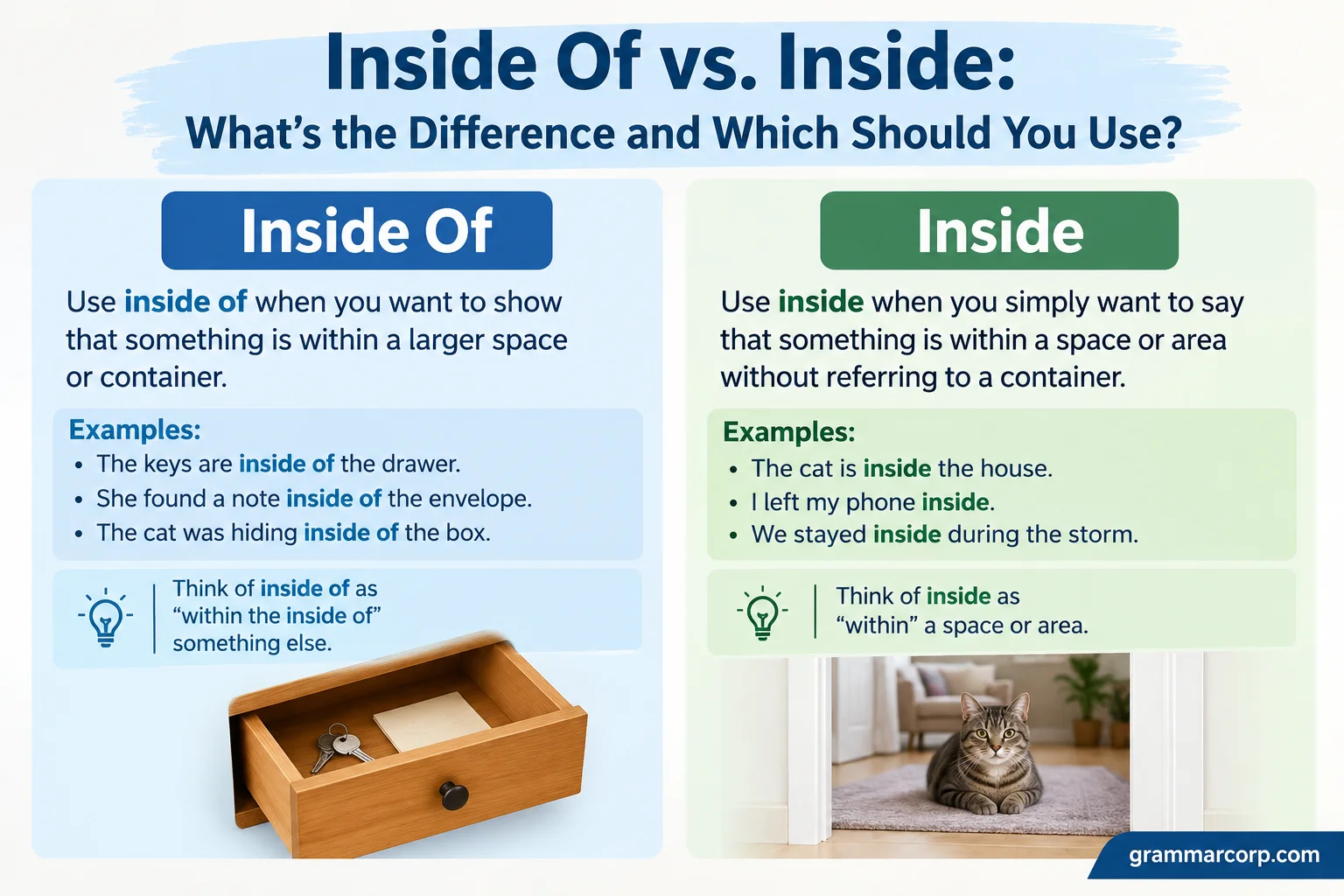
Inside Of vs. Inside: What’s the Difference and Which Should? becomes easier when you understand how each phrase works in everyday English. Both inside and inside of describe something located within a physical space, such as a house, box, or cave. However, their grammatical roles, sentence structure, and context can affect which expression sounds natural. In American English, inside is often preferred because it offers simplicity, directness, and concise wording.
For example, “The letter is inside the drawer” communicates the same basic meaning as “The letter is inside of the drawer.” The shorter expression usually makes writing clearer without changing the semantic meaning. Understanding these subtle differences can help learners improve their word choice, avoid common mistakes, and build confidence in spoken English and written English.
The word inside can function as a preposition, adverb, adjective, or noun, depending on its grammatical function and sentence construction. As a preposition, it identifies an internal location or physical position, as in “She is inside the house.” As an adverb, it can stand alone in “Go inside.” As an adjective, it describes an interior area, as in “the inside wall.” As a noun, it appears in phrases such as “the inside of the car,” referring to its interior or internal space.
Quick Answer:
Inside and inside of are both acceptable in many American English sentences when describing something located within a physical space. However, inside is generally the shorter and more direct choice.
- Use inside: “The keys are inside the drawer.”
- Use inside of: “The keys are inside of the drawer.”
- For formal writing: Prefer inside when both expressions fit equally well.
- For everyday conversation: Either expression can sound natural.
- Remember: Inside can function as a preposition, adverb, adjective, or noun. The phrase inside commonly functions as a prepositional phrase.
The key is to choose the expression that makes your sentence clear and natural. You don’t need to add off simply because a noun follows inside.
Comparison Overview
The following table highlights the main differences between inside and inside of.
| Feature | Inside | Inside Of |
| Basic meaning | Within a space or boundary | Within a space or boundary |
| Grammatical use | Preposition, adverb, adjective, or noun | Commonly a prepositional phrase |
| Typical style | Concise and direct | Often conversational |
| American English | Common and standard | Common and accepted in many contexts |
| Formal writing | Usually the simpler choice | Acceptable when natural, but sometimes wordier |
| Example | The cat is inside the house. | The cat is inside of the house. |
| Meaning in the example | The cat is within the house. | The cat is within the house. |
As the table shows, these expressions often describe the same location. Their difference is usually about wording rather than meaning.
For example, if you tell someone that your phone is inside the bag, the listener understands where the phone is. Adding of generally doesn’t change that information.
Nevertheless, you cannot replace inside with inside of in every sentence. The word inside has several grammatical roles, and the phrase inside of doesn’t serve all of them in the same way.
Main Differences Between Inside Of vs. Inside
Although inside and inside of often mean the same thing, a few important differences help you choose the right expression. These differences involve meaning, grammar, sentence flow, and the level of formality.
Difference in Meaning Between Inside and Inside Of
When you describe a physical location, inside and inside of usually have the same meaning. Both indicate that something is within an enclosed space or a defined boundary.
Consider these examples:
- The children are inside the classroom.
- The children are inside of the classroom.
Both sentences tell you that the children are in the classroom rather than outside it. Neither expression suggests a different location.
The same principle applies to everyday objects and familiar places.
| Using Inside | Using Inside Of |
| There is a letter inside the envelope. | There is a letter inside of the envelope. |
| The dog is inside the garage. | The dog is inside of the garage. |
| She found money inside her pocket. | She found money inside of her pocket. |
| We stayed inside the hotel. | We stayed inside of the hotel. |
In each pair, the intended meaning remains essentially unchanged.
However, context still matters. Inside can also describe an interior part, a person’s private thoughts, or information known only to a particular group. In these cases, replacing the word with inside of may sound unnatural or change the sentence’s structure.
For example, you might say, “She has an inside source at the company.” Here, inside describes a connection to someone with access to internal information. The phrase inside of source would not work in the same way.
Practical tip: When both expressions describe a physical location, choose the one that sounds most natural in your sentence. In most edited writing, inside is an excellent starting point.
Difference in Grammar Between Inside and Inside Of
One of the most useful distinctions concerns grammatical function. The word inside can play several roles in a sentence, while inside commonly introduces a noun phrase that identifies a location.
Consider the following examples:
- Preposition: The cookies are inside the jar.
- Adverb: Come inside.
- Adjective: The inside wall needs painting.
- Noun: The inside of the box is clean.
Notice that inside works in all four sentences. Its role changes according to how you use it.
The phrase inside of works differently. In “The cookies are inside of the jar,” the entire expression identifies where the cookies are. However, you wouldn’t normally say, “Come inside of” when you simply mean “Come inside.”
The difference becomes clearer when you compare complete sentences.
| Sentence | Is the wording natural? | Explanation |
| Please come inside. | Yes | Inside works as an adverb. |
| Please come inside of the house. | Yes | Inside of the house identifies a location. |
| The inside of the box is dirty. | Yes | Inside functions as a noun. |
| The inside of the box is dirty of. | No | The extra of doesn’t belong at the end. |
| Put the shoes inside the closet. | Yes | Inside introduces the location of the shoes. |
The lesson is simple: don’t treat inside and inside of as interchangeable in every grammatical structure. First, identify how the word functions. Then decide whether the longer phrase fits.
Difference in Formality and Style
When writing a school assignment, business email, report, or article, you generally want your sentences to be clear and direct. For that reason, inside often makes a better stylistic choice when either expression works.
Compare these sentences:
- “Please place the signed contract inside the folder.”
- “Please place the signed contract inside of the folder.”
Both are understandable, but the first sounds more direct. The second isn’t automatically incorrect; it simply uses an extra word that the sentence doesn’t need.
In casual conversation, however, many American English speakers use inside of naturally. You might hear someone say, “There’s a spider inside of the bathroom!” The phrase fits ordinary speech, even though “inside the bathroom” is shorter.
It’s important not to confuse formal preference with grammatical correctness. A phrase can be grammatically acceptable while still being less efficient in a particular sentence.
Use this quick guide:
- Academic writing: Prefer inside when it expresses your meaning clearly.
- Business communication: Choose the shorter expression unless the longer one improves the wording.
- Casual conversation: Both expressions can work naturally.
- Creative writing: Choose the version that best fits the character’s voice, rhythm, or dialogue.
- Grammar exercises: Follow the specific rule or style guide provided by your instructor.
Ultimately, good writing isn’t about removing every longer expression. It’s about choosing words that serve a purpose.
What Does Inside Mean?
The word inside refers to the inner part of something or a position within a boundary. That boundary might be a physical object, a room, a building, or even an area defined by rules or limits.
For example, if you put a book inside a backpack, the book is within the backpack’s outer boundary. If you ask someone to come inside, you’re asking them to enter a building or another enclosed space.
According to standard English usage, inside can function as a preposition, adverb, adjective, or noun. Learning these four roles will help you understand why the word appears in so many different sentence patterns.
Inside as a Preposition
A preposition expresses a relationship between a noun or pronoun and another part of a sentence. When inside functions as a preposition, it identifies where something is located.
Examples include:
- The milk is inside the refrigerator.
- I left my notebook inside my locker.
- A bird flew inside the garage.
- Please keep your shoes inside the house during the storm.
- The documents are inside the blue folder.
In each sentence, inside connects the subject or object with a particular location. The noun phrase that follows tells the reader which space contains the item.
You can often replace inside with inside of without changing the basic meaning. For instance, “The milk is inside of the refrigerator” communicates the same location as the original sentence.
Still, the shorter version is usually sufficient.
Inside as an Adverb
An adverb can describe an action, condition, or location without requiring a noun immediately afterward. Inside commonly performs this role when the context already makes the location clear.
For example:
- It’s cold outside, so come inside.
- The children went inside when it started raining.
- We waited inside until the storm passed.
- Please stay inside until the weather improves.
In these examples, inside stands alone. The listener understands that the people are entering or remaining within a building or another familiar space.
You cannot simply add of after inside in these sentences without changing the construction. “Come inside of” sounds incomplete when the speaker intends to use inside as a standalone adverb.
You could say, “Come inside of the house,” but that version includes an expressed location. The two constructions follow different patterns.
Inside as an Adjective
An adjective describes a noun. When inside works as an adjective, it identifies the inner part or surface of something.
Here are a few examples:
- The inside pocket is large enough for my phone.
- We need to paint the inside wall.
- The inside door handle is loose.
- Check the inside cover for the publisher’s information.
In each example, inside comes before a noun and describes which part of an object the speaker means.
The phrase inside of cannot replace inside in the same position. For instance, “the inside of pocket” doesn’t work as a direct replacement for “the inside pocket.” You would need to restructure the sentence, perhaps as “the inside of the pocket.”
Inside as a Noun
The word inside can also function as a noun when it refers to an interior part or surface.
Examples:
- The inside of the box was covered in dust.
- The inside of my shoe feels damp.
- We cleaned the inside of the car.
- The inside of the cabinet needs another coat of paint.
This pattern often uses the inside of followed by a noun. Here, inside is the noun, and of connects it to the object whose interior you’re describing.
This is an important distinction because inside of is not always a redundant phrase. In “the inside of the box,” the word of serves a clear grammatical purpose. Removing it would require changing the sentence’s structure: “The box’s inside was covered in dust.”
Both versions can work, but they aren’t identical in form.
What Does Inside Of Mean?
Inside of is an expression used to describe a position within a physical space, container, or boundary. It commonly appears in American English, especially in everyday speech.
For example, “The puppy is inside of the crate” tells you that the puppy is within the crate. The phrase doesn’t usually suggest anything different from “The puppy is inside the crate.”
The word of forms part of the expression in this construction. Although it often contributes little to the basic meaning of physical location, that doesn’t automatically make the phrase incorrect.
Using Inside Of for Physical Locations
The most familiar use of inside of involves objects, rooms, vehicles, and enclosed spaces.
Examples include:
- My wallet is inside of the backpack.
- The guests are inside of the restaurant.
- We found the missing toy inside of the closet.
- The cat is sleeping inside of the cardboard box.
- She left her lunch inside of the refrigerator.
Each sentence describes something located within a particular space.
However, you can shorten every example by removing of. The result remains clear:
- My wallet is inside the backpack.
- The guests are inside the restaurant.
- We found the missing toy inside the closet.
- The cat is sleeping inside the cardboard box.
- She left her lunch inside the refrigerator.
The shorter sentences are often preferable in edited prose because they communicate the same information with fewer words.
Using Inside Of in Everyday Conversation
People don’t always choose the shortest possible expression when speaking. Conversation often includes extra words, repeated phrases, and familiar patterns that make speech sound natural to the speaker.
For example, someone might say:
“Don’t leave your wet shoes inside of the house!”
Another person might say:
“Don’t leave your wet shoes inside the house!”
Both sentences communicate the same request. The choice may reflect personal speaking habits, regional patterns, or the rhythm of the sentence.
This doesn’t mean you should add of to every sentence. Rather, it shows that natural language doesn’t always follow the most concise written style.
A useful rule: If you’re speaking casually and inside of comes naturally, there’s usually no need to worry about it. When editing an article or report, check whether the extra word adds anything useful.
When Inside Of Sounds Awkward
Although inside of works in many sentences, it doesn’t fit every construction.
Consider these examples:
- Awkward: “Come inside of!”
- Natural: “Come inside!”
- Awkward: “The inside of pocket is torn.”
- Natural: “The inside pocket is torn.”
- Natural alternative: “The inside of the pocket is torn.”
The first example lacks an expressed object after of. The second pair illustrates the difference between an adjective followed by a noun and a noun followed by an of phrase.
The problem isn’t that inside of is always wrong. The problem is that the expression must fit the grammatical structure of the sentence.
When a phrase sounds awkward, check whether you’re using inside as an adverb, adjective, or noun. That small step often reveals the correct construction.
Inside vs. Inside Of: Examples in Everyday Sentences
The easiest way to understand the difference between inside and inside of is to compare them in real situations. The examples below show how both expressions work in everyday American English.
Examples With Houses and Buildings
When describing a location within a house, office, school, or other building, both expressions generally work.
| Using Inside | Using Inside Of |
| The children are inside the school. | The children are inside of the school. |
| She left her umbrella inside the office. | She left her umbrella inside of the office. |
| The guests are waiting inside the restaurant. | The guests are waiting inside of the restaurant. |
| We stayed inside the house during the storm. | We stayed inside of the house during the storm. |
Why do both work? Each sentence identifies a location within a building. The additional of doesn’t usually change the intended meaning.
In a school report or workplace email, the shorter form is generally the better choice. In casual conversation, either version may sound natural.
Examples With Bags, Boxes, and Containers
The same rule applies when you describe an object inside a container.
- The gift is inside the box.
- The gift is inside of the box.
- Keep the medicine inside the cabinet.
- Keep the medicine inside of the cabinet.
- I found my headphones inside the backpack.
- I found my headphones inside of the backpack.
These sentences all describe the location of an object. In most cases, you can remove of without changing the meaning.
However, context may affect which expression sounds best. For instance, “Put the papers inside the folder” is a natural, direct instruction. Adding of is possible, but it doesn’t make the instruction clearer.
Examples With Cars and Other Vehicles
Vehicles provide another useful way to compare the expressions.
- The passengers are inside the bus.
- The passengers are inside of the bus.
- I left my water bottle inside the car.
- I left my water bottle inside of the car.
- Please remain inside the vehicle.
- Please remain inside of the vehicle.
The shorter form works particularly well in signs, instructions, and safety announcements. For example, “Please remain inside the vehicle” is direct and easy to understand.
The longer form remains understandable, but it usually offers no additional information.
Examples Where Inside Of Cannot Simply Replace Inside
The two expressions are not interchangeable in every grammatical role.
| Sentence | Explanation |
| Please come inside. | Inside functions as an adverb. |
| She turned the jacket inside out. | Inside out is an established expression. |
| He has an inside connection. | Inside describes a type of connection. |
| The inside of the cup is stained. | Inside functions as a noun. |
| The cat is inside of the cupboard. | Inside of introduces a physical location. |
These examples highlight an important point: replacing words mechanically can produce awkward sentences. You should consider the whole expression rather than focusing on the presence or absence of of.
Is Inside Of Grammatically Correct?
Yes, inside of is grammatically acceptable in many contexts, particularly in American English. It commonly describes something located within a physical space.
For example:
- The keys are inside of the drawer.
- The children are inside of the classroom.
- There is a package inside of the mailbox.
None of these sentences is automatically wrong because it includes of. However, a writer might choose the shorter versions for a more concise style.
It’s helpful to distinguish three separate questions:
- Is it grammatical? The expression can be grammatically correct.
- Is it necessary? Often, no. The word inside may express the same meaning.
- Is it the best stylistic choice? That depends on the sentence and the writing context.
Suppose you’re writing an instruction for employees: “Store the equipment inside of the storage room.” The sentence is understandable, but “Store the equipment inside the storage room” is more direct.
Now imagine a character speaking in a short story: “I think I left it somewhere inside of that old house.” The longer phrasing may fit the character’s conversational voice.
Grammar and style work together, but they aren’t the same thing. An expression doesn’t become grammatically incorrect simply because another version is shorter.
Is Inside Of Redundant?
In many sentences about physical location, inside of includes an extra word that you can remove without changing the main meaning.
Consider these examples:
- “The keys are inside of the drawer.”
- “The keys are inside the drawer.”
Both sentences tell you where the keys are. In this context, of doesn’t add essential information.
However, calling every use of inside of redundant would be inaccurate. The phrase the inside of has a different grammatical structure.
Compare:
- “The inside of the drawer is dusty.”
- “The drawer’s inside is dusty.”
In the first sentence, inside functions as a noun, and of the drawer identifies the object whose interior you’re describing. In the second, the possessive construction expresses the relationship differently.
You can’t simply remove of from the first sentence and write “The inside the drawer is dusty.” That would be ungrammatical.
Therefore, whether of is unnecessary depends on how you use the expression.
A Simple Editing Test
When editing your writing, ask yourself these questions:
- Does inside already communicate the intended location?
- Does removing of preserve the sentence’s meaning?
- Does the shorter version sound natural?
- Does the longer version serve a purpose in the sentence?
If removing of makes the sentence clearer without changing its meaning, the shorter version is usually preferable.
Inside Of vs. Within: What’s the Difference?
Inside, inside of, and within can all describe something located inside a boundary. However, within also appears in contexts involving time limits, rules, and abstract boundaries.
Inside and Inside Of
These expressions commonly describe physical locations.
- The dog is inside the house.
- The dog is inside of the house.
Both sentences describe the dog’s location.
Within
The word within can describe physical locations, but it also refers to limits or boundaries that aren’t physical.
Examples:
- Please respond within three days.
- The solution lies within your control.
- The documents are within the building.
- The project must remain within budget.
In the first example, within refers to a time limit. In the second and fourth, it describes a boundary or limitation rather than an enclosed physical space.
You generally wouldn’t replace within three days with inside three days and expect the same meaning. The expressions have different grammatical uses.
| Expression | Typical Use | Example |
| Inside | Physical location | The files are inside the cabinet. |
| Inside of | Physical location, often conversational | The files are inside of the cabinet. |
| Within | Physical or abstract boundaries | Please finish within three days. |
Choose within when you’re describing a limit or time frame. For ordinary physical locations, inside is often the simplest choice.
Read More : In the Morning or On the Morning: Which Is Correct?
Common Mistakes to Avoid When Using Inside Of vs. Inside
Even though these expressions are straightforward, a few common mistakes can make your writing less natural.
Assuming Inside Of Is Always Wrong
One widespread misconception is that inside of is grammatically incorrect in every situation.
That’s not true. The expression is widely used in American English and works in many sentences describing physical locations.
For example, “The cat is inside of the bedroom” is understandable and acceptable. You can shorten it to “The cat is inside the bedroom,” but that doesn’t mean the original sentence is automatically wrong.
Adding Of When It Isn’t Needed
The opposite mistake is assuming that of must follow inside whenever a noun comes next.
For example:
- Wordy: “The documents are inside of the folder.”
- Concise: “The documents are inside the folder.”
The shorter sentence is clear and natural. There’s no need to add another word merely to make the sentence sound more formal.
Using Inside Of as a Replacement for Every Use of Inside
Remember that inside can function as an adverb, adjective, or noun.
You can say, “Come inside,” but “Come inside of” usually sounds incomplete when used alone. Similarly, “inside pocket” is a natural adjective-noun combination, while “inside of pocket” doesn’t work as a direct replacement.
Always consider the grammatical role before changing the wording.
Confusing Correctness With Personal Preference
Some writers prefer concise sentences, while others use expressions that reflect their conversational style. Neither preference establishes a universal grammar rule.
Instead of automatically correcting every instance of inside of, consider the sentence’s purpose. In formal writing, concision often helps. In dialogue, the longer expression may sound perfectly natural.
Ignoring the Full Sentence
A word can be correct in one sentence and awkward in another. For example, inside works naturally in “The children went inside.” By contrast, the inside of the house uses a noun construction that needs a different sentence pattern.
The best approach is to check the entire sentence, not just the two words you’re comparing.
A Practical Case Study: Editing Inside Of in Everyday Writing
Imagine that you’re reviewing a short workplace notice before sending it to your team.
Your first draft reads:
“Please leave all deliveries inside of the reception area and place smaller packages inside of the storage cabinet.”
The message is understandable. However, you can make it more direct by removing the unnecessary instances of of.
Revised version:
“Please leave all deliveries inside the reception area and place smaller packages inside the storage cabinet.”
What changed? The instructions became shorter without losing any information.
Now consider a different sentence:
“The inside of the storage cabinet needs cleaning.”
Here, you shouldn’t remove of in the same way. The phrase the inside of the storage cabinet identifies the cabinet’s interior. Removing of without restructuring the sentence would make it ungrammatical.
This example demonstrates a useful editing principle: remove unnecessary words, but preserve the grammatical structure that makes your sentence work.
Quick Rule for Choosing Inside or Inside Of
If you need a simple rule to remember, use this one: prefer inside when both expressions communicate the same meaning naturally.
Here’s a quick reference guide:
- Choose inside for concise descriptions of physical locations.
- Use inside of when it fits naturally, especially in conversational American English.
- Use inside as an adverb when no object follows, as in “Come inside.”
- Use the inside of when inside functions as a noun, as in “the inside of the box.”
- Don’t automatically label inside of incorrect simply because it contains an extra word.
- Choose within when discussing time limits, restrictions, or abstract boundaries where that word fits better.
These guidelines will help you avoid unnecessary wording without treating an accepted expression as a grammar error.
FAQs:
1. What is the difference between inside and inside of?
Inside and inside of often have the same meaning when describing a location. For example, “The keys are inside the box” and “The keys are inside of the box” are both understandable. However, inside is usually more concise and preferred in formal writing.
2. Is the inside grammatically correct?
Yes, inside of is grammatically acceptable in many contexts, especially in conversational American English. However, the word of is often unnecessary when describing a physical location, so inside is generally the simpler choice.
3. Should I use inside or inside of in formal writing?
Use inside in professional emails, school essays, reports, and other formal documents. For example, “Please leave the documents inside the folder” is direct, clear, and natural.
4. Can inside function as different parts of speech?
Yes. Inside can function as a preposition, adverb, adjective, or noun. For example, “She is inside the house” uses it as a preposition, “Come inside” uses it as an adverb, “the inside wall” uses it as an adjective, and “the inside of the car” uses it as a noun.
5. What does inside of five minutes mean?
Inside of five minutes means within five minutes. In this time-related expression, inside of communicates a time limit. You can also say within five minutes, which is concise and widely understood.
Conclusion:
Understanding inside vs. inside of helps you make clearer choices in everyday conversations and professional writing. Both expressions can describe something within a physical space, but inside is usually shorter and more direct. Use “inside the box” when describing a location, and use “the inside of the box” when referring to its interior.
Remember that inside of can also be useful in expressions such as “inside of five minutes.” By considering the context, sentence structure, and intended meaning, you can choose the expression that sounds natural and communicates your message clearly.












1 thought on “Inside Of vs. Inside: What’s the Difference and Which Should?”