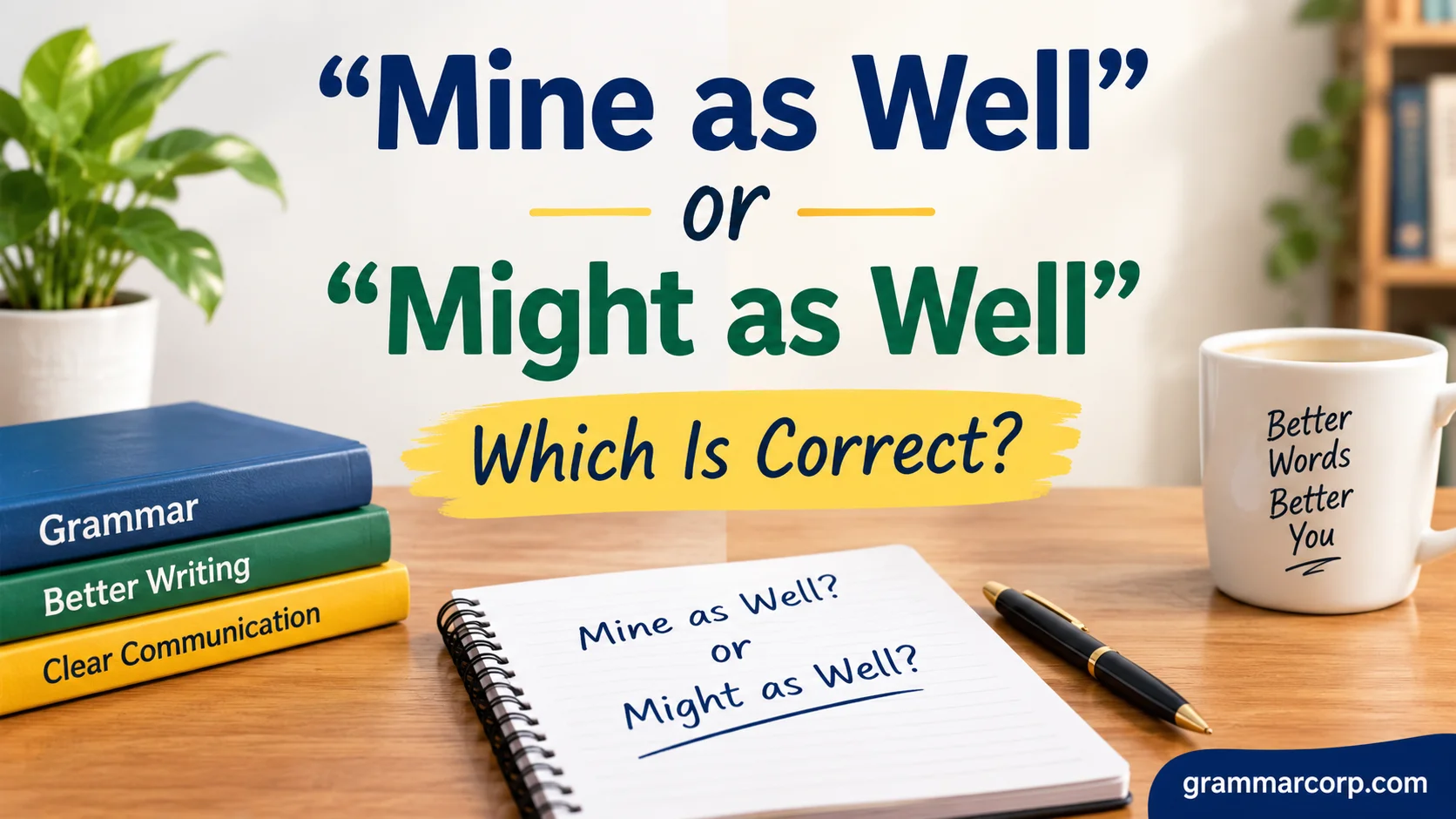
“Mine as Well” or “Might as Well”: Which Is Correct? Learn why “might as well” suggests a sensible choice while “mine” shows ownership.
Might as well is the correct expression when you want to suggest a practical action, make a sensible decision, or choose an option when there is no better alternative. For example, if you’re already at the grocery store, you might as well pick up some milk. In contrast, mine is a possessive pronoun that expresses ownership or means “belonging to me.”
Although these phrases may sound similar in spoken English, they have different meanings and grammatical uses. Writing “We mine as well go” is a common mistake because the sentence needs “might as well” to express a suggestion. Understanding this word choice helps you improve your grammar, spelling, and writing accuracy.
Quick Answer: “Mine as Well” or “Might as Well”?
“Might as well” is the correct expression when you want to suggest doing something because it’s reasonable, convenient, or the best available option. “Mine as well” is generally a spelling or hearing mistake when used with this intended meaning.
- Correct: We might as well leave before the traffic gets worse.
- Incorrect: We mine as well leave before the traffic gets worse.
The word might is a modal verb that expresses possibility or a suggested course of action. The phrase as well contributes to the expression’s meaning, which often involves deciding that an action makes sense in a particular situation.
Remember this simple rule: If you mean “we may as well do it” or “there’s little reason not to do it,” write “might as well.”
Comparison Overview
The quickest way to understand “mine as well” versus “might as well” is to compare their spelling, grammatical function, and meaning.
| Feature | Might as well | Mine as well |
| Standard expression for suggesting an action | Yes | No |
| Grammatical function | Expression using a modal verb | Combination that doesn’t convey the intended idiomatic meaning |
| Common meaning | A reasonable action or practical choice | No standard meaning in this context |
| Example | We might as well take a taxi. | We mine as well take a taxi. |
| Appropriate in everyday English | Yes | No, not with the intended meaning |
| Main reason to use it | To suggest an action or accept a practical option | Not a substitute for “might as well” |
The distinction is straightforward. Use “might as well” when discussing what someone could reasonably do. Although mine is a valid English word, it doesn’t replace might in this expression.
For example, you might say, “The movie starts in ten minutes, so we might as well find our seats.” The expression explains why finding your seats now makes sense. Changing might to mine would break the intended meaning.
Main Differences Between “Mine as Well” and “Might as Well”
Although these phrases look similar, the key difference lies in the words themselves. Understanding their grammatical roles will help you recognize the correct expression without second-guessing your spelling.
What Does “Might as Well” Mean?
The phrase “might as well” suggests that an action is reasonable, worthwhile, or convenient given the circumstances. It often appears when someone considers the available options and decides that a particular action makes sense.
Consider this situation: you’ve arrived at a restaurant, but your friends won’t arrive for another twenty minutes. You could wait outside or find a table. You might say, “I might as well get us a table.”
Here, the expression doesn’t mean you’re uncertain about whether tables exist. Instead, you’re suggesting a practical decision based on the situation.
The phrase commonly communicates three related ideas:
- Practicality: An action makes sense under the circumstances.
- Opportunity: There’s a chance to do something useful.
- Resignation: There isn’t a better option, so proceeding seems reasonable.
For example, “Since we’re already downtown, we might as well visit the museum.” This sentence suggests that visiting the museum is a sensible way to use the opportunity.
The phrase can also express mild reluctance. Consider “The weather ruined our picnic, so we might as well head home.” The speaker accepts the situation and chooses the next reasonable step.
What Does “Mine as Well” Mean?
“Mine as well” isn’t a standard alternative to “might as well.” When someone writes it in a sentence about making a practical choice, the phrase is generally a spelling mistake or a misunderstanding of the intended expression.
The word mine has legitimate meanings in English. It can function as a possessive pronoun, as in “That backpack is mine.” It can also refer to a place where people extract minerals or other materials from the earth, as in “The workers entered the mine.”
However, neither meaning fits the expression used to suggest a reasonable action.
Compare these examples:
- Correct: If you’re going to the store, you might as well buy some bread.
- Incorrect: If you’re going to the store, you mine as well buy some bread.
- Correct use of mine: That seat is mine, so please don’t move my bag.
- Correct use of mine as a noun: The old mine closed several years ago.
These examples demonstrate why context matters. Mine is a real word, but that doesn’t make it an appropriate replacement for might.
Why “Might” Is the Correct Word
The word might is a modal auxiliary verb. Modal verbs help express ideas such as possibility, ability, permission, and obligation. In “might as well,” the word introduces the possibility or reasonableness of taking a particular action.
The word mine, by contrast, normally indicates possession or refers to an excavation site. It doesn’t perform the same grammatical function.
Think of it this way: if you’re choosing between two reasonable options, you might say, “We might as well take the train.” The sentence presents taking the train as a sensible choice. Replacing might with mine removes the grammatical structure needed to express that idea.
How to Use “Might as Well” Correctly
Now that the difference is clear, let’s look at how you can use “might as well” naturally in everyday conversations, emails, and other forms of writing.
Use “Might as Well” to Suggest a Practical Action
One of the most common uses of the expression is to recommend an action that makes sense in a particular situation.
For example, imagine that you’re already at the library and realize you need another book for your assignment. You could say, “I might as well borrow the book while I’m here.”
The action is convenient because you’re already in the right place. There’s no need to make another trip later.
Here are more examples:
- “Since the store is nearby, we might as well walk.”
- “You have an extra hour, so you might as well finish the assignment.”
- “The kitchen is already clean, so I might as well prepare dinner.”
- “We’re passing the post office, so we might as well mail the package.”
In each example, the expression connects an action to the circumstances that make it sensible. You aren’t necessarily making a firm recommendation. You’re pointing out a reasonable option.
Use “Might as Well” When There’s No Better Option
Sometimes, the phrase communicates acceptance rather than enthusiasm. A person may choose an action because other options have disappeared or no longer seem worthwhile.
Suppose your train is delayed for an hour. You could complain about the delay, or you could find somewhere comfortable to sit. You might say, “We might as well get something to eat while we wait.”
The expression acknowledges the inconvenience without dwelling on it.
Consider these examples:
- “The bus has already left, so we might as well wait for the next one.”
- “Nobody else volunteered, so I might as well handle the presentation.”
- “The outdoor event was canceled, so we might as well watch a movie at home.”
- “We missed the early show, so we might as well attend the evening screening.”
Notice that the phrase doesn’t always suggest excitement. Depending on the context, it can communicate patience, mild disappointment, or a practical attitude toward an unexpected situation.
Use “Might as Well” in Questions and Suggestions
You can also use the expression to invite agreement or present an idea for consideration.
For example:
- “We might as well start now, don’t you think?”
- “Since everyone is here, might as well get started.”
- “We have some time before dinner. Might as well take a walk?”
- “If you’re already making coffee, you might as well make another cup.”
In casual American English, speakers sometimes omit the subject we, I, or you in informal suggestions such as “Might as well get going.” The full construction would be “We might as well get going.”
However, in formal writing, it’s usually clearer to include the subject and write a complete sentence. For example, “We might as well begin the meeting now” works well in a professional email.
Also, don’t confuse a casual suggestion with a standard question. “Might we as well start now?” sounds unnatural in most everyday American English. “We might as well start now, shouldn’t we?” or “We might as well start now, don’t you think?” sounds more natural.
“Might as Well” in Different Sentence Structures
The expression works in several sentence patterns. Once you understand the basic structure, you’ll be able to use it in a wider range of situations.
“I Might as Well,” “You Might as Well,” and “We Might as Well”
The word might doesn’t change according to the subject. Whether you’re talking about yourself, another person, or a group, the same form applies.
| Subject | Example |
| I | I might as well call the office now. |
| You | You might as well ask for directions. |
| He | He might as well take the earlier train. |
| She | She might as well bring her laptop. |
| We | We might as well order dinner now. |
| They | They might as well stay overnight. |
This is an important point because modal verbs don’t take the usual third-person singular -s ending. You write “She might as well leave,” not “She mights as well leave.”
Negative Sentences With “Might as Well”
You can use a negative construction when suggesting that an action isn’t worth doing or that there’s little reason to do it.
For example:
- “You might as well not bother calling; the office is closed.”
- “We might as well not drive if the roads are flooded.”
- “He might as well not apply if he doesn’t meet the basic requirements.”
The phrase “might as well not” often suggests that an action would serve little purpose. However, the precise meaning depends on the situation.
Compare these sentences:
- “You might as well call her.” This suggests that calling is a reasonable option.
- “You might as well not call her.” This suggests that calling may be unnecessary or unhelpful.
The placement of not changes the meaning, so make sure it appears in the right position.
“Might as Well” in Longer Sentences
The phrase also fits naturally into sentences that explain a reason or condition.
For example:
- “If we’re going to arrive early anyway, we might as well stop for breakfast.”
- “Since you already have the document open, you might as well correct the spelling mistakes.”
- “Because the weather is improving, we might as well continue our walk.”
Words such as if, since, and because help explain why the action makes sense. They give readers enough context to understand the decision.
Can You Use “Might as Well” to Talk About the Past?
Yes, but you need to distinguish between a present or future choice and a decision that someone could have made in the past.
The basic phrase often refers to a current or upcoming action:
- “We might as well leave now.”
- “I might as well send the email tonight.”
To discuss an unrealized past possibility, English commonly uses “might as well have” followed by a past participle.
For example:
- “We might as well have stayed home.” This can suggest that staying home would have been just as reasonable, perhaps given how the outing turned out.
- “I might as well have taken the bus.” This can suggest that taking the bus would have been an equally sensible choice in retrospect.
The exact implication depends on the surrounding context. This construction can express regret, disappointment, or a comparison between what happened and another possible action.
Why Do People Write “Mine as Well” Instead of “Might as Well”?
If “might as well” is the correct expression, why does “mine as well” appear in messages, online discussions, and informal writing? The answer usually involves pronunciation, spelling habits, and confusion between similar-sounding words.
Similar Sounds Can Cause Confusion
In everyday speech, people often pronounce words less distinctly than they do when reading aloud. The final consonants in might may become less noticeable, especially when someone speaks quickly.
As a result, listeners who aren’t familiar with the expression might misinterpret what they hear. They may then write mine because it seems to match their impression of the sound.
However, pronunciation doesn’t determine the standard spelling of an expression. Familiarity with the phrase and its meaning helps you recognize the correct form.
Typing Errors and Autocorrect
Sometimes, the problem has nothing to do with pronunciation. A person may type mine instead of might because they’re writing quickly or because an automatic correction changes the intended word.
Speech-to-text software can also misunderstand words when the speaker’s pronunciation is unclear.
To avoid these errors, read the entire sentence after typing it. If you’re suggesting an action, check whether might as well expresses your intended meaning.
A Simple Way to Remember the Correct Phrase
Use this memory trick: “Might as well” contains “might,” which expresses possibility.
When you’re deciding whether to do something, ask yourself whether the sentence means that an action is reasonable, convenient, or worth considering.
For example:
- “We ___ as well leave early.”
- “You ___ as well ask for help.”
- “I ___ as well finish this today.”
In all three sentences, might is the correct word. The phrase suggests a practical decision rather than ownership, so mine doesn’t fit.
Common Mistakes to Avoid With “Might as Well”
Even after learning the correct spelling, you may encounter other mistakes involving this expression. Understanding them will help you use it more naturally.
| Common mistake | Correct form | Explanation |
| We mine as well go. | We might as well go. | Use might to suggest a practical action. |
| She mights as well stay. | She might as well stay. | Modal verbs don’t take an -s ending. |
| We might aswell leave. | We might as well leave. | Write the expression as three separate words. |
| He might as well to ask. | He might as well ask. | Use the base form of the verb after the expression. |
| They might as well leaves. | They might as well leave. | Use the base form leave, not leaves. |
| You might as well not to go. | You might as well not go. | Use the base verb after not. |
A particularly common mistake is adding to before the main verb. In standard English, modal verbs such as might take a bare infinitive, meaning the base form of the verb without to.
Therefore, you write “We might as well wait,” not “We might as well to wait.”
Another useful point concerns tone. The expression doesn’t always mean that someone has given up or feels disappointed. It can simply indicate that an action is convenient.
For instance, “We’re already at the park, so we might as well take a walk” sounds like a sensible suggestion. There’s no reason to assume that the speaker feels reluctant.
“Might as Well” vs. Similar Expressions
Several English expressions communicate ideas similar to “might as well.” However, they aren’t always interchangeable. Choosing the right alternative depends on what you want to emphasize.
“Might as Well” vs. “May as Well”
Both “might as well” and “may as well” can suggest that an action is reasonable under the circumstances.
For example:
- “We might as well order now.”
- “We may as well order now.”
Both sentences are understandable and grammatically acceptable. In many everyday situations, they communicate essentially the same idea.
The difference is often subtle. Might as well is a familiar choice in conversational American English, while may as well is also established and may sound slightly different depending on the speaker and context.
Neither expression should automatically be considered incorrect. Choose the one that sounds natural in your sentence and remains consistent with your intended tone.
“Might as Well” vs. “As Well”
These expressions look similar, but they perform different jobs.
“Might as well” suggests that doing something is a reasonable choice. “As well” often means also or in addition.
Compare the examples:
- “We might as well order pizza.” This suggests that ordering pizza is a practical choice.
- “We ordered pizza as well.” This means pizza was ordered in addition to something else.
Here’s another comparison:
| Expression | Meaning | Example |
| Might as well | A reasonable action | We might as well leave early. |
| As well | Also or in addition | She brought her notebook as well. |
The surrounding sentence usually makes the difference clear. If you’re recommending an action, you probably need might as well. If you’re adding another item or action to a list, as well may be the better choice.
“Might as Well” vs. “Might as Well Just”
Adding just can make a suggestion sound more direct or emphasize that an action is the simplest available option.
For example:
- “We might as well take a taxi.”
- “We might as well just take a taxi.”
Both sentences are correct. The second version places extra emphasis on taking a taxi as the straightforward solution.
You might use this wording when you’ve considered other options but no longer see a good reason to pursue them.
For example, “The bus won’t arrive for another hour, so we might as well just walk.” Here, just reinforces the idea that walking is the practical choice.
However, just isn’t necessary. The shorter sentence communicates the main idea perfectly well.
“Might as Well” vs. “Why Not?”
Both expressions can introduce suggestions, but they approach the idea differently.
- “We might as well go for a walk.” This presents walking as a reasonable option.
- “Why not go for a walk?” This invites someone to consider the idea.
“Why not?” can sound more encouraging or persuasive. Meanwhile, “might as well” may emphasize convenience, circumstances, or the absence of a better option.
Choose the expression that matches the message you want to convey.
Read More : Smooth or Smoothe: Which Spelling Is Correct?
Is “Might as Well” Formal or Informal?
“Might as well” works in both casual and many professional contexts. It’s especially common in conversation because it communicates practical decisions in a concise, natural way.
You can use it when speaking with friends, discussing plans with coworkers, or writing an ordinary workplace email.
For example:
“Since everyone’s available this afternoon, we might as well schedule the meeting today.”
This sentence is clear and professional enough for many routine workplace situations.
However, if you’re writing a highly formal report or presenting a carefully reasoned recommendation, a more precise alternative may work better.
Consider these examples:
| Situation | Natural wording |
| Casual conversation | We might as well leave now. |
| Workplace email | We might as well review the proposal today. |
| Formal recommendation | It would be reasonable to review the proposal today. |
| Explaining a practical decision | Given the circumstances, proceeding seems appropriate. |
| Suggesting an option | We could consider leaving earlier. |
The key isn’t to avoid “might as well” in formal writing. Instead, consider whether the expression matches the purpose and tone of your message.
For instance, if you’re discussing a business decision, “We might as well try this approach” sounds conversational. “Testing this approach may be a reasonable next step” sounds more analytical.
Both can be effective. The best choice depends on your audience and the degree of formality you need.
Real-Life Examples of “Might as Well” in Context
The easiest way to understand a phrase is to see how people might use it in realistic situations. These examples demonstrate how the meaning changes slightly according to context.
At Work
Imagine that a team has finished its main project ahead of schedule. One employee notices that a related document still needs proofreading.
They say, “Since we have some time left, we might as well proofread the document.”
The phrase presents proofreading as a useful way to spend the remaining time. It doesn’t suggest that the team must do it or that the task is particularly exciting.
While Traveling
Suppose you’re visiting a city and discover that a famous landmark is only a short walk away.
You might say, “We’re already in the area, so we might as well visit the landmark.”
The expression connects your current location with an opportunity. Visiting the landmark makes sense because you’re nearby.
During Everyday Conversations
Imagine that you and a friend are discussing dinner. Neither of you wants to cook, and a restaurant nearby offers takeout.
You might say, “Neither of us feels like cooking, so we might as well order dinner.”
The expression communicates a practical choice. It doesn’t necessarily indicate that ordering food is the only available option.
When Plans Change
Suppose a scheduled outdoor activity gets canceled because of rain. You and your friends decide to watch a movie instead.
You might say, “The weather isn’t cooperating, so we might as well watch a movie.”
Here, the phrase reflects acceptance of the changed circumstances. Rather than focusing on the canceled plan, you’re choosing another reasonable activity.
These examples share one important feature: the speaker connects a decision to the situation at hand. That connection is central to the meaning of “might as well.”
FAQs:
1. Is “mine as well” grammatically correct?
Yes, “mine as well” can be grammatically correct when you want to express shared ownership. For example, “That book is mine as well” means that the book belongs to me too. However, it cannot replace “might as well” when suggesting an action.
2. Is it “might as well” or “mine as well”?
“Might as well” is correct when suggesting a practical action or sensible choice. For example, “We might as well leave now.” “Mine as well” expresses ownership in a suitable context.
3. Why do people confuse “might as well” with “mine as well”?
People may confuse these expressions because they can sound similar during quick, casual speech. This pronunciation confusion can lead to spelling mistakes when someone writes what they think they heard.
4. What does “might as well” mean?
“Might as well” means that an action is reasonable or worth doing under the circumstances, especially when there is no better alternative. For example, “It’s already late, so we might as well head home.”
5. Can I use “mine as well” in everyday conversation?
Yes, when the context involves ownership. For example, “Your bag is blue, and mine is blue as well.” You can also say, “That bag is mine as well.” When recommending an action, however, use “might as well.”
Conclusion:
Choosing between “might as well” and “mine as well” depends on the meaning you want to express. Use “might as well” to suggest a sensible action when there is no better option. Use “mine as well” when expressing ownership, such as saying something belongs to you too.
Understanding this difference helps you avoid common grammar mistakes and communicate more clearly in spoken and written English.












1 thought on ““Mine as Well” or “Might as Well”: Which Is Correct?”