
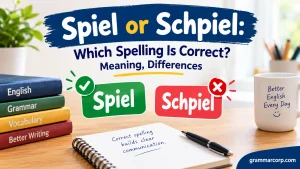
Spiel or Schpiel: Which Spelling Is Correct? Meaning, Differences explains why these spellings cause confusion in English.
The English language includes easily confused words such as spiel and schpiel. The standard spelling is spiel, while schpiel is an alternative spelling influenced by Yiddish. Both forms refer to a persuasive speech, sales pitch, or lengthy explanation. Understanding their spelling conventions, pronunciation, and German and Yiddish influences can help learners of English choose the right word and communicate clearly.
The word spiel comes from the German word Spiel, meaning “play,” and entered English through language influences that include Yiddish. Today, it describes an elaborate or rehearsed verbal pitch intended to persuade an audience. For example, a salesperson might give a spiel about why a product is superior to others, or a politician might repeat a familiar speech. In professional communication, using the standard spelling helps prevent confusion and misinterpretation.
When writing an article, preparing a presentation, or using the word in day-to-day conversation, choose spiel for standard English. You can use it to describe a persuasive speech, a usual sales pitch, or a long explanation. Although schpiel appears in some informal contexts, spiel remains the safest choice in formal writing. Learning the word’s origin, meaning, and practical usage examples makes this spelling distinction easier to remember.
Quick Answer: Spiel vs. Schpiel
Spiel is the standard spelling to use in most English writing, including American English. Schpiel is an alternative spelling that emphasizes the word’s common pronunciation with an initial sh sound. Both generally refer to a lengthy, rehearsed, persuasive, or sometimes tiresome speech.
For example:
- Standard spelling: The salesperson gave me the same spiel I had heard last week.
- Alternative spelling: He launched into his familiar schpiel about the benefits of the product.
Although readers may understand either version, spiel is the safer choice for professional writing, school assignments, articles, and everyday communication.
The word doesn’t always imply dishonesty or exaggeration. Depending on the context, a spiel can be an ordinary explanation, an enthusiastic pitch, or a repetitive speech that the listener has heard many times.
Comparison Overview
The following table highlights the main similarities and differences between spiel and schpiel.
| Feature | Spiel | Schpiel |
| Status | Standard English spelling | Alternative spelling |
| Meaning | A lengthy, rehearsed, persuasive, or familiar speech | Generally the same meaning |
| Pronunciation | Commonly “speel”; also pronounced “shpeel” | Usually “shpeel” |
| Usage | Common in everyday and professional English | More noticeable in informal or stylistic writing |
| Formal writing | Recommended | Usually less suitable |
| Typical expressions | Sales spiel, usual spiel, political spiel | The same expressions, when using the variant |
| Best choice for general readers | Yes | Only when the alternative spelling serves a purpose |
The key distinction is spelling preference rather than meaning. You don’t need to learn two separate definitions or treat the words as opposites.
For most readers, spiel is the best default choice. It is widely recognized in English dictionaries and works naturally in conversations, news articles, business writing, and informal storytelling.
Schpiel can still appear in English-language writing, particularly when a writer wants to highlight the pronunciation associated with the word’s Yiddish background. However, using the standard spelling avoids unnecessary questions about whether you’ve made a typo.
What Does Spiel Mean?
A spiel is a speech, explanation, pitch, or extended account that someone delivers to an audience. It often sounds rehearsed or familiar, as though the speaker has given the same explanation many times before.
The word frequently appears when someone wants to persuade another person, promote a product, explain a plan, or repeat a familiar argument. Depending on the situation, it can sound neutral, humorous, skeptical, or critical.
Consider this example:
The salesperson gave us a detailed spiel about the new phone’s features.
Here, spiel refers to the salesperson’s explanation. The sentence doesn’t necessarily suggest that the salesperson lied. It simply presents the explanation as a prepared or recognizable pitch.
Now consider a slightly different example:
I’m tired of hearing his spiel about why he deserves another chance.
In this sentence, the word suggests frustration. The speaker has probably heard the same argument repeatedly and no longer finds it convincing.
The surrounding context determines the tone.
Spiel as a Noun
The most common use of spiel is as a noun. It describes the speech or explanation itself rather than the act of speaking.
You might hear someone mention a sales spiel, a political spiel, or a person’s usual spiel. Each expression describes a particular kind of speech, often one that the speaker has prepared or repeated.
Here are some examples:
- Sales: The representative delivered a spiel about the company’s latest subscription plan.
- Business: Before the meeting, Maya practiced her spiel for potential investors.
- Politics: Voters had heard the candidate’s spiel about economic reform several times.
- Everyday conversation: Whenever we discuss vacations, he gives us the same spiel about saving money.
- Entertainment: The tour guide’s opening spiel introduced the building’s history.
Notice that the word works across several settings. It can describe a professional presentation or a casual explanation between friends.
A spiel may also be long and detailed without being particularly persuasive. The defining idea is often the prepared, extended, or familiar nature of the speech.
Spiel as a Verb
Although spiel is most familiar as a noun, it can also function as a verb. In this use, it means to speak at length, deliver a pitch, or present a familiar explanation.
For example:
The vendor began to spiel about the advantages of buying in bulk.
Here, spiel describes the act of talking through a pitch rather than the pitch itself.
The verb is informal, so it usually fits casual conversations, dialogue, and lighthearted writing better than highly formal reports.
Common forms include:
| Verb form | Example |
| Base form: spiel | He tends to spiel whenever someone asks about his business. |
| Third-person singular: spiels | She spiels about the project to anyone who will listen. |
| Past tense: spieled or spielled | He spieled about the new service for several minutes. |
| Present participle: spieling | They were spieling about the benefits of the membership. |
Usage and dictionary treatment of less common verb forms can vary. If you want to avoid an awkward construction, you can use give a spiel, deliver a pitch, or talk at length instead.
For instance, rather than writing, “He was spieling about the offer,” you could write, “He was giving his usual spiel about the offer.” The second version is more familiar to many English readers.
Common Expressions and Contexts Using Spiel
Certain expressions appear frequently because they capture the way people repeat explanations, promote products, or try to convince others.
A sales spiel
A sales spiel is a prepared pitch designed to encourage someone to buy a product or service.
The car dealer delivered a sales spiel about the vehicle’s fuel efficiency.
The expression may describe a useful explanation of a product or a pitch that feels overly rehearsed.
The same old spiel
This phrase refers to a familiar explanation or excuse that someone has repeated many times.
Every time he misses a deadline, he gives us the same old spiel about being too busy.
The phrase often carries a skeptical or impatient tone.
A political spiel
A political spiel is a speech or explanation about political ideas, policies, or campaign promises.
The audience listened politely as the candidate launched into his political spiel.
Depending on the writer’s attitude, the expression can sound neutral or suggest that the speech contains predictable talking points.
Give someone a spiel
This expression means to deliver a prepared explanation, pitch, or lengthy account to someone.
The instructor gave the new students a spiel about classroom expectations.
Here, the speech serves a practical purpose rather than an obviously persuasive one.
Someone’s usual spiel
This phrase describes the familiar speech a person tends to give in a particular situation.
I already know her usual spiel about the importance of arriving early.
It suggests that the listener recognizes the explanation and may have heard it before.
These expressions demonstrate why spiel remains useful in everyday English. One short word can communicate that a speech is lengthy, familiar, prepared, or intended to persuade.
What Does Schpiel Mean?
Schpiel is an alternative spelling of spiel. It generally refers to the same kind of speech: a lengthy explanation, a familiar pitch, or a persuasive account that someone delivers to another person.
The spelling makes the initial sh sound more visible. That’s useful because many speakers pronounce spiel with a sound similar to the beginning of ship, rather than the s sound at the beginning of spin. Dictionaries recognize both pronunciations of spiel.
After the meeting started, he launched into his usual schpiel about the company’s new strategy.
The meaning is essentially the same as it would be if the sentence used spiel. The spelling doesn’t create a new meaning or change the type of speech being described.
Schpiel as an Alternative Spelling
English sometimes adopts more than one spelling for a word borrowed from another language. Pronunciation, transliteration, and established writing habits can all influence the form that English speakers use.
Schpiel is one such variant. It appears alongside related spellings such as shpiel and shpil, particularly in writing influenced by Yiddish. The Jewish English Lexicon lists these as alternative spellings associated with the word.
However, a spelling can be recognizable without being the best option for every audience.
In a general-interest article or a business email, spiel will usually be the clearest choice. In an informal conversation or a piece of writing that deliberately reflects a particular pronunciation or cultural background, schpiel may be appropriate.
The important point is to choose deliberately rather than assume the two spellings have separate definitions.
When Is Schpiel Used?
You may encounter schpiel when a writer wants to emphasize the word’s sh pronunciation or use a spelling associated with Yiddish-influenced English.
For example:
- He gave us his usual schpiel about working harder.
- The organizer delivered a long schpiel before the event began.
- I knew the schpiel by heart because I’d heard it so many times.
Each sentence uses the word to describe an extended or familiar speech.
Still, the spelling isn’t necessary to communicate that meaning. You can replace schpiel with spiel in all three examples without changing the central idea.
For most standard American English writing, use spiel unless you have a specific stylistic reason to choose the variant.
Main Differences Between Spiel and Schpiel
The difference between spiel and schpiel becomes easier to understand when you consider spelling, pronunciation, meaning, and audience expectations separately.
Spelling and Standard Usage: Spiel vs. Schpiel
The most practical distinction concerns which spelling readers are most likely to expect.
Spiel is the conventional English spelling found in major dictionaries. The American Heritage Dictionary defines it as a lengthy or extravagant speech or argument, usually intended to persuade. Oxford also records the word and its informal, often disapproving sense.
American Heritage Dictionary
+1
Schpiel is listed as an alternative form, but it is less suitable as the default spelling in general English prose.
Consider these examples:
- Preferred: The manager gave the staff a spiel about the new attendance policy.
- Alternative: The manager gave the staff a schpiel about the new attendance policy.
Both sentences convey the same idea. The first, however, follows the conventional spelling that readers are more likely to encounter in dictionaries and general reference material.
When writing an essay, a workplace report, or an informational article, consistency and reader familiarity matter. Choosing spiel makes your writing easier to recognize without sacrificing meaning.
Meaning and Connotation: Do Spiel and Schpiel Mean the Same Thing?
Yes. The two spellings generally refer to the same word, so their meaning depends more on context than on spelling.
A spiel can be neutral when it describes a prepared explanation. It can sound positive when someone delivers an engaging pitch, or negative when a listener thinks the speaker is repetitive or insincere.
Compare these examples:
Neutral tone: The guide gave a short spiel about the museum’s history.
The guide simply explained what visitors needed to know.
Positive tone: Her spiel about the community project inspired several people to volunteer.
Here, the speech successfully encouraged others to take action.
Negative tone: I’m tired of hearing the same spiel about why the deadline keeps changing.
In this example, the speaker expresses frustration with a repeated explanation.
Changing spiel to schpiel wouldn’t alter these meanings. The words surrounding it establish the tone.
One common mistake is assuming that a spiel must be dishonest. Although the word often carries a skeptical tone, it can describe a perfectly reasonable explanation or presentation.
Pronunciation: How Do You Say Spiel and Schpiel?
The pronunciation of spiel varies. Major dictionaries record both an initial s sound and an initial sh sound.
The two common pronunciations are:
- SPEEL: The first sound resembles the s in sun.
- SHPEEL: The first sound resembles the sh in ship.
The word has one syllable, and both pronunciations rhyme with feel.
The spelling schpiel signals the sh pronunciation more directly to many English readers. Even so, the alternative spelling isn’t required when you pronounce spiel that way.
For example, you can write, “The salesperson gave a spiel,” and pronounce the word “shpeel.” That pronunciation is recognized in English dictionaries.
Don’t confuse pronunciation with correctness. English spelling often preserves historical forms even when speakers pronounce the same word differently.
Which Spelling Should You Use?
For most situations, choose spiel. It is the most practical spelling for general American English and works across a wide range of writing styles.
Use the following guide when deciding:
| Situation | Recommended choice | Reason |
| School assignment | Spiel | Familiar standard spelling |
| Business email | Spiel | Clear and professional |
| Blog post or news article | Spiel | Suitable for a broad audience |
| Casual text message | Spiel or schpiel | Either may be understood |
| Dialogue emphasizing a character’s voice | Depends on context | The variant may support a deliberate stylistic choice |
| Writing about Yiddish-influenced vocabulary | Depends on the subject | A culturally appropriate spelling may be relevant |
You don’t need to avoid schpiel in every circumstance. Instead, consider whether the alternative spelling contributes something meaningful to the writing.
If it doesn’t, the standard spelling is the simplest option.
Origin and Etymology of Spiel and Schpiel
The history of spiel explains why English speakers use different spellings and pronunciations. The word has connections to German and Yiddish, two languages that have influenced English vocabulary in different ways.
German and Yiddish Roots of Spiel
The English word spiel is associated with German Spiel, meaning “game” or “play,” and Yiddish shpil, which can refer to a game, performance, or speech. Both forms trace back to older Germanic language forms.
The modern English meaning developed beyond the original idea of playing a game. By the late nineteenth century, spiel was being used in English slang for a persuasive or glib speech. Etymonline records the noun in this sense from 1896 and an earlier related verb from 1894.
This development illustrates how borrowed words often change meaning as people use them in new settings.
A word that originally referred to play or performance can eventually describe a familiar sales pitch or an extended explanation. The modern English word reflects that shift.
How the Alternative Spelling Developed
The spellings spiel, shpiel, and schpiel reflect different ways English writers represent sounds associated with the word’s German and Yiddish background.
In German, the initial sp in Spiel is pronounced with an shp sound. Yiddish shpil also begins with an sh sound. English speakers therefore encounter both the spelling spiel and variants that make the pronunciation more apparent.
The alternative spelling doesn’t necessarily indicate that a writer has a different meaning in mind. Often, it simply reflects a different spelling convention.
It’s also important not to oversimplify the history. The existence of schpiel doesn’t prove that it developed directly from modern English spiel. Both spellings belong to a broader family of forms influenced by the word’s linguistic history.
For everyday writing, you don’t need to know every stage of that history. Remembering that spiel is the standard English spelling and schpiel is a recognized alternative will usually be enough.
Read More : Deduce vs. Induce: Meaning, Differences, Examples, and Usage
Spiel vs. Schpiel: Examples in Sentences
Examples make the distinction easier to apply. Since the spellings generally share the same meaning, the main question is whether the sentence uses the word naturally and whether the spelling suits its audience.
Examples With Spiel
Here are examples of spiel in several everyday contexts.
1. A sales pitch
The salesperson gave me a spiel about the advantages of the extended warranty.
The word describes a prepared explanation intended to persuade the customer.
2. A repeated excuse
Every Monday, he gives us the same spiel about why his work isn’t finished.
The expression the same spiel suggests that the listener has heard the explanation before.
3. A business presentation
Before meeting the investors, Priya practiced her spiel about the company’s growth plans.
Here, spiel describes a prepared pitch. It doesn’t automatically imply that the presentation is dishonest.
4. A political speech
The candidate delivered a familiar spiel about improving public services.
The word suggests a recognizable set of talking points.
5. A casual explanation
Let me give you the quick spiel before we get started.
This sentence uses the word in a friendly, informal way. The speaker wants to explain the basics before an activity begins.
6. A tour introduction
Our guide gave a short spiel about the building’s architecture.
The speech provides background information to the audience.
7. A marketing presentation
The company’s marketing spiel emphasized convenience and affordability.
The word describes the main promotional message.
8. A familiar argument
I listened patiently, even though I already knew his spiel by heart.
This example emphasizes repetition. The speaker knows the explanation so well that hearing it again offers little new information.
Examples With Schpiel
The spelling schpiel can appear in informal writing, dialogue, or contexts where the writer wants to highlight the sh pronunciation.
Consider these examples:
- He launched into his usual schpiel about the importance of teamwork.
- I knew the entire schpiel before the presentation even began.
- She gave us a long schpiel about the new rules.
All three sentences communicate the same basic idea as their versions with spiel.
However, when writing for a broad American English audience, it’s generally better to use the standard spelling unless the alternative serves a clear purpose.
A useful editing test: Replace schpiel with spiel. If the sentence loses nothing in meaning, tone, or character, the standard spelling is probably the better choice.
Change block type or style
Move Paragraph block from position 172 up to position 171
Move Paragraph block from position 172 down to position 173
Change alignment
Change text alignment
Displays more block tools
Incorrect or Awkward Usage to Avoid
Although spiel is versatile, it doesn’t fit every situation involving speech.
Consider these examples:
| Awkward or unsuitable sentence | Better alternative | Explanation |
| The judge delivered a spiel explaining the final legal ruling. | The judge delivered an explanation of the ruling. | Explanation is more neutral and precise. |
| She gave a spiel consisting of one brief answer. | She gave a brief answer. | Spiel usually suggests a more extended account. |
| The teacher’s spiel was a single word. | The teacher’s response was a single word. | The context doesn’t support the usual sense of spiel. |
| He repeated his schpiel in a formal research paper. | He repeated his spiel in a formal research paper. | The conventional spelling suits general formal prose better. |
These examples aren’t strict grammatical prohibitions. They’re practical choices that help your writing sound natural and precise.
A short speech can sometimes be called a spiel in informal conversation, especially if it’s part of a familiar routine. Nevertheless, the word usually works best when the speech has some length, preparation, persuasive purpose, or recognizable pattern.
Synonyms and Related Words for Spiel
Choosing a synonym can improve clarity when spiel sounds too informal or doesn’t quite capture the intended meaning.
Several words overlap with spiel, but each emphasizes a different aspect of speaking.
| Word | Meaning | Example |
| Pitch | A presentation intended to persuade someone | The founder delivered a pitch to potential investors. |
| Sales talk | Language intended to encourage a purchase | I wasn’t convinced by the sales talk. |
| Rant | A long, often emotional expression of anger or frustration | He went on a rant about the new policy. |
| Tirade | A forceful, angry speech | The manager launched into a tirade about the delays. |
| Speech | A broad term for an organized act of speaking | The principal gave a speech at graduation. |
| Explanation | Information that makes something easier to understand | She gave an explanation of the new process. |
| Script | Prepared words intended to be spoken or performed | The presenter followed a carefully written script. |
| Line | A familiar claim or statement, sometimes viewed skeptically | I’ve heard that line before. |
How to Choose the Right Synonym
The best replacement depends on what you want to emphasize.
Use pitch when persuasion is central. For example, a business owner might prepare a pitch to convince customers to try a new service.
Choose explanation when you want a neutral word without the informal or skeptical tone that spiel can carry.
Use rant or tirade when the speech is angry or emotionally charged. Neither word is an exact synonym for spiel, because each emphasizes a different quality.
Finally, choose a script when you’re referring to prepared words rather than the speech as a whole.
The distinction matters because calling someone’s explanation a spiel may suggest that it sounds rehearsed or repetitive. Calling it an explanation usually avoids that implication.
FAQs:
1. Is it spelled spiel or schpiel?
Spiel is the standard spelling in English. Schpiel is also used as a variant spelling, influenced by Yiddish. For formal writing, spiel is generally the safest choice.
2. What does spiel mean?
A spiel is a lengthy speech, explanation, or sales pitch, often intended to persuade someone. For example, a salesperson might give a spiel about a product’s benefits.
3. Is schpiel incorrect?
Not necessarily. Although spiel is the standard English spelling, schpiel appears as a variant influenced by Yiddish. The best choice depends on your audience and writing context.
4. What is the origin of the word spiel?
Spiel comes from the German word Spiel, meaning “play.” The word entered English through language influences that include Yiddish and developed its modern sense of a speech or persuasive pitch.
5. Can I use spiel in professional writing?
Yes. You can use spiel in professional writing when referring to a rehearsed explanation, lengthy speech, or sales pitch. However, in formal reports, a more precise term such as presentation, explanation, or sales pitch may be more suitable.
Conclusion:
Both spiel and schpiel appear in English, but spiel is the preferred standard spelling. It refers to a lengthy speech, persuasive explanation, or sales pitch and has roots in the German word for “play,” with Yiddish also influencing its use.
Although schpiel may appear as a variant, choosing spiel is the clearest option for most everyday and professional writing. Remember the standard spelling, use the word in the right context, and your message will be easier for readers to understand.








1 thought on “Spiel or Schpiel: Which Spelling Is Correct? Meaning, Differences”