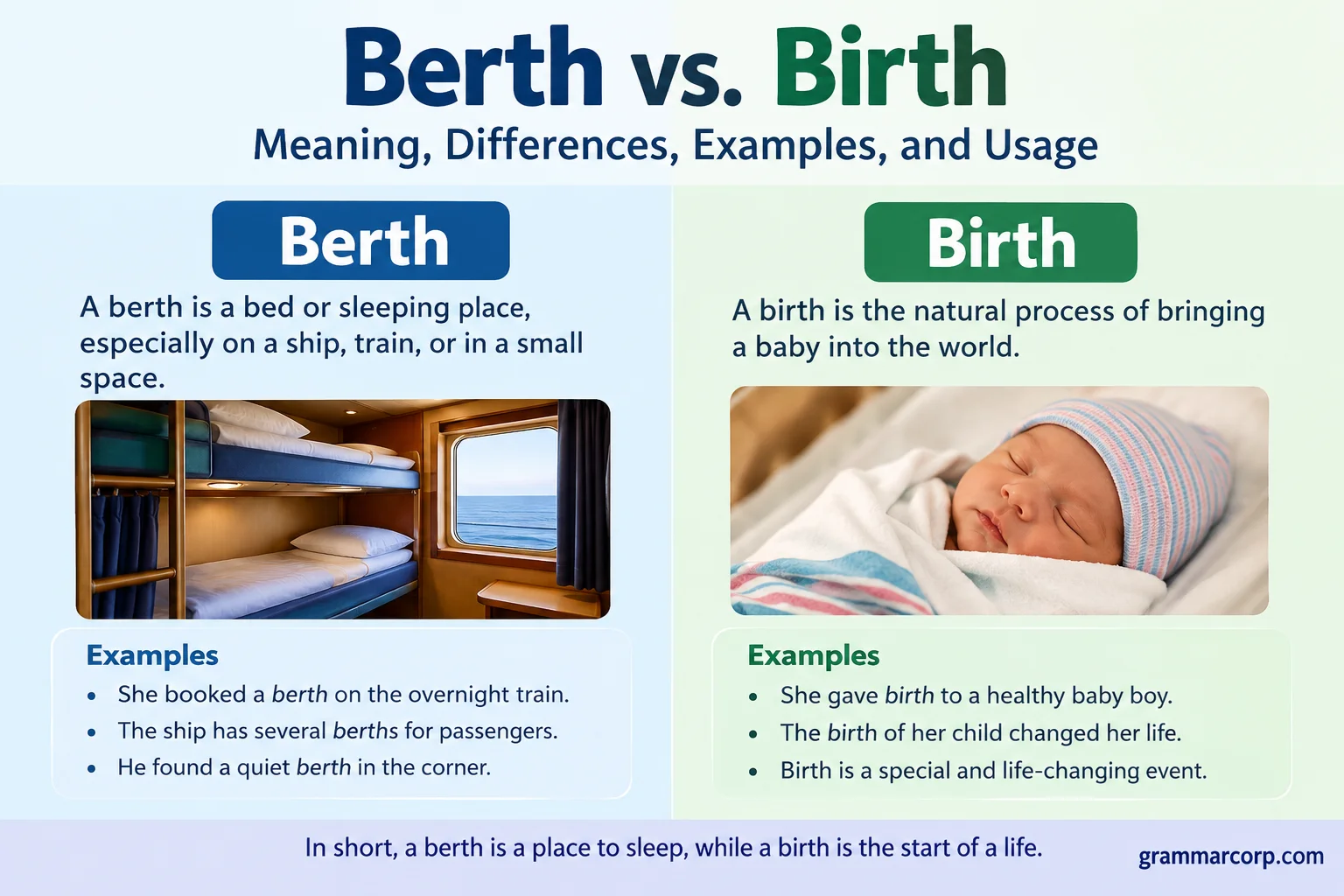
Berth vs. Birth: Meaning, Differences, Examples, and Usage explains how these similar-sounding words differ in travel, life, and writing today.
The words berth and birth are homophones in American English because they have the same pronunciation but different meanings. Berth refers to a sleeping space, an assigned position, or a designated location where a vessel is moored at a port or docks. You might reserve a berth on an overnight train, book a sleeping berth on a ship, or discuss a docking berth in maritime terminology.
The word also appears in sports terminology when a sports team earns a championship berth or sports qualification. By contrast, birth means the beginning of life, the act of being born, or the process of birth. It can describe childbirth, the arrival of a newborn, or the origin of something, such as the birth of an idea or movement.
Understanding the berth meaning and birth meaning helps you avoid spelling confusion in email writing, official forms, professional writing, and academic work. For example, “We reserved a berth on the overnight train” refers to passenger accommodation, while “The baby’s birth was recorded on an official document” refers to the beginning of life.
Quick Answer: Berth vs. Birth
Berth refers to a sleeping space, a designated place for a ship to dock, or a position secured in a competition. Birth refers to the process of being born, a person’s origin, or the beginning of something new.
Although the words have different spellings and meanings, they are pronounced identically in standard American English.
- Berth: The passengers booked a lower berth on the train.
- Birth: The family celebrated the birth of their daughter.
A simple way to remember the difference is to associate berth with beds, boats, and positions and birth with babies, beginnings, and origins.
Comparison Overview
The following table summarizes the main differences between berth and birth.
| Feature | Berth | Birth |
| Primary meaning | A sleeping space, docking place, or allocated position | The beginning of life or a person’s origin |
| Part of speech | Noun and verb | Primarily a noun; also a verb |
| Pronunciation | /bɝːθ/ | /bɝːθ/ |
| Spelling | Contains e after the initial b | Contains i after the initial b |
| Common contexts | Trains, ships, sports, competitions, and distance | Babies, personal records, family background, and beginnings |
| Common phrases | Lower berth, wide berth, playoff berth | Date of birth, place of birth, birth certificate |
| Example | The team secured a berth in the finals. | The birth of the organization marked a new chapter. |
The key difference is meaning, not sound. When you hear either word in conversation, you generally need the surrounding context to determine which spelling the speaker intends.
For example, a sentence about a train’s sleeping arrangements points to berth. A sentence about a person’s birthday or birthplace points to birth.
What Does Berth Mean?
A berth is a designated place or position. Depending on the context, it can refer to a bed on a ship or train, a location where a vessel docks, or a place earned in a competition.
The word has several distinct uses, so understanding the context is essential.
Berth as a Bed or Sleeping Space
On ships and overnight trains, a berth is a designated sleeping space. It often refers to a compact bed built into a cabin or sleeping compartment.
Unlike a regular bed in a house, a berth is designed for transportation. Its size, layout, and location depend on the vehicle and the available space.
For example, overnight trains may offer upper and lower berths. Ships may have berths inside shared cabins or private sleeping quarters.
Consider these examples:
- We reserved a lower berth for the overnight journey.
- The train attendant helped us find our sleeping berths.
- Each cabin contains two berths and a small storage area.
- She climbed into her upper berth and settled down for the night.
A berth may also be assigned to a particular passenger. In this context, reserving a berth means securing a specific sleeping space rather than simply purchasing a ticket.
For instance, a train ticket might guarantee transportation without including a sleeping berth. This distinction matters when booking long-distance travel.
Berth as a Docking Place for a Ship
In maritime settings, a berth is a designated place where a vessel can moor at a port or harbor. Ships use these spaces to load cargo, unload goods, take on passengers, or complete other port operations.
A berth is more specific than a general reference to a port. A large port may contain multiple berths, each designed to accommodate particular vessels or activities.
For example, a container ship may use a berth equipped with cranes for loading and unloading shipping containers. A passenger vessel may use a berth near a terminal where travelers can board or disembark.
Here are some examples:
- The cargo ship waited for an available berth.
- Port workers prepared the berth before the vessel arrived.
- The cruise ship occupied its assigned berth throughout the morning.
- Strong winds delayed the vessel’s approach to the berth.
The term also appears in shipping schedules, port management, and maritime logistics. In these contexts, the berth’s location and availability can affect when a ship completes its work.
Berth as a Position or Opportunity
The word berth also has a figurative meaning: a place or position secured in a group, competition, or event.
This usage is especially common in sports. A team that qualifies for a tournament or championship may earn a berth in that event.
For example, if a basketball team wins enough games to qualify for a postseason tournament, sports reporters might say the team has secured a playoff berth.
The word doesn’t refer to a physical bed in this situation. Instead, it describes a place the team has earned.
Common examples include:
- The team secured a berth in the championship.
- Three more victories could earn the club a playoff berth.
- The athlete earned a berth on the national team.
- Their strong performance secured them a berth in the final round.
This meaning also appears outside sports. A person may earn a berth in a prestigious program or secure a place in a competitive event.
The central idea remains the same: someone has obtained a designated position or place.
Berth as a Verb
Although people commonly use berth as a noun, it can also function as a verb.
In maritime contexts, to berth a ship means to bring it into its designated docking position. The verb can also describe providing someone with a sleeping space.
Examples include:
- The crew berthed the vessel shortly after sunrise.
- The ship will berth at the eastern terminal tomorrow.
- The passengers were berthed in separate cabins.
The verb takes different forms depending on the sentence:
| Verb form | Example |
| Base form: berth | The vessel will berth at the port. |
| Third-person singular: berths | The ship berths here every Tuesday. |
| Past tense: berthed | The vessel berthed safely last night. |
| Present participle: berthing | The crew is berthing the ship. |
In sports writing, the phrase earn a berth or secure a berth is much more common than using berth as a verb.
What Does Birth Mean?
Birth refers to the process of being born, the beginning of a person’s life, or the origin of something. People also use it when discussing family background, official records, and the creation of new ideas or movements.
Unlike berth, which often relates to transportation or a designated position, birth centers on beginnings and origins.
Birth as the Beginning of Life
The most familiar meaning of birth is the process through which a baby enters the world. It can refer to the event itself or, more broadly, the beginning of someone’s life.
For example, a family might announce a child’s birth, while a hospital might record the time and date when the child was born.
Consider these sentences:
- The birth of their daughter brought great joy to the family.
- The hospital recorded the baby’s date of birth.
- Her parents celebrated the birth of their first child.
- The birth took place early on Monday morning.
- News of the baby’s birth spread quickly among their relatives.
Notice that birth is a noun in each example. The related verb born appears in a different grammatical construction, as in “She was born on Monday.”
This distinction is useful because birth and born aren’t interchangeable.
- Correct: The birth of their son was a memorable event.
- Correct: Their son was born in July.
- Incorrect: Their son was birth in July.
The noun names the event, while born appears in the construction used to describe when or where someone entered the world.
Birth as Origin or Background
The word birth can also refer to someone’s origin, family background, or circumstances of birth. This meaning often appears in formal documents, biographies, and discussions of identity.
Common expressions include date of birth, place of birth, and by birth.
For example, a job application might ask for your date of birth. A passport application might request your place of birth. A biography might describe someone as a member of a particular family by birth.
Here are several examples:
- Please enter your date of birth on the application.
- Her place of birth is listed as Boston.
- He is a British citizen by birth.
- The historical record provides details about the writer’s birth.
- She was born into a family of musicians.
These expressions have specific meanings. Your date of birth identifies when you were born, while your place of birth identifies where you were born.
Neither term automatically establishes your current residence. Someone born in one country may later live in another.
Likewise, by birth often describes an inherited or original status, but its precise meaning depends on the context.
Birth in Figurative Expressions
Not every use of birth involves a baby. The word also describes the beginning of an idea, organization, movement, tradition, or other development.
In these cases, birth acts as a metaphor for creation. Just as a person’s life begins at birth, a new project or movement begins when it comes into existence.
For example:
- The birth of the internet transformed communication.
- The meeting marked the birth of a new partnership.
- Her research contributed to the birth of a new scientific theory.
- The invention gave birth to an entirely new industry.
- The movement’s birth can be traced to a small group of activists.
The expression give birth to can therefore have both literal and figurative meanings.
In a literal sentence, it describes childbirth. In a figurative sentence, it means to create, produce, or cause something to develop.
Compare these examples:
- Literal: She gave birth to a healthy baby.
- Figurative: The discovery gave birth to a new research project.
The surrounding words make the intended meaning clear.
Birth as a Verb: Is It Correct?
Yes. Although birth appears most often as a noun, it can also function as a verb.
As a verb, birth means to give birth to something or bring something into existence. Its use is less common in everyday conversation than the noun or the phrase give birth to.
For example:
- The organization birthed several successful community projects.
- The collaboration birthed a new approach to education.
- The movement was birthed during a period of social change.
The verb appears more frequently in figurative or specialized writing. In ordinary conversation, people often prefer alternatives such as created, started, or gave rise to.
For instance, “The partnership created a new opportunity” may sound more natural than “The partnership birthed a new opportunity” in many contexts.
The best choice depends on your intended meaning and tone.
Main Differences Between Berth and Birth
Although berth and birth share the same pronunciation in standard American English, their spelling, meaning, and typical usage differ.
Difference in Meaning
The clearest distinction is what each word describes.
Berth usually refers to a place or position. Depending on the context, it may mean a sleeping space, a ship’s docking location, or a position in a competition.
Birth refers to the beginning of life, a person’s origin, or the creation of something new.
Compare the following examples:
| Sentence | Correct word | Reason |
| We reserved a sleeping space on the train. | Berth | It refers to a place to sleep. |
| The family welcomed a newborn baby. | Birth | It refers to the beginning of life. |
| The ship waited for a docking space. | Berth | It refers to a designated place in a port. |
| The team qualified for the playoffs. | Berth | It refers to a position in a competition. |
| The form asks when you were born. | Birth | It refers to the beginning of a person’s life. |
| The invention marked the beginning of a new era. | Birth | It refers to the start of something new. |
A useful rule is to ask what the sentence describes. If it concerns a place or position, berth may be correct. If it concerns life, origin, or creation, birth is generally the better choice.
Difference in Spelling
The spelling difference is small but important.
- Berth: B-E-R-T-H
- Birth: B-I-R-T-H
Only one letter changes: berth contains e, while birth contains i.
Because the words sound alike, you can’t rely on pronunciation to choose the spelling. You need to understand the meaning of the sentence.
Try this memory trick:
- Berth has an e, like the beginning of bed when you associate it with a sleeping berth.
- Birth has an i, as in infant, which can remind you of a baby’s birth.
This isn’t a formal spelling rule. It’s simply a convenient way to remember which word belongs in a particular context.
Difference in Pronunciation
In standard American English, berth and birth are homophones. Both are pronounced /bɝːθ/.
The pronunciation begins with the /b/ sound, continues through the American English vowel /ɝː/, and ends with the unvoiced /θ/ sound found in think and month.
The spelling changes, but the pronunciation remains the same.
This is why the two words can cause confusion in conversations, dictation, and speech-to-text software. A listener who hears “The team earned a berth” must use the context to identify the correct spelling.
Homophones are words that sound alike but have different meanings and often different spellings. Other examples include brake and break, right and write, and sea and see.
Difference in Grammar and Usage
Both words function as nouns, but each has different grammatical patterns.
You might reserve a berth, occupy a berth, or secure a berth. With birth, common expressions include record a birth, announce a birth, and date of birth.
Their verb forms also differ.
| Word | Noun usage | Verb usage |
| Berth | The passenger booked a berth. | The ship will berth at the terminal. |
| Birth | The birth was recorded. | The event birthed a new organization. |
Although both words can function as verbs, their use as nouns is generally more familiar to everyday readers.
Remember that birth is not the past tense of bear. The verb bear has the past tense bore and the past participle borne in many contexts. In the construction relating to childbirth, born is used instead.
For example, “She was born in April” is correct, while “She was birth in April” is not.
Berth vs. Birth: Examples in Sentences
Seeing each word in context makes the distinction easier to remember. The following examples cover common situations involving travel, sports, family life, and formal writing.
Examples of Berth in Sentences
- We booked a lower berth because it was easier to access.
- The passengers stored their luggage beside their berths.
- The ship waited offshore until the port assigned it a berth.
- The team secured a berth in the national championship.
- The vessel berthed at the harbor shortly before noon.
- He earned a berth on the university’s basketball team.
- The captain requested a wider berth while maneuvering through the crowded harbor.
- The train’s sleeping compartment contained two upper berths and two lower berths.
Each sentence refers to a sleeping space, a docking location, or a designated position.
Examples of Birth in Sentences
- The birth of their first child changed their daily lives.
- The form requires your full name and date of birth.
- Her place of birth appears on her official record.
- The birth of the new organization attracted public attention.
- He has lived abroad since birth.
- The discovery marked the birth of a new scientific field.
- The hospital recorded the baby’s birth shortly after midnight.
- Their partnership gave birth to an innovative community project.
In these examples, birth refers to life, origin, or the beginning of something.
Berth vs. Birth in Side-by-Side Examples
These paired sentences show how the meaning changes when you choose one word instead of the other.
Travel
- The passenger reserved a berth on the train.
- The passenger recorded the birth on the form.
The first sentence describes a sleeping space. The second refers to a birth event, although it would need more context to explain whose birth was recorded.
Sports
- The team earned a berth in the playoffs.
- The team celebrated the birth of its new training program.
The first describes qualification for a competition. The second describes the creation of a program.
Maritime travel
- The ship moved into its assigned berth.
- The crew celebrated the birth of the captain’s child.
The first concerns docking. The second concerns a family event.
Official records
- Please confirm your date of birth.
- Please confirm your reserved berth before boarding.
The first requests personal information. The second asks about a sleeping arrangement.
These comparisons demonstrate why choosing the right word matters even when both spellings sound identical.
Common Expressions and Phrases With Berth and Birth
Certain expressions make the meaning of each word easier to identify. Learning them can also help you recognize the words more quickly while reading.
Common Expressions With Berth
| Expression | Meaning | Example |
| Lower berth | A lower sleeping space on a train or ship | She chose the lower berth. |
| Upper berth | A higher sleeping space | He climbed into the upper berth. |
| Sleeping berth | A designated place to sleep | The ticket included a sleeping berth. |
| Wide berth | A generous amount of distance | Give the damaged building a wide berth. |
| Secure a berth | Obtain a place or position | The team secured a berth in the finals. |
| Playoff berth | A place in a sports playoff | The club earned a playoff berth. |
| Berthing area | A designated area for docking vessels | The harbor expanded its berthing area. |
One expression deserves special attention: give someone or something a wide berth.
This idiom means to keep a safe or comfortable distance from a person, object, or situation. It may refer to physical distance or an intentional effort to avoid involvement.
For example, “After the disagreement, she gave the subject a wide berth” means she avoided discussing it.
The phrase doesn’t refer to a wide bed. Instead, it uses berth in the sense of space or distance.
Common Expressions With Birth
| Expression | Meaning | Example |
| Date of birth | The date someone was born | Enter your date of birth. |
| Place of birth | The location where someone was born | Her place of birth was listed as Dallas. |
| Birth certificate | An official record of a birth | He requested a copy of his birth certificate. |
| Birth rate | A measure of births in a population | The report examined the country’s birth rate. |
| Birth weight | A baby’s weight at birth | The doctor recorded the baby’s birth weight. |
| By birth | By origin or circumstances of birth | She is a citizen by birth. |
| Give birth to | Deliver a baby; figuratively, create something | The discovery gave birth to a new theory. |
| Since birth | From the time someone was born | They have known each other since birth. |
| The birth of an idea | The beginning of an idea | The conversation led to the birth of an idea. |
These phrases are useful in everyday communication and formal writing. For instance, date of birth commonly appears on registration forms, while birth rate appears in demographic reports.
Understanding these combinations can help you avoid spelling errors because the surrounding words often provide a strong clue.
Common Mistakes to Avoid When Using Berth and Birth
Even experienced writers sometimes confuse homophones. The good news is that a quick meaning check can prevent most errors.
Using Birth When You Mean a Sleeping Space
Incorrect: We reserved a birth on the overnight train.
Correct: We reserved a berth on the overnight train.
The sentence describes a sleeping space, so berth is the correct choice. The word birth would refer to the beginning of life and would make the sentence incorrect.
Using Berth When You Mean the Arrival of a Baby
Incorrect: The berth of their daughter was celebrated by the family.
Correct: The birth of their daughter was celebrated by the family.
The family is celebrating the arrival of a child. Therefore, birth expresses the intended meaning.
Confusing Berth With Birth in Sports
Incorrect: The team earned a birth in the playoffs.
Correct: The team earned a berth in the playoffs.
Sports writers use berth to describe a place secured in a competition. Although the phrase may sound like it refers to the beginning of something, it actually describes qualification.
Confusing Berth With Birth in Official Documents
Incorrect: Please enter your berth date on the application.
Correct: Please enter your birth date on the application.
The standard expression is birth date or date of birth. It identifies when someone was born.
A berth date is not the usual expression for personal birth information.
Using Born and Birth Interchangeably
Incorrect: He was birth in 2008.
Correct: He was born in 2008.
The noun birth cannot replace born in this sentence. English uses the construction was born to describe a person’s birth.
However, you can use birth as a noun:
- His birth took place in 2008.
- He was born in 2008.
Both sentences communicate the same basic information, but their grammatical structures differ.
Read More : Realise or Realize: What’s the Difference and Which Spelling?
How to Remember the Difference Between Berth and Birth
You don’t need to memorize long definitions to distinguish these words. A few simple associations and a quick context check will usually do the job.
Use Meaning-Based Memory Tricks
Remember these three associations:
- Berth = Bed: A berth on a train or ship provides a place to sleep.
- Berth = Boat: A berth can also be the place where a vessel docks.
- Birth = Beginning: A birth marks the beginning of a person’s life or, figuratively, something new.
You can also connect birth with baby and berth with bunk. These associations aren’t spelling rules, but they can make the correct choice easier to recall.
Check the Context Before Choosing a Word
When you’re unsure which spelling to use, replace the word mentally with its meaning.
Ask yourself:
- Does the sentence refer to a bed or sleeping space? Use berth.
- Does it describe a ship’s docking location? Use berth.
- Does it refer to a place earned in a tournament? Use berth.
- Does it describe a baby entering the world? Use birth.
- Does it refer to a person’s origin or the beginning of something? Use birth.
For example, consider the sentence “The team earned a ___ in the finals.”
Replacing the blank with sleeping space makes no sense. Replacing it with position fits the context. Therefore, berth is the correct choice.
This method works particularly well for homophones because pronunciation alone can’t tell you which spelling to select.
Berth vs. Birth: Practice Questions
Test your understanding by choosing the correct word for each sentence. Use the meaning of the sentence as your main clue.
Fill-in-the-Blank Exercise
Choose berth or birth for each blank.
- The passengers booked an upper _____ for their overnight journey.
- The family celebrated the _____ of their first child.
- The team secured a _____ in the championship.
- Please provide your date of _____ on the application.
- The ship waited for an available _____ at the harbor.
- The invention marked the _____ of a new industry.
- The sailor climbed into his sleeping _____.
- The organization gave _____ to a new community initiative.
Answer Key With Explanations
| No. | Correct answer | Explanation |
| 1 | Berth | It refers to a sleeping space on a train or ship. |
| 2 | Birth | It describes the beginning of a child’s life. |
| 3 | Berth | It means a place secured in a competition. |
| 4 | Birth | Date of birth is the standard expression. |
| 5 | Berth | It refers to a ship’s designated docking place. |
| 6 | Birth | It describes the beginning of an industry. |
| 7 | Berth | It means a designated sleeping space. |
| 8 | Birth | Give birth to can figuratively mean to create something. |
If you answered all eight correctly, you understand the central distinction. If you missed any, revisit the relevant definition and focus on the meaning rather than the pronunciation.
FAQs:
1. What is the main difference between berth and birth?
Berth refers to a sleeping space on a ship or train, a designated position, or a place where a vessel docks. Birth refers to the beginning of life or the act of being born.
2. Are berth and birth pronounced the same way?
Yes. In American English, berth and birth are homophones because they sound the same but have different meanings and spellings.
3. How do you use berth in a sentence?
You can use berth when discussing travel, accommodation, docking, or an assigned position. For example, “We reserved a berth on the overnight train before our journey.”
4. How do you use birth in a sentence?
Use birth when referring to the beginning of life or the origin of something. For example, “The hospital recorded the baby’s birth on the official documents.”
5. Can berth and birth be used interchangeably?
No. Although these words sound alike, their meanings are different. Using berth instead of birth, or vice versa, can change the meaning of your sentence and create a spelling mistake.
Conclusion:
Understanding berth vs. birth becomes easier when you focus on the meaning of each word. Remember that berth relates to sleeping spaces, vessel docking, and assigned positions, while birth refers to the beginning of life or the origin of something.
Although their pronunciation is identical in American English, their spelling and usage are different. By checking the context before choosing a word, you can avoid common mistakes and improve your English grammar, spelling accuracy, and everyday writing.













1 thought on “Berth vs. Birth: Meaning, Differences, Examples, and Usage”