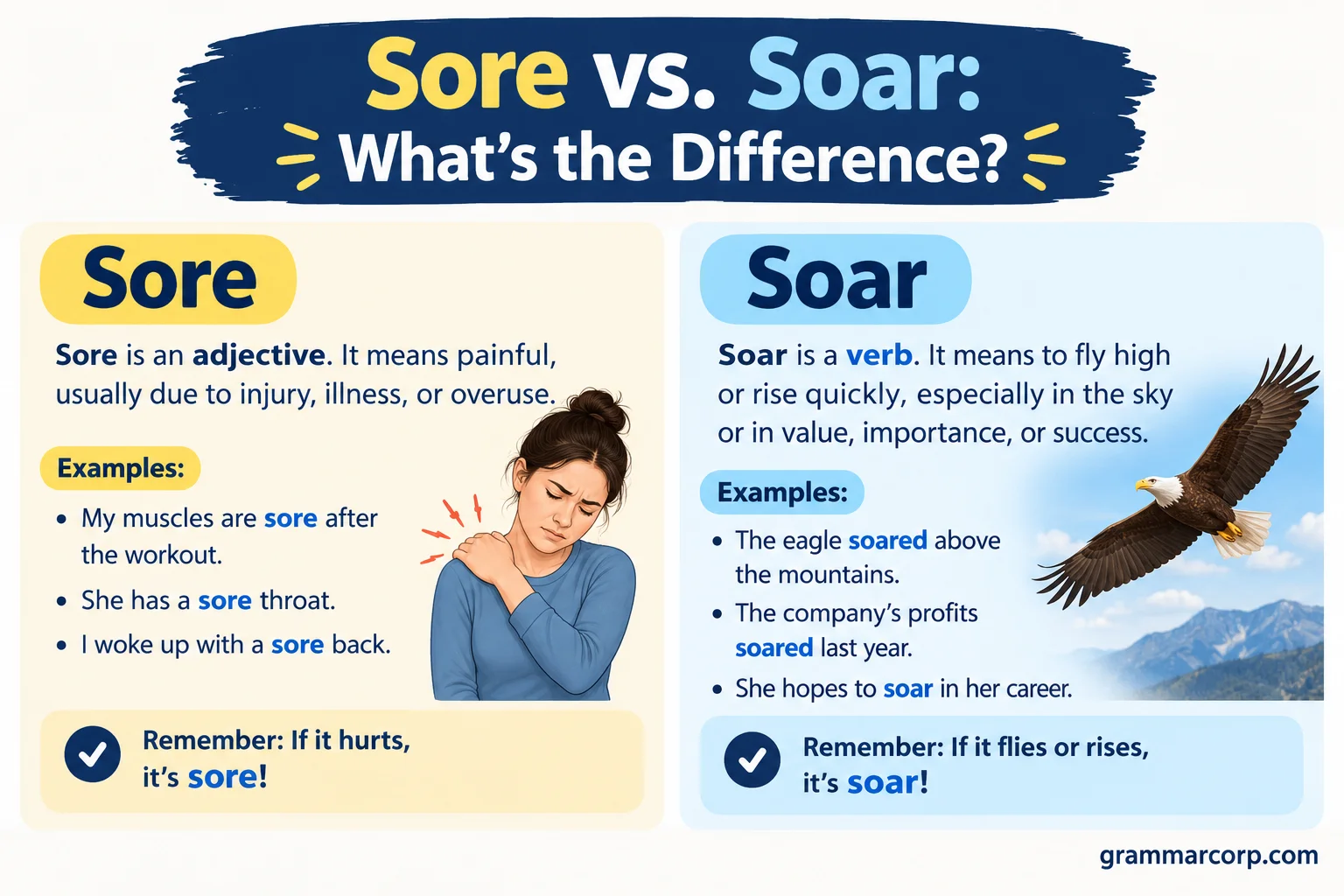
The phrase Sore vs. Soar: What’s the Difference?] helps explain a common English spelling problem where homophones have the same pronunciation but different meanings. Sore usually describes physical pain, tenderness, emotional distress, or discomfort, while soar describes rising rapidly or flying high. Because the words sound alike, pronunciation can’t tell you which word to choose, so context, grammar, spelling, and meaning matter.
In writing and daily communication, this common confusion can cause common mistakes, especially for learners trying to understand the sore vs. soar meaning.Even walking for an hour, dealing with a car broke situation, or putting pressure on a hand area or feet can produce physical discomfort. These examples give the word a practical source of meaning and make its origins, uses, and meanings easier to remember.
In the vast English world, even native speakers can encounter this amusing mix-up, particularly when two words are exactly alike in sound but separate in function. Their unique journey can seem like twins separated at birth: one points toward a body that may feel pain, while the other suggests an eagle moving upward or figures showing a rapid increase. That contrast creates an amusing picture and can prevent embarrassing situations once you start remembering this difference. The level of a price, sales figure, or measurement may keep rising, while a person’s muscles, feet, or another body area may remain sore after a demanding activity.
Quick Answer:
Sore means painful, tender, irritated, or emotionally upset. It can also be a noun for a painful area on the body.
Soar means to fly or rise high. It can also describe something increasing quickly or dramatically, such as prices, temperatures, sales, or hopes.
| Word | Basic meaning | Example |
| Sore | Painful, tender, irritated, or angry | My feet are sore after the long walk. |
| Soar | Fly high or rise quickly | Prices continue to soar. |
The easiest rule is:
Sore = pain or irritation. Soar = rise or fly.
Both words are pronounced the same in standard English. Cambridge gives both sore and soar the US pronunciation /sɔːr/.
Comparison Overview
The two words may look similar and sound identical, but they perform different jobs in a sentence.
Sore is commonly an adjective. It describes something that hurts, feels tender, or causes emotional discomfort. It can also be used as a noun for a painful area of the body.
Soar is primarily a verb. It describes upward movement, high flight, or a dramatic increase.
| Feature | Sore | Soar |
| Pronunciation | /sɔːr/ | /sɔːr/ |
| Main grammatical role | Adjective | Verb |
| Main idea | Pain, tenderness, irritation | Flying or rising |
| Physical use | A sore throat | A bird can soar |
| Emotional use | A sore subject | Spirits can soar |
| Increase | Not normally used | Prices can soar |
| Past form | Usually no verb form | Soared |
| -ing form | Not normally applicable | Soaring |
| Example | My shoulder is sore. | The plane began to soar. |
The spelling is therefore important. You can’t rely on sound alone.
Are Sore and Soar Homophones?
Yes. Sore and soar are homophones because they have the same pronunciation while having different spellings and meanings. Merriam-Webster specifically lists soar among the homophones of sore.
This explains why writers sometimes choose the wrong spelling.
For example:
- My throat is sore.
- The eagle began to soar.
- Food prices continue to soar.
- My legs are sore.
When spoken aloud, the difference disappears. When written down, the context determines the correct word.
Main Differences Between Sore vs. Soar
The most important difference between sore vs. soar is the idea behind each word.
Soreness connects to pain, tenderness, irritation, or emotional upset.
Soar connects to height, flight, upward movement, or rapid growth.
Sore Describes Pain or Tenderness
Use sore when a body part hurts or feels uncomfortable.
Common examples include:
- sore muscles
- sore feet
- sore throat
- sore back
- sore shoulder
- sore eyes
- sore legs
For example:
My legs are sore after walking all afternoon.
Here, the legs feel painful or uncomfortable. Therefore, sore is correct.
Sore Can Describe Emotional Upset
The word doesn’t only describe physical discomfort.
It can also describe someone who feels angry, irritated, or upset, especially after an unpleasant experience. Merriam-Webster includes this emotional sense in its definition of sore.
For example:
He was sore about losing the competition.
In this sentence, sore doesn’t mean that he has physical pain. It means he feels annoyed or upset.
Another common expression is sore loser. A sore loser is someone who reacts badly after losing.
Soar Describes Flying High
Use soar when something rises or flies high through the air.
For example:
The eagle soared above the valley.
The eagle is moving through the air at a great height.
The same idea applies to birds, aircraft, gliders, rockets, and other objects moving upward. Dictionaries describe soar as flying or rising high in the air.
Soar Also Means Rise Quickly
You don’t need actual wings to soar.
The word is frequently used figuratively for things that increase quickly or dramatically.
For example:
- Prices soared.
- Temperatures soared.
- Sales soared.
- Costs soared.
- Demand soared.
- Confidence soared.
Oxford specifically gives soar for values, amounts, or levels that rise very quickly.
This figurative meaning is one of the biggest reasons people need to understand sore vs. soar.
What Does Sore Mean?
Sore primarily describes something that is painful, tender, or uncomfortable.
Cambridge defines the adjective in terms of pain or discomfort, particularly when a body part is affected by injury, infection, or overuse.
Consider this sentence:
My arms are sore after exercising.
The adjective sore tells us how the arms feel.
Sore as an Adjective
Here are some natural examples:
- I woke up with a sore throat.
- My feet are sore from walking.
- Her shoulders were sore after carrying the bags.
- His back felt sore after the long trip.
- My eyes are sore from staring at the screen.
The word often appears after forms of be or feel.
Common patterns include:
Subject + be + sore
My legs are sore.
Subject + feel + sore
My shoulders feel sore.
It can also appear before a noun:
She has a sore throat.
Sore Can Describe a Sensitive Subject
English also uses sore for something emotionally difficult or sensitive.
For example:
That topic is still a sore subject for him.
Here, sore doesn’t describe physical pain. Instead, it describes something that causes emotional discomfort or distress.
This meaning appears in expressions such as:
- sore subject
- sore point
- sore spot
- sore loser
Sore as a Noun
Sore can also function as a noun.
As a noun, it refers to a painful area on the body.
For example:
The doctor examined the sore on his skin.
This use is grammatically different from:
My skin is sore.
In the first sentence, sore is a noun. In the second, sore is an adjective.
Useful Sore Examples
| Sentence | Meaning of sore |
| My feet are sore. | Painful or tender |
| She has a sore throat. | Painful or irritated throat |
| He is sore about the decision. | Angry or upset |
| That’s a sore point. | Sensitive or upsetting subject |
| The doctor treated the sore. | Painful area on the body |
What Does Soar Mean?
Soar is a verb associated with height, flight, upward movement, and rapid increases.
Merriam-Webster defines it as flying aloft or hovering in the air. It also uses the word for dramatic increases in position, value, or price.
Soar Means to Fly High
This is the most literal use.
For example:
The eagle soared over the mountains.
The eagle isn’t simply moving forward. It is rising or gliding at a considerable height.
Other examples include:
- The bird soared across the sky.
- The glider soared above the fields.
- The aircraft soared into the clouds.
- The rocket soared upward.
- The ball soared over the fence.
The word often creates an image of smooth, impressive upward movement.
Soar Means to Increase Rapidly
This figurative meaning is equally important.
You can say:
House prices soared last year.
You aren’t saying that houses physically flew into the sky. You’re saying their prices increased sharply.
Other natural examples include:
- Food costs soared.
- Demand soared after the announcement.
- Temperatures soared during the afternoon.
- Ticket prices soared before the event.
- Online sales soared during the promotion.
Cambridge similarly uses soar for things that rise quickly to a high level.
Soar Can Describe Emotions
Soar can also describe a strong rise in someone’s feelings or emotional state.
For example:
Her spirits soared when she heard the good news.
The phrase spirits soar means someone’s mood becomes much more positive or excited.
You can also write:
His confidence soared after the successful performance.
The confidence isn’t physically moving upward. The word creates the idea of a strong emotional rise.
Sore vs. Soar Pronunciation
Pronunciation is where this pair becomes tricky.
Sore and soar are pronounced the same in standard English. Cambridge lists both with the US pronunciation /sɔːr/.
| Word | US pronunciation | Same sound? |
| sore | /sɔːr/ | Yes |
| soar | /sɔːr/ | Yes |
This means you can’t hear the spelling difference.
Imagine someone says:
The prices will soar.
You hear the sound but not the letters. If you’re writing the sentence, you need to understand what the word means.
The same problem appears with:
My muscles are sore.
Both words sound alike. Only their meanings tell you which spelling belongs on the page.
Why Context Matters
When homophones sound identical, context becomes your spelling guide.
Ask yourself what the sentence means.
If the sentence is about:
- pain
- tenderness
- irritation
- emotional upset
choose sore.
If the sentence is about:
- flying
- height
- rising
- rapid growth
- increasing prices or values
choose soar.
That’s more reliable than trying to hear a difference that isn’t there.
Read More : Autumn vs. Fall: What’s the Difference and Which Should You Use?
How to Use Sore Correctly
The easiest way to use sore correctly is to connect it with discomfort or emotional irritation.
Sore With Body Parts
This is one of its most common uses.
Examples:
- My neck is sore.
- Her feet were sore.
- I have a sore throat.
- His shoulders feel sore.
- Their muscles became sore after the activity.
The meaning is usually physical discomfort or tenderness.
Sore With Feelings
The emotional use works differently.
Examples:
- She felt sore after the argument.
- He was sore about losing.
- Don’t be a sore loser.
- That’s still a sore point.
- It remains a sore subject.
In these sentences, sore describes emotional discomfort or irritation.
Sore in Common Expressions
Some expressions are especially useful to recognize.
| Expression | Meaning |
| Sore throat | Painful or irritated throat |
| Sore muscles | Muscles that hurt or feel tender |
| Sore feet | Feet that hurt or feel uncomfortable |
| Sore point | A sensitive or upsetting subject |
| Sore subject | A subject that causes emotional discomfort |
| Sore loser | Someone who reacts badly to losing |
Learning these common combinations can make the spelling much easier to remember.
How to Use Soar Correctly
Use soar when something moves upward or rises dramatically.
Soar in the Present Tense
Examples include:
- Birds soar above the valley.
- Prices soar during periods of high demand.
- Temperatures soar in extreme heat.
- Sales soar after successful promotions.
For third-person singular subjects, use soars:
- The eagle soars above the trees.
- Demand soars during the holiday season.
- Her confidence soars after each success.
Soar in the Past Tense
The past form is soared.
Examples:
- The eagle soared across the sky.
- Prices soared during the shortage.
- Temperatures soared yesterday.
- His confidence soared after the announcement.
Oxford lists soared as both the past simple and past participle form of soar.
Soaring as the -ing Form
The -ing form is soaring.
Examples:
- Soaring prices are affecting consumers.
- We watched the birds soaring above the lake.
- The company is experiencing soaring demand.
- Soaring temperatures can make outdoor conditions uncomfortable.
This form frequently appears before nouns in phrases such as soaring costs and soaring prices.
Common Sore vs. Soar Mistakes
Because both words are real English words, spelling software may not always catch a mistake.
That’s what makes this pair particularly tricky.
Sore Throat vs. Soar Throat
Correct:
I have a sore throat.
Incorrect:
I have a soar throat.
A throat can be painful or irritated. It doesn’t fly upward.
Sore Muscles vs. Soar Muscles
Correct:
My muscles are sore after the workout.
Incorrect:
My muscles are soar after the workout.
The adjective sore describes the discomfort.
Prices Soar vs. Prices Sore
Correct:
Prices continue to soar.
Incorrect:
Prices continue to sore.
Prices can rise sharply, so soar is the correct verb.
Eagles Soar vs. Eagles Sore
Correct:
Eagles soar through the sky.
Incorrect:
Eagles sore through the sky.
The intended meaning involves flight, so the correct word is soar.
A Sore Point vs. A Soar Point
Correct:
That remains a sore point for her.
Here, the phrase refers to a sensitive or upsetting issue.
Soar point doesn’t carry that meaning.
Sore vs. Soar Examples in Everyday Sentences
Seeing the words in different contexts is one of the fastest ways to understand the distinction.
Physical Pain
- My feet are sore after the long walk.
- She woke up with a sore shoulder.
- His legs were sore the next morning.
- I have a sore throat.
- My eyes feel sore after staring at the screen.
Emotional Feelings
- He was sore about losing the game.
- She remained sore about the criticism.
- That subject is a sore point.
- Nobody likes dealing with a sore loser.
- The issue became a sore subject.
Flying and Height
- The eagle began to soar above the valley.
- The birds soared over the cliffs.
- The glider soared through the air.
- The aircraft soared above the clouds.
- The ball soared over the fence.
Rapid Increase
- Food prices began to soar.
- Temperatures soared during the afternoon.
- Demand soared after the announcement.
- Sales soared during the promotion.
- Housing costs have soared in recent years.
Feelings and Abstract Ideas
- Her confidence soared after the success.
- His spirits soared when he heard the news.
- Their hopes soared after the positive announcement.
- Excitement soared as the event approached.
A Simple Case Study: Choosing Sore or Soar
Consider this short paragraph:
After a long hike, Maya’s feet were sore. On the way home, she watched an eagle soar above the hills. Later, she noticed that travel costs had soared.
Three uses appear in just a few sentences.
Feet were sore because they were uncomfortable and painful.
An eagle soared because it was flying high.
Costs had soared because they had increased significantly.
The pronunciation stays almost identical in all three cases. The meaning and grammatical role change.
This is exactly why learning the words through context works better than memorizing their sounds.
Easy Tricks to Remember Sore vs. Soar
A good memory trick should connect the spelling with the meaning.
Remember Sore With Pain
Think:
Sore → something hurts.
If you could replace the word with painful, tender, or hurting, you probably need sore.
For example:
My back is sore.
You could say:
My back is painful.
Therefore, sore fits.
Remember Soar With the Sky
Think:
Soar → sky.
Both ideas point upward.
If the sentence involves flying high or moving upward, soar is usually the right choice.
For example:
The bird began to soar.
The bird is moving through the air at a high level.
Use the Replacement Test
When you’re unsure, replace the word mentally.
If painful fits:
My feet are ___.
→ My feet are painful.
So the answer is sore.
If rise quickly fits:
Prices will ___.
→ Prices will rise quickly.
So the answer is soar.
This test works especially well in everyday writing.
Sore vs. Soar: Quick Practice
Try choosing the correct word in each sentence.
- My legs are ___ after the hike.
- The eagle began to ___ above the trees.
- Food prices continue to ___.
- She has a ___ throat.
- His confidence began to ___.
- That topic is a ___ point.
- The bird ___ into the open sky.
- My shoulders feel ___ today.
Answers
- My legs are sore after the hike.
- The eagle began to soar above the trees.
- Food prices continue to soar.
- She has a sore throat.
- His confidence began to soar.
- That topic is a sore point.
- The bird soared into the open sky.
- My shoulders feel sore today.
Notice the pattern. Physical or emotional discomfort points to sore. Upward movement or rapid growth points to soar.
Sore vs. Soar: Which Word Should You Use?
Use this simple decision process whenever you’re unsure.
Ask What the Word Describes
If it describes a body part or someone’s emotional reaction, sore may be correct.
If it describes movement upward or a rapid increase, soar is likely correct.
Check the Grammar
Sore commonly works as an adjective:
My feet are sore.
Soar works as a verb:
Prices soar.
This grammatical difference gives you another useful clue.
Check the Meaning
| If the sentence means… | Use |
| Painful | sore |
| Tender | sore |
| Emotionally upset | sore |
| A painful area | sore |
| Fly high | soar |
| Rise high | soar |
| Increase quickly | soar |
| Become much greater | soar |
The distinction becomes straightforward once you focus on meaning instead of sound.
FAQs:
Is sore or soar correct for describing pain?
Sore is correct when you mean physical pain, tenderness, or discomfort. For example, you can say that your legs are sore after a long run.
Is soar used only for birds?
No. Soar can describe an eagle or other birds flying high, but it can also mean something rising rapidly. For example, prices, sales, or temperatures can soar.
Are sore and soar homophones?
Yes. Sore and soar are homophones because they have the same pronunciation but different spelling and meanings.
How can I remember the difference between sore and soar?
Use a simple memory tricks approach: connect sore with pain and soar with flying high. This makes the difference easier to recall in writing.
Can soar describe prices or sales?
Yes. Soar can describe a rapid increase in prices, sales, value, or another level. For example, you might say that sales soared after a product became popular.
Conclusion:
Understanding sore vs. soar becomes much easier when you focus on context, rather than pronunciation alone. Sore relates to pain, discomfort, or difficult feelings, while soar refers to flying high or something rising rapidly.
Although these words sound alike, their spelling, meaning, and usage are clearly different.














1 thought on “Sore vs. Soar: What’s the Difference?”