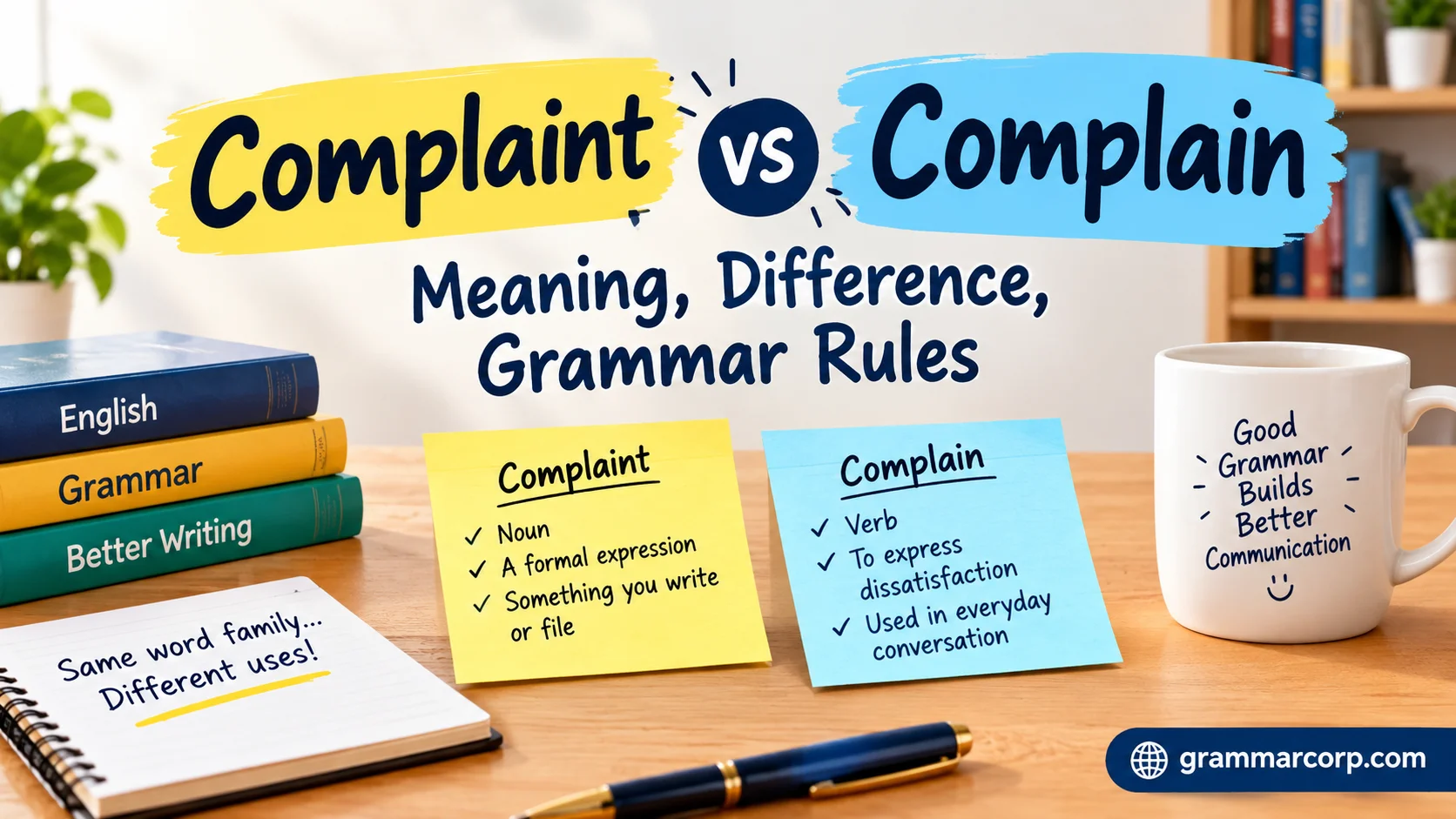
Complaint vs Complain: Meaning, Difference, Grammar Rules become easier when you know the basic distinction: complaint is a noun, while complain is a verb used to express a concern or dissatisfaction. When there is a problem, the complaint is the statement or concern itself, while to complain means to describe the problem. For example, you may complain about poor service or make a complaint when the service isn’t right.
The words look similar, are related, and can sound alike, which can confuse writers when they need to choose the correct word in a sentence. The key difference becomes easier to remember when you think of a noun as a thing and a verb as an action. This simple guide explains the meaning, grammar, and usage through real sentences, examples, and practical ways to avoid common mistakes.
The same distinction matters in everyday English usage, formal writing, casual messages, and real-world contexts. When drafting emails, managing meetings, or working in project management, writers may need scheduling, time management, and calendar coordination skills to plan, organize, and communicate carefully. The wrong form can reduce clarity and interrupt communication flow in formal workplace exchanges, workplace emails, customer responses, academic writing, academic reports, medical reports, legal documents, and school notices. Complaints are expressions of discontent, pain, grief, or unease, while complains is a verb form connected with expressing discomfort or dissatisfaction.
Quick Answer:
Complaint is a noun. It refers to a statement, concern, grievance, or expression of dissatisfaction.
Complaint is a verb. It describes the action of expressing dissatisfaction or reporting that something is wrong.
Compare these sentences:
- I want to complain about the service.
- I have a complaint about the service.
- She complained to the manager.
- She made a complaint to the manager.
A useful rule is:
You complain. You make a complaint.
If you need a word that names the issue or concern, choose complaint. If you need a word that describes the action, choose complain.
Comparison Overview
The following table gives you the quickest way to understand complaint vs complain:
| Feature | Complaint | Complain |
| Part of speech | Noun | Verb |
| Basic meaning | A statement or expression of dissatisfaction | To express dissatisfaction |
| Plural form | Complaints | Not normally plural |
| Past form | — | Complained |
| -ing form | — | Complaining |
| Third-person form | — | Complains |
| Common pattern | Make a complaint | Complain about something |
| Example | I filed a complaint. | I complained about the delay. |
The words belong to the same word family. However, they perform different grammatical jobs.
Think of it this way: complain is something you do, while complaint is something you have, make, file, receive, or discuss.
That distinction solves most confusion between the two.
Main Differences Between Complaint vs Complain
The biggest difference between complaint vs complain comes down to part of speech.
Complaint Is a Noun
A noun names a person, place, thing, idea, or concept. Complaint functions as a noun because it names an expression of dissatisfaction or the issue being raised.
For example:
- I submitted a complaint.
- The company received a complaint.
- Her complaint was taken seriously.
- We investigated the customer’s complaint.
- Several complaints arrived this week.
Notice the words around complaint. You can use articles and possessive words with it:
- a complaint
- the complaint
- my complaint
- your complaint
- their complaint
- several complaints
These patterns clearly show its noun function.
Complain Is a Verb
A verb describes an action, event, or state. Complain describes the act of expressing dissatisfaction.
For example:
- I complain about the noise.
- She complains about the weather.
- They complained about the delay.
- We are complaining about the service.
- He wants to complain to the manager.
Because complain is a verb, it changes according to tense and subject.
| Verb Form | Example |
| Complain | I complain about the problem. |
| Complains | She complains about the problem. |
| Complained | He complained yesterday. |
| Complaining | They are complaining now. |
| To complain | I want to complain. |
You cannot use these verb forms with complaint.
For instance, complainted isn’t the past tense of complain. The correct word is complained.
What Does Complaint Mean?
Complaint means an expression of dissatisfaction, concern, or objection about something.
You can make a complaint in casual conversation. You can also submit one through a formal process.
For example, a customer might have a complaint about a damaged product. An employee might make a complaint about workplace conditions. A patient might describe a physical problem as a complaint in a medical context.
Examples of Complaint in Sentences
- I have a complaint about my order.
- The hotel received a complaint from a guest.
- She submitted a formal complaint.
- His main complaint was the long waiting time.
- The company investigated the customer’s complaint.
- We received several complaints about the new system.
In each sentence, complaint names something. It doesn’t describe the act of expressing dissatisfaction.
Common Expressions With Complaint
English uses complaint in several common combinations.
Make a Complaint
Make a complaint means to formally or informally express dissatisfaction.
- I want to make a complaint about the service.
- She decided to make a complaint.
File a Complaint
File a complaint usually suggests submitting a complaint through an official process.
- The customer filed a complaint with the company.
- They decided to file a formal complaint.
Receive a Complaint
A person or organization can receive a complaint.
- The restaurant received a complaint from a customer.
- Our department received several complaints.
Handle a Complaint
Businesses often handle complaints from customers.
- The manager knows how to handle a complaint professionally.
- The support team handles customer complaints.
Resolve a Complaint
To resolve a complaint means to address the problem and reach an appropriate solution.
- The company resolved the complaint quickly.
- The manager contacted the customer to resolve the complaint.
These expressions demonstrate why complaint works as a noun.
What Does Complain Mean?
Complain means to express dissatisfaction, annoyance, pain, or concern.
It describes what someone does.
For example:
- Customers complain about high prices.
- She complained about the noise.
- He complained to the manager.
- They keep complaining about the delay.
The word can describe anything from a mild expression of annoyance to a formal statement about a serious problem.
Complain About Something
One of the most common patterns is:
complain about + thing or situation
Examples:
- She complained about the food.
- They complained about the noise.
- Customers complained about the delay.
- He often complains about his workload.
The thing following about identifies the subject of the complaint.
Complain to Someone
You can use complain to when you identify the person or organization receiving the complaint.
Examples:
- I complained to the manager.
- She complained to customer service.
- They complained to their teacher about the problem.
You can combine both structures:
She complained to the manager about the service.
Here, manager identifies the person she spoke to. Service identifies the subject of her complaint.
Complain That
You can also use complain that before a complete clause.
Examples:
- He complained that the room was too cold.
- She complained that nobody had informed her.
- Customers complained that the website was difficult to use.
This construction allows you to state the full reason for the dissatisfaction.
Complain Of
Complain of can appear when someone reports a problem, especially a physical symptom or condition.
For example:
- The patient complained of severe discomfort.
- She complained of a headache.
This construction appears frequently in formal or medical contexts.
Complaint vs Complain in Sentences
Looking at the two words side by side makes the difference easier to recognize.
Examples With Complaint
- I have a complaint.
- She made a complaint.
- We received a complaint.
- He filed a complaint.
- The manager reviewed the complaint.
- Several complaints were submitted.
Examples With Complain
- I want to complain.
- She complained about the food.
- We complain about the same issue.
- He complained to the manager.
- They are complaining about the delay.
- Customers often complain when prices increase.
Compare Equivalent Ideas
Sometimes the same basic message can use either word.
| Using Complain | Using Complaint |
| I want to complain about the service. | I want to make a complaint about the service. |
| She complained to the manager. | She made a complaint to the manager. |
| Customers complained about the delay. | Customers made complaints about the delay. |
| He complained about the product. | He submitted a complaint about the product. |
The meaning remains closely related. The grammatical structure changes.
This is an important point. Complaint and complain aren’t interchangeable simply because they describe the same general situation.
Common Mistakes With Complaint and Complain
These words create predictable errors because their spellings look so similar.
Mistake: I Want to Complaint
❌ I want to complaint about the service.
✅ I want to complain about the service.
Why? The phrase want to requires the base form of a verb.
You say:
- I want to go.
- I want to ask.
- I want to complain.
You don’t say:
- I want to complaint.
- I want to questioning.
- I want to requestion.
The correct sentence uses complain.
Mistake: I Have a Complain
❌ I have a complain.
✅ I have a complaint.
The article a is a useful clue. Here, you need a noun.
You can have:
- a problem
- a question
- a concern
- a complaint
You don’t normally have a complaint in standard English.
Mistake: They Complaint About It
❌ They complaint about the service.
✅ They complain about the service.
The sentence needs a verb because they need an action.
Mistake: We Received Several Complains
❌ We received several complains.
✅ We received several complaints.
The plural noun is complaints.
Remember:
complaint → complaints
The t stays in the noun.
Mistake: She Complainted Yesterday
❌ She complainted yesterday.
✅ She complained yesterday.
The past tense of complain is complained.
Don’t add -ed to the noun complaint.
Common Error Table
| Incorrect | Correct | Why? |
| I want to complaint. | I want to complain. | A verb follows this infinitive structure. |
| I have a complain. | I have a complaint. | A noun follows the article. |
| They complaint often. | They complain often. | The sentence needs a verb. |
| Several complains arrived. | Several complaints arrived. | Complaints is the plural noun. |
| She complainted yesterday. | She complained yesterday. | Complained is the past tense. |
| He is complainting. | He is complaining. | Complaining is the -ing form. |
Complaint vs Complain in Customer Service
Customer service provides some of the clearest real-world examples of this difference.
A customer complains when they express dissatisfaction. The company may then receive or record a complaint.
Consider this scenario:
A customer receives the wrong product. They contact customer service and explain the problem.
You could say:
The customer complained about receiving the wrong product.
Once the company records the issue, you could say:
The company received a complaint about the incorrect order.
The underlying event is the same. The grammatical perspective changes.
Useful Customer-Service Phrases
With complain:
- complain about a product
- complain about poor service
- complain to customer service
- complain to a manager
- complain that an order is late
With complaint:
- make a complaint
- file a complaint
- submit a complaint
- receive a complaint
- investigate a complaint
- resolve a complaint
- respond to a complaint
These combinations are useful in emails, business communication, support conversations, and everyday English.
Complaint vs Complain in the Workplace
The distinction also matters at work.
An employee might complain about an issue. The company might receive a complaint.
For example:
- Several employees complained about the new schedule.
- Management received several complaints about the new schedule.
Another example:
- She complained to her supervisor.
- She made a formal complaint to her supervisor.
The first sentence focuses on the employee’s action. The second focuses on the complaint itself.
Formal Workplace Language
In professional writing, a complaint often appears when an issue becomes part of an official process.
Common expressions include:
- formal complaint
- written complaint
- employee complaint
- customer complaint
- complaint procedure
- complaint process
- complaint handling
Meanwhile, complain remains useful when describing someone’s behavior or communication.
- The employee complained about the schedule.
- The customer complained to the supervisor.
Complaint vs Complain in School
The same grammar applies in educational settings.
Students might complain about homework, schedules, rules, or facilities.
For example:
- The students complained about the new schedule.
- Several students made complaints about the cafeteria.
- She complained to the teacher about the assignment.
- He submitted a formal complaint about the issue.
Again, complain describes the action. Complaint names the concern.
Pronunciation and Spelling: Complaint vs Complain
Pronunciation offers another useful way to separate the words.
Complaint is pronounced approximately:
kuhm-PLAYNT
Complain is pronounced approximately:
kuhm-PLAYN
The most noticeable difference comes at the end.
- complaint ends with a /t/ sound.
- complain ends with an /n/ sound.
The spelling also gives you a useful visual reminder:
complain → complaint
The noun contains an extra t.
However, don’t treat that spelling difference as the actual grammar rule. The important rule remains noun versus verb.
Related Forms of Complain
The verb has several forms:
| Form | Word |
| Base form | complain |
| Third-person singular | complains |
| Past tense | complained |
| Past participle | complained |
| Present participle | complaining |
Examples:
- I complain when something goes wrong.
- She complains about the noise.
- He complained yesterday.
- They have complained before.
- We are complaining about the delay.
Related Forms of Complaint
The noun mainly appears as:
- complaint
- complaints
Examples:
- I made a complaint.
- We received two complaints.
- The complaint was investigated.
- Customer complaints increased.
A Simple Memory Trick for Complaint vs Complain
Grammar becomes easier when you connect a word to a simple pattern.
Remember: You Complain
Complaining is the action.
You complain that something happened.
Remember: You Make a Complaint
Complaint is the noun.
You can:
- make a complaint
- file a complaint
- submit a complaint
- receive a complaint
- investigate a complaint
- resolve a complaint
This gives you a reliable shortcut:
Do the action → complain. Name the issue → complaint.
Complaint vs Complain: Word Family
Understanding related forms can make the distinction even clearer.
Complain
Complain is the main verb.
Customers complain about slow service.
Complained
Complained is the past tense and past participle.
The customer complained yesterday.
Complaining
Complaining is the present participle or gerund form.
The customer is complaining about the delay.
Complains
Complains is the third-person singular present form.
She complains whenever the service is slow.
Complaint
Complaint is the noun.
The company received a complaint.
Complaints
Complaints is the plural noun.
The company received several complaints.
Complainer
Complainer is a noun for someone who complains, often with a negative or critical tone.
Nobody wants to be known as a constant complainer.
The last word carries a different tone. Calling someone a complainer can sound critical because it focuses on their repeated behavior.
Complaint vs Complain and Related Words
Several words can describe dissatisfaction, but they don’t all mean exactly the same thing.
| Word | Typical Meaning |
| Complaint | An expression of dissatisfaction |
| Complain | To express dissatisfaction |
| Concern | A worry or issue that needs attention |
| Criticism | An expression of disapproval or an assessment of faults |
| Objection | A statement that you oppose something |
| Grievance | A formal or serious complaint about unfair treatment or a problem |
| Accusation | A claim that someone has done something wrong |
For example, a concern doesn’t necessarily express strong dissatisfaction.
You might say:
I have a concern about the new policy.
That sounds different from:
I want to make a complaint about the new policy.
Likewise, a grievance often suggests a more serious or formal issue.
Understanding these distinctions helps you choose the most precise word instead of treating every negative comment as a complaint.
Read More : Is It Correct to Say “Thanks for Letting Me Know”?
Complaint vs Complain in American and British English
The basic distinction remains the same in both American and British English.
In both varieties:
- complaint functions as a noun.
- complain functions as a verb.
- complained is the past tense.
- complaining is the -ing form.
- complaints is the plural noun.
For example:
- American English: I filed a complaint.
- British English: I filed a complaint.
The core grammar doesn’t change.
Some expressions may vary in frequency depending on region, industry, or context. However, you don’t need a separate American-versus-British rule to remember the difference between these two words.
Case Study: How One Situation Uses Both Words
Imagine a customer orders a laptop online. The package arrives late and the product doesn’t match the order.
The customer contacts the retailer.
First, the customer complains:
The customer complained about the incorrect product and the delivery delay.
The retailer records the issue:
The retailer received a complaint from the customer.
The support team investigates it:
The team reviewed the complaint.
The company then contacts the customer:
The company responded to the complaint.
The customer later describes what happened:
The customer complained to the support manager.
Notice how naturally both words work in the same situation.
Complaint describes what the customer does. Complaint describes the issue or formal record that results from that action.
How to Choose Complaint or Complain
When you’re unsure, follow these steps.
Check the Part of Speech
Ask:
Am I naming the concern or describing the action?
If you’re naming it, use complaint.
If you’re describing the action, use complain.
Look at the Words Around It
If you see:
- a
- an
- the
- my
- your
- several
- many
you may need the noun complaint.
Examples:
- a complaint
- my complaint
- several complaints
If the sentence contains:
- want to
- need to
- will
- can
- should
- did
- is
check whether you need a verb form of complain.
Examples:
- want to complain
- need to complain
- will complain
- can complain
- should complain
- did complain
- is complaining
Context still matters. The important thing is to identify the grammatical role before choosing the word.
Practice: Complaint or Complain?
Test yourself with these sentences.
Fill in the Blanks
- I want to ______ about the delay.
- She submitted a formal ______.
- Customers often ______ about slow service.
- We received three ______ yesterday.
- He ______ to the manager.
- I have a ______ about my order.
- They are ______ about the new rules.
- The company investigated the customer’s ______.
- She wants to ______ about the problem.
- Several employees made ______ about the policy.
Answers
| Sentence | Answer | Reason |
| I want to ______ about the delay. | complain | Verb needed |
| She submitted a formal ______. | complaint | Noun needed |
| Customers often ______ about slow service. | complain | Verb needed |
| We received three ______ yesterday. | complaints | Plural noun needed |
| He ______ to the manager. | complained | Past-tense verb needed |
| I have a ______ about my order. | complaint | Noun follows a |
| They are ______ about the new rules. | complaining | -ing verb needed |
| The company investigated the customer’s ______. | complaint | Noun needed |
| She wants to ______ about the problem. | complain | Base verb follows to |
| Several employees made ______ about the policy. | complaints | Plural noun needed |
The fastest way to improve is to stop memorizing isolated sentences. Instead, learn the patterns.
Remember:
complain about something
complain to someone
make a complaint
file a complaint
receive a complaint
Those patterns will help you choose the correct form naturally.
FAQs:
1. What is the main difference between complaint and complain?
Complaint is a noun that refers to a concern, problem, or expression of dissatisfaction. Complain is a verb that means to express dissatisfaction about something.
2. Is complaint a noun or a verb?
Complaint is a noun. For example, “The customer made a complaint about the poor service.”
3. Is complain a noun or a verb?
Complain is a verb. For example, “The customer decided to complain about the poor service.”
4. What is the difference between complaints and complaints?
Complaints is the plural noun, meaning multiple concerns or expressions of dissatisfaction. Complains is the third-person singular form of the verb complain, as in “She complains about the noise.”
5. How can I remember complaints vs complain?
A simple rule is to remember that complaint names a thing, while complain describes an action. If you can replace the word with “a concern” or “a problem,” complaint is usually the right choice.
Conclusion:
Understanding Complaint vs Complain: Meaning, Difference, Grammar Rules becomes much easier once you remember their grammatical roles. Complaint is a noun for a concern or expression of dissatisfaction, while complain is a verb for expressing that dissatisfaction.
Keeping this simple difference in mind can help you avoid common mistakes and make your emails, reports, workplace messages, and everyday English clearer and more accurate.












1 thought on “Complaint vs Complain: Meaning, Difference, Grammar Rules”