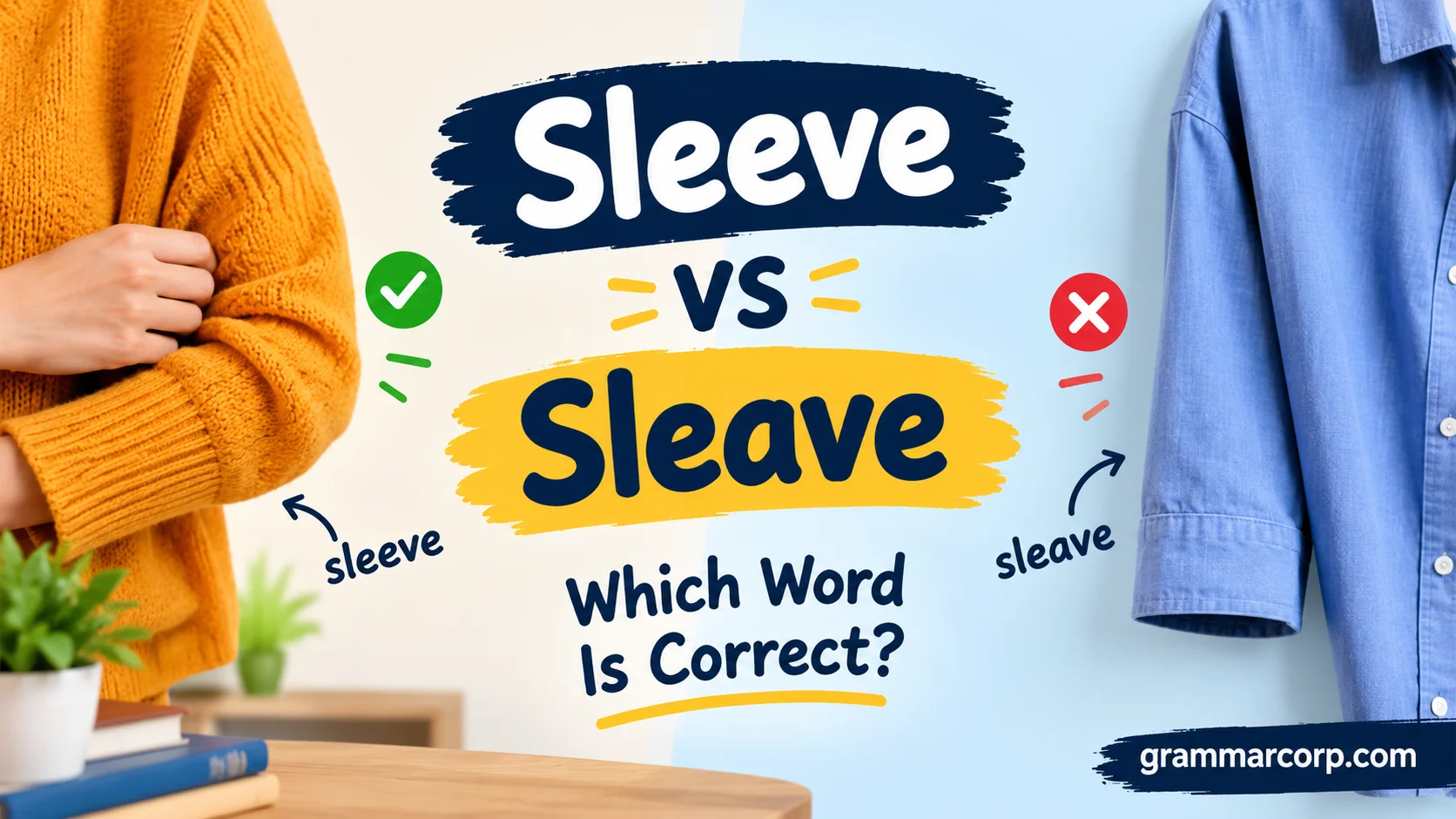
Sleeve vs Sleave: Which Word Is Correct? The answer is simple: sleeve is correct for clothing, while sleave has a rare historical meaning.
The confusing words sleeve and sleave look remarkably similar, and their same pronunciation makes their spelling differences difficult to notice. However, they have different meanings and are not interchangeable words in standard English. A sleeve is the part of clothing, such as a shirt, jacket, coat, or dress, that covers your arm.
The Oxford definition describes it as part of a garment, while Merriam-Webster also includes modern meanings, such as a tubular covering or protective casing. In professional writing and casual conversations, people may choose the wrong spelling after hearing the words in speech. For example, “She pulled her sleeve down to check her watch and wrist” is correct. Writing “short sleave shirt” instead of “short sleeve shirt” creates a spelling error.
Sleave is a legitimate English word, but it is an uncommon word in modern everyday English. Its historical meaning relates to silk, thread, and loosely twisted material, including untwisted silk fibers, silk thread filaments, and other textile materials. In historical contexts, the noun is considered archaic and can mean a skein. Its verb form is obsolete and refers to separating silk into filaments through thread separation. This rare word appears mainly in historical English, literary English, and other literary usage, rather than contemporary English.
Quick Answer:
If you’re wondering whether you should write sleeve or sleave, use this simple rule:
Use sleeve for clothing and most modern meanings. Use sleave only when you’re referring to the rare historical textile word.
For example:
- Correct: The sleeve of my shirt is too long.
- Correct: She rolled up her sleeves.
- Correct: The jacket has short sleeves.
- Incorrect: The sleave of my shirt is too long.
- Incorrect: She rolled up her sleaves.
But sleave isn’t simply a misspelling in every situation. It has its own dictionary entry and historical meaning. Merriam-Webster defines the noun as an archaic skein and the verb as an obsolete word meaning to separate silk thread into filaments.
So the answer depends on what you mean, not just how the word sounds.
Comparison Overview
The easiest way to understand sleeve vs sleave is to compare their meanings, usage, and grammatical roles.
| Feature | Sleeve | Sleave |
| Main meaning | Part of clothing covering the arm | A skein or mass of thread |
| Modern usage | Very common | Extremely rare |
| Clothing meaning | Yes | No |
| Textile meaning | Not its primary meaning | Yes |
| Part of speech | Mainly noun; also used as a verb | Noun and obsolete verb |
| Pronunciation | /sliːv/ | /sliːv/ |
| Everyday conversations | Common | Almost never |
| Historical literature | Sometimes | Yes |
| Technical meanings | Yes | Primarily historical textile use |
| Correct for a shirt arm covering | Yes | No |
Oxford gives sleeve the pronunciation /sliːv/ and defines it as the part of clothing covering all or part of the arm.
Merriam-Webster gives sleave the pronunciation ˈslēv, showing why the words can create confusion even though their meanings differ.
The practical difference
Think of the two words this way:
Sleeve = clothing or covering.
Sleave = old textile terminology.
If you’re writing an email, school assignment, article, social media post, or everyday message about clothing, you’ll almost certainly need sleeve.
Main Differences Between Sleeve vs Sleave
The biggest difference between sleeve vs sleave is their meaning.
Sleeve refers to part of a garment
A sleeve is the part of a piece of clothing designed to cover all or part of your arm.
You see sleeves on:
- Shirts
- T-shirts
- Jackets
- Coats
- Dresses
- Sweaters
- Blouses
- Uniforms
Oxford gives examples such as short and long sleeves and notes common combinations such as short-sleeved shirt.
For example:
The shirt has long sleeves.
Here, sleeves clearly refers to the parts of the shirt that cover the arms.
Sleave refers to an old textile term
Sleave has a very different history.
Merriam-Webster defines the noun as an archaic word meaning skein. A skein is a length or coil of thread or yarn arranged loosely rather than wound into a ball. The dictionary also records sleave as an obsolete verb meaning to separate silk thread into filaments.
That makes sleave a word connected with thread and textile production, rather than a part of clothing.
Sleeve has several modern meanings
The word sleeve doesn’t only describe clothing.
Merriam-Webster also defines it as a tubular part designed to fit over another component and as an open-ended cover or packaging.
For example:
- A metal sleeve can fit around part of a machine.
- A protective sleeve can cover an object.
- A record sleeve can hold and protect a record.
Oxford similarly lists a sleeve as a tube that covers part of a machine and uses sleeve for the stiff paper cover associated with records.
So sleeve has developed well beyond its clothing meaning.
Sleave has a much narrower use
Sleave doesn’t have the same broad modern range.
Its dictionary meanings are strongly tied to historical textile language. That’s why you might encounter it in older literature but almost never hear it during an ordinary conversation about clothes.
This distinction matters because someone who sees sleave in an old book shouldn’t automatically assume the author made a spelling mistake.
What Does Sleeve Mean?
Sleeve definition
A sleeve is a section of clothing that covers some or all of an arm.
You can describe sleeves by their length, shape, construction, or style.
Common examples include:
- Long sleeve
- Short sleeve
- Three-quarter sleeve
- Puff sleeve
- Bell sleeve
- Raglan sleeve
- Sleeveless
Oxford lists short-sleeved and other combinations as standard uses of the word.
Sleeve in everyday sentences
Here are natural examples:
- My shirt sleeve is caught on the door.
- She rolled up her sleeves before washing the dishes.
- This jacket has very long sleeves.
- The dress has short sleeves.
- He wiped his face with his sleeve.
- The button on my sleeve came loose.
These are all ordinary modern uses.
Sleeve as a protective covering
English also uses sleeve for objects that surround or protect something else.
For example:
The mechanic replaced the damaged metal sleeve.
Here, the word has nothing to do with clothing. It describes a tubular component that fits over another part.
This meaning makes sense because the basic idea remains similar: something surrounds or covers another thing.
Sleeve in music and media
A record sleeve is the cover that holds and protects a record. Oxford lists this as another established meaning of sleeve.
The word can therefore appear in discussions about music, album artwork, packaging, and design.
What Does Sleave Mean?
Sleave as a noun
Sleave is an archaic noun referring to a skein, particularly a mass or arrangement of thread.
Merriam-Webster records the noun as archaic and gives its first known use as 1591.
That date helps explain why modern readers may find the word unfamiliar. It belongs to an older layer of English vocabulary.
A modern writer would normally choose words such as thread, yarn, or skein instead.
Sleave as a verb
Sleave also exists as a verb.
Merriam-Webster labels this use obsolete and defines it as meaning to separate silk thread into filaments. Its first known use as a verb dates to around 1628.
That means the verb has an even more specialized historical character.
You wouldn’t normally write:
I need to sleave this thread.
Modern English would use a clearer expression such as separate the thread into strands.
Why does sleave seem so strange today?
Language changes constantly.
Words that once had practical uses can become rare when the technology, craft, or everyday practice connected to them becomes less common. As textile terminology changed, sleave stopped functioning as a normal everyday word.
That doesn’t make it fake.
It simply means the word has a restricted historical life.
Sleeve vs Sleave Pronunciation
Pronunciation creates much of the confusion between these words.
How do you pronounce sleeve?
Sleeve is pronounced:
/sliːv/
It rhymes with words such as:
- Leave
- Eve
- Believe
- Receive
- Grieve
Oxford gives the pronunciation of sleeve as /sliːv/.
How do you pronounce sleave?
Merriam-Webster gives sleave the pronunciation ˈslēv.
So for modern readers, the two words can sound essentially identical.
That’s why hearing the word doesn’t tell you which spelling the writer intended.
Are sleeve and sleave homophones?
They can function as homophones because they share the same pronunciation while having different meanings and spellings.
This is similar to other English pairs where sound alone doesn’t reveal spelling.
For sleeve vs sleave, context does the heavy lifting.
If someone says:
Roll up your ___.
You need the surrounding meaning to determine the spelling. If the sentence refers to clothing, sleeves is clearly intended.
Sleeve vs Sleave Examples
Examples make the difference much easier to remember.
Correct examples with sleeve
Clothing:
- The shirt has a loose sleeve.
- Her dress has long sleeves.
- I rolled up my sleeves.
- The jacket’s sleeve was torn.
- His watch disappeared beneath his sleeve.
Protective covering:
- The cable has a protective sleeve.
- The machine uses a metal sleeve around the shaft.
- Put the document inside a plastic sleeve.
Figurative use:
- She has another plan up her sleeve.
- He always seems to have a trick up his sleeve.
Correct examples with sleave
Because sleave is archaic or obsolete, its examples belong mainly to historical or literary contexts.
For example:
- The poem uses sleave as an old textile term.
- The historical text describes a tangled sleave of thread.
- The craftsman would sleave silk into separate filaments.
These examples aren’t typical modern conversation. Their purpose is to show the word’s historical meaning accurately.
Incorrect examples
| Incorrect | Correct | Why |
| The sleave of my shirt is torn. | The sleeve of my shirt is torn. | Clothing requires sleeve. |
| Roll up your sleaves. | Roll up your sleeves. | The expression refers to shirt sleeves. |
| Her jacket has short sleaves. | Her jacket has short sleeves. | Sleeve is the modern clothing word. |
| The sleave of his coat was wet. | The sleeve of his coat was wet. | A coat has sleeves. |
These aren’t situations where sleave provides an alternative spelling. In modern clothing-related English, sleave is wrong.
Common Expressions With Sleeve
The word sleeve appears in several established English expressions.
Have something up your sleeve
If someone has something up their sleeve, they have a secret idea, plan, advantage, or solution ready to use.
For example:
I don’t know how she’ll solve the problem, but she probably has something up her sleeve.
Oxford lists expressions such as have/keep something up your sleeve and explains the idea as keeping an idea or plan secret until you need it.
Have a trick up your sleeve
This means you have a hidden strategy or idea that you can use when necessary.
Don’t underestimate him. He may have another trick up his sleeve.
The phrase builds on the old image of someone hiding something inside a sleeve.
Roll up your sleeves
Roll up your sleeves means to prepare to work hard. It can also mean preparing to fight or deal with a difficult task.
Oxford specifically defines the expression as preparing to work or fight.
For example:
We’ve got a lot to finish, so let’s roll up our sleeves and get started.
Wear your heart on your sleeve
This expression means to make your emotions obvious to other people.
Someone who wears their heart on their sleeve doesn’t hide their feelings easily.
Oxford includes this as an established idiom and defines it as allowing your feelings to be seen by others.
Notice something important: these expressions all use sleeve, never sleave.
Sleave in Shakespeare’s Macbeth
One of the most famous reasons people encounter sleave today comes from William Shakespeare’s Macbeth.
Macbeth describes sleep using the image of something that can knit up a tangled textile. The relevant phrase includes sleave, which refers to thread or a skein. Merriam-Webster specifically cites Shakespeare’s use when defining the archaic noun.
Shakespeare’s wording is:
“the raveled sleave of care”
This short phrase uses the old textile sense of sleave. Shakespeare’s Words identifies sleave in the passage as strands, threads, or a skein of silk.
Why Shakespeare used sleave
The word creates a strong image.
Imagine a tangled mass of thread. Untangling it takes patience. Shakespeare applies that image to mental strain and care.
Sleep, in the metaphor, helps untangle the day’s worries.
That’s why sleave isn’t merely an odd spelling of sleeve in this context. Shakespeare is using an older word with a specific textile meaning.
Why this matters today
If you encounter sleave in a literary quotation, correcting it to sleeve would destroy the original meaning.
The two words may sound alike, but their historical meanings differ.
This is a good example of why dictionaries matter when you encounter an unfamiliar word. A strange spelling isn’t automatically an error.
Is Sleave a Misspelling of Sleeve?
Sometimes, yes.
Sometimes, absolutely not.
The distinction depends on context.
When sleave is a spelling mistake
If someone writes:
My shirt sleave is too short.
They almost certainly mean sleeve.
Likewise:
She rolled up her sleaves.
should be:
She rolled up her sleeves.
The same applies to jackets, coats, dresses, sweaters, and other garments.
When sleave is correct
Sleave is correct when the writer intentionally uses its historical textile meaning.
That might happen in:
- Historical writing
- Literary analysis
- Shakespeare studies
- Historical dictionaries
- Discussions of old textile terminology
- Reproductions or explanations of older English
Merriam-Webster explicitly recognizes sleave as a separate dictionary word rather than merely listing it as an incorrect spelling of sleeve.
A useful context test
Ask yourself:
Am I talking about clothing?
If yes, choose sleeve.
Am I discussing an old word connected with thread, silk, or a historical text?
If yes, sleave may be appropriate.
That’s the simplest way to separate the two.
The History of Sleeve
The word sleeve has a much longer everyday history than modern readers might realize.
Merriam-Webster traces it through Middle English sleve and ultimately to older Germanic forms. Its first known use in the modern dictionary record dates to before the 12th century.
That long history helps explain why sleeve developed several related meanings.
At its core, the word describes something associated with covering or enclosing. Over time, English extended the concept from clothing to other protective coverings.
Today, that expansion remains visible in technical and packaging language.
From clothing to other coverings
The basic image is easy to understand:
A sleeve surrounds something.
A shirt sleeve surrounds part of your arm.
A machine sleeve can surround part of a mechanical component.
A protective sleeve can surround an object to shield it from damage.
The meanings differ, but the underlying idea remains connected.
Read More : Is It Correct to Say “Very Helpful”? Grammar, Meaning, and Usage
Sleeve vs Sleave in Modern English
For modern writing, the choice is usually straightforward.
Use sleeve in everyday writing
Choose sleeve when you’re talking about:
- Clothing
- Fashion
- Arms
- Protective coverings
- Packaging
- Machine components
- Record covers
- Common idioms
You don’t need to worry about sleave in ordinary situations.
Use sleave only when the context calls for it
Sleave belongs to a much narrower vocabulary.
If you’re writing about Shakespeare or historical textile terminology, it can be useful and precise.
Otherwise, using sleave where you mean sleeve will probably look like a spelling mistake to your readers.
That distinction is especially important in professional writing. Rare words can add precision when they’re accurate, but they can create confusion when they appear accidentally.
Sleeve vs Sleave: A Practical Case Study
Consider this sentence:
The tailor adjusted the sleave of the jacket.
At first glance, the meaning seems obvious. The writer means the part of the jacket covering the arm.
So the correct version is:
The tailor adjusted the sleeve of the jacket.
Now consider a completely different sentence discussing Shakespeare’s Macbeth:
Shakespeare uses the word sleave to create a textile image of tangled care.
Here, sleave is correct because the writer is discussing the historical word itself.
What changed?
The spelling didn’t change because of pronunciation.
The meaning changed.
| Context | Correct word |
| Part of a jacket | Sleeve |
| Part of a shirt | Sleeve |
| Part of a dress | Sleeve |
| Machine covering | Sleeve |
| Protective tube | Sleeve |
| Historical silk/thread term | Sleave |
| Shakespeare’s historical usage | Sleave |
This illustrates the central lesson of sleeve vs sleave: context determines the correct word.
How to Remember Sleeve vs Sleave
You don’t need a complicated mnemonic.
Just remember:
Sleeve = clothing
Think:
shirt → arm → sleeve
If you’re talking about something you roll up, pull down, button, or wear on your arm, it’s sleeve.
Sleave = old thread terminology
Think:
sleave → skein → historical textile language
If you encounter sleave in an old literary passage, don’t immediately assume the author misspelled sleeve.
The easiest memory rule
Clothes have sleeves. Old textile language can have sleave.
That one distinction will solve almost every modern usage question.
FAQs:
1. Is sleeve or sleave the correct spelling?
Sleeve is the correct spelling when referring to the part of a shirt, jacket, coat, or dress that covers the arm. Sleave is a rare English word with a historical connection to silk fibers and thread.
2. What does the word sleave mean?
Sleave is an uncommon, historical word. As a noun, it can refer to a skein or loosely arranged silk thread. Its verb form has an obsolete meaning related to separating silk threads into filaments.
3. Do sleeve and sleave have the same pronunciation?
They are commonly pronounced alike in English, which can make them confusing. However, their meanings and spelling differ, so they are not interchangeable in everyday writing.
4. Is it correct to write “short sleave shirt”?
No, the correct phrase is “short sleeve shirt.” Sleeve refers to the part of a garment that covers the arm. Using sleave in this phrase is a spelling mistake.
5. What does “up your sleeve” mean?
The expression “up your sleeve” usually refers to having a secret plan, clever idea, or strategy ready to use. For example, “The manager had another idea up her sleeve” means the manager had an additional plan.
Conclusion:
The difference between sleeve and sleave comes down to spelling, meaning, and everyday usage. Use sleeve when discussing clothing, such as shirts, jackets, coats, and dresses. Although sleave is a legitimate English word, it is rare and mainly associated with historical textile terminology.
Remembering this distinction will help you avoid common spelling mistakes and communicate more clearly in professional writing, casual conversations, and everyday English.












1 thought on “Sleeve vs Sleave: Which Word Is Correct?”