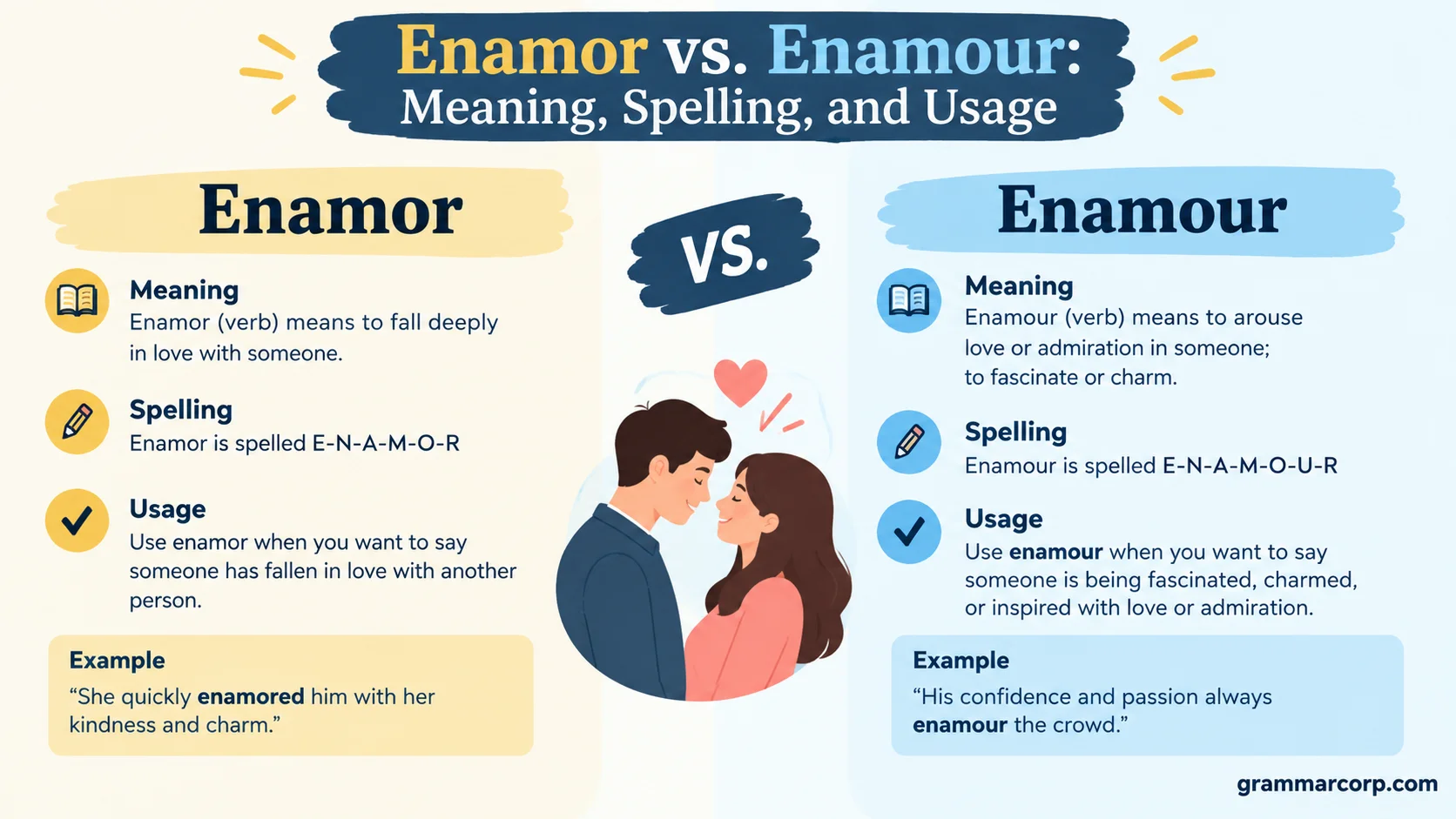
Enamor vs. Enamour: Meaning, Spelling, and Usage explains why these words have the same meaning despite a small spelling difference in English usage. The main difference comes from English variety, regional spelling conventions, and preferred usage. American English generally uses enamor, while British English prefers enamour.This difference can be confusing, but understanding the regional choice makes the distinction easier. The distinction comes down to spelling conventions, not emotional weight. American and British writers may use different variations, but both words carry the same idea of attraction and being emotionally attracted. If you have wondered about the spelling or noticed either word written in a letter, the choice is simply a matter of English convention.
In practical usage, choosing the right form can make your work look more polished and intentional, particularly when you are aiming to write clearly and professionally in formal communication, academic writing, or blog content. Exploring these nuances through simple sentences can help students and English learners understand the terms correctly. A new car may charm someone, a kid at school may become interested in something, or a magician’s captivating performance may leave an audience deeply attracted or charmed. These examples show how spelling variation, regional differences, passive construction, academic writing, blog content, simple sentences, international cooking, and captivating performance provide useful contexts for understanding the words.
A closer look at the history of the English language makes the distinction even easier to remember. The two spellings are almost identical, like linguistic twins, and both express a strong feeling of love, admiration, deep affection, or being emotionally drawn toward something beautiful or inspiring. Someone may be enamored with a person’s smile or enamoured by the beauty of a city, while the emotional essence remains the same thing. The preferred version can depend on cultural preference, personal tone, audience preference, writing style, context, and the style of expression used in modern writing. From my own experience with language, thoughtful word choices can strengthen expression without changing the central idea.The most natural choice depends on the audience, cultural setting, personal style, and intended tone.
Quick Answer:
Enamor and enamour mean essentially the same thing. They are different regional spellings of the same verb.
- Enamor is the standard American English spelling.
- Enamour is the standard British English spelling.
- Both mean to cause someone to like, love, admire, charm, or become strongly attracted to someone or something.
- American English uses enamored.
- British English uses enamoured.
- The two spellings generally have the same pronunciation.
- Neither spelling is inherently more correct than the other.
Cambridge identifies enamor as a US formal form and gives enamour as the UK equivalent. It defines the verb as causing someone to like or love something or someone.
So, if you’re writing for an American audience, choose enamor. If you’re following British English conventions, choose enamour.
Comparison Overview
| Feature | Enamor | Enamour |
| Main variety | American English | British English |
| Meaning | To cause someone to like, love, or admire | To cause someone to like, love, or admire |
| Part of speech | Verb | Verb |
| Related adjective | Enamored | Enamoured |
| Pronunciation | Generally /ɪˈnæm.ər/ in US English | Generally /ɪˈnæm.ə/ in UK English |
| Usage style | Formal | Formal |
| Meaning difference | None of practical significance | None of practical significance |
| Best choice for US writing | Yes | Usually no |
| Best choice for UK writing | Usually no | Yes |
Collins likewise lists enamor in American English and identifies enamour as the especially British form.
The important point is simple: the extra u changes the regional spelling, not the basic meaning.
Main Differences Between Enamor vs. Enamour
At first glance, the difference seems obvious: one word has a u, and the other doesn’t. However, spelling isn’t the only useful distinction to understand.
Regional spelling
The biggest difference is regional.
American English generally favors the shorter spelling:
enamor
British English retains the spelling:
enamour
This follows a broader pattern in English. American spelling often removes the u found in many traditional British spellings.
For example:
| American English | British English |
| color | colour |
| honor | honour |
| labor | labour |
| favor | favour |
| behavior | behaviour |
| enamor | enamour |
That doesn’t mean every word follows exactly the same historical path. It simply shows why enamor vs. enamour fits a familiar American-British spelling pattern.
Meaning
There isn’t a meaningful difference in definition.
Both forms can describe someone becoming strongly attracted to, charmed by, or fond of someone or something.
For example:
American English:
The beautiful coastline enamored the visitors.
British English:
The beautiful coastline enamoured the visitors.
The spelling changes, but the underlying idea remains the same.
Cambridge gives the same core definition for both forms and explicitly cross-references enamor with UK enamour.
Related forms
The spelling difference continues into related forms.
American English:
- enamor
- enamored
- enamoring
British English:
- enamour
- enamoured
- enamouring
The most commonly encountered difference is enamored vs. enamoured.
Oxford lists enamoured as a British form and identifies enamored as the US English equivalent.
What Does Enamor Mean?
Enamor means to cause someone to like, love, admire, or become strongly attracted to someone or something.
It can describe romantic feelings, but the word isn’t limited to romance.
You might become enamored with:
- A person
- A city
- A piece of music
- A book
- An idea
- A style
- A landscape
- A hobby
- A particular experience
Collins gives two closely related senses: filling someone with love and desire, and charming or captivating them. It also notes that the verb is now mainly used in the passive construction.
That distinction matters because enamor can describe admiration that doesn’t involve romantic love.
Enamor in a romantic context
Consider:
He became enamored of her kindness and confidence.
Here, enamored expresses strong affection or attraction.
The word has a somewhat formal or literary tone. In casual conversation, someone might simply say:
He really likes her.
So enamored often sounds more polished or expressive than everyday alternatives.
Enamor in a non-romantic context
The word can also describe enthusiasm for an object, place, idea, or experience.
For example:
The travelers became enamored with the quiet mountain village.
Nobody needs to interpret this as romantic love. The sentence can simply mean that the travelers found the village extremely appealing.
Oxford describes enamoured as meaning that someone likes something a lot. It also gives a separate literary sense involving being in love with someone.
Enamor as a stronger form of liking
Think of the word as occupying a stronger and more expressive position than ordinary like.
A rough progression might look like this:
like → admire → enjoy → become captivated → become enamored
This isn’t a strict scale because context changes the strength of each word. Still, it helps explain why writers choose enamor when ordinary words don’t fully capture their enthusiasm.
What Does Enamour Mean?
Enamour means the same thing as enamor. The difference is spelling.
British English uses enamour, while American English generally uses enamor.
Cambridge labels enamour as UK formal English and gives enamor as its US equivalent.
For example:
The landscape enamoured her from the moment she arrived.
In American English, the equivalent sentence would normally use:
The landscape enamored her from the moment she arrived.
The meaning remains unchanged.
Why does enamour have a u?
The spelling comes from the word’s history and its development through French and English.
Collins traces enamour to Middle English through Old French enamourer, connected with amour, meaning love. It records the English word from around the 14th century.
The American spelling later developed without the u, fitting the spelling preferences that became characteristic of American English.
So the u isn’t a modern mistake or an unnecessary addition. It’s part of the established British spelling.
Enamor vs. Enamour in American and British English
Regional spelling becomes especially important when you’re writing for a specific audience.
American English
Use:
- enamor
- enamored
For example:
The artist’s work quickly enamored the audience.
American dictionaries and learner resources recognize enamor as the US form. Cambridge labels it “US formal” and lists enamour as the UK form.
British English
Use:
- enamour
- enamoured
For example:
The artist’s work quickly enamoured the audience.
Cambridge explicitly identifies enamoured as the UK form and enamored as the US form.
Other varieties of English
English spelling doesn’t divide neatly into only two groups.
Writers in countries such as Canada, Australia, and New Zealand may encounter or use British-influenced spelling conventions. However, individual style guides, publications, institutions, and publishers can establish their own preferences.
That’s why the safest rule isn’t simply “Country X always uses this spelling.”
Instead, ask:
Which English style does the publication or institution follow?
If you’re writing for an American publication, use enamor. If you’re writing according to British spelling conventions, use enamour.
Why consistency matters
Imagine an article that uses:
- color
- honor
- labor
- enamoured
The mixture might look inconsistent in a publication that expects American English.
Likewise, a British-style document that uses:
- colour
- honour
- labour
- enamored
could appear inconsistent.
Consistency gives your writing a professional finish.
How to Use Enamor and Enamour in a Sentence
Both words function as transitive verbs. That means they can take an object.
For example:
The novel enamored its readers.
Here, the novel performs the action and its readers receive it.
However, modern usage often favors passive constructions involving enamored/enamoured.
Common American constructions
Examples include:
- She was enamored of the old building.
- He became enamored with the new design.
- They were enamored of the idea.
- The experience left her enamored with the city.
Oxford gives both enamoured of and enamoured with as established constructions.
Common British constructions
The same structures work with the British spelling:
- She was enamoured of the old building.
- He became enamoured with the new design.
- They were enamoured of the idea.
- The visitors became enamoured with the city.
Collins also gives examples of both enamoured of and enamoured with.
Enamor vs. simple alternatives
Although enamor is correct, it can sound formal.
Compare:
| More formal | Simpler alternative |
| She was enamored of the painting. | She loved the painting. |
| He became enamored with the city. | He really liked the city. |
| They were enamored of the idea. | They really liked the idea. |
| The audience was enamored with the performance. | The audience loved the performance. |
The best choice depends on your audience.
A formal essay, literary review, or descriptive article may benefit from enamored. A casual conversation might sound more natural with loved, liked, or admired.
Enamor vs. Enamour Pronunciation
The extra u doesn’t normally create a major pronunciation difference between the two spellings.
Cambridge gives US and UK pronunciation forms that reflect the different accents. The US form is represented approximately as /ɪˈnæm.ɚ/, while the UK form is approximately /ɪˈnæm.ər/.
An easy pronunciation guide is:
enamor: ih-NAM-er
enamour: ih-NAM-er
The exact final sound can vary with accent.
This is another useful point: don’t assume the added u means you should pronounce an additional syllable.
Enamor vs. Enamour vs. Enamored vs. Enamoured
These four forms can look confusing until you separate the base verb from its related form.
| Form | English variety | Function |
| enamor | American | Verb |
| enamour | British | Verb |
| enamored | American | Adjective/past participle |
| enamoured | British | Adjective/past participle |
Enamor
The book may enamor new readers.
This is the American base form.
Enamour
The book may enamour new readers.
This is the British spelling of the same verb.
Enamored
She became enamored with the author’s style.
This is the American form.
Enamoured
She became enamoured with the author’s style.
This is the British form.
Oxford identifies enamoured as the British form and enamored as the US form.
Which Is Correct: Enamor or Enamour?
Both are correct.
The right choice depends on the English variety you’re using.
Choose enamor when you’re following American English.
Choose enamour when you’re following British English.
There’s no need to treat one as a misspelling of the other.
If you’re writing for Americans
Use:
enamor → enamored
Example:
She became enamored with the city’s architecture.
If you’re writing for British readers
Use:
enamour → enamoured
Example:
She became enamoured with the city’s architecture.
If you’re writing for an international audience
Pick a consistent style and follow it throughout the article.
Don’t switch randomly between American and British spellings.
Common Mistakes With Enamor and Enamour
Several mistakes appear when writers aren’t familiar with the regional distinction.
Mistake: Calling enamour incorrect
Enamour isn’t a misspelling.
It’s a recognized British English form. Cambridge and Collins both list it as the UK equivalent of enamor.
Mistake: Assuming the words have different meanings
They don’t have a meaningful difference in their core definitions.
The difference is primarily regional spelling.
Mistake: Mixing the related forms
A writer might use enamor in one sentence and enamoured in another.
That combination may be appropriate in certain contexts, but it doesn’t follow a consistent American or British spelling system.
If you’re using American English, prefer:
enamor → enamored
If you’re using British English, prefer:
enamour → enamoured
Mistake: Assuming enamored only means romantic love
It can describe romantic attraction, but that’s not its only use.
You can be enamored with an idea, place, style, activity, or object.
Oxford specifically gives a non-romantic sense involving liking something a lot.
Mistake: Using it when a simpler word works better
Sometimes like, love, admire, or enjoy communicates the idea more naturally.
For example:
I was enamored with the restaurant.
This sounds somewhat formal.
In casual conversation:
I loved the restaurant.
may sound more natural.
The goal isn’t to use the most sophisticated word available. It’s to use the right word for the situation.
Read More : Give Someone the Third Degree: Meaning, Origin, Examples & Usage
Enamor and Enamour Synonyms
Both forms have many close synonyms. However, each synonym carries its own shade of meaning.
| Synonym | General meaning | Typical nuance |
| Like | Find enjoyable or appealing | Neutral |
| Love | Feel strong affection | Strong and broad |
| Admire | Regard with approval or respect | Often respectful |
| Adore | Love or like intensely | Very strong |
| Attract | Draw someone’s interest or attention | Focuses on appeal |
| Charm | Please or delight someone | Warm and appealing |
| Captivate | Hold someone’s attention strongly | Powerful attraction |
| Fascinate | Make someone intensely interested | Intellectual or emotional interest |
| Enchant | Delight greatly | Often literary or expressive |
| Infatuate | Cause intense but often temporary attraction | Stronger and more emotionally charged |
Collins lists words such as fascinate, bewitch, enchant, and enrapture among synonyms associated with enamor.
Enamor vs. admire
Admire often emphasizes respect or appreciation.
She admired the architect’s creativity.
Enamor suggests a stronger emotional attraction.
She became enamored with the architect’s work.
Enamor vs. captivate
Captivate focuses strongly on holding someone’s attention.
The performance captivated the audience.
Enamor emphasizes affection, attraction, or strong liking.
The performance enamored the audience.
The two can overlap, but they aren’t always interchangeable.
Enamor vs. infatuate
These words shouldn’t automatically be treated as exact synonyms.
Infatuation often suggests an intense attraction that may be short-lived or unrealistic.
Enamor is broader and can describe a genuine strong liking for a person, place, idea, or thing.
Enamor vs. Enamour Examples in Different Contexts
Seeing the two spellings side by side makes the distinction much easier.
Romantic context
American:
She became enamored of him after spending more time together.
British:
She became enamoured of him after spending more time together.
Travel context
American:
The travelers were enamored with the coastal scenery.
British:
The travelers were enamoured with the coastal scenery.
Art context
American:
The gallery’s collection enamored visitors.
British:
The gallery’s collection enamoured visitors.
Literature context
American:
Readers became enamored with the novel’s unusual style.
British:
Readers became enamoured with the novel’s unusual style.
Ideas and opinions
American:
The committee wasn’t enamored with the proposal.
British:
The committee wasn’t enamoured with the proposal.
That last pattern is particularly useful because not enamored/not enamoured often expresses the idea that someone doesn’t particularly like or approve of something.
Oxford specifically notes that enamoured often appears in negative sentences.
Why Is Enamor Often Used in the Passive Form?
One interesting feature of this word is its frequent use in passive or adjective-like constructions.
Instead of:
The city enamored her.
you’ll often see:
She was enamored of the city.
The second structure focuses attention on the person’s feelings, not the thing causing those feelings.
This makes the word useful in descriptive writing.
Compare:
| Active | Passive-style construction |
| The landscape enamored him. | He was enamored of the landscape. |
| The music enamored the listeners. | The listeners were enamored with the music. |
| The idea enamored the team. | The team became enamored with the idea. |
Collins notes that enamor is now mainly used in the passive voice, particularly with of.
That usage pattern helps explain why you may encounter enamored/enamoured much more often than the base verb.
A Simple Way to Remember Enamor vs. Enamour
If you constantly forget which version belongs to which variety of English, use this shortcut:
American English = enamor
British English = enamour
The same basic pattern appears in several familiar pairs:
- American color → British colour
- American honor → British honour
- American favor → British favour
- American labor → British labour
- American enamor → British enamour
Then remember the adjective forms:
American: enamored
British: enamoured
Once you remember the spelling pattern, the distinction becomes much easier.
Enamor vs. Enamour: A Practical Writing Guide
Use this checklist before publishing your writing:
- Writing in American English? Use enamor.
- Writing in British English? Use enamour.
- Writing about the adjective? Use enamored in American English.
- Following British spelling? Use enamoured.
- Unsure about the meaning? Both forms express strong liking, attraction, affection, or admiration.
- Writing casually? Consider whether like, love, admire, or enjoy sounds more natural.
- Writing formally? Enamor or enamour can provide a more literary tone.
- Editing an existing article? Follow the publication’s established spelling style.
The best spelling isn’t determined by which version looks more familiar. It’s determined by the English variety and style you’re following.
FAQs:
1. What is the difference between enamor and enamour?
Enamor and enamour have the same meaning. Enamor is the usual spelling in American English, while enamour is preferred in British English.
2. Is enamor correct in American English?
Yes. Enamor is the standard American English spelling. It means to cause someone to feel strong love, admiration, or attraction toward someone or something.
3. Is enamour correct in British English?
Yes. Enamour is the standard British English spelling. The additional u does not change the meaning or pronunciation of the word.
4. What does enamored or enamoured mean?
Enamored and enamoured mean strongly attracted, charmed, or filled with admiration for someone or something. For example, someone can be enamored with a beautiful place.
5. Should I use enamor or enamour in my writing?
Choose the spelling that matches your variety of English and your audience. Use enamor for American English and enamour for British English, and stay consistent throughout your writing.
Conclusion:
Enamor and enamour are two spellings of the same word, not two words with different meanings. The main distinction is regional: American English generally uses enamor, while British English uses enamour. Once you understand this small spelling difference, choosing the appropriate form becomes simple.







1 thought on “Enamor vs. Enamour: Meaning, Spelling, and Usage”