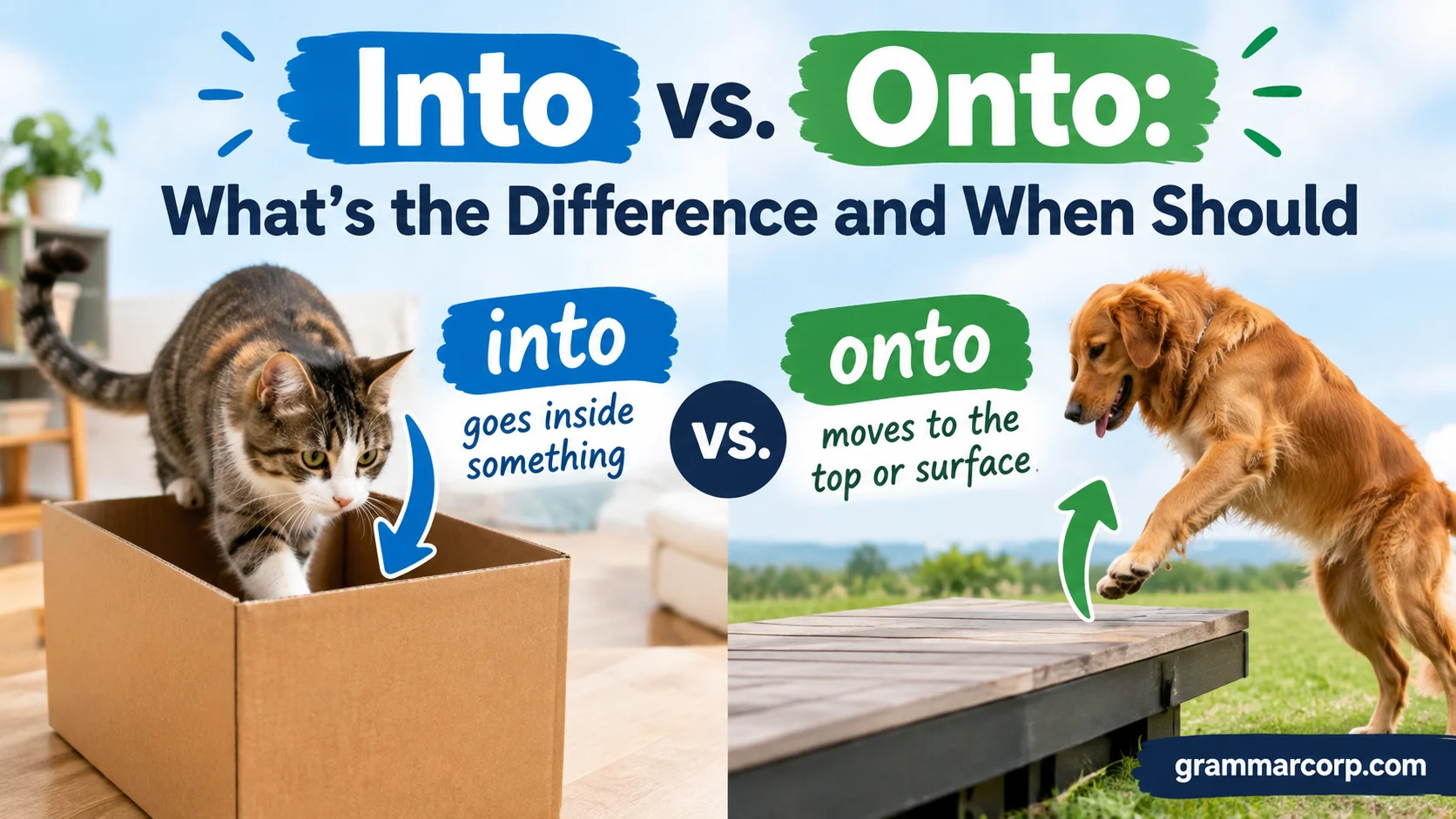
Into vs. Onto: What’s the Difference and When Should You Use Each? explains how these prepositions describe movement, direction, and position in English.
In English grammar, into and onto may look similar, but they perform different jobs. Into shows movement from outside to inside, as in “She walked into the room.” Onto describes movement toward a surface, as in “She stepped onto the stage.” These examples show the basic distinction between entry and movement toward a position. Understanding these spatial relationships improves sentence meaning, reading comprehension, writing skills, and daily communication. I find that visualizing the action makes the difference easier to remember.
Confusion often arises when writers mix up into vs. onto, in to vs. into, and on to vs. onto. Although the spaces may seem optional, they affect grammatical structure and meaning. For example, “She went into the room” describes entering, while “She came in to ask a question” uses two separate words. Similarly, “The cat jumped onto the roof” describes movement toward a surface, while “She held on to the rail” uses a separate-word combination. Checking the verb, context, and sentence structure helps you choose the correct form. Clear grammar rules, comparison tables, practical examples, and useful tests can also prevent common mistakes.
To understand these forms, try visualizing movement and completing real-life exercises. Imagine someone going inside a room or climbing onto a roof. Grammar Monster and a short video lesson can provide additional examples and explanations. With consistent practice and repeated application of correct usage patterns, learners can improve clarity, confidence, and accuracy in written and oral communication. Over time, these skills help you avoid confusing sentences, strengthen language skills, and communicate with precision, fluency, and a natural writing flow.
Quick Answer:
Use into when something moves inside, enters, becomes, or changes into something.
- She walked into the house.
- Pour the water into the glass.
- The caterpillar turned into a butterfly.
- He ran into the room.
Use onto when something moves to a position on a surface or another physical position.
- The cat jumped onto the table.
- She stepped onto the platform.
- Put the books onto the shelf.
- The ball rolled onto the floor.
A quick memory trick is:
Into = in + movement toward the inside
Onto = on + movement toward a surface
However, the distinction isn’t limited to physical movement. Into also has meanings involving change, contact, interest, and involvement. Onto can describe changing subjects, holding something, discovering something, and moving toward a new stage.
Merriam-Webster defines into as indicating entry, insertion, inclusion, contact, change of state, and other relationships. Cambridge similarly explains onto as showing movement to a position on or toward a surface.
Comparison Overview
| Word | Main function | Typical idea | Example |
| Into | Preposition | Movement inside | She walked into the room. |
| Onto | Preposition | Movement to a surface | She stepped onto the stage. |
| In to | Two separate words | in + to | He came in to ask a question. |
| On to | Two separate words | on + to | Let’s move on to the next topic. |
The easiest way to understand into vs. onto is to focus on the destination.
If the destination is inside something, use into.
If the destination is on a surface or position, use onto.
Consider these two sentences:
- The child climbed into the box.
- The child climbed onto the box.
The first sentence means the child ended up inside the box. The second means the child ended up on top of or on the surface of the box.
That difference can completely change the mental picture.
Main Differences Between Into vs. Onto
The biggest difference between into and onto is the relationship between movement and destination.
Into Shows Movement to the Inside
Into commonly describes movement from an outside position to an inside position.
Consider:
- She walked into the kitchen.
- He jumped into the pool.
- They drove into the city.
- I put the documents into the folder.
- The bird flew into the house.
In each example, the subject or object moves toward a destination that can be understood as an interior space.
The boundary doesn’t always need to be a literal wall. A container, area, situation, or condition can also create the idea of entering something.
Onto Shows Movement to a Surface
Onto usually describes movement toward a position on a surface.
Examples include:
- The cat jumped onto the sofa.
- She stepped onto the stage.
- He climbed onto the roof.
- Put the plate onto the table.
- The leaves fell onto the ground.
Cambridge explains that onto is used for direction or movement toward a position on a surface. It also notes that on and onto can sometimes overlap, although onto gives a stronger sense of movement.
Into Can Describe Contact or Impact
Into doesn’t always mean entering an enclosed space.
It can also describe movement that ends in contact with something.
- The car crashed into the barrier.
- He bumped into the wall.
- The ball flew into the window.
- She walked into a pole.
Here, the object doesn’t necessarily enter the thing it contacts. Instead, into describes movement toward and against it.
Merriam-Webster specifically includes the meaning “to a position of contact with” or “against” in its definition of into.
Into Can Describe Change
Another major use of into involves transformation.
- The seed grew into a plant.
- The discussion turned into an argument.
- Water can turn into ice.
- The small project developed into a larger business.
Here, it doesn’t describe physical entry. Instead, it identifies the new state, form, or condition that results from a change.
This is one reason the simple rule “into means inside” isn’t enough for every sentence.
Onto Can Describe More Than Physical Surfaces
Onto has several established nonphysical uses.
For example:
- Let’s move onto the next topic.
- She held onto the railing.
- The researchers may be onto something important.
- The company moved onto a new platform.
Cambridge lists uses of onto involving changing subjects, holding something, knowing about something, adding something, and other relationships.
So while onto = movement to a surface works as the core rule, real English uses the word more broadly.
When to Use Into
Use Into for Entering a Room, Building, or Space
When someone or something moves from outside to inside, into is normally the right choice.
- She walked into the classroom.
- They ran into the building.
- We went into the store.
- The dog wandered into the garden.
The important feature isn’t the size of the place. A tiny box and a huge building can both take into.
- Put the coin into the box.
- Drive into the garage.
Use Into for Putting Something Inside a Container
Use into when an object moves from outside a container to inside it.
- Pour the milk into the cup.
- Put the clothes into the bag.
- Drop the letter into the mailbox.
- Place the files into the drawer.
The same principle applies whether the movement happens quickly or slowly.
Use Into for Entering a Vehicle
English commonly uses into when someone enters a vehicle.
- Get into the car.
- She climbed into the truck.
- He stepped into the taxi.
Compare this with onto:
- Get into the car. → Enter the car.
- Climb onto the car. → Move to a position on its exterior.
The destination determines the preposition.
Use Into for Contact or Collision
Use into when movement results in contact with something.
- The cyclist ran into a barrier.
- The ball crashed into the fence.
- The child bumped into the chair.
This meaning is different from physical entry.
Use Into for Transformation
Use when one thing changes into another.
- The discussion turned into a debate.
- The plan developed into a major project.
- The liquid changed into a solid.
Merriam-Webster lists into for movement toward a state, condition, or form.
Use Into for Interest or Involvement
Into also appears in informal expressions about interests.
- She’s really into photography.
- He’s into science.
- They’re into classical music.
Here, into doesn’t indicate physical movement. It means interested or involved in something.
When to Use Onto
Use Onto for Movement to a Surface
This is the clearest use of onto.
- The cat jumped onto the bed.
- He stepped onto the sidewalk.
- She climbed onto the platform.
- The book fell onto the floor.
Oxford defines onto as a preposition used with verbs to express movement on or to a particular place or position.
Use Onto for Placement
When something moves to a surface, onto can describe the destination.
- Put the phone onto the desk.
- Move the box onto the shelf.
- Place the dishes onto the counter.
In everyday English, on may also work in many of these sentences.
For example:
- Put the book on the table.
- Put the book onto the table.
The second version highlights the movement toward the table. Cambridge notes that on and onto can overlap in some situations.
Use Onto for Stages and Platforms
A stage is a useful example because it demonstrates the movement clearly.
- The actor walked onto the stage.
- The speaker stepped onto the platform.
- The athlete climbed onto the podium.
The person moves from another position to a new position on a raised or defined surface.
Use Onto for Roads and Routes
Onto can also describe movement onto a road.
- Turn onto the main road.
- The car merged onto the highway.
- The path leads onto the main street.
Merriam-Webster includes examples such as turning onto a named street.
Into vs. Onto With Vehicles
Vehicles create some of the most useful examples because English distinguishes between entering and moving onto something.
| Situation | Correct form | Why |
| Entering a car | get into the car | You enter its interior |
| Entering a taxi | get into the taxi | You move inside |
| Entering a truck | climb into the truck | You enter the vehicle |
| Moving onto a bus | get onto the bus | You move onto the vehicle as a means of transport |
| Stepping onto a platform | step onto the platform | You reach its surface |
English also commonly uses on with public transportation:
- on the bus
- on the train
- on the plane
That doesn’t mean onto is wrong when movement matters.
Compare:
- She is on the bus.
- She got onto the bus.
The first describes her position. The second emphasizes movement.
Into vs. In To: What Is the Difference?
One of the biggest problems with into vs. onto is that learners often forget about in to.
Into is one word and usually functions as a preposition.
In to consists of two separate words that happen to appear next to each other.
Compare:
- She walked into the room.
- She came in to talk to us.
In the first sentence, into means movement inside.
In the second, in belongs to the verb or verb phrase while to introduces what follows.
Examples of Into
- He went into the office.
- She looked into the problem.
- They drove into town.
- Put the keys into the drawer.
Examples of In To
- He came in to check the system.
- She went in to ask a question.
- The manager stepped in to help.
- I logged in to check my account.
A useful way to spot the difference is to examine the words around in.
If in functions as part of the verb phrase and to has its own grammatical role, keep them separate.
The International Association for the Evaluation of Educational Achievement’s style guide similarly distinguishes into from in to, explaining that into is a preposition while in to consists of separate grammatical elements.
Onto vs. On To: What Is the Difference?
The same problem occurs with onto and on to.
Onto is generally used as a preposition showing movement to a position or surface.
- The cat jumped onto the table.
- She stepped onto the platform.
To uses two separate words.
- Let’s move on to the next question.
- He went on to explain the results.
- We drove on to the next town.
Dictionary.com explains that on to commonly appears when on belongs to a phrasal verb and to has a separate grammatical function.
A Useful Onto vs. On To Test
Try replacing onto with on or upon.
For example:
She placed the folder onto the desk.
You can say:
She placed the folder on the desk.
The meaning still works.
Now consider:
Let’s move on to the next lesson.
Replacing on to with upon doesn’t produce the intended meaning.
That strongly suggests you need the two-word form.
Still, this isn’t an absolute mechanical rule for every sentence. Context and the structure of the verb matter.
Common Sentences: Into vs. Onto
The following examples show how a small preposition changes the meaning.
| Sentence | Meaning |
| She walked into the room. | She entered the room. |
| She walked onto the stage. | She moved to a position on the stage. |
| He jumped into the pool. | He entered the water. |
| He jumped onto the platform. | He landed on its surface. |
| Put the papers into the drawer. | The papers go inside. |
| Put the papers onto the desk. | The papers go on the surface. |
| The car drove into the garage. | The car entered the garage. |
| The car drove onto the road. | The car moved onto the road. |
The contrast becomes especially clear when the same verb appears with both prepositions.
Jump Into vs. Jump Onto
- The child jumped into the pool.
- The child jumped onto the bed.
The first destination surrounds or contains the child.
The second provides a surface for the child to land on.
Climb Into vs. Climb Onto
- She climbed into the boat.
- She climbed onto the roof.
The first describes entering an interior space. The second describes reaching a surface.
Common Mistakes With Into and Onto
Mistake: Using Onto for an Interior Space
Incorrect:
- She walked onto the classroom.
Better:
- She walked into the classroom.
A classroom is treated as an interior destination in this context.
Mistake: Using Into for a Surface
Incorrect:
- The cat jumped into the table.
Better:
- The cat jumped onto the table.
If the cat lands on the table’s surface, onto expresses the intended movement.
Mistake: Confusing Into With In To
Consider:
- He went into the room.
- He went in to speak with the teacher.
These sentences don’t have the same structure.
The first focuses on entering a place. The second uses in separately and then uses to for the following purpose or action.
Mistake: Writing Onto When You Need On To
Consider:
- Let’s move on to the next subject.
The phrase means to continue to another subject.
Writing onto can change the interpretation because onto suggests a single preposition involving movement to a position.
Mistake: Assuming On and Onto Are Always Different
English doesn’t always force a strict choice between on and onto.
Cambridge notes that on and onto can sometimes have very little difference when they describe attachment or movement. Onto tends to give a stronger sense of movement.
For example:
- Put the book on the table.
- Put the book onto the table.
Both can be grammatical. The second emphasizes the movement toward the surface.
A Simple Way to Remember Into vs. Onto
Use the destination test.
Ask yourself:
Where does the person or object end up?
If the answer is inside, choose into.
She walked into the house.
If the answer is on a surface, choose onto.
She walked onto the stage.
You can visualize it like this:
Outside → inside = INTO
Away from surface → on surface = ONTO
Then ask a second question:
Are these actually two separate words?
If in belongs to a verb and to performs another grammatical job, you may need in to.
If on belongs to a verb and to introduces the next destination, action, or idea, you may need on to.
Read More : Minute or Minute: Which Spelling Is Correct?
Into vs. Onto in Everyday English
Understanding these words becomes easier when you see them in natural situations.
At Home
- Put the clothes into the closet.
- Place the clothes onto the bed.
The closet provides an interior space. The bed provides a surface.
At School
- Walk into the classroom.
- Step onto the stage.
- Move on to the next question.
Three similar-looking constructions perform three different jobs.
While Driving
- Drive into the garage.
- Turn onto the main road.
- Continue on to the next town.
Again, the preposition follows the relationship being described.
At Work
- Put the documents into the folder.
- Move the file onto the shared drive.
- Let’s move on to the next issue.
These examples show why memorizing one simple definition isn’t enough. You need to recognize the relationship between the verb, destination, and object.
Why Context Matters More Than a Single Rule
Grammar rules help you make quick decisions, but English contains established expressions that don’t always fit a basic physical model.
For example, into can mean interested in something:
I’m really into astronomy.
Nothing physically moves inside anything.
Likewise, onto can indicate awareness:
They were onto the problem.
It can also indicate progression:
Let’s move onto the next point.
Cambridge and Merriam-Webster both document these broader meanings.
That means the best approach is to learn the core meaning first, then learn common extended uses.
Case Study: Three Similar Sentences With Different Meanings
Consider these sentences:
She went into the room.
This describes entry. She moved from outside the room to inside it.
She stepped onto the platform.
This describes movement to a surface. She ended up standing on the platform.
She moved on to the next task.
This describes progression. She finished or left one task and continued with another.
The words look similar, but their grammatical roles differ.
This is why punctuation and spacing aren’t merely visual details. The difference between into, in to, onto, and on to can affect the structure and meaning of the sentence.
Into vs. Onto Quick Reference
| If you mean… | Use | Example |
| Entering an interior | into | Walk into the house. |
| Putting something inside | into | Put it into the box. |
| Contact or collision | into | Run into the wall. |
| Transformation | into | Turn water into ice. |
| Interest | into | She’s into music. |
| Moving to a surface | onto | Jump onto the table. |
| Moving to a platform | onto | Step onto the stage. |
| Moving to a road | onto | Turn onto the highway. |
| Changing subjects | onto/on to | Move on to the next topic. |
| Separate in + to | in to | Come in to discuss it. |
FAQs:
1. What is the main difference between into and onto?
Into describes movement from outside to inside something, while onto describes movement toward a position on a surface. For example, “She walked into the room” shows entry, while “She jumped onto the bed” shows movement to a surface.
2. When should I use into in a sentence?
Use into when describing movement inside a place or object, or a change from one state to another. For example, “He went into the kitchen” describes entering a room, while “The caterpillar turned into a butterfly” describes a transformation.
3. When should I use onto instead of on to?
Use onto when something moves to a position on a surface, as in “The cat jumped onto the table.” Use on to when on and to perform separate grammatical roles, as in “She held on to the railing.”
4. Are into and in to interchangeable?
No, into and in to have different grammatical functions. Into is generally a preposition showing movement inside something, as in “She walked into the office.” In to consists of two separate words, as in “He came in to speak with the teacher.”
5. How can I remember the difference between into and onto?
Think about the destination. If someone moves from outside to inside, use into. If someone or something moves to a position on a surface, use onto. Practicing with everyday examples can improve your grammar, sentence clarity, and confidence.
Conclusion:
Understanding Into vs. Onto: What’s the Difference and When Should You Use Each? becomes easier when you focus on movement, meaning, and sentence structure. Use into for movement inside a place or for certain changes in state, and use onto for movement toward a surface.
Remember that in to and on to sometimes need to remain separate because of their grammatical roles. With regular practice and attention to context, you can avoid common mistakes, improve your English writing, and communicate more clearly and confidently.












1 thought on “Into vs. Onto: What’s the Difference and When Should”