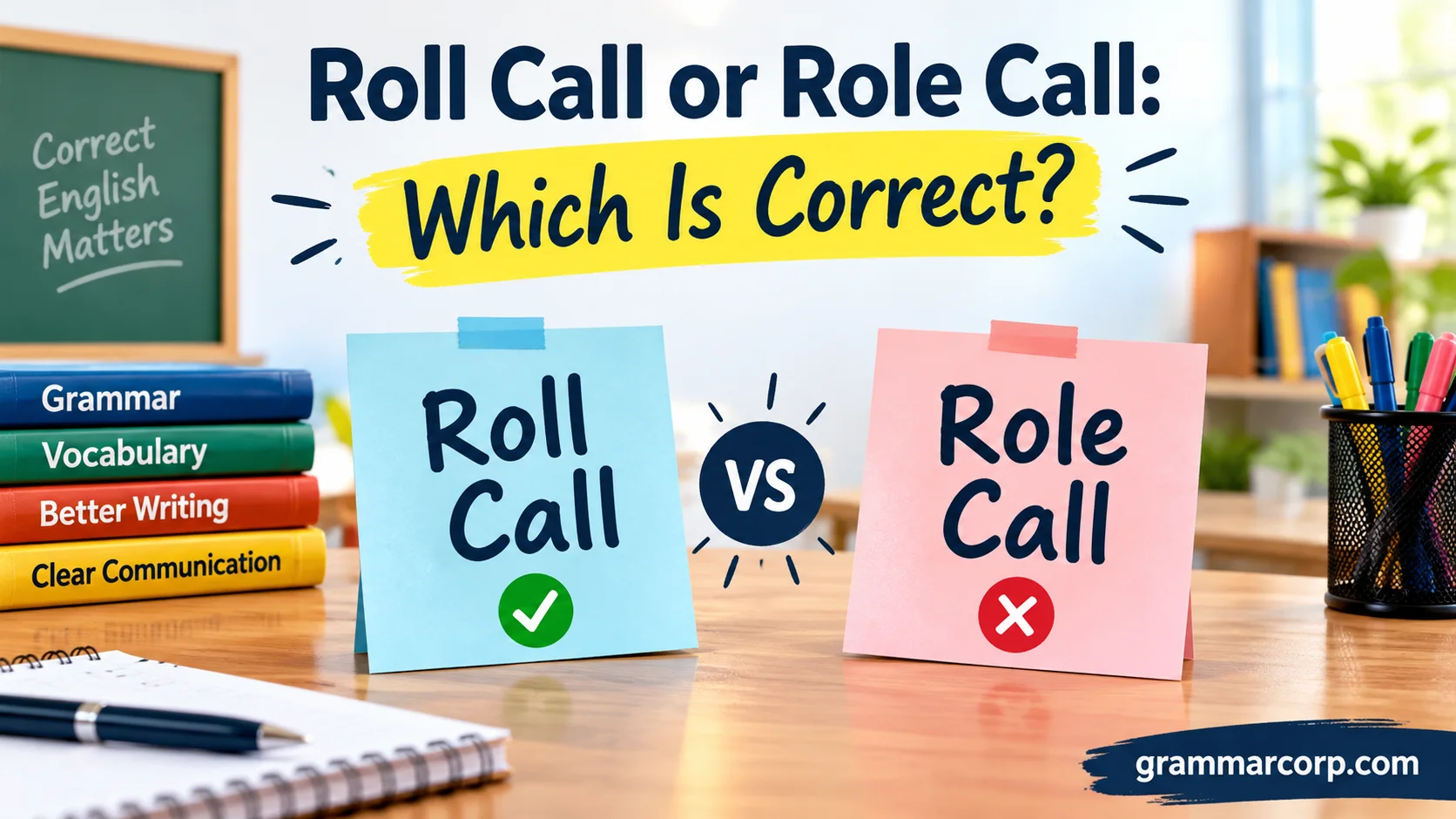
Roll Call or Role Call: Which Is Correct? is easier to understand when you connect roll call with attendance and role with a person’s function or part. Roll Call vs Role Call often creates confusion because the phrases sound alike, are exactly alike in speech, but have a different meaning and spelling. The correct phrase is roll call, the standard expression for checking attendance when a teacher calls students’ names, a military unit checks who is present, or an organization checks its members against a list.
In schools, school life, meetings, and every day situations, speakers, leaders, facilitators, record keepers, managers, and writers may use an attendance check, name check, membership list, register, or attendance sheet during a session. A quick rule is to use roll call when checking names, calling out names, marking presence, or tracking participants’ attendance. This makes choosing the right word easier for daily use, daily management, classroom management, and organizational procedures, while helping confirm, verify, and identify participants, maintain student accountability, and improve accuracy in attendance tracking.
The other word, role, has a different meaning and can describe a part, character, or function, especially in an actor or theater context. This distinction explains why role call is generally incorrect when the purpose is attendance. In my experience, English learners, native speakers, students, HR staff, teachers, writers, and other professional users sometimes hear the same sound, say the words aloud, and begin second-guessing, which can cause writing mistakes, careless writing, and incorrect usage. The reason is simple: words may sound alike without having the same meaning. By considering the context, phrase usage, spelling difference, and correct phrase, people can understand which word fits each situation.
Quick Answer:
Roll call is the correct phrase when you mean calling the names of people on a list to check attendance or presence.
Role call is generally incorrect when used with this meaning.
The easiest way to remember it is:
Roll = roster. Roll call = calling the names on a roster.
For example:
- The teacher took roll call before starting the lesson.
- Everyone must be present for roll call.
- The captain conducted roll call before the group left.
- The committee held a roll call vote.
By contrast, role refers to a person’s function, responsibility, position, or character.
- She played the role of the team leader.
- His role involves managing the project.
- Everyone has an important role in the production.
So if you’re asking is it roll call or role call, choose roll call when you mean attendance.
Comparison Overview
The difference becomes clear when you look at the words side by side.
| Word or phrase | Correct use | Meaning | Example |
| Roll | Yes | A list, register, or other meanings depending on context | The names appear on the class roll. |
| Role | Yes | A function, responsibility, position, or character | Her role is to lead the team. |
| Roll call | Yes | Calling names to check attendance | The teacher started roll call. |
| Role call | Usually incorrect | Not the standard phrase for attendance | Use roll call instead. |
| Call the roll | Yes | Call names from an attendance list | The instructor will call the roll. |
| Roll-call vote | Yes | A vote recorded by calling members’ names | The legislature held a roll-call vote. |
The important point is that roll call functions as an established expression. You shouldn’t change roll to role simply because the words sound identical.
Main Differences Between Roll Call or Role Call
The main difference between roll call and role call comes down to meaning.
What Does Roll Mean?
Roll has several meanings in English. One important meaning involves a list or register of names.
Historically and in formal contexts, a roll can refer to an official list of people. For example, an organization might maintain a membership roll. A school might keep a class roll.
That meaning explains roll call.
When someone conducts a roll call, they call the names on a list. Each person usually responds or gets marked as present or absent.
The word roll also has many unrelated meanings:
- To move by turning over and over
- To turn something around
- A small round bread product
- A cylindrical or wound quantity of material
- A list or register
- A series or succession of names
Context tells you which meaning applies.
What Does Role Mean?
Role refers to the part, function, position, or responsibility someone has in a particular situation.
You might talk about:
- A student’s role in a group project
- A manager’s role at a company
- An actor’s role in a film
- A parent’s role in a family
- A player’s role on a sports team
- A leader’s role within an organization
For example:
The captain’s role is to organize the team.
Here, role describes a responsibility or function. It has nothing to do with an attendance list.
Why Roll Call Is the Correct Expression
The phrase roll call comes from the idea of calling names from a roll, meaning a list or register.
Think of a classroom. A teacher has a list of students:
- Alex
- Jordan
- Maya
- Sam
- Taylor
The teacher calls each name and records who is present.
That’s roll call.
The teacher isn’t calling out everyone’s roles. The teacher is calling names from a roll.
What Does Roll Call Mean?
Roll call means the process of calling people’s names from an official list to determine who is present.
It’s especially common in settings where attendance or accountability matters.
Roll Call in Schools
Schools are one of the most familiar places where people hear roll call.
A teacher may begin class by checking the attendance list. Students respond when the teacher calls their names.
For example:
The teacher finished the roll call before beginning the lesson.
In everyday American English, attendance is also extremely common.
You might hear:
- The teacher took attendance.
- The teacher called the roll.
- The teacher conducted a roll call.
These expressions can describe closely related actions.
Roll Call in the Military
Military organizations have traditionally used roll call to account for personnel.
A leader may call names or otherwise verify members against an official list. The purpose is straightforward: determine who is present and accountable.
The exact procedures vary by organization and situation, but the underlying concept remains the same.
Roll Call in Meetings and Organizations
You can also use roll call outside schools and military settings.
An organization might check which members are present before a formal meeting begins.
For example:
The secretary completed the roll call before the meeting began.
In less formal workplaces, however, people usually say attendance check or simply take attendance.
Roll Call in Government
The term also appears in government and legislative settings.
A roll-call vote records how individual members vote. Rather than recording only the final number, the procedure identifies members and records their individual votes.
That makes roll-call vote different from an ordinary attendance check.
Roll Call vs. Call the Roll
You may encounter another phrase that looks slightly different:
call the roll
It means essentially the same basic activity as conducting a roll call.
For example:
- The teacher will call the roll.
- The teacher will conduct roll call.
Both expressions connect to the idea of calling names from a list.
The grammatical structure differs, but the underlying meaning remains similar.
Roll Call and Call the Roll Examples
| Expression | Example | Meaning |
| Roll call | We started roll call at nine. | The attendance-checking activity |
| Call the roll | The teacher called the roll. | The act of calling names |
| Take attendance | The teacher took attendance. | Checking who is present |
These alternatives can make your writing sound more natural depending on the context.
Why Do People Confuse Roll Call and Role Call?
The confusion exists mainly because roll and role are homophones.
A homophone is a word that sounds like another word but has a different spelling and meaning.
Other familiar examples include:
- to / too / two
- there / their / they’re
- right / write
- brake / break
- peace / piece
When someone hears roll call, they don’t see the spelling. They only hear the sound.
That can create uncertainty when they later write the phrase.
The Sound Doesn’t Tell You the Spelling
English contains many words whose pronunciation doesn’t provide enough information to determine their spelling.
That’s why you should connect the word to its meaning.
Ask yourself:
Am I talking about a list of names?
If yes, think roll.
Am I talking about someone’s responsibility or function?
If yes, think role.
This approach works better than trying to remember the pronunciation.
Roll Call or Role Call Examples
Seeing the words in real sentences makes the distinction easier.
Correct Roll Call Examples
Here are several natural examples:
- The teacher began roll call at the start of class.
- Everyone answered when their name came up during roll call.
- We arrived before roll call began.
- The officer conducted roll call before the shift.
- The coach checked the roster during roll call.
- The organization completed its roll call before the meeting.
- Students should be seated when roll call starts.
- The instructor marked attendance during roll call.
- The team gathered for roll call.
- The committee used a roll-call vote to record each member’s decision.
Incorrect Role Call Examples
When someone writes role call but means attendance, the wording should normally be changed to roll call.
| Incorrect | Correct |
| The teacher took role call. | The teacher took roll call. |
| We arrived before role call. | We arrived before roll call. |
| The officer conducted role call. | The officer conducted roll call. |
| Everyone answered during role call. | Everyone answered during roll call. |
| The class waited for role call. | The class waited for roll call. |
The correction isn’t about pronunciation. Both phrases sound alike. The correction comes from the meaning of roll in the established expression.
Read More : Portmanteau Words in American English: Meaning, History
When Should You Use Roll, Role, and Roll Call?
A quick decision process can prevent most mistakes.
Use Roll When You Mean a List or Register
Use roll when the word refers to a list or register.
For example:
His name appears on the membership roll.
Here, roll means a list of members.
You can also use roll in its many other meanings:
- Roll a ball across the floor.
- Roll the window down.
- Roll out the dough.
- Buy a dinner roll.
- A roll of paper sat on the desk.
The meaning changes with context.
Use Role for a Function or Position
Use role when you mean someone’s function, duty, position, or character.
Examples include:
Her role is to organize the event.
He accepted a leading role in the play.
Each person has a different role on the project.
Here, replacing role with roll would change the meaning or make the sentence incorrect.
Use Roll Call for Attendance
Use roll call when someone calls names from a list to determine who is present.
Examples:
- The teacher took roll calls.
- The commander conducted a roll call.
- We gathered for a roll call.
- The clerk began a roll call.
The phrase remains roll call even when the people being called have different roles.
That’s an important distinction.
A Simple Memory Trick for Roll Call or Role Call
The easiest memory trick is:
Roll = roster.
Both roll and roster begin with R.
A roster contains names. A roll can also refer to a list of names. Therefore:
Roll → roster → roll call
Meanwhile:
Role → responsibility → someone’s function
This gives you a simple mental test:
| If you’re talking about… | Use |
| A list of names | roll |
| Checking attendance | roll call |
| A person’s responsibility | role |
| A position in an organization | role |
| A character played by an actor | role |
| A formal vote recorded by member | roll-call vote |
Common Roll Call Mistakes to Avoid
Knowing the correct spelling helps, but several related mistakes can still cause confusion.
Mistake: Writing Role Call for Attendance
This is the biggest mistake.
If you’re checking who is present, write roll call.
Mistake: Thinking Role Makes Sense Because People Have Roles
Someone might reason that a meeting involves people with different roles. That doesn’t make role call the correct expression.
The phrase doesn’t mean calling people according to their jobs or responsibilities.
It means calling names from a list.
Mistake: Assuming Similar Sound Means Similar Meaning
Roll and role sound alike, but their meanings differ.
English has many homophones. You need to use context to select the correct spelling.
Mistake: Confusing Roll Call With a Roll-Call Vote
A roll call can refer to checking attendance.
A roll-call vote refers to a voting procedure where members’ votes are recorded individually.
For example:
The committee conducted a roll-call vote.
The phrase contains roll, not role, because it relates to the list of members being called.
Mistake: Overthinking the Spelling
Once you understand the connection between roll and a list or register, the phrase becomes easier to remember.
You don’t need a complicated grammar rule.
Just remember:
Attendance → roll call.
Function or responsibility → role.
Roll Call Synonyms and Alternative Expressions
You don’t always need to use the phrase roll call.
Depending on the setting, another expression may sound more natural.
Take Attendance
Take attendance is extremely common in schools and workplaces.
Example:
The teacher took attendance before the test.
It focuses directly on recording who is present.
Check Attendance
Check attendance also works when you want to emphasize the act of verifying presence.
Example:
The coordinator checked attendance before the event started.
Call the Roll
Call the roll is another traditional expression.
Example:
The instructor called the roll at the beginning of the session.
Check the Roster
Check the roster emphasizes the list itself.
Example:
The coach checked the roster before the game.
However, this doesn’t necessarily mean that the coach called every name aloud.
That’s an important difference.
Case Study: A Classroom Attendance Example
Imagine a teacher has 25 students in a class.
At the beginning of the lesson, the teacher opens the attendance list and calls each student’s name. Students respond, and the teacher records their attendance.
What should you call this process?
Roll call is correct.
You could also say:
The teacher took attendance.
Or:
The teacher called the roll.
Now imagine that one student has the role of group leader.
That word has a completely different meaning.
You could write:
Maya’s role is to lead the group discussion.
You wouldn’t write:
Maya’s roll is to lead the group discussion.
The two words sound alike, but their meanings separate them clearly.
Roll Call in Formal and Everyday English
The phrase roll call works in both formal and conversational writing.
In everyday speech, however, take attendance may sound more natural in many school settings.
Compare:
The teacher took attendance.
The teacher conducted a roll call.
Both communicate the basic idea. The second can sound more formal or traditional depending on the setting.
Your choice should match the context.
Common Contexts at a Glance
| Context | Natural expression |
| Classroom | Take attendance / roll call |
| Formal organization | Roll call |
| Military setting | Roll call |
| Meeting | Roll call / attendance check |
| Government voting | Roll-call vote |
| Informal workplace | Take attendance |
| Checking a membership list | Check the roster |
Is Role Call Ever Correct?
The phrase role call isn’t the standard expression for checking attendance.
If you literally mean calling out people’s roles, you could construct a sentence where the two words appear separately.
For example:
The coordinator called out each person’s role during the presentation.
Here, role correctly describes someone’s function.
However, that isn’t the same as the established phrase roll call.
This distinction matters because English allows combinations of words that are grammatically possible without making them standard expressions.
So when your intended meaning is attendance, don’t use role call.
Roll Call or Role Call: A Quick Decision Guide
When you’re unsure, use this checklist.
Are You Checking Who Is Present?
Use roll call.
The teacher started roll call.
Are You Describing Someone’s Function?
Use role.
Her role is to manage the team.
Are You Talking About a List of Names?
Use roll.
His name appears on the official roll.
Are You Describing a Person’s Position?
Use role.
He has an important role in the organization.
Are Individual Votes Being Recorded?
Use roll-call vote.
The bill passed after a roll-call vote.
This five-question test handles most situations where people confuse roll and role.
FAQs:
1. Is it roll call or roll call?
The correct phrase is roll call when you mean checking attendance or calling people’s names. Role call is generally incorrect in this context.
2. What does roll call mean?
Roll call means checking a list of people to see who is present. It is common in schools, meetings, military settings, and organizations.
3. What does role mean?
Role refers to a person’s part, function, or character in a particular situation. For example, an actor may have a specific role in a theater production.
4. Why do people confuse roll and role?
People often confuse them because roll and role are homophones. They have the same pronunciation in standard English but different spellings and meanings.
5. Is it role model or roll model?
The correct expression is role model because role refers to someone whose behavior or qualities provide an example for others. The roll model is incorrect.
Conclusion:
Roll call is the correct expression when you mean checking attendance, calling names, or confirming who is present. Role has a different meaning and refers to a part, function, or character.
Although roll and role sound alike, understanding their meanings and context makes the correct spelling easier to choose. Remember the simple rule: use roll call for attendance and role model for an example to follow.









1 thought on “Roll Call or Role Call: Which Is Correct?”