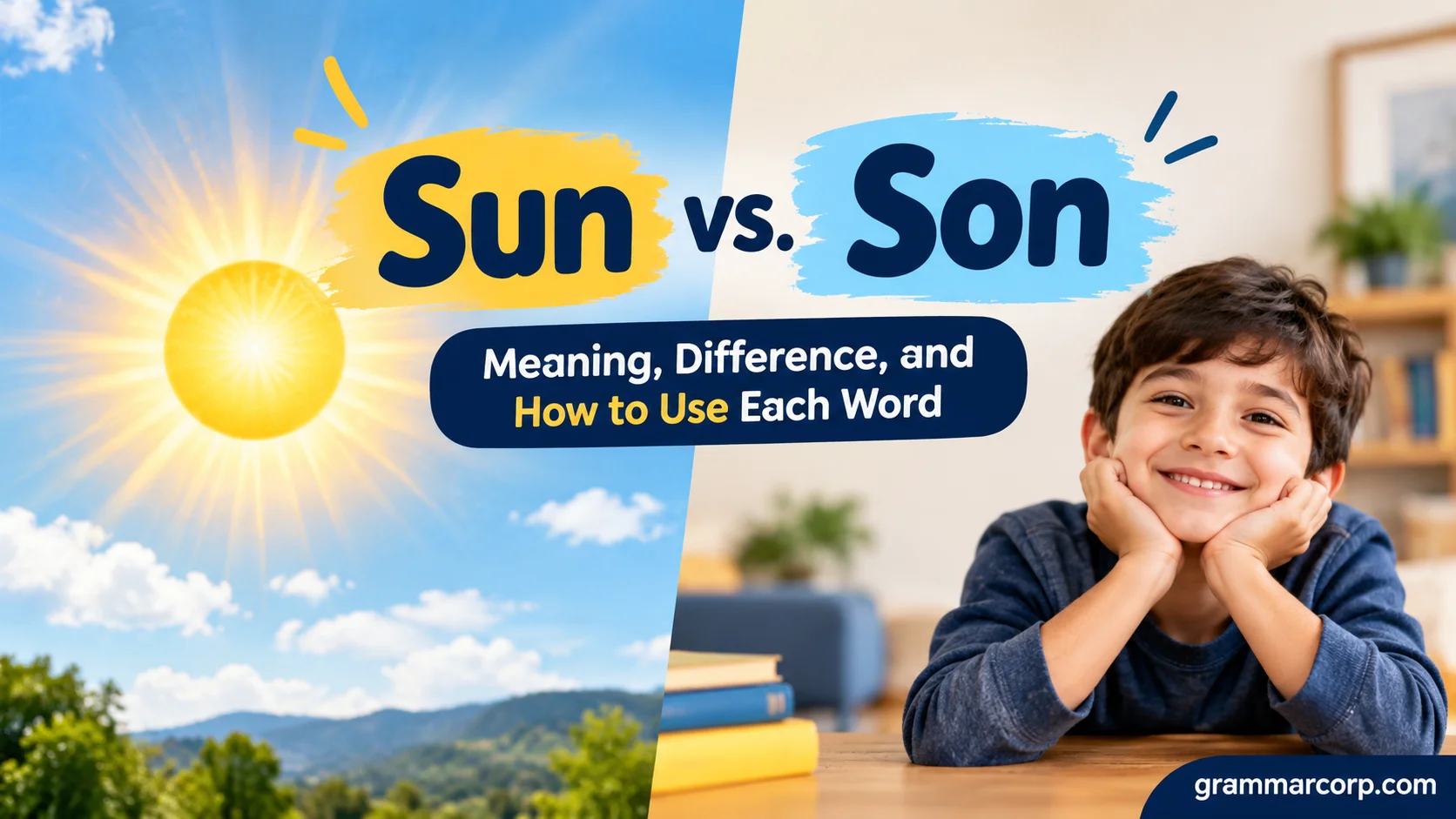
Understanding Sun vs. Son: Meaning, Difference, and How to Use Each Word helps English learners avoid spelling mistakes and choose the correct word in everyday communication.
The sun is a star in the solar system that appears in the sky and provides Earth with daylight, natural light, heat, and energy that support life. A son, however, is a child or male offspring in a family, connected to a parent through a parent-child relationship. These words are homophones because they have the same pronunciation in standard English but different meanings and spellings.
Although their spelling differs by a single letter, this small change can create word confusion for native speakers, non-native speakers, and other English learners. A useful spelling clue is to associate sun with sunlight and solar energy, while son relates to family, father, and offspring. This simple approach strengthens word recognition, spelling accuracy, and correct word choice.
In my experience of studying English grammar, learning words through context and practical sentence examples is more effective than memorizing spelling rules alone. For example, “The sun provides light and heat energy” describes a celestial body, while “Her son is preparing for school exams” refers to a family member. Imagine a fairy tale in which a prince calls himself the rising sun instead of the loving son when speaking to his father. The resulting laughter illustrates how an amusing error can change the meaning of a sentence and create confusion in communication. Such storytelling provides a memorable way to understand semantic differences and improve correct usage.
Quick Answer:
The difference between sun and son is their meaning and spelling, even though they have the same pronunciation.
- Sun means the star at the center of our solar system. It can also refer to the sunlight or warmth produced by that star.
- Son means a male child in relation to a parent or parents.
- Sun and son are homophones because they sound the same but have different spellings and meanings.
- The easiest way to remember them is sun = sky and son = family.
For example:
The sun is shining brightly.
Here, sun refers to the star in our solar system.
Her son is playing outside.
Here, son refers to her male child.
Comparison Overview
The easiest way to understand sun vs. son is to compare their meanings side by side.
| Feature | Sun | Son |
| Meaning | The star at the center of our solar system | A male child |
| Pronunciation | /sʌn/ | /sʌn/ |
| Part of speech | Noun | Noun |
| Main context | Astronomy, weather, daylight, nature | Family and relationships |
| Spelling clue | Contains u | Contains o |
| Example | The sun is setting. | Their son is sleeping. |
| Related words | sunlight, sunshine, sunrise, sunset | father, mother, daughter, child |
Both words usually sound like sun when spoken. That means you can’t depend on pronunciation to choose the correct spelling.
Instead, look at the meaning of the sentence.
If you’re talking about something in the sky that gives Earth light and heat, use sun. If you’re talking about someone’s male child, use son.
Main Differences Between Sun vs. Son
The biggest difference between sun vs. son comes down to what each word represents.
Sun Refers to a Star
The Sun is the star at the center of our solar system. Earth and the other planets orbit it because of its gravity.
The Sun provides most of the energy that supports life on Earth. Its light and heat influence Earth’s climate, weather, and natural processes such as photosynthesis.
In everyday writing, sun can also refer to sunlight or sunshine.
For example:
- The sun is coming through the window.
- We spent the afternoon in the sun.
- The plants need sun to grow.
- The sun disappeared behind the clouds.
- The sun rises in the east and sets in the west.
In astronomy, Sun may be capitalized when the word specifically names our star. In ordinary expressions, lowercase sun is common.
Son Refers to a Male Child
A son is a male child in relation to a parent or parents.
The word doesn’t necessarily mean a young boy. Someone can remain their parents’ son throughout adulthood.
For example:
- They have one son and two daughters.
- Her son starts college this fall.
- His son helped him with the project.
- The couple welcomed their first son.
- Their adult son lives nearby.
The key idea is simple: son describes a family relationship.
Sun and Son Have Different Spelling
Although sun and son sound alike, their letters point toward different meanings.
The u in sun can help you associate the word with the sky.
The o in son can remind you of a family word connected with a boy or male child.
These aren’t grammar rules. They’re memory tricks. Their real difference comes from meaning and spelling.
What Does Sun Mean?
The word sun primarily refers to the star that sits at the center of our solar system.
The Sun is enormous compared with Earth. Its diameter is about 1.39 million kilometers, while Earth’s diameter is about 12,742 kilometers. The Sun also contains about 99.8% of the total mass of the solar system.
Those facts help explain why the Sun dominates our planetary system.
Sun in Astronomy
In scientific writing, Sun refers specifically to our star.
The Sun is a G-type main-sequence star, often described as a G2V star. It formed about 4.6 billion years ago and is roughly 150 million kilometers from Earth on average.
The Sun isn’t simply a bright object in the daytime sky. It powers many processes that make Earth’s environment suitable for life.
Its energy drives:
- Photosynthesis
- Earth’s climate system
- The water cycle
- Weather patterns
- Plant growth
- Solar power generation
Sun in Everyday English
You don’t need to discuss astronomy every time you use sun.
In everyday English, the word often describes daylight, warmth, or exposure to sunlight.
Consider these examples:
- The sun feels warm today.
- The morning sun filled the room with light.
- We watched the sun set.
- The clothes dried in the sun.
- Clouds covered the sun.
Here, context tells you that sun relates to sunlight, daylight, or the astronomical object.
Common Words With Sun
English contains many compound words and expressions built around sun.
| Word or Phrase | Meaning |
| Sunlight | Light that comes from the Sun |
| Sunshine | Direct or visible sunlight |
| Sunrise | The apparent rising of the Sun above the horizon |
| Sunset | The apparent setting of the Sun below the horizon |
| Sunbeam | A beam or shaft of sunlight |
| Sunflower | A flowering plant whose name comes from its association with the Sun |
These words all retain the connection between sun and light or the sky.
What Does Son Mean?
The word son describes a male child in relation to a parent.
It identifies a family relationship rather than an object, place, or natural phenomenon.
Son as a Family Relationship
A person may say:
- My son is at school.
- Their son enjoys reading.
- Her son called yesterday.
- His son works in engineering.
- Our son is learning to drive.
In each sentence, the son identifies a male child or male descendant.
Son Can Refer to an Adult
One common misunderstanding is thinking that son only describes a young boy.
That’s not true.
A person remains someone’s son regardless of age. A 5-year-old can be a son. A 25-year-old can be a son. An elderly man can still be his parents’ son.
For example:
Their son is 35 years old and lives in another city.
The word son still works because the relationship hasn’t changed.
Possessive Forms of Son
The word son frequently appears with possessive words.
Examples include:
- my son
- your son
- his son
- her son
- their son
- John’s son
These constructions make the family relationship clear.
Sun vs. Son in Sentences
Seeing the words in real sentences makes the sun vs. son difference much easier to recognize.
| Sentence | Correct Word | Explanation |
| The sun is bright today. | Sun | Refers to the star. |
| Their son is at school. | Son | Refers to a male child. |
| The plants need sun. | Sun | Refers to sunlight. |
| Her son loves science. | Son | Refers to her male child. |
| We watched the sun set. | Sun | Refers to the Sun near the horizon. |
| His son called him. | Son | Refers to a family member. |
Paired Examples
Consider how changing one letter completely changes the meaning:
- The sun is rising.
- Their son is rising early.
The first sentence discusses the sky. The second discusses a person.
Another pair:
- The sun warmed the garden.
- Her son watered the garden.
Again, one word describes a natural object while the other describes a family member.
This is why context matters so much with homophones.
Why Do Sun and Son Sound the Same?
Sun and son are homophones.
A homophone is a word that has the same pronunciation as another word but a different meaning or spelling.
Other familiar English homophones include:
- sea / see
- right / write
- flower / flour
- pair / pear
- two / too / to
English contains many of these pairs because its vocabulary developed from several languages and historical sound changes.
Sun and Son Pronunciation
Both sun and son are normally pronounced:
/sʌn/
The vowel sound is the same in both words.
That’s why someone listening to a sentence can’t always tell which spelling the speaker intends.
For example, if someone says:
My son is outside.
You hear the same central word sound as in:
The sun is outside.
The meaning comes from the surrounding words and context.
Why Spelling Still Matters
Speaking may not reveal the difference, but writing does.
Compare:
The son is shining.
This suggests that a male child is somehow shining. The sentence doesn’t express the intended meaning if you’re discussing daylight.
The correct version is:
The sun is shining.
Similarly:
My sun is at school.
If you’re talking about your male child, the correct spelling is:
My son is at school.
Both incorrect versions contain real English words. That’s why ordinary spell-checking may not always catch the mistake.
How to Remember Sun vs. Son
You don’t need a complicated grammar rule to remember sun vs. son.
A simple association works well:
Sun = Sky
Think about the sun in the sky.
Words associated with it include:
- sunlight
- sunshine
- sunrise
- sunset
- solar
If your sentence involves light, heat, daylight, or astronomy, sun is probably the word you need.
Son = Family
Think about a son in a family.
Words that commonly appear nearby include:
- mother
- father
- parent
- daughter
- child
- brother
- family
If the sentence discusses someone’s male child, choose son.
A Simple Memory Test
Ask yourself:
Am I talking about the sky or a family member?
- Sky → sun
- Family → son
This two-word rule solves most sun or son spelling problems immediately.
Common Mistakes With Sun and Son
Because the two words sound identical, writers often type the wrong one.
Mistake: Using Sun for a Male Child
Incorrect:
My sun is studying at school.
Correct:
My son is studying at school.
The sentence refers to a male child, so son is correct.
Mistake: Using Son for the Star
Incorrect:
The son is shining brightly.
Correct:
The sun is shining brightly.
The sentence describes the star in our solar system, so sun is correct.
Mistake: Trusting Spell-Check Too Much
Spell-checking software often checks whether a word is spelled correctly. It doesn’t always understand whether you’ve chosen the correct word for the context.
Both sun and son are correctly spelled English words.
That means a sentence such as:
My sun plays soccer.
may not trigger a basic spelling warning even though son is the intended word.
This is a useful lesson about proofreading: correct spelling doesn’t always mean correct word choice.
Mistakes in Text Messages
Fast typing can make homophone mistakes especially common in:
- Text messages
- Social media posts
- Comments
- Emails
- School assignments
- Voice-to-text messages
A quick reread can catch most errors.
Look for the surrounding meaning. If the sentence describes a family member, check whether you’ve written son. If it describes daylight or the star, check for sun.
Sun vs. Son: Practical Examples
Let’s look at several everyday situations.
Talking About Weather
Use sun:
The sun finally came out after the rain.
The sentence describes daylight and weather.
Talking About Family
Use son:
Her son came home after school.
The sentence describes a male child.
Talking About Plants
Use sun:
This plant grows best with plenty of sun.
Here, sun refers to sunlight.
Talking About a Parent
Use son:
His son helped him repair the fence.
The word identifies a family relationship.
Talking About Astronomy
Use Sun:
Earth orbits the Sun.
The word identifies the specific star at the center of our solar system.
Read More : Lifetime or Life Time: Which One Is Correct?
A Short Case Study: Why Context Beats Pronunciation
Imagine a student writing this paragraph:
The son came out after the storm. The garden looked brighter because of the son. My sun helped me plant flowers.
At first glance, everything may look familiar because all three words are valid English words.
However, context reveals two mistakes.
A corrected version would be:
The sun came out after the storm. The garden looked brighter because of the sun. My son helped me plant flowers.
This example demonstrates an important principle of English spelling: homophones require contextual reading.
You can’t simply ask how the word sounds. You must ask what the word means.
Sun vs. Son: Quick Comparison
Here’s the fastest reference to keep handy:
| If You Mean… | Use |
| The star at the center of our solar system | Sun |
| Daylight or sunlight | Sun |
| Warmth from the Sun | Sun |
| Sunrise or sunset | Sun |
| A male child | Son |
| Someone’s male descendant | Son |
| A family relationship | Son |
The core distinction is remarkably simple:
Sun = the star or its light.
Son = a male child.
FAQs:
1. What is the difference between sun and son?
The sun is a star that provides Earth with light and heat, while a son is a male child in a family. They sound the same but have different meanings and spellings.
2. Are sun and son homophones?
Yes, sun and son are homophones because they have the same pronunciation in standard English but different spellings and meanings.
3. How can I remember the correct spelling of sun and son?
Connect the sun with sunlight, the sky, and solar energy. Remember son by thinking about a child, a parent, or a family relationship. These associations make the words easier to distinguish.
4. Can sun and son be used interchangeably?
No, they cannot be used interchangeably because they describe different things. Using the wrong word can change a sentence’s meaning and confuse the reader.
5. What are some examples of sun and son in sentences?
Here are two simple examples:
- Sun: The sun provides light and heat to Earth.
- Son: Their son enjoys reading books.
These examples show how context helps you choose the correct word.
Conclusion:
Understanding sun vs. son becomes easier when you connect each word with its meaning and context. The sun refers to the star that gives Earth light and heat, whereas a son refers to a male child in a family.
Although these homophones sound alike, their spelling and meaning are different. With regular reading, writing, and spelling practice, you can avoid common mistakes and use both words correctly in everyday communication.











1 thought on “Sun vs. Son: Meaning, Difference, and How to Use Each Word”