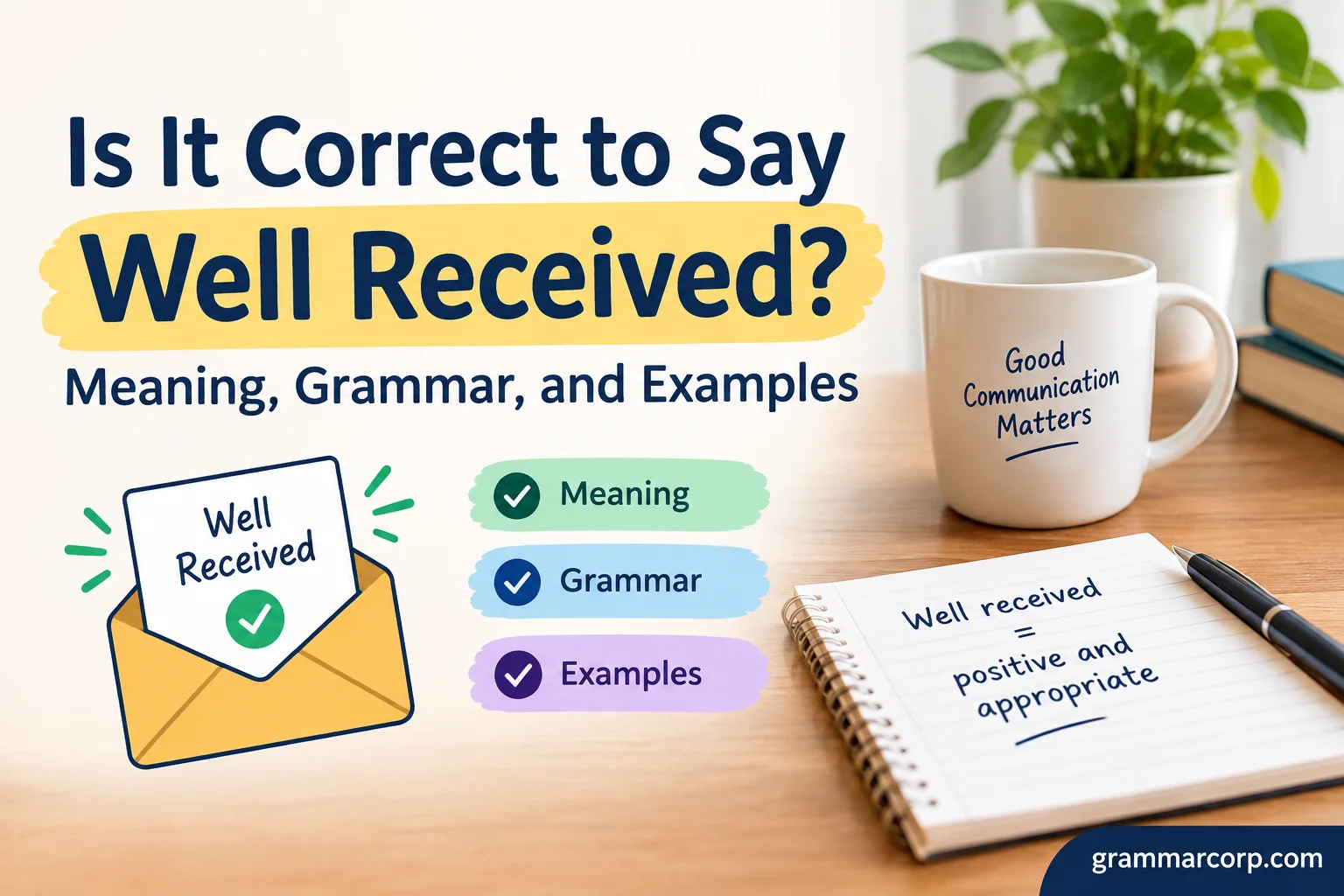
In professional communication, the right words help your message feel clear and understood. Is It Correct to Say Well Received? Meaning, Grammar, and Examples, well received is a polite, professional phrase often used in emails and workplace conversations to describe information, documents, feedback, a proposal, report, request, presentation, or project update that was accepted positively.
The best way to use it depends on the situation, meaning, and proper usage: well received normally appears after a verb, while well-received appears before a noun as a compound modifier.. For daily communication, simple, warm, and natural language can make writing more personal and meaningful. When professionals are exploring alternative expressions rather than repeating the same term, clearer wording can improve clarity and tone.
Depending on the context, thank you for the update, I received your email, and your feedback was appreciated and can provide warmer alternatives. These professional email phrases work well for emails, reports, requests, proposals, and updates, while workplace communication benefits from intentional expressions that help readers understand acknowledgment, approval, or appreciation.
Quick Answer:
Yes, it is correct to say well received.
The phrase well received means that something was accepted, welcomed, appreciated, or viewed positively.
Use it without a hyphen when it follows a verb:
- The presentation was well received.
- The proposal was well received by the committee.
- Her speech was well received by the audience.
Use well-received when it comes directly before a noun as a compound adjective:
- It was a well-received presentation.
- She delivered a well-received speech.
- They launched a well-received product.
Oxford’s usage guidance gives the same general pattern for compound adjectives beginning with well: they generally appear without a hyphen after a verb and with a hyphen before a noun.
So the easiest rule to remember is:
After a verb: well received. Before a noun: well-received.
However, the phrase has another meaning worth understanding. Well received usually describes a positive response. It doesn’t simply mean that someone received or opened a message.
Comparison Overview
| Expression | Correct? | Typical position | Meaning | Example |
| well received | Yes | After a verb | Received positively | The proposal was well received. |
| well-received | Yes | Before a noun | Positively received | It was a well-received proposal. |
| received well | Yes | Varies | Received positively | The audience received the speech well. |
| received with thanks | Yes | Email acknowledgment | Confirms receipt with thanks | Received with thanks. |
| poorly received | Yes | After a verb | Received negatively | The proposal was poorly received. |
| favorably received | Yes | Formal contexts | Received positively | The report was favorably received. |
The key difference isn’t the meaning of well received and well-received. They express essentially the same idea. The main difference is how they function in the sentence.
Main Differences Between Well Received, Well-Received, and Received Well
These expressions can look almost identical at first glance. Their grammatical positions make the difference.
Well received
Use well received when the phrase comes after a verb such as was, were, is, has been, or will be.
Examples:
- The new policy was well received.
- The book has been well received by readers.
- The announcement was well received by employees.
Here, the phrase describes how people responded to something.
Well-received
Use well-received when the two words work together before a noun.
Examples:
- It was a well-received policy.
- She gave a well-received presentation.
- They released a well-received book.
The hyphen shows that well and received form one compound modifier for the noun that follows.
Received well
Received well can also be grammatically correct. However, it often sounds less natural than well received when you’re describing the general reception of something.
Compare these sentences:
- The presentation was well received by the audience.
- The audience received the presentation well.
Both communicate a positive response. The second version changes the sentence from passive to active voice.
The first is usually the more natural choice when the thing receiving the reaction is the focus.
What Does “Well Received” Mean?
Well received means that something got a positive response from the people who experienced, considered, reviewed, or encountered it.
The response might involve:
- Approval
- Appreciation
- Enthusiasm
- Acceptance
- Support
- Positive reviews
- General popularity
- A favorable reaction
For example:
The proposal was well received by the board.
This means the board responded positively to the proposal. It doesn’t necessarily mean every board member completely agreed with every detail.
That’s an important distinction.
Well received usually describes an overall favorable response. It doesn’t automatically mean universally loved, perfect, or completely accepted.
Collins defines well-received as something that has been greeted or reviewed with approval.
Examples of the meaning
Consider these sentences:
- The new restaurant was well received by local customers.
- Her research was well received at the conference.
- The announcement was well received by employees.
- The film was well received by critics.
- His suggestion was well received during the meeting.
In each example, people reacted favorably to something.
What “well received” does not necessarily mean
The phrase doesn’t always mean:
- Everyone agreed.
- Everyone loved it.
- It became successful.
- It made money.
- Nobody criticized it.
- It achieved its intended goal.
For instance, a product can receive positive reviews while still selling poorly.
Likewise, a proposal can be well received without being approved.
That’s why well received describes reception, not necessarily the final outcome.
Is “Well Received” Grammatically Correct?
Yes. Well received is grammatically correct standard English.
It commonly appears in passive constructions such as:
- The speech was well received.
- The report was well received.
- The proposal has been well received.
- The new feature is well received by users.
The underlying idea becomes clearer if you turn the sentence into an active voice.
Passive voice
The audience received the presentation well.
Active voice
The presentation was well received by the audience.
Both sentences describe the same basic reaction.
The passive version places the presentation at the center of attention. That’s why it works especially well in reports, reviews, business writing, and formal summaries.
Oxford provides The product has been well received by consumers as a standard example of this construction.
Why “well” matters
The word well tells the reader that the reception was favorable.
Compare:
- The proposal was received.
- The proposal was well received.
- The proposal was poorly received.
The first sentence simply says the proposal was received.
The second says people responded positively.
The third says people responded negatively.
That small adverb changes the meaning considerably.
Should “Well Received” Be Hyphenated?
This is the part that causes the most confusion.
The answer depends on where the phrase appears.
Use “well received” after a verb
When the phrase comes after the noun and a verb, you normally don’t need a hyphen.
Examples:
- The movie was well received.
- The campaign was well received.
- The proposal was well received.
- The presentation has been well received.
- The announcement will be well received.
Here, well received forms part of the predicate describing the subject.
Use “well-received” before a noun
When the phrase comes before a noun and works as one compound modifier, use the hyphen.
Examples:
- a well-received movie
- a well-received campaign
- a well-received proposal
- a well-received presentation
- a well-received announcement
Dictionary sources recognize well-received as an adjective meaning favorably regarded or greeted with approval.
A simple comparison
| Sentence | Correct form |
| The speech was well received. | No hyphen |
| It was a well-received speech. | Hyphen |
| The book was well received. | No hyphen |
| She wrote a well-received book. | Hyphen |
| The campaign was well received. | No hyphen |
| They created a well-received campaign. | Hyphen |
This pattern covers most situations you’ll encounter.
Why Is “Well-Received” Hyphenated Before a Noun?
Hyphens can help readers understand which words belong together.
Look at this phrase:
a well-received proposal
Here, well-received works as one compound modifier describing proposal.
The hyphen connects the words visually.
Without the hyphen, the reader could still understand the sentence in many cases. However, standard usage generally favors the hyphen when the compound appears before the noun.
The same pattern appears in expressions such as:
- well-known author
- well-written article
- well-designed website
- well-organized event
- well-established company
- well-received proposal
Oxford specifically notes this broader pattern with well compounds: the compound normally loses the hyphen when it stands after a verb but uses the hyphen before a noun.
Before the noun
She gave a well-received speech.
After the verb
Her speech was well received.
The meaning stays nearly identical. The grammatical structure changes.
Why “Well Received” Usually Has No Hyphen After a Verb
Consider this sentence:
The proposal was well received.
The words well received appear after was and describe the proposal.
The reader can easily understand the relationship between the phrase and the subject. The compound modifier doesn’t sit directly before another noun.
That’s why the hyphen isn’t normally needed.
Compare:
The proposal was well received.
with:
It was a well-received proposal.
The first sentence uses the open form. The second uses the hyphenated compound adjective.
A useful editing trick
When you’re unsure, look at the word immediately following well received.
If a noun follows and well received describes that noun, the hyphenated form is usually appropriate:
- a well-received article
- a well-received idea
- a well-received product
If the phrase follows a verb and doesn’t directly modify a noun afterward, leave it open:
- The article was well received.
- The idea was well received.
- The product was well received.
“Well Received” vs. “Received Well”
The two constructions can communicate the same basic idea, but they organize the sentence differently.
Well received
The manager’s proposal was well received by the team.
This is a passive construction.
The proposal becomes the subject, while the team identifies the people who responded.
Received well
The team received the manager’s proposal well.
This is an active construction.
The team becomes the subject because the sentence focuses on what the team did.
Which one sounds more natural?
In many formal contexts, well received sounds more natural:
The report was well received by senior management.
This construction is especially common when writing about the reception of:
- Reports
- Products
- Speeches
- Proposals
- Books
- Films
- Research
- Presentations
However, received well isn’t automatically wrong.
For example:
The audience received the speaker’s comments well.
That’s grammatically sound.
The choice depends on what you want to emphasize.
How to Use “Well Received” in a Sentence
The phrase works across many contexts.
In professional writing
Business writers often use well received to describe responses to projects, proposals, presentations, or announcements.
Examples:
- The new proposal was well received by the leadership team.
- The presentation was well received during the quarterly meeting.
- The revised policy was well received by employees.
- The training session was well received by participants.
These sentences work because they describe how a group reacted to something.
In academic writing
Academic writers may use the phrase when discussing research, arguments, papers, presentations, or scholarly work.
Examples:
- The study was well received at the conference.
- The paper was well received by reviewers.
- The researcher’s argument was well received by the audience.
In academic writing, however, precision matters. If you know the specific response, saying exactly what happened can be stronger.
Instead of:
The paper was well received.
You might write:
The paper received positive feedback from three reviewers.
The second version gives the reader more concrete information.
In entertainment
The phrase frequently describes books, movies, shows, performances, and other creative work.
Examples:
- The film was well received by critics.
- The novel was well received by readers.
- The performance was well received by the audience.
- It became a well-received stage production.
The phrase doesn’t guarantee commercial success. A creative work can receive favorable reviews without becoming a major commercial hit.
In everyday communication
You can also use it for ordinary situations:
- Your suggestion was well received.
- Her invitation was well received.
- The idea was well received by everyone at the meeting.
- His joke wasn’t particularly well received.
The last example shows that the phrase can easily take a negative modifier such as not particularly.
Common Mistakes With “Well Received”
Mistake: Using the hyphen everywhere
A common error is writing:
The presentation was well-received by the audience.
The more standard form is:
The presentation was well received by the audience.
The hyphen isn’t normally needed after the verb.
Mistake: Leaving out the hyphen before a noun
Consider:
She gave a well received presentation.
The preferred form is:
She gave a well-received presentation.
Here, well-received directly modifies the presentation.
Mistake: Assuming “well received” means “message received”
This distinction matters in professional email.
Suppose someone sends you a document and you reply:
Well received, thank you.
The recipient may understand that you mean I received the document. However, in broader standard English, well received normally suggests that the thing received a favorable response.
For a simple acknowledgment, clearer wording includes:
- Received with thanks.
- Thanks, I’ve received it.
- Thank you for sending this.
- I’ve received the document.
- Thanks, I’ll review it.
This avoids ambiguity.
Mistake: Treating “well received” as proof of success
Something can be well received without achieving every intended goal.
For example:
The new service was well received but attracted fewer customers than expected.
There is no contradiction. Customers who tried it may have liked it even though overall demand remained low.
Mistake: Using the phrase without evidence in formal reports
In professional or academic writing, well received can sometimes sound vague.
Compare:
The training program was well received.
with:
Ninety-two percent of participants rated the training positively.
The second sentence gives measurable evidence.
Use well received when a general description is enough. Use specific data when the reader needs proof.
Read More : This Is She or This Is Her: Which Is Correct?
Better Alternatives to “Well Received”
Although well received is correct, repeating it throughout a report can make your writing dull.
Choose an alternative based on the exact meaning you want.
| Alternative | Best when you mean | Example |
| well regarded | People have a favorable opinion | The author is well regarded by critics. |
| well liked | People generally like something | The feature is well liked by users. |
| welcomed | Something was accepted positively | The changes were welcomed by employees. |
| appreciated | People valued something | Her efforts were appreciated by the team. |
| favorably received | Formal positive reception | The proposal was favorably received. |
| positively received | A clear positive reaction | The announcement was positively received. |
| met with approval | People approved of something | The plan was met with approval. |
| praised | People expressed strong approval | The design was praised by reviewers. |
| popular | Something gained broad appeal | The new feature quickly became popular. |
The best alternative depends on the evidence behind your statement.
For example, praised is stronger than well received because it suggests explicit positive comments. Popular focuses on appeal or widespread use rather than a specific reception.
“Well Received” in Professional Emails
Well received is appropriate in professional writing when you’re describing a positive reaction.
For example:
The proposal was well received by the management team.
That’s clear and professional.
However, be careful when using well received as a standalone response to an email.
If someone sends you a file and you simply reply:
Well received.
they might wonder whether you mean:
- You received the file.
- You liked the file.
- You approved the file.
- You found the file useful.
The phrase doesn’t clearly communicate a simple receipt.
Better email wording
If you only want to confirm receipt:
Received with thanks.
If you want to confirm receipt and explain what happens next:
Thanks, I’ve received the document and will review it today.
If you want to express approval:
Thank you for sending this. The proposal was well received by the team.
These sentences separate receipt from reaction, making the intended meaning much clearer.
Case Study: Choosing the Right Form
Imagine a company has launched a new customer service program.
A writer could describe the result in several ways.
Version one
The program was well received by customers.
This tells readers that customers responded positively.
Version two
The company launched a well-received customer service program.
Here, well-received modifies program, so the hyphenated form.
Version three
Customers received the program well.
This is grammatically possible and uses an active construction. However, it may sound less natural than the first version.
Version four
Customer surveys showed that 87% of respondents rated the program positively.
This gives specific evidence rather than a general description.
Each sentence has a legitimate purpose.
The first is concise. The second works well as descriptive prose. The third emphasizes the customers. The fourth provides measurable evidence.
The strongest choice depends on what the reader needs to know.
Is “Well Received” Formal or Informal?
Well received works in both formal and informal contexts.
You’ll commonly see it in:
- Business reports
- Academic writing
- News writing
- Reviews
- Marketing
- Workplace emails
- Presentations
- Everyday conversation
It isn’t so formal that you need to avoid it in ordinary speech.
For example:
Your idea was really well received.
sounds perfectly natural in conversation.
In a formal report, you might instead write:
The proposal received a favorable response from the committee.
Both versions are correct. The second simply has a more formal tone.
Can “Well Received” Describe a Person?
Yes, although the context matters.
For example:
The guest speaker was well received by the audience.
This means the audience responded positively to the speaker.
You can also write:
The new manager was well received by the staff.
Here, the phrase describes the person’s reception after joining a group.
However, well received doesn’t necessarily mean that everyone personally liked the person. It describes the overall reaction or welcome.
Does “Well Received” Mean Successful?
Not necessarily.
This distinction is easy to miss.
Reception and success aren’t the same thing.
A movie can receive positive reviews but earn little money.
A product can receive enthusiastic feedback from early users but fail to attract a large market.
A proposal can be well received but later rejected because of budget limitations.
For example:
The proposal was well received, but the company couldn’t fund it.
The sentence makes perfect sense because the proposal received a positive reaction even though it didn’t become a completed project.
So when you write well received, think positive reaction, not automatically successful outcome.
Is “Well Received” Used in American and British English?
Yes. The expression is used in both American and British English.
The basic meaning and grammatical distinction remain the same:
- well received after a verb
- well-received before a noun
Collins lists well-received as an adjective and notes the open form when it appears after the noun.
Oxford’s usage guidance likewise describes the broader hyphenation pattern for well compounds.
So you don’t need to treat this as a British-versus-American spelling issue.
It’s primarily a question of sentence structure.
Quick Rules to Remember
If you forget everything else, remember these rules.
Rule one: Use “well received” after a verb
- The article was well received.
- The idea was well received.
- The event has been well received.
Rule two: Use “well-received” before a noun
- a well-received article
- a well-received idea
- a well-received event
Rule three: “Received well” can be grammatical
- The audience received the speech well.
But well received often sounds more natural when the thing receiving the reaction is the focus.
Rule four: Don’t confuse reception with simple receipt
Well received generally means received positively.
It doesn’t simply mean I received it.
Rule five: Use precise evidence when possible
Instead of saying something was well received, consider giving measurable feedback when the context calls for it.
FAQs:
Is “well received” grammatically correct?
Yes, well received is grammatically correct when it follows a verb and describes a positive response to something.
When should I use “well-received” with a hyphen?
Use well-received before a noun when the phrase works as a compound modifier, such as “a well-received proposal.”
What does “well received” mean?
Well received means that something got a positive, favorable, or approving response from people who encountered it.
Can I use “well received” in professional emails?
Yes. It is common in professional emails, reports, and workplace communication, although simpler alternatives may sometimes sound warmer and more natural.
Does “well received” mean “I got your message”?
Not exactly. Well received usually suggests a positive reaction, while “I received your email” simply confirms that the message was received.
Conclusion:
Well received is a correct and useful expression when you want to describe a positive response. Use well received after a verb and well-received before a noun as a compound modifier.
In professional communication, the phrase works well, but simpler alternatives such as may be more natural when you only want to acknowledge a message.








1 thought on “Is It Correct to Say Well Received? Meaning, Grammar, and Examples”