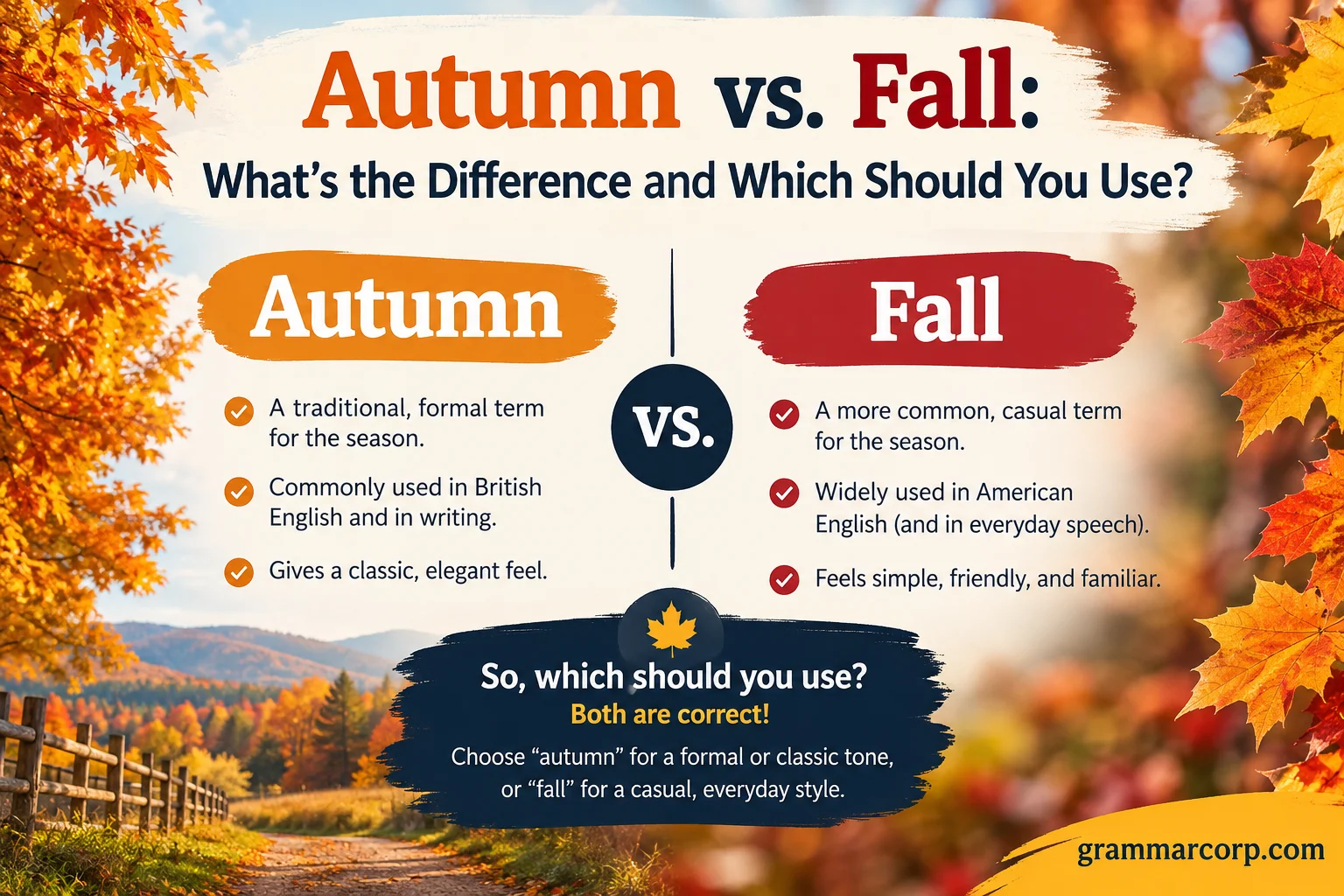
Autumn vs. Fall simply reflects regional English usage, not a difference in the season itself; both names are grammatically correct.
Both autumn and fall describe the same season, the period between summer and winter, when English speakers notice leaves changing color, falling leaves, cooler temperatures, and crisper air during the seasonal transition. The history, origins, and geography of these terms explain their variation. Autumn is the older term, while fall developed from the expression fall of the leaf.
American English, American usage, and conversational English generally favor fall, while British English, British usage, and English usage commonly favor autumn. This pattern appears across English-speaking countries, including the United States, United Kingdom, and England, although English speakers can use either form. In English literature, writers, authors, language learners, and grammar enthusiasts encounter both words, while grammar courses may explain their regional usage and regional differences.
In formal writing, casual writing, everyday language, everyday conversation, everyday speech, and ordinary speech, word choice can reveal location, culture, or preferred style. Seasonal language, seasonal vocabulary, seasonal terminology, seasonal expressions, seasonal expression, seasonal imagery, and seasonal insights all show how language develops naturally across regions.
Quick Answer:
Autumn and fall mean the same thing: the season between summer and winter.
The biggest difference is regional usage.
- Fall is more common in American English.
- Autumn is more common in British English.
- Autumn is also widely used in Australia and New Zealand.
- Both words are understood across major varieties of English.
- Autumn can sound slightly more formal or literary.
- Fall often sounds more natural in everyday American English.
- Neither word is grammatically more correct than the other.
So, if you’re writing for an American audience, fall is usually the most natural choice. If you’re writing for a British audience, autumn is generally the better choice.
Comparison Overview
| Feature | Autumn | Fall |
| Basic meaning | Season between summer and winter | Season between summer and winter |
| Part of speech | Noun | Noun |
| American English | Common | Very common |
| British English | Very common | Less common |
| Australian English | Common | Less common |
| New Zealand English | Common | Less common |
| Historical origin | Latin autumnus, through French/Middle English | Connected to the fall of leaves |
| Everyday American speech | Common | Usually preferred |
| Formal or literary tone | Often perceived as more formal | More conversational in many U.S. contexts |
| Correctness | Correct | Correct |
The table shows why autumn vs. fall is primarily a question of vocabulary preference rather than grammar.
Cambridge Dictionary defines the seasonal meaning of fall as the season after summer and before winter and identifies autumn as the UK term. Oxford similarly labels autumn as especially British English and notes that North American English usually uses fall.
Main Differences Between Autumn vs. Fall
The words differ in several practical ways even though their basic meaning remains the same.
Regional Usage
The clearest difference is geography.
In the United States, people commonly say:
- fall weather
- fall semester
- fall foliage
- fall colors
- next fall
- this fall
In Britain, autumn is the usual choice:
- autumn weather
- autumn term
- autumn leaves
- autumn colors
- next autumn
- this autumn
This doesn’t mean Americans never use autumn. They certainly do. Likewise, people in Britain understand fall when it refers to the season.
The distinction is about what sounds normal and familiar within a particular variety of English.
Formality and Style
There is also a small stylistic difference.
Autumn often has a more formal, traditional, or literary feel. You might encounter it frequently in descriptive writing, literature, poetry, or British publications.
Fall often feels more conversational in American English. It’s particularly common in everyday speech and familiar American expressions.
However, don’t turn this stylistic tendency into a strict grammar rule.
An American writer can absolutely use autumn. A writer doesn’t become more formal simply by replacing every instance of fall with autumn.
Likewise, fall isn’t an informal or incorrect word. It is a standard English noun with a long history.
Common Expressions
Regional vocabulary becomes especially noticeable in fixed phrases.
For example, American English commonly uses:
- fall semester
- fall break
- fall foliage
- fall fashion
- fall sports
- fall season
British English commonly uses:
- autumn term
- autumn leaves
- autumn colors
- autumn collection
- autumn weather
- early autumn
The difference is useful to understand if you’re learning English because individual words often become natural through collocations, or words that commonly appear together.
Historical Development
The history is perhaps the most surprising part.
Both autumn and fall originated in Britain. The idea that fall was created by Americans isn’t accurate.
According to Merriam-Webster, autumn entered English in the 1300s from Latin autumnus. The word had earlier French connections as well.
The word fall developed differently. Writers used expressions involving the fall of the leaves, referring to the time when leaves dropped from trees. Over time, the longer expression was shortened to simply fall. Merriam-Webster dates this shortened seasonal use to the 1600s.
That gives us a simple historical picture:
autumn → older seasonal name
fall of the leaves → fall → seasonal name
Both words then traveled with English speakers to North America.
Where Does the Word “Autumn” Come From?
The history of autumn reaches much further back than modern British or American English.
Oxford gives the word origin as Late Middle English, coming from Old French autompne or directly from Latin autumnus.
Merriam-Webster similarly traces it through Middle English and Anglo-French to Latin autumnus.
That Latin connection helps explain why autumn looks different from the names of the other seasons.
Consider the familiar sequence:
- spring
- summer
- autumn
- winter
Three of these words have very old Germanic roots. Autumn comes from a different linguistic route.
Autumn and the Older Word “Harvest”
Before autumn became established, harvest was used as a name for this part of the year.
That made practical sense because this period was closely associated with gathering crops.
But harvest had a problem. It could refer both to:
- The time when crops were gathered.
- The actual process or result of gathering those crops.
That overlap could create ambiguity.
The arrival and spread of autumn gave English speakers a clearer name for the season itself.
Today, harvest remains an important word, but it doesn’t normally function as the standard name for the entire season.
Where Does the Word “Fall” Come From?
The seasonal meaning of fall has an unusually visual origin.
Think about what happens to deciduous trees as the season progresses. Leaves change color, detach from branches, and fall toward the ground.
English writers used expressions involving the fall of the leaf or fall of the leaves. Eventually, fall could stand on its own as the name of the season.
This wasn’t originally an American invention.
Merriam-Webster explains that the seasonal sense developed in Britain and that the shorter form fall appeared in the 1600s.
The ordinary word fall itself is much older. Merriam-Webster traces the noun and verb to Middle English and Old English roots, with the verb’s first known use dating to before the 12th century.
So there are really two related stories:
fall = the action of dropping
fall = the season associated with falling leaves
That connection remains easy to see in modern phrases such as fall foliage and fall colors.
Why Do Americans Say “Fall” While the British Say “Autumn”?
This difference developed gradually as varieties of English became more distinct.
Both autumn and fall were available in English when English settlers moved to North America.
For a long time, autumn remained widely used. Merriam-Webster notes that the seasonal sense of fall wasn’t entered into a dictionary until Samuel Johnson’s Dictionary of the English Language in 1755.
Over time, however, fall became strongly associated with American English.
By the 19th century, American English dictionaries were identifying the seasonal use of fall as distinctly American. Merriam-Webster cites an 1816 observation that the season was commonly called fall in North America.
Language doesn’t always change because someone makes a deliberate decision.
Words become popular through repeated everyday use. Once a community adopts a particular word, families, schools, newspapers, businesses, and institutions continue passing it along.
Regional Preference Today
A simple way to remember the modern pattern is:
United States → fall
United Kingdom → autumn
Australia → autumn
New Zealand → autumn
Canada is more mixed and can use both terms.
These are general tendencies rather than rigid rules. English-speaking communities contain enormous regional and individual variation.
Is “Autumn” More Formal Than “Fall”?
This question doesn’t have a simple yes-or-no answer.
Autumn can feel more formal or literary, especially to American readers. That’s partly because fall is so strongly established in everyday American speech.
For example:
The autumn landscape looked beautiful after the rain.
This can sound slightly more literary than:
The fall landscape looked beautiful after the rain.
But the difference isn’t a grammar rule.
In American English
You might naturally hear:
- fall semester
- fall break
- fall weather
- fall colors
These are completely normal expressions.
You might also see:
- autumn collection
- autumn landscape
- autumn traditions
These aren’t wrong. They simply carry a somewhat different stylistic flavor.
In British English
Autumn is the ordinary word, so it doesn’t necessarily feel formal to British speakers.
That’s an important point for English learners.
A word can feel formal in one variety of English simply because another word dominates everyday conversation.
How to Use “Autumn” and “Fall” in a Sentence
Both words normally function as nouns when they name the season.
Using “Autumn”
Examples include:
- We usually travel in autumn.
- The leaves change color in autumn.
- It was a particularly wet autumn.
- The autumn weather was mild.
- Classes begin in early autumn.
Oxford lists common combinations such as autumn leaves, autumn colors, autumn term, and early autumn.
Using “Fall”
Examples include:
- We usually travel in the fall.
- The leaves change color in the fall.
- It was a particularly warm fall.
- The fall weather was mild.
- Classes begin in the fall.
Cambridge gives examples including fall day, fall colors, fall foliage, and fall semester.
“In Autumn” vs. “In the Fall”
One small construction difference is worth noticing.
British English commonly uses:
in autumn
American English commonly uses:
in the fall
Both are grammatical.
You’ll also see in the autumn, particularly in British English. The choice of article can depend on the variety of English and the specific construction.
Are Autumn and Fall Capitalized?
Usually, no.
Season names are normally common nouns, so they aren’t automatically capitalized.
Correct:
- We visited in autumn.
- I love fall weather.
- Winter comes after fall.
- Spring arrives before summer.
Capitalization can change when the season name appears at the beginning of a sentence or in certain titles and proper names.
Merriam-Webster specifically explains that season names such as spring, summer, fall, autumn, and winter are normally lowercase because they are common nouns.
Correct Examples
- Autumn is my favorite season.
- I love walking through the park in autumn.
- Fall begins after summer.
- We enjoy fall foliage every year.
The first examples use capital letters because the words begin sentences.
Read More : What Does Hullabaloo Mean? Definition, Origin, Pronunciation & Examples
Autumn vs. Fall Examples in Real Contexts
Seeing the words in context makes the distinction much easier.
Everyday Conversation
American English:
I love the cool weather in the fall.
British English:
I love the cool weather in autumn.
Both sentences communicate essentially the same idea.
Education
American English commonly uses:
fall semester
British English commonly uses:
autumn term
Oxford specifically lists autumn term as a British English expression, while American English commonly uses fall semester.
Nature
American:
- fall foliage
- fall colors
- fall leaves
- fall weather
British:
- autumn foliage
- autumn colors
- autumn leaves
- autumn weather
Fashion
Both varieties can use seasonal fashion language:
- fall collection
- autumn collection
- fall fashion
- autumn fashion
The preferred word depends largely on the intended audience and publication style.
A Simple Case Study: Choosing the Right Word for Your Audience
Imagine a website publishing articles for readers in the United States.
The writer has two possible headlines:
Fall Travel Guide for New England
Autumn Travel Guide for New England
Both are grammatically correct.
However, Fall Travel Guide may feel more immediately natural to a U.S. audience because fall is the dominant American term.
Now imagine a British travel website discussing the same topic:
Autumn Travel Guide
That version fits the vocabulary British readers generally expect.
The important lesson isn’t that one headline is better English.
The lesson is that audience alignment matters.
Good writing doesn’t just communicate a technically correct meaning. It also uses vocabulary that feels natural to the intended readers.
Common Questions About Autumn vs. Fall
Are autumn and fall the same thing?
Yes. Autumn and fall are two names for the same season, the period between summer and winter. The main difference is regional preference rather than meaning.
Is fall American or British English?
Fall is strongly associated with American English today, although its seasonal use originated in Britain. It remained in common use in North America while becoming less dominant in Britain.
Is autumn British English?
Autumn is especially common in British English, but Americans also understand and use it. Oxford specifically identifies autumn as especially British English while noting that North American English usually uses fall.
Why do Americans say fall?
The seasonal word fall developed from expressions describing the falling of leaves. Both fall and autumn were historically used in Britain, but fall eventually became much more strongly associated with American English.
Which is more formal, autumn or fall?
Autumn can sound somewhat more formal or literary, particularly in American English. However, this isn’t a strict grammatical distinction. Both are standard English words.
Can Americans say autumn?
Absolutely. Autumn is correct American English, even though fall is generally more common in the United States.
Can British people say fall?
Yes. British speakers understand the seasonal meaning of fall. However, autumn is the normal British term in most contexts.
Which word should English learners use?
Choose the word that matches your target variety of English.
If you’re mainly communicating with Americans, fall will usually sound more natural.
If you’re learning British English, autumn is generally the better default.
Most importantly, don’t worry about being misunderstood. Both words are widely recognized.
Autumn vs. Fall: Which One Should You Use?
There’s no universal winner.
The best choice depends on who you’re writing for.
Choose “Fall” When:
- Your audience is primarily American.
- You’re writing in American English.
- You’re discussing a fall semester.
- You’re talking about fall foliage.
- You’re writing everyday American content.
- You want the vocabulary that most U.S. readers expect.
Choose “Autumn” When:
- Your audience is primarily British.
- You’re writing in British English.
- You’re targeting readers in Australia or New Zealand.
- You’re using a literary or traditional style.
- Your publication consistently follows British vocabulary.
- Autumn term is the established phrase in your context.
If You Write for an International Audience
Either word can work.
The key is consistency.
If an article begins by using fall, don’t randomly switch to autumn every few paragraphs unless there’s a specific reason.
For example, this sounds inconsistent:
Fall brings cooler weather. During autumn, many trees lose their leaves. The fall season is popular for travel.
A cleaner version would consistently use one term:
Fall brings cooler weather. During fall, many trees lose their leaves. The fall season is popular for travel.
Or:
Autumn brings cooler weather. During autumn, many trees lose their leaves. The autumn season is popular for travel.
Consistency helps readers focus on the message instead of noticing unnecessary vocabulary changes.
Interesting Facts About Autumn vs. Fall
Here are several facts that make the history of these words easier to remember:
- Autumn and fall have the same basic seasonal meaning.
- Both words originated in Britain, rather than one being exclusively British and the other exclusively American from the beginning.
- Autumn has roots in Latin through French and Middle English.
- The seasonal use of fall developed from language associated with falling leaves.
- Fall became particularly associated with American English during the development of distinct American usage.
- British English generally prefers autumn.
- American English generally prefers fall.
- Neither word is inherently more correct than the other.
- Season names are normally not capitalized unless normal capitalization rules require it.
FAQs:
Is autumn and fall the same thing?
Yes. Autumn and fall refer to the same season, the period between summer and winter. The main difference is regional usage, not meaning.
Which is more common in American English?
Fall is generally more common in American English and American usage. You’ll often hear it in everyday conversation, everyday speech, and casual communication in the United States.
Which is more common in British English?
Autumn is generally preferred in British English and British usage, particularly in the United Kingdom and England. It’s also common in more formal and literary contexts.
Is “autumn” more formal than “fall”?
Not necessarily. Both words are grammatically correct and widely accepted. However, autumn can sometimes sound more formal or literary because of its stronger association with British English and English literature.
Can I use autumn and fall interchangeably?
Yes. They are interchangeable terms and interchangeable words. Your word choice can depend on your audience, location, writing style, or language preference.
Conclusion:
Autumn vs. Fall is mainly a question of regional language choice, not correctness. Both words describe the same season, and both are widely understood by English speakers. If you’re writing for an American audience, fall will usually sound more natural.
For a British audience, autumn is generally the better choice. In either case, the important thing is to consider your audience preference, regional preference, and overall style.












1 thought on “Autumn vs. Fall: What’s the Difference and Which Should You Use?”