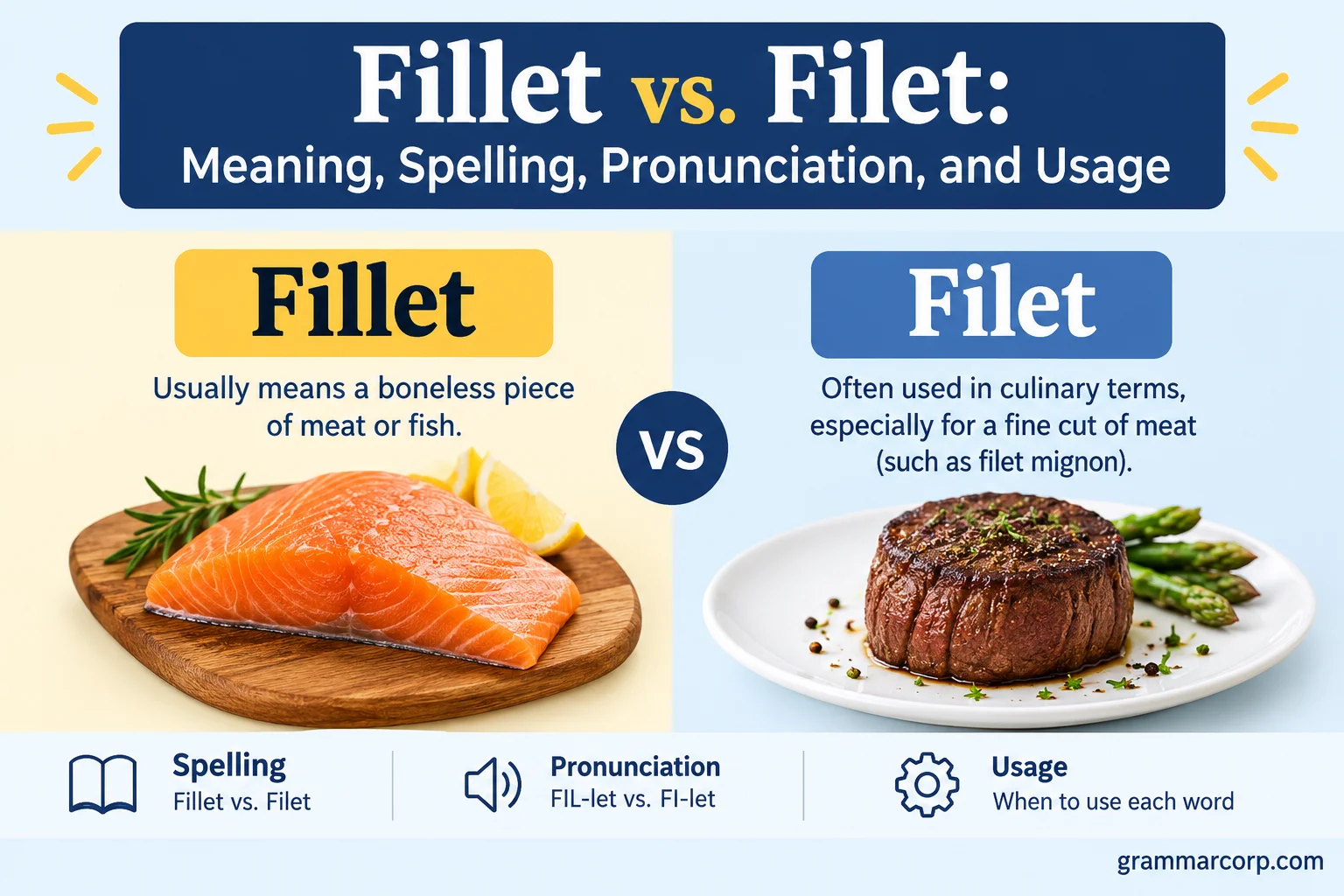
Fillet vs. Filet: Meaning, Spelling, Pronunciation, and Usage explains why these culinary terms differ in spelling, style, and regional use. Fillet vs. Filet is a common spelling question because the two words look almost the same, have a similar sound, and share the same basic culinary meaning: a boneless piece of meat or fish. A fish fillet and fish filet can both describe the same food. In British English, fillet is the standard culinary term, while American English commonly uses filet, although fillet also appears in American contexts, especially in technical terms.
Cambridge gives filet as the U.S. form and fillet as the U.K. form, while Merriam-Webster recognizes filet as a less common variant. In my experience with English terminology, the best spelling choice depends on the variety, region, setting, and preferred form of English. The difference is not only an extra l in the spelling. Pronunciation may show a regional pronunciation difference, while both words can work as nouns and verbs. Their meanings can extend outside food, making the spelling distinction more interesting
A dictionary, dictionary form, dictionary listing, or dictionary definition can clarify these forms. Both are word forms, and filet may appear as a lexical variant or alternate spelling of fillet. This linguistic variation is common in the English language, especially in food-related, meat-related, and fish-related vocabulary. The history also explains why the distinction can feel fuzzier in casual conversations, busy kitchens, and food writing. French, French cuisine, French-derived dishes, and filet mignon influenced modern food terminology, while Latin, Germanic languages, old loanwords, and other loanwords shaped the origins, etymology, and word history of these forms.
Quick Answer:
Fillet and filet can both mean a boneless piece of meat or fish. The main difference is regional usage.
- Fillet is the standard British English spelling.
- Filet is the common American English spelling for the culinary meaning.
- Fillet also appears in American English.
- Both words can work as a noun.
- Both can work as a verb when describing the process of removing meat or fish from bones.
- Filet mignon is the established American culinary spelling.
- Pronunciation can vary depending on the region and the sense of the word.
Cambridge defines filet as “a piece of meat or fish without bones” and labels it as the U.S. form of fillet.
Merriam-Webster goes a little further. It lists fillet as the main entry and gives filet as a variant. Its culinary pronunciation can also differ from the more traditional pronunciation of fillet.
The easiest rule to remember
If you’re writing British English, use fillet.
If you’re writing American English, filet is common for food. Fillet is still valid in many American contexts.
Don’t assume that one spelling is always right and the other is always wrong. Context and regional English matter.
Comparison Overview
Here’s a quick comparison of fillet vs. filet:
| Feature | Fillet | Filet |
| Main culinary meaning | Boneless meat or fish | Boneless meat or fish |
| British English | Standard | Less common |
| American English | Used | Common culinary form |
| Noun | Yes | Yes |
| Verb | Yes | Yes |
| Fish usage | Common | Common in U.S. English |
| Beef usage | Common | Common in U.S. English |
| Pronunciation | Can vary | Usually pronounced with a long “ay” sound in U.S. English |
| Common fixed expression | Fillet steak | Filet mignon |
| Technical meanings | Yes | More limited |
| Basic idea | Cut of boneless meat or fish | Same culinary idea |
Cambridge specifically identifies filet as U.S. and fillet as U.K. for this meaning. Its American Dictionary also recognizes fillet as another form.
That last point matters. The American spelling isn’t an absolute rule.
You may see fish fillet in an American publication. You may also see fish filet. Neither automatically signals a different piece of fish.
Main Differences Between Fillet vs. Filet
The biggest difference between fillet vs. filet comes down to spelling conventions and regional usage.
Fillet is the traditional British spelling
British English normally uses fillet when referring to boneless meat or fish.
Examples include:
- fish fillet
- cod fillet
- salmon fillet
- fillet of beef
- fillet steak
Cambridge lists these examples under its British English entry.
If your audience mainly uses British English then fillet is the natural choice.
Filet is common in American English
American English frequently uses filet for the same culinary idea.
Examples include:
- fish filet
- chicken filet
- filet of beef
- filet mignon
Cambridge labels filet as the U.S. form of fillet.
This explains why an American restaurant menu may use filet while a British menu uses fillet.
Fillet also has wider meanings
This is one reason you shouldn’t treat fillet and filet as perfect replacements in every situation.
Merriam-Webster gives fillet several meanings. These include a narrow strip of material and a rounded junction between surfaces. It also gives architectural uses for the word.
For example:
- a decorative fillet
- a narrow fillet of material
- a mechanical fillet
- an architectural fillet
In engineering and computer-aided design, a fillet can describe a rounded transition between surfaces. That has nothing to do with food.
So while fillet vs. filet often concerns meat and fish, fillet has a much broader vocabulary history.
What Does Fillet Mean?
Fillet can function as both a noun and a verb.
Fillet as a noun
As a noun, fillet commonly means a piece or slice of meat or fish with the bones removed.
Merriam-Webster specifically defines one culinary sense as a piece or slice of boneless meat or fish. It also identifies beef tenderloin as a specific example of the term.
Examples include:
- a salmon fillet
- a cod fillet
- a beef fillet
- a chicken fillet
- several fish fillets
The word doesn’t describe only fish.
You can use fillet for meat as well. The exact meaning depends on the animal and culinary context.
Fillet as a verb
Fillet can also describe the action of cutting meat or fish away from the bones.
For example:
The chef filleted the fish.
Here filleted is the past tense of fillet.
Merriam-Webster defines the verb as meaning “to cut into fillets.”
Common forms include:
- fillet
- fillets
- filleted
- filleting
The spelling becomes especially noticeable in filleting. The final consonant doubles before the -ing ending.
Examples of fillet in sentences
- The chef prepared a fresh salmon fillet.
- We bought two cod fillets for dinner.
- She carefully filleted the fish.
- The recipe calls for four chicken fillets.
- The restaurant serves grilled fillet steak.
These examples show how the same word can describe either the food itself or the action used to prepare it.
What Does Filet Mean?
Filet has a very similar culinary meaning.
Filet as a noun
A filet is a boneless piece of meat or fish.
Cambridge identifies filet as a U.S. noun and gives examples such as chicken or cod filets and filet of beef.
Examples include:
- chicken filet
- cod filet
- beef filet
- fish filet
- filet mignon
The basic concept remains the same: the meat or fish has been separated from its bones.
Filet as a verb
Filet can also function as a verb in American English.
It means to cut a piece of meat or fish from the bones. Cambridge lists the verb alongside the noun and identifies it as the U.S. form of fillet.
For example:
- The cook fileted the fish.
- The chef knows how to filet a whole trout.
- The fish was carefully fileted before cooking.
You may also encounter fileting in American writing.
Is filet a real word?
Yes.
Filet is a legitimate English word. It isn’t simply a spelling mistake caused by forgetting an extra l.
Major dictionaries recognize it in English. Cambridge labels it as the U.S. form of fillet. Merriam-Webster lists it as a variant of fillet.
That makes an important distinction:
Filet is not wrong simply because it doesn’t contain two l’s.
The appropriate spelling depends on the context and variety of English.
Fillet vs. Filet Pronunciation
Spelling isn’t the only source of confusion. Pronunciation also changes between regions and meanings.
How to pronounce fillet
In British English, fillet is commonly pronounced roughly like:
FILL-it
Cambridge gives the British pronunciation as /ˈfɪl.ɪt/.
American English can use another pronunciation for the culinary sense. Cambridge’s American Dictionary gives pronunciations with a long ay sound.
Merriam-Webster also lists more than one pronunciation for fillet.
How to pronounce filet
In American English, filet is commonly pronounced approximately:
fill-AY
Cambridge gives the U.S. pronunciation as /fɪˈleɪ/.
The stress falls toward the second syllable.
Pronunciation comparison
| Word | Common pronunciation | Typical association |
| fillet | FILL-it | British English |
| fillet | fill-AY | Culinary American usage can use this form |
| filet | fill-AY | American English |
| filet | fill-AY / regional variation | Other English contexts |
English pronunciation doesn’t always follow spelling in a neat way.
That’s especially true with words borrowed from French. Filet itself has a French-looking spelling and a pronunciation that doesn’t follow the simplest English reading of the letters.
Fillet vs. Filet in British and American English
Regional English explains much of the confusion.
Fillet in British English
British English strongly favors fillet.
You are likely to see:
- fish fillet
- salmon fillet
- cod fillet
- fillet of beef
- fillet steak
Cambridge labels fillet as the UK form and gives these culinary examples.
So if you’re writing an article for readers in the United Kingdom then fillet is usually the safest choice.
Filet in American English
American English commonly uses filet for food.
The best-known example is probably:
filet mignon
This spelling is deeply established in American culinary English.
American readers may also encounter:
- fish filet
- chicken filet
- beef filet
- filet of beef
Cambridge identifies filet as the U.S. form.
Americans also use fillet
Here’s where a simple rule can become misleading.
It would be inaccurate to claim that Americans always use filet.
American dictionaries recognize fillet too. Cambridge’s American Dictionary describes fillet as a noun and verb and gives filet as an alternative.
Merriam-Webster goes even further by making fillet the main dictionary entry and listing filet as a variant.
So the practical rule is about preference, not absolute correctness.
Fillet vs. Filet in Food Terminology
The difference becomes especially visible in restaurant language.
Fish
Both spellings can describe a boneless portion of fish.
For example:
| British-style usage | American-style usage |
| salmon fillet | salmon filet |
| cod fillet | cod filet |
| trout fillet | trout filet |
| fish fillet | fish filet |
The food itself doesn’t automatically change because the spelling changes.
A salmon fillet and a salmon filet generally describe the same basic type of boneless portion.
Beef
Beef terminology creates a few more interesting distinctions.
British English commonly uses fillet steak or fillet of beef.
American English commonly uses filet in expressions such as filet mignon.
The terms can overlap in what they describe. Yet established culinary names often preserve their own conventional spelling.
Filet mignon
Filet mignon deserves special attention.
It is a fixed culinary expression in American English. Changing it to fillet mignon may make the phrase look unusual to American readers even though fillet is a legitimate English word.
This illustrates a broader writing principle:
Established expressions don’t always follow the simplest spelling rule.
If you’re writing about this specific dish then filet mignon is the standard form most American readers expect.
Fillet vs. Filet in Technical and Architectural Contexts
Food isn’t the only place where fillet appears.
In engineering and architecture, fillet has a different meaning.
Merriam-Webster defines a technical sense as a concave junction where two surfaces meet. It also describes a strip that creates a rounded appearance at such a junction.
Imagine two surfaces meeting at a sharp inside corner.
A designer may replace that sharp corner with a smooth curve.
That rounded transition is called a fillet.
Why this matters
If you work with:
- mechanical design
- engineering drawings
- CAD software
- manufacturing
- architecture
- machining
you’ll frequently encounter fillet.
In this context, replacing the word with filet isn’t a simple British-versus-American food spelling issue.
The technical term is normally written fillet.
Example
A design specification might refer to a 5 mm fillet radius.
That has nothing to do with meat or fish.
This is one of the strongest reasons a complete fillet vs. filet explanation needs more than a simple statement about American and British spelling.
Fillet vs. Filet: Word Origin
The history of these words helps explain why their spellings look so closely related.
Merriam-Webster traces fillet to Middle English filet. The word came through Anglo-French and ultimately connects with Latin filum, meaning thread. Merriam-Webster dates the noun’s first known English use to the 14th century.
That history makes the spelling relationship less surprising.
The word didn’t appear in English as two completely unrelated inventions. The modern forms developed from a shared linguistic history.
From a narrow strip to a piece of meat
The historical connection to a thread or narrow strip is useful because fillet still carries non-food meanings involving narrow strips.
Over time the word developed specialized meanings.
Today you can encounter fillet in several fields:
- food
- architecture
- engineering
- anatomy
- decorative design
Merriam-Webster’s entry reflects these different senses.
Filet also has its own history
Merriam-Webster has a separate entry for filet in another sense involving a type of lace with a square mesh and geometric designs. That entry traces this meaning to French and dates its first known English use to 1838.
This is another reminder that spelling alone doesn’t tell the entire story.
Fillet vs. Filet: Are They Actually Different?
When you’re talking about a boneless piece of meat or fish, fillet and filet usually refer to the same basic idea.
The difference is mainly linguistic.
Here’s what changes:
- Spelling
- Regional preference
- Pronunciation
- Established culinary expressions
- Context
Here’s what usually doesn’t change:
- The basic concept of boneless meat or fish
- The use of the word as a noun
- The ability to use the word as a verb for cutting meat or fish from bones
Cambridge directly connects the two forms by labeling filet as the U.S. form of fillet.
A simple example
Suppose one recipe says:
Place the fish fillet in the pan.
Another says:
Place the fish filet in the pan.
The spelling differs.
The basic culinary instruction doesn’t.
Neither word automatically describes a superior or different cut.
Common Mistakes With Fillet and Filet
Mistake: Calling filet a misspelling
This is one of the most common errors.
Filet is a valid English word.
Cambridge identifies it as a U.S. term. Merriam-Webster lists it as a variant.
Mistake: Saying fillet is only British
This is also too broad.
American English uses fillet too. Cambridge’s American Dictionary explicitly recognizes it.
So saying that Americans never write fillet would be inaccurate.
Mistake: Assuming the spelling changes the food
The extra l doesn’t automatically mean you’re dealing with another cut of meat or fish.
In the culinary sense, the two spellings generally refer to a boneless portion.
Mistake: Switching between spellings without a reason
If you’re writing an article or recipe then consistency matters.
For a British audience:
fish fillet
For an American audience:
fish filet may fit the expected style.
Don’t alternate between the two simply to make your writing look varied.
Spelling variation isn’t the same thing as vocabulary variety.
Mistake: Changing established names
Some culinary expressions have a conventional form.
Filet mignon is the obvious example.
When a term has an established spelling then keep it intact unless your publication’s style guide says otherwise.
Fillet vs. Filet: Practical Examples
The following examples show how the words work in real sentences.
Examples with fillet
- The chef prepared a delicate fish fillet.
- We bought four salmon fillets from the market.
- The recipe calls for one beef fillet.
- She carefully filleted the trout.
- The restaurant serves grilled fillet steak.
- He learned how to fillet a fish properly.
Examples with filet
- The restaurant serves a grilled beef filet.
- She ordered a filet mignon with vegetables.
- The recipe calls for two cod filets.
- The chef fileted the fish before cooking it.
- The menu includes a chicken filet sandwich.
Correctness depends on context
| Example | Status | Explanation |
| fish fillet | Correct | Standard British form and also used in American English |
| fish filet | Correct | Common American form |
| salmon fillet | Correct | Widely recognized |
| salmon filet | Correct | Common U.S. form |
| fillet steak | Correct | Standard British culinary expression |
| filet mignon | Correct | Established culinary expression |
| filet mignon in every British context | Not necessarily preferred | British English commonly uses different terminology |
| fillet radius | Correct | Technical engineering usage |
| filet radius | Usually inappropriate | Technical terminology normally uses fillet |
Filleted vs. Fileted: Which Is Correct?
This question naturally follows from fillet vs. filet.
Both forms can appear because the base verbs vary by spelling.
Filleted comes from fillet.
Fileted comes from filet.
Merriam-Webster explicitly gives filleted and filleting as forms of the verb fillet.
American English can also use forms based on filet.
For example:
- The fish was filleted.
- The fish was fileted.
The first is widely established. The second reflects the filet spelling.
If you’re writing for an international audience then filleted may be more immediately recognizable. If you’re following an American house style that consistently uses filet as a verb then fileted can fit that system.
Case Study: One Word, Two English Styles
Consider a recipe website publishing a fish recipe.
A British version might say:
Season the cod fillets and place them skin-side down in the pan.
An American version might say:
Season the cod filets and place them skin-side down in the pan.
The cooking instruction remains essentially the same.
The spelling reflects the publication’s English variety.
Now consider an engineering manual.
It might say:
Apply a 3 mm fillet to the inside corner.
Here fillet refers to a rounded transition between surfaces.
Changing it to filet would not simply create an American version of the same technical term.
This comparison shows why context matters more than the number of letters in the word.
Read More : A Big Ask Meaning: What It Means and How to Use It
When Should You Use Fillet or Filet?
Use fillet when:
- You’re writing British English.
- You’re describing a boneless cut in a British culinary context.
- You’re using terms such as fillet steak.
- You’re discussing an engineering or architectural rounded junction.
- Your publication’s style guide specifies fillet.
Use filet when:
- You’re writing American English.
- You’re using common American culinary terminology.
- You’re writing filet mignon.
- Your publication consistently uses filet for boneless meat or fish.
The best editing rule
Don’t choose based only on which spelling looks more familiar.
Choose based on:
- Audience
- English variety
- Context
- Established terminology
- House style
Then remain consistent.
Fillet vs. Filet: Quick Decision Guide
Ask yourself a few simple questions.
Are you writing British English?
Use fillet for the culinary sense.
Are you writing American English?
Filet is a common choice for meat and fish. Fillet is also recognized.
Are you writing about filet mignon?
Use filet mignon.
Are you writing about engineering or architecture?
Use fillet when referring to the rounded transition between surfaces.
Are you describing the action of removing meat from bones?
Both fillet and filet can function as verbs depending on regional usage.
Do you need one universal spelling?
There isn’t one spelling that works as the preferred form for every English-speaking audience.
Follow your target variety of English.
Fillet vs. Filet: Final Comparison
| Question | Fillet | Filet |
| Is it a real English word? | Yes | Yes |
| Can it mean boneless meat or fish? | Yes | Yes |
| Can it be a verb? | Yes | Yes |
| Common in British English? | Yes | Less common |
| Common in American English? | Yes | Yes |
| Specifically associated with U.S. culinary usage? | Less strongly | Yes |
| Used in filet mignon? | No | Yes |
| Used in engineering terminology? | Yes | Generally no |
| Does it always describe a different cut? | No | No |
| Is one always correct? | No | No |
FAQs:
1. What is the difference between fillet and filet?
Fillet and filet generally have the same basic meaning: a boneless piece of meat or fish. The main difference is spelling and regional usage. Fillet is more common in British English, while filet is widely used in American English and in some French-derived culinary terms.
2. Is filet or fillet correct?
Both filet and fillet are correct. The preferred spelling depends on the variety of English and the context. In British English, fillet is standard, while American English commonly uses filet.
3. Is filet mignon spelled with filet?
Yes. Filet mignon is the traditional spelling of this French-derived culinary term. The expression refers to a particularly tender cut of beef.
4. Are fillet and filet pronounced the same?
They can have similar or identical pronunciation depending on the speaker and regional variety of English. Pronunciation may vary, so the spelling alone does not always tell you exactly how the word will sound.
5. What does filleting or fileting mean?
Filleting or fileting means carefully separating meat or fish from the bone. The terms are commonly used when discussing food preparation and culinary techniques.
Conclusion:
Fillet and filet share nearly the same culinary meaning, but their spelling reflects differences in English usage, regional preference, and French influence.
Fillet is strongly associated with British English, while filet is common in American English and familiar in expressions such as filet mignon. Understanding these variations makes it easier to choose the appropriate spelling for your audience, setting, and style of writing.














1 thought on “Fillet vs. Filet: Meaning, Spelling, Pronunciation, and Usage”