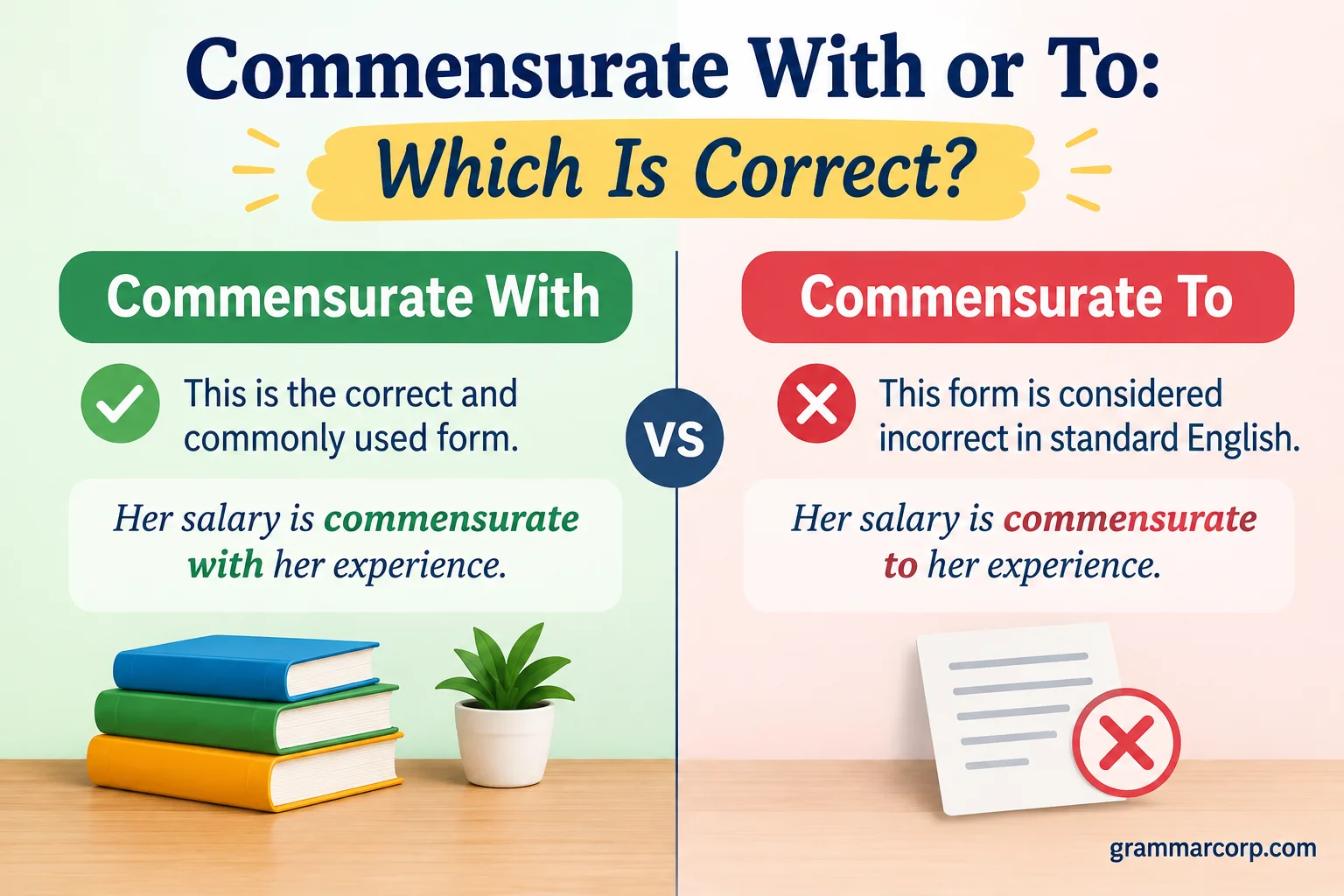
Choosing between Commensurate With or To: Which Is Correct?. Both prepositions appear in English in many different expressions. However, when you use the adjective commensurate to show that one thing matches another in size, degree, quality, value, or importance, standard English uses commensurate with.
For example, you would normally write salary commensurate with experience, not salary commensurate to experience. Major learner’s dictionaries describe commensurate with the pattern commensurate with something. Oxford defines it as matching something in size, importance, or quality skills, experience, duties, rank, and qualifications.
That makes the practical rule quite simple: use “commensurate with” when you mean proportionate, matching, or corresponding to something else.
Quick Answer:
Commensurate with is the standard and preferred construction.
Use commensurate with when one thing corresponds appropriately to another in size, amount, degree, quality, importance, or extent.
Correct examples
- The salary should be commensurate with your experience.
- The punishment should be commensurate with the offense.
- The workload should be commensurate with the available resources.
- The benefits should be commensurate with the responsibilities of the position.
- The price is commensurate with the quality of the product.
Commensurate is not the standard pattern you should choose in careful formal English. Major dictionaries present the adjective with with, including Oxford’s entry commensurate with something and Cambridge’s commensurate with something collocation.
So if you’re writing an email, résumé, report, academic paper, business document, or formal article, the safest choice is commensurate with.
Comparison Overview
The difference becomes easier to understand when you compare the two constructions directly.
| Expression | Standard usage | Recommended in formal writing? | Example |
| Commensurate with | Established standard pattern | Yes | Salary commensurate with experience |
| Commensurate to | Not the usual dictionary pattern | Generally avoid | Salary commensurate to experience |
| Proportionate to | Standard construction | Yes | Punishment proportionate to the offense |
| Equivalent to | Standard construction | Yes | The amount is equivalent to the original cost |
| Corresponding to | Standard construction | Yes | Benefits corresponding to the employee’s role |
The key point is that different adjectives take different prepositions.
You say commensurate with, but you can say proportionate to or equivalent to. English doesn’t always allow you to swap prepositions simply because two adjectives have similar meanings.
Oxford lists commensurate as a formal adjective followed by with something and defines it as matching something in size, importance, quality, and similar characteristics.
The easiest rule to remember
Commensurate goes with “with.”
If you can replace commensurate with proportionate, the meaning becomes clearer. For example:
Salary commensurate with experience
means roughly:
Salary proportionate to experience
Notice that the preposition changes because the adjectives have different established patterns.
Main Differences Between Commensurate With or To
The most important difference isn’t really a difference in meaning. It’s a difference in standard grammatical usage.
“Commensurate with” is the established expression
When commensurate means corresponding or proportionate, with introduces the thing used for comparison.
Consider:
The compensation is commensurate with the employee’s responsibilities.
The sentence says that the compensation corresponds appropriately to the responsibilities.
The same structure appears in:
- Experience commensurate with the position
- Pay commensurate with qualifications
- Resources commensurate with demand
- Effort commensurate with results
- Risk commensurate with reward
Cambridge specifically identifies commensurate with something as a formal collocation. Its examples include salaries matching skills and experience as well as duties matching a person’s rank.
“Commensurate to” is not the normal choice
You may encounter commas in some writing. However, that doesn’t make it the preferred construction.
For standard modern English, especially in polished professional writing, commensurate with is the stronger choice because it follows the established dictionary pattern.
Instead of writing:
The salary should be commensurate to the candidate’s experience.
write:
The salary should be commensurate with the candidate’s experience.
This small change makes the sentence sound natural and follows the construction documented by major dictionaries.
Why the confusion happens
The confusion often comes from another perfectly valid expression:
proportionate to
For example:
- The penalty should be proportionate to the offense.
- The response should be proportionate to the situation.
- The cost should be proportionate to the benefit.
Because commensurate and proportionate have related meanings, writers sometimes transfer to from proportionate to into commensurate to.
That is a common type of preposition mistake. Similar meanings don’t guarantee identical grammatical patterns.
What Does “Commensurate With” Mean?
Commensurate with means that something is appropriately matched or proportionate to another thing.
Merriam-Webster defines commensurate as corresponding in size, extent, amount, or degree, with proportionate listed as a close synonym. It also gives examples such as a job being commensurate with someone’s abilities and experience.
Cambridge gives a closely related definition: something is commensurate when it is in a correct and suitable amount compared with something else.
In simple terms, think of commensurate with as meaning:
- matching
- proportionate to
- corresponding to
- appropriate for the level of
- in keeping with
However, the exact substitute depends on the sentence.
It doesn’t always mean “exactly equal”
This distinction matters.
If someone says:
Her salary is commensurate with her experience.
the sentence doesn’t necessarily mean her salary and experience have equal numerical values. Experience isn’t normally measured in dollars anyway.
Instead, it means the level of compensation is appropriate in relation to the person’s experience.
Likewise:
The response was commensurate with the seriousness of the problem.
This means the response was appropriately matched to the seriousness of the situation.
The relationship can involve degree rather than exact equality.
Why Is “Commensurate With” Correct?
The simplest explanation is usage.
Dictionaries consistently present commensurate with the construction with something. Oxford gives the pattern commensurate (with something) and defines it as matching something in size, importance, quality, and related characteristics.
Cambridge likewise presents commensurate with something as a formal collocation. Its examples include wages compared with educational qualifications and service improvements compared with higher charges.
Merriam-Webster defines commensurate as proportionate or corresponding in size, amount, extent, or degree. Its examples also use with in constructions involving abilities, experience, impact, and reward.
This isn’t simply a matter of choosing whichever preposition sounds better. Commensurate with is the established English pattern.
A useful grammar comparison
Consider these common adjective-preposition combinations:
| Adjective | Common construction |
| Commensurate | commensurate with |
| Proportionate | proportionate to |
| Equivalent | equivalent to |
| Consistent | consistent with |
| Comparable | comparable to/with, depending on context |
| Compatible | compatible with |
| Relevant | relevant to |
| Appropriate | appropriate for/to, depending on meaning |
The lesson is straightforward: learn the adjective together with its usual preposition.
Read More : Fiancé vs Fiancée: Meaning, Difference, Spelling & Usage
Commensurate With: Meaning and Examples in Different Contexts
The phrase appears most often in formal writing because commensurate itself has a formal tone. Oxford and Cambridge both label the word as formal.
Here are the most useful contexts.
Workplace and Salary
One of the most common expressions is:
Salary commensurate with experience
This phrase means the salary should reflect the candidate’s level of experience.
For example:
The company offers compensation commensurate with experience and qualifications.
The phrase is common in job advertisements because employers often want to indicate that compensation depends on a person’s background and the requirements of the role.
Other examples include:
- Pay commensurate with experience
- Salary commensurate with qualifications
- Compensation commensurate with responsibilities
- Benefits commensurate with seniority
- Rewards commensurate with performance
Cambridge and Oxford both use salary and experience as examples of the standard construction.
Education
The word can describe an appropriate relationship between academic expectations and a student’s level or workload.
For example:
The course workload should be commensurate with the number of credits awarded.
Here, the workload should reasonably match the academic value represented by the credits.
Another example:
The assessment should be commensurate with the level of the course.
The point isn’t that the assessment and course have identical qualities. Instead, the assessment should be appropriate for that level.
Business
Business writing frequently uses commensurate to describe relationships between investment, resources, costs, and returns.
For example:
The company needs resources commensurate with its growth targets.
That means the resources should be sufficient and appropriate for the scale of those targets.
You might also write:
- Investment commensurate with expected returns
- Costs commensurate with the project’s scope
- Resources commensurate with customer demand
- Staffing commensurate with operational needs
Law and Government
Formal and legal writing often needs language that expresses proportionality.
For example:
The penalty should be commensurate with the severity of the violation.
The sentence means the penalty should appropriately reflect the seriousness of the violation.
This usage is particularly useful when discussing degree, seriousness, responsibility, or consequences.
Everyday Situations
Although commensurate sounds formal, its underlying idea is simple.
Consider:
The price should be commensurate with the quality.
In ordinary language, you could say:
The price should match the quality.
Both express a similar relationship. The difference is tone.
Commensurate sounds more formal and analytical. Match sounds more conversational.
Common Expressions With “Commensurate With”
Some combinations occur so frequently that they’re worth learning as complete phrases.
Salary commensurate with experience
This is probably the most recognizable employment expression.
It means compensation should reflect the applicant’s experience.
Compensation commensurate with qualifications
This emphasizes the relationship between a person’s qualifications and compensation.
Pay commensurate with responsibilities
The more demanding or responsible the position, the more appropriate compensation should reflect that level.
Benefits commensurate with position
This describes benefits that correspond appropriately to the employee’s role or level.
Effort commensurate with results
This suggests that the amount of effort should correspond to the results expected or achieved.
Cost commensurate with quality
This means the cost should reasonably reflect the level of quality.
Resources commensurate with demand
This means resources should be adequate for the level of demand.
Risk commensurate with reward
This describes a situation in which the potential reward corresponds appropriately to the level of risk.
Commensurate With vs. Proportionate To
This is one of the most useful comparisons because the two expressions are close in meaning.
Commensurate with means something corresponds or matches another thing in degree, size, quality, importance, or amount.
Proportionate to emphasizes a proportional relationship.
Compare these sentences:
The salary is commensurate with her experience.
The salary is proportionate to her experience.
The first sounds more natural in standard professional English when discussing a person’s qualifications and compensation.
Now consider:
The punishment was proportionate to the offense.
Here, proportionate to is an extremely natural choice.
Both expressions communicate a relationship. They simply have different established grammatical patterns.
Which one should you use?
Use commensurate with when the adjective is commensurate.
Use proportionate to when the adjective is proportionate.
Don’t combine the two patterns into commensurate to merely because proportionate to is familiar.
Commensurate With vs. Equal To
Another important distinction involves equal.
If two quantities are exactly the same, equal to may be the clearest expression.
For example:
Five dollars is equal to 500 cents.
That’s an exact mathematical relationship.
But commensurate doesn’t always describe exact equality. Merriam-Webster gives commensurate meanings involving both equality in measure or extent and correspondence or proportionality. In ordinary modern usage, the proportional sense is especially important.
Consider:
Her salary is commensurate with her experience.
Experience isn’t a quantity that can simply be equated with a dollar figure. The sentence instead describes an appropriate relationship.
That’s why replacing commensurate with with equal to can change the meaning.
Common Mistakes to Avoid
Using “commensurate to”
This is the biggest issue addressed by the phrase commensurate with or to.
For formal writing, choose:
The compensation is commensurate with the responsibilities.
rather than:
The compensation is commensurate to the responsibilities.
Confusing “commensurate” with “commiserate”
These words look and sound somewhat similar, but they mean completely different things.
Commensurate relates to proportion, size, degree, or correspondence.
Commiserate means to express sympathy or share another person’s distress.
For example:
The salary is commensurate with experience.
But:
Friends gathered to commiserate after the disappointing result.
Don’t confuse the two.
Assuming “commensurate” always means “equal”
It can carry a sense of equality in certain definitions. However, modern usage commonly focuses on something being proportionate or appropriately matched. Merriam-Webster lists proportional, comparable, and proportionate among its synonyms.
Using the word when a simpler one works better
Commensurate is useful, but it isn’t necessary in every sentence.
For example:
The salary should match your experience.
is perfectly clear.
A more formal version is:
The salary should be commensurate with your experience.
Choose based on your audience.
Better Alternatives to “Commensurate With”
Sometimes the best writing choice isn’t the most sophisticated word. It’s the clearest one.
| Formal expression | Possible simpler alternative |
| Salary commensurate with experience | Salary matching experience |
| Compensation commensurate with qualifications | Compensation reflecting qualifications |
| Cost commensurate with quality | Cost appropriate for the quality |
| Effort commensurate with results | Effort matching the results |
| Resources commensurate with demand | Resources appropriate for the demand |
| Response commensurate with the problem | Response appropriate to the problem |
| Benefits commensurate with the position | Benefits appropriate for the position |
When “matching” works
Matching is useful in conversational writing.
The pay should match the level of responsibility.
This sounds natural and direct.
When “proportionate” works
Proportionate works especially well when the relationship involves degree or scale.
The response should be proportionate to the seriousness of the issue.
When “appropriate” works
Appropriate is useful when you want to emphasize suitability rather than a measurable proportional relationship.
The resources should be appropriate for the project’s needs.
How to Use “Commensurate With” Correctly
A simple sentence structure can help you use the phrase confidently.
Basic pattern
Subject + be + commensurate with + comparison
Examples:
- The salary is commensurate with experience.
- The benefits are commensurate with the position.
- The workload is commensurate with the course level.
- The response was commensurate with the seriousness of the problem.
Noun phrase pattern
You can also place the phrase directly after a noun:
a salary commensurate with experience
benefits commensurate with the position
responsibilities commensurate with seniority
This structure is particularly common in formal job advertisements and professional documents.
“Commensurate with” can introduce a clause
The phrase can also be followed by a noun phrase containing additional information.
For example:
The company provided support commensurate with what the project required.
The comparison is between the level of support and the project’s requirements.
A Practical Case Study: Choosing the Right Preposition
Imagine you’re writing a job advertisement.
You want to communicate that the company will determine pay based on a candidate’s experience.
Here are three versions:
Option A: Salary commensurate with experience.
Option B: Salary commensurate to experience.
Option C: Salary proportionate with experience.
The strongest standard choice is Option A.
Why?
Because commensurate with is the established dictionary construction. Oxford explicitly gives commensurate with something, while Cambridge identifies the same phrase as a formal collocation.
Option B uses the less-established commensurate to construction.
Option C combines the adjective proportionate with with, even though proportionate to is the normal pattern.
This example shows why learning complete word combinations is more useful than memorizing isolated definitions.
Is “Commensurate With” Formal?
Yes. Commensurate is generally considered a formal word.
Cambridge labels it formal and defines it as being in a correct and suitable amount compared with something else. Oxford also labels it formal.
That doesn’t mean you should avoid it. It simply means you should consider your audience.
Formal writing
The compensation package should be commensurate with the responsibilities of the role.
Plain English
The compensation should match the responsibilities of the role.
Both are clear. The first sounds more formal and professional.
The Origin of “Commensurate”
The word has an interesting connection to measurement.
Oxford traces commensurate to Late Latin commensuratus, connected with the idea of measuring together.
Merriam-Webster similarly connects the word with mensura, the Latin word associated with measure.
That origin fits the modern meaning well.
When two things are commensurate, you are essentially considering how one measures against the other.
The modern sense has moved beyond literal measurement. Today, the comparison can involve abstract qualities such as importance, responsibility, experience, seriousness, or value.
Commensurate With in Professional Writing
The phrase works particularly well when precision and formality matter.
In resumes and career writing
You might see:
Seeking a leadership position with compensation commensurate with experience.
In business reports
You could write:
Additional staffing will be required to provide resources commensurate with projected demand.
In academic writing
A formal paper might state:
The methodology should be commensurate with the complexity of the research question.
In policy writing
A policy document might say:
The response should be commensurate with the scale of the identified risk.
These examples all use the same underlying relationship: one thing should appropriately correspond to another.
FAQs:
Is “commensurate with” correct?
Yes. “Commensurate with” is the standard and widely accepted expression in English. It means that something is proportional, equal, or appropriately matched to something else.
Is “commensurate to” grammatically correct?
“Commensurate to” does appear occasionally, but it is much less common and generally sounds less natural in formal or edited English. “Commensurate with” is the preferred choice.
What does “commensurate with experience” mean?
“Commensurate with experience” means that something, usually a salary, is appropriately matched to a person’s level of experience, skills, or qualifications.
Can I use “commensurate with” in professional writing?
Yes. “Commensurate with” is especially suitable for professional writing, job advertisements, contracts, business communication, and academic contexts. For example, “The position offers a salary commensurate with experience.”
What is an easy way to remember the correct phrase?
Remember the simple rule: when commensurate means proportional, matching, or corresponding to something, use with. Therefore, write “commensurate with,” not “commensurate to.”
Conclusion:
“Commensurate with” is the standard choice in modern English. Although “commensurate to” can occasionally be found, it is less common and less natural, especially in formal writing.
If you want your grammar and professional communication to sound clear and polished, choose “commensurate with” when describing something that appropriately matches another thing in value, degree, size, experience, or importance.









1 thought on “Commensurate With or To: Which Is Correct?”