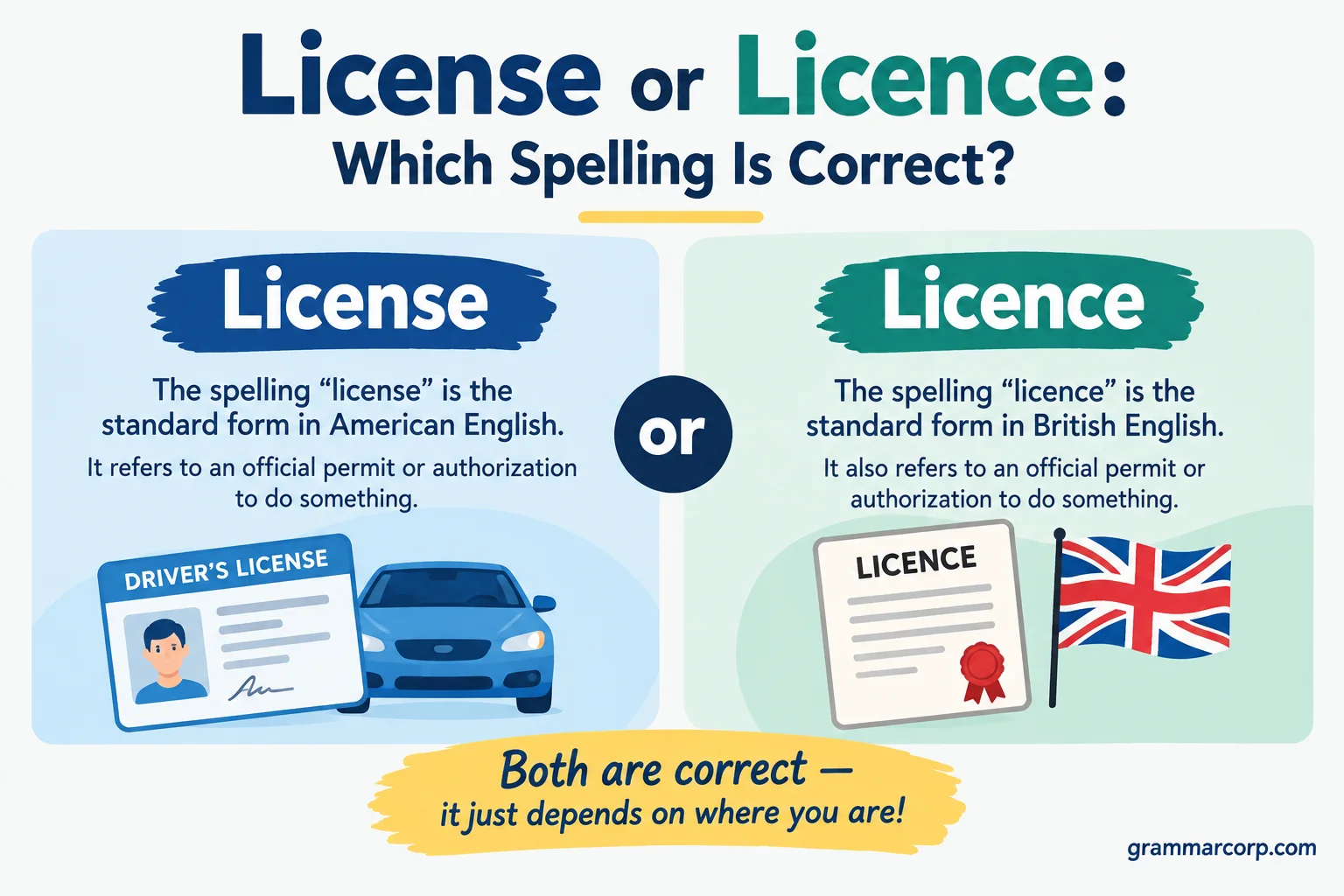
License or Licence: Which Spelling Is Correct? explains why licence and license differ across English regional conventions and usage. This spelling question often leaves people stopped mid-sentence, wondering which forms are correct. The answer depends on where you are writing and how you are using the word. In American English, license works as both a noun and verb, while British English uses licence as the British noun and license as the verb. This spelling difference is tied to regional English conventions, the variety of English, and the grammatical role of the word.
The grammatical difference becomes especially useful when you learn the regional rules. Cambridge Dictionary identifies license as the US spelling and recognizes licence as the British noun. The meaning stays essentially the same, although the spelling convention changes. Common examples include driver’s license, driving licence, business license, and licence agreement. Their pronunciation is generally the same, which makes these related spellings easy to get mixed up. In my experience, treating licence and license as a prime example of regional variation makes the distinction much easier to master.
English can be tough to learn and master when words have similar spellings and meanings. This guide breaks down everything clearly, including the difference between licence and license, license vs. licence, regional language conventions, grammatical context, common examples, and related words. If you write in British English, the distinction between noun and verb matters; in American English, the spelling stays license for both. Once you remember these rules, you can choose the appropriate form without having to second-guess yourself.
Quick Answer:
The short answer is simple:
- American English: use license as both a noun and a verb.
- British English: use licence as a noun and license as a verb.
- Canadian English: licence is commonly used for the noun, although usage can vary by context and style.
- Australian English: licence is used as the noun form, including in driver’s licence.
- Both license and licence are pronounced the same in standard English.
For example:
US: I renewed my driver’s license.
UK: I renewed my driving licence.
The meaning doesn’t change. Only the regional spelling does.
Merriam-Webster lists licence as a variant of the noun license and also records licence as a less common variant of the verb.
Comparison Overview
The easiest way to understand license vs. licence is to compare the major English varieties side by side.
| Feature | American English | British English | Canadian English | Australian English |
| Noun | license | licence | licence commonly used | licence |
| Verb | license | license | license commonly used | license |
| Pronunciation | /ˈlaɪ.səns/ | /ˈlaɪ.səns/ | Generally the same | Generally the same |
| Driver document | driver’s license | driving licence | driver’s licence / driver licence | driver’s licence |
| Main distinction | One spelling | Noun/verb distinction | British-influenced spelling | British-influenced spelling |
Oxford Learner’s Dictionaries specifically identifies licence as the British English noun and license as the North American noun. It also notes that Canadian English uses licence in this context.
The important point is that English doesn’t have one universal spelling rule here. Your target variety of English determines the correct choice.
License vs. Licence at a Glance
| Word | Meaning | Typical US use | Typical UK use |
| license | Official permission or document | Noun and verb | Verb |
| licence | Official permission or document | Generally not standard US spelling | Noun |
So if you’re writing for an American audience, license works in both sentences:
- The state issued her a license.
- The state will license the company.
In British English, the distinction becomes visible:
- The agency issued her a licence.
- The agency will license the company.
Main Differences Between License and Licence
The biggest difference isn’t meaning. It’s spelling convention.
American English simplified the distinction by using license for both grammatical functions. British English traditionally maintains a distinction between the noun licence and the verb license.
License as a Noun
A license is an official permission or document that allows someone to do, own, or use something.
For example:
- She applied for a license.
- His license expires next month.
- The company needs a business license.
- You need a fishing license in that area.
- The software requires a valid license.
Cambridge defines the American noun license as an official document that gives someone permission to own, do, or use something.
In British English, those same meanings normally use licence:
- She applied for a licence.
- His licence expires next month.
- The company needs a business licence.
- You need a fishing licence.
The underlying concept remains identical.
License as a Verb
As a verb, license means to give someone official permission to do, own, produce, or use something.
Examples include:
- The agency will license the business.
- The company is licensed to operate.
- The government licensed the organization.
- The publisher licensed the technology.
British English generally uses license for this verb too.
That’s where many learners get confused. They may assume that British English always changes license to licence. It doesn’t.
The useful British rule is:
Noun → licence
Verb → license
Oxford lists license as the standard verb and notes that British English also uses the less frequent spelling licence.
Why the Difference Exists
The two spellings come from the same historical word family. Oxford explains that the modern -se spelling developed by analogy with spelling pairs such as practice and practise.
Merriam-Webster traces the word through Middle English and Anglo-French to the Latin licentia, connected with the idea of permission. The noun entered English centuries before the modern regional spelling conventions developed.
So license and licence aren’t two unrelated words. They’re regional spelling forms that developed from the same historical source.
Is It License or Licence in American English?
For American English, the answer is straightforward: license.
American English uses license as the noun:
- driver’s license
- business license
- fishing license
- marriage license
- software license
- professional license
It also uses license as the verb:
- to license a company
- to license software
- to license technology
- to license a product
Oxford’s American English dictionary gives license as the noun spelling and identifies Canadian English licence separately.
American English Examples
Consider these sentences:
- You need a license to operate the business.
- She renewed her driver’s license.
- The state issued the professional license.
- The company plans to license its technology.
- The publisher agreed to license the software.
All of these use the license correctly in American English.
The same spelling appears in common compounds:
- license plate
- license holder
- license number
- license fee
- license agreement
- licensed professional
- licensing agreement
The consistency makes American usage easier to remember: use license regardless of whether the word functions as a noun or verb.
Is It License or License in British English?
British English requires a little more attention.
When the word functions as a noun, the standard spelling is licence.
When it functions as a verb, the standard spelling is license.
Cambridge lists licence as a UK noun and says the verb licence is another spelling of license.
British English Noun Examples
Use licence when you’re referring to the permission itself or the document that proves it:
- She has a valid driving licence.
- The company applied for a business licence.
- He renewed his professional licence.
- The software licence expires soon.
- The council issued the licence.
British English Verb Examples
Use license when the word describes the action of giving permission:
- The authority will license the operator.
- The agency licensed the company.
- The organization is licensed to provide the service.
- The regulator can license new providers.
This distinction works much like a grammatical switch. Look at what the word is doing before choosing the spelling.
License or Licence for a Driver’s Document?
This is one of the most common places where people encounter the difference.
In the United States, the standard phrase is:
driver’s license
In the United Kingdom, the standard phrase is:
driving licence
Cambridge identifies driver’s license as US usage and gives driving licence for UK English. It also identifies driver’s licence in Australian English.
Oxford likewise lists driver’s license in American English and notes driver’s licence as the British form.
| English variety | Common form |
| United States | driver’s license |
| United Kingdom | driving licence |
| Australia | driver’s licence |
| Canada | driver’s licence / driver licence |
Notice that there are actually two differences in some versions:
- license vs. licence
- driver’s vs. driving
That’s why regional usage can look more complicated than a simple spelling swap.
Example Comparison
American English:
She renewed her driver’s license last week.
British English:
She renewed her driving licence last week.
Australian English:
She renewed her driver’s licence last week.
All three sentences refer to the same basic document.
License or Licence in Business and Technology
The distinction becomes especially useful in professional writing.
Businesses frequently discuss licenses, licensing, and licensed products. The same basic regional rules apply.
American English
American writers normally use:
- software license
- business license
- commercial license
- license agreement
- licensed technology
- licensing terms
For example:
The company purchased a software license for its new system.
British English
British writers normally use:
- software licence
- business licence
- commercial licence
- licence agreement
- licensed technology
- licensing terms
For example:
The company purchased a software licence for its new system.
However, notice something important: licensing normally keeps the s spelling even in British English. Cambridge lists licensing as the standard form and licencing as an alternative British spelling.
That means writers shouldn’t assume every related word automatically changes from s to c.
License, Licence, Licensed, and Licensing
The related forms create another layer of confusion.
Here’s a practical comparison:
| Form | American English | British English |
| Noun | license | licence |
| Verb | license | license |
| Past tense | licensed | licensed |
| Past participle | licensed | licensed |
| -ing form | licensing | licensing |
| Alternative UK -ing form | — | licencing |
Merriam-Webster lists licensed and licensing as the standard forms associated with license, while also recording licenced and licencing as variants.
Cambridge similarly recognizes licencing as another spelling of licensing in UK English.
Why This Matters
A common mistake is to reason like this:
licence → licenced → licencing
That pattern can appear in British usage, but it isn’t the only accepted convention. licensed and licensing remain widely used.
For polished professional writing, the safest approach is to follow the spelling convention required by the publication, organization, or style guide you’re using.
Read More : Put Two and Two Together: Meaning, Examples & How to Use It
Are License and Licence Pronounced Differently?
Generally, no.
The two spellings normally have the same pronunciation. Cambridge gives the pronunciation of licence as /ˈlaɪ.səns/ and identifies the same pronunciation in its US and UK entries.
You can think of the difference as visual rather than auditory.
license → roughly LYE-suhns
licence → roughly LYE-suhns
The final s sound remains.
This matters because hearing the word won’t tell you which spelling to write. You need to identify the regional English you’re using and, in British English, determine whether the word is a noun or verb.
License or Licence: Common Examples
Seeing the words in real sentences makes the distinction much easier.
American English Examples
- The driver showed her license.
- His professional license expires soon.
- The company applied for a business license.
- The publisher owns a software license.
- The agency will license the technology.
- The product is properly licensed.
- The agreement covers several licensing arrangements.
British English Examples
- The driver showed her licence.
- His professional licence expires soon.
- The company applied for a business licence.
- The publisher owns a software licence.
- The agency will license the technology.
- The product is properly licensed.
- The agreement covers several licensing arrangements.
Side-by-Side Comparison
| American English | British English |
| driver’s license | driving licence |
| business license | business licence |
| software license | software licence |
| fishing license | fishing licence |
| marriage license | marriage licence |
| license agreement | licence agreement |
| to license software | to license software |
| licensed technology | licensed technology |
| licensing agreement | licensing agreement |
The table shows the central pattern clearly: the noun changes between US and UK English, while the verb usually stays license.
License or Licence in Canadian English
Canadian English deserves a separate mention because it doesn’t always follow American spelling.
Oxford’s American English dictionary specifically notes Canadian English also licence for the noun.
That means Canadian writing often uses:
- driver’s licence
- business licence
- software licence
rather than the American license.
Canadian usage can vary across terms and institutional contexts. If you’re writing specifically for Canadian readers, don’t automatically copy American spelling simply because Canada and the United States share a border.
Instead, use a Canadian dictionary, organizational style guide, or the spelling used by the relevant Canadian institution.
The broader lesson is useful: English spelling follows regional traditions rather than national geography alone.
License or Licence in Australian English
Australian English generally follows the British-style noun spelling licence.
For example:
- driver’s licence
- business licence
- fishing licence
Cambridge identifies driver’s licence as Australian English while giving driver’s license for US English and driving licence for UK English.
For Australian content, therefore, licence is usually the appropriate noun form.
Again, the verb remains license in standard usage:
- The authority can license the operator.
- The company is licensed to provide the service.
Common Mistakes With License and Licence
The spelling itself is easy once the regional rule becomes familiar. The real problems usually appear when writers mix conventions.
Mistake: Using Licence in American English
An American sentence such as:
She renewed her driver’s licence.
doesn’t follow standard American spelling.
For US English, write:
She renewed her driver’s license.
Mistake: Using License for Every Noun in British English
A British writer may write:
She renewed her driving license.
American readers will understand it. However, standard British usage normally prefers:
She renewed her driving licence.
Mistake: Assuming British English Uses Licence as the Verb
This is the most important grammatical mistake.
British English normally distinguishes:
- licence = noun
- license = verb
So:
The company received a licence.
but:
The authority will license the company.
Mistake: Changing Every Related Word to C
British English doesn’t require every related form to switch from s to c.
For example, licensing is standard and widely used. Cambridge also records licencing as an alternative UK spelling.
The safest rule is to check the exact form rather than applying a mechanical spelling formula.
A Simple Memory Trick for License vs. Licence
If you’re writing British English, remember:
Noun = C
Verb = S
That gives you:
- a licence = the document or permission
- to license = to give permission
Think of the C in licence as connected with a certificate or document. Think of the S in license as the action of giving the sanction.
This isn’t a universal English spelling rule. It’s simply a memory device for this particular distinction.
If you’re writing American English, the trick becomes even easier:
License for both.
You don’t need to switch between license and licence.
A Practical Decision Guide
When you’re unsure which spelling to use, ask two questions.
What variety of English are you writing?
If the answer is American English, choose a license.
If the answer is British English, continue to the next question.
Is the word a noun or a verb?
If it’s a British English noun, choose licence.
If it’s a British English verb, choose license.
Here’s the complete decision tree:
| Situation | Correct choice |
| US noun | license |
| US verb | license |
| UK noun | licence |
| UK verb | license |
| Canadian noun | licence commonly used |
| Australian noun | licence |
| UK/Australian verb | license |
Once you identify the regional variety and grammatical role, the choice becomes almost automatic.
Case Study: One Idea, Three Regional Spellings
Consider a company that needs official permission to operate.
An American document might say:
The company obtained a business license.
A British document would normally say:
The company obtained a business licence.
An Australian document could say:
The company obtained a business licence.
Now change the grammatical role.
The regulator licenses the company.
The spelling remains license because it functions as a verb.
This small example captures the entire distinction. The meaning stays stable, while the spelling responds to regional convention and grammar.
License or Licence in Formal Writing
Consistency matters more than trying to make every variety of English look identical.
If you’re writing an American article, use license consistently.
If you’re writing for a British audience, use licence for nouns and license for verbs.
Don’t switch between forms simply because you see both spellings online. Websites often combine content written for different audiences, and international publications may use house styles that differ from general regional conventions.
For American Content
Prefer:
- driver’s license
- business license
- software license
- license agreement
- license the technology
For British Content
Prefer:
- driving licence
- business licence
- software licence
- licence agreement
- license the technology
The goal isn’t to decide that one spelling is universally superior. The goal is to match the spelling to your intended variety of English.
What Does License Mean?
Beyond the spelling question, license has several related meanings.
As a noun, it can mean official permission or the document showing that permission.
For example:
- a driver’s license
- a business license
- a software license
It can also mean freedom or permission to act in a particular way. Oxford lists senses involving official permission as well as freedom to act or depart from ordinary rules.
One familiar expression is artistic license, which refers to the freedom an artist or writer takes to change facts or normal conventions for a creative effect. Cambridge and Oxford both recognize the expression.
As a verb, license means to give official permission.
For example:
- The regulator licensed the operator.
- The company licensed its technology.
- The organization licensed the product.
So the word covers more ground than a simple government document.
FAQs:
Is “license” or “licence” correct?
Both license and licence are correct spellings. The appropriate choice depends on the variety of English you’re using. American English uses license, while British English generally uses licence as a noun.
Is “license” American or British English?
License is the standard spelling in American English for both the noun and verb. British English uses licence for the noun but license for the verb.
Is a driver’s license or driving licence correct?
Both are correct, depending on regional spelling conventions. Driver’s license is common in American English, while driving licence is standard in British English.
Do “license” and “licence” have different meanings?
No. The meaning is generally the same. The main difference is spelling and, in British English, the grammatical role of the word.
How can I remember the difference between license and licence?
A simple way to remember it is: American English uses license for both noun and verb, while British English uses licence as a noun and license as a verb.
Conclusion:
The choice between license and licence comes down mainly to regional English conventions. Use license consistently in American English, but use licence for the noun and license for the verb in British English.
Once you understand this spelling convention and grammatical distinction, this common English spelling question becomes much easier to handle.







1 thought on “License or Licence: Which Spelling Is Correct?”