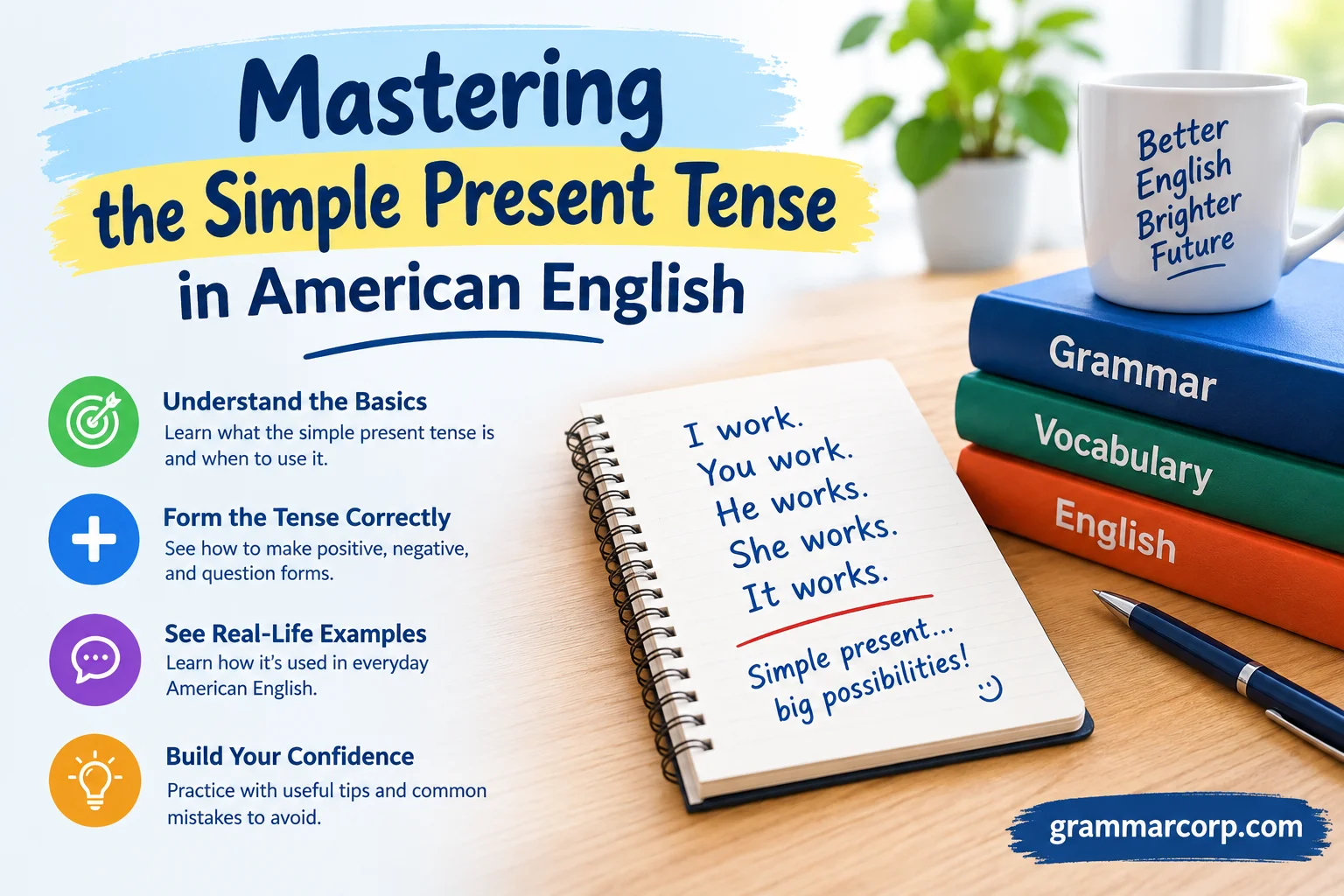
Mastering the Simple Present Tense in American English becomes easier when English learners connect grammar learning with real communication, daily communication, and familiar English sentences. In my teaching experience, I’ve found that learners understand the simple present tense faster when they notice how the subject affects verb forms and how a singular subject can make a verb change by taking an ending, such as -s.
These simple present tense rules help learners recognize sentence structure, time expressions, habitual actions, general facts, unchanging truths, and regular actions in natural American English grammar. Through practical examples, present tense examples, and steady practice, learners can understand different forms, usage, and patterns, while seeing how the tense can represent time and express actions that happen regularly. I also encourage learners to compare the tense with other present tenses, because this improves English usage, correct usage, and overall understanding.
The same approach helps learners use the form naturally rather than simply memorize rules. With grammar structures, grammatical patterns, and language structure connected to everyday patterns, learners can build confidence, develop English speaking skills and English writing skills, and express ideas naturally. This is useful for spoken English, written English, daily English, formal situations, and informal situations, including everyday conversations, daily American conversations, workplace emails, classroom discussions, and other forms of communication.
Quick Answer:
The simple present tense describes actions, situations, or states that happen regularly, remain generally true, or exist in the present.
The basic structure is:
Subject + base verb
Examples:
- I work in Chicago.
- You study English.
- We watch movies on Fridays.
- They live nearby.
With he, she, or it, the verb usually takes -s or -es:
- She works in Chicago.
- He studies English.
- It looks expensive.
For negatives and most questions, English uses do or does:
- I don’t work on Sundays.
- She doesn’t work on Sundays.
- Do you live here?
- Does he speak English?
The simple present doesn’t usually mean an action is happening at this exact second. For an action happening now, American English often uses the present continuous instead.
Comparison Overview
The simple present becomes much easier when you compare it with related structures.
| Feature | Simple Present | Present Continuous |
| Main purpose | Habits, facts, states, repeated actions | Actions happening now or around now |
| Example | I work from home. | I’m working from home today. |
| Repeated action | She walks to school every day. | She’s walking to school right now. |
| General fact | Water boils at 100°C at standard atmospheric pressure. | — |
| Temporary situation | Usually not the best choice | He’s staying with friends this week. |
| Stative verbs | Common | Often avoided |
| Fixed schedules | The train leaves at 8. | — |
The difference isn’t simply present = now and continuous = now. English tense depends on how you view the action.
For example:
- I play tennis on Saturdays.
- I’m playing tennis right now.
The first sentence describes a regular activity. The second focuses on an activity in progress.
Main Differences Between Simple Present Tense and Present Continuous
The biggest mistake learners make is choosing a tense based only on the word “present.” Instead, consider the meaning.
Simple Present for Regular Actions
Use the simple present when something happens repeatedly.
- I go to the gym after work.
- She calls her mother every evening.
- We eat dinner around seven.
- They visit their grandparents every summer.
Present Continuous for Actions in Progress
Use the present continuous for something happening at the moment or around the current period.
- I’m writing an email right now.
- She’s talking to her manager.
- They’re staying at a hotel this week.
Simple Present for Stable Situations
The simple present works well for situations that feel stable or long-term.
- He lives in Boston.
- She works for a software company.
- They own a small restaurant.
Present Continuous for Temporary Situations
When something has a temporary quality, the present continuous often sounds more natural.
- He’s living with his brother this month.
- She’s working from another office this week.
- They’re staying with relatives while their house is renovated.
The distinction isn’t always absolute. Context matters.
What Is the Simple Present Tense?
The simple present is a verb tense that expresses present facts, repeated actions, routines, states, and other situations viewed as current or generally true.
Consider these examples:
- I drink coffee every morning.
- My brother plays basketball.
- The Earth orbits the Sun.
- She likes jazz.
- The store opens at 9 a.m.
- We need more information.
Notice something important: none of these sentences necessarily describes an action happening at this exact second.
That’s why the simple present can confuse learners.
The Simple Present Does Not Always Mean Right Now
If someone asks:
What do you do?
You might answer:
I work at a hospital.
You aren’t necessarily working at the hospital at that exact moment. You’re describing your occupation or regular activity.
By contrast:
What are you doing?
You might answer:
I’m studying English.
That question asks about your current activity.
Simple Present Tense Formula
Learning the core formulas gives you a reliable foundation.
| Sentence Type | I/You/We/They | He/She/It |
| Positive | subject + base verb | subject + verb-s/es |
| Negative | subject + do not + base verb | subject + does not + base verb |
| Question | Do + subject + base verb? | Does + subject + base verb? |
Examples:
- They work here.
- She works here.
- They do not work here.
- She does not work here.
- Do they work here?
- Does she work here?
This pattern is worth mastering because it handles a large share of ordinary simple present sentences.
How to Form Positive Simple Present Sentences
For I, you, we, and they, use the base form of the verb.
- I read every night.
- You speak clearly.
- We need help.
- They drive to work.
The same base form applies to plural subjects.
He, She, and It
With he, she, and it, add the appropriate ending.
- He works late.
- She reads every morning.
- It looks good.
The spelling depends on the verb.
| Base Verb | He/She/It Form |
| work | works |
| read | reads |
| play | plays |
| wash | washes |
| watch | watches |
| fix | fixes |
| study | studies |
| try | tries |
| have | has |
| do | does |
Third-Person Singular Simple Present Rules
The third-person singular causes a surprising number of mistakes.
Add -s
For many verbs, simply add -s.
- work → works
- play → plays
- run → runs
- eat → eats
Add -es
Many verbs ending in -s, -sh, -ch, -x, or -z take -es.
- wash → washes
- watch → watches
- fix → fixes
- buzz → buzzes
Change Consonant + Y to -ies
When a verb ends in a consonant followed by y, change the y to i and add -es.
- study → studies
- try → tries
- carry → carries
But don’t change a vowel + y combination:
- play → plays
- enjoy → enjoys
- stay → stays
Important Irregular Forms
Two especially common verbs need special attention:
- have → has
- do → does
Examples:
- She has two brothers.
- He does his homework every evening.
Negative Simple Present Sentences
To make most simple present verbs negative, use do not or does not followed by the base verb.
Don’t
Use do not or the contraction don’t with:
- I
- you
- we
- they
Examples:
- I don’t like spicy food.
- You don’t need a ticket.
- We don’t work weekends.
- They don’t live here.
Doesn’t
Use does not or doesn’t with:
- he
- she
- it
Examples:
- He doesn’t drive.
- She doesn’t eat meat.
- It doesn’t work.
Don’t Add -s After Doesn’t
This rule matters.
Incorrect:
- She doesn’t like coffee.
Correct:
- She doesn’t like coffee.
Why? Does already carry the third-person grammatical marking. The main verb returns to its base form.
Simple Present Questions
Questions usually require do or does.
Questions With Do
Use do with I, you, we, and they.
- Do you work here?
- Do they speak Spanish?
- Do we need reservations?
- Do I look tired?
Questions With Does
Use does with he, she, and it.
- Does she work here?
- Does he drive?
- Does it cost much?
- Does your brother live nearby?
Again, the main verb stays in its base form.
Not:
Does she works here?
Correct:
Does she work here?
WH-Questions
The same structure works with question words.
- Where do you live?
- What does she want?
- When does the store open?
- Why do they leave early?
- How does this work?
The Verb Be in the Simple Present
The verb behaves differently.
Instead of using do or does in ordinary affirmative, negative, and question structures, it changes directly.
| Subject | Be |
| I | am |
| You | are |
| We | are |
| They | are |
| He | is |
| She | is |
| It | is |
Examples:
- I am ready.
- You are early.
- They are busy.
- She is tired.
Negative Forms of Be
- I am not ready.
- You aren’t late.
- He isn’t available.
- They aren’t busy.
Questions With Be
- Are you ready?
- Is she home?
- Are they students?
- Is it expensive?
Don’t say:
Do you ready?
Say:
Are you ready?
When to Use the Simple Present Tense
Understanding the uses matters more than memorizing the definition.
Habits and Routines
Use the simple present for things you do regularly.
- I brush my teeth twice a day.
- She takes the bus to work.
- We watch a movie on Friday nights.
- He checks his email every morning.
Frequency expressions make the routine especially clear.
Common examples include:
- always
- usually
- normally
- often
- sometimes
- rarely
- seldom
- never
- every day
- once a week
- twice a month
Facts and General Truths
Use the simple present for facts that are generally true.
- Ice melts when heated.
- Plants need light to grow.
- The Pacific Ocean covers a large part of Earth’s surface.
- A triangle has three sides.
The important idea is general validity rather than something occurring at one specific moment.
Long-Term Situations
The simple present often describes jobs, homes, relationships, and other relatively stable situations.
- She lives in Seattle.
- He works for a bank.
- My parents own a house in Arizona.
- I study computer science.
“Long-term” doesn’t mean permanent forever. It simply contrasts with a temporary situation.
Feelings, Opinions, and States
Many verbs describe states rather than visible actions.
- I like jazz.
- She knows the answer.
- He believes you.
- We want more time.
- They need help.
These are often called stative verbs.
Stative Verbs in the Simple Present
Stative verbs describe conditions, thoughts, feelings, possession, perception, or relationships rather than deliberate ongoing actions.
Common examples include:
| Category | Examples |
| Knowledge | know, understand, remember |
| Opinion | believe, agree, think |
| Emotion | like, love, hate, prefer |
| Possession | have, own, belong |
| Need | need, want |
| Perception | hear, see, smell |
Many stative verbs normally appear in the simple present tense.
- I understand the problem.
- She knows the answer.
- They own the building.
- He prefers tea.
However, English changes over time, and some verbs can work in either tense depending on meaning.
For example:
- I think you’re right.
- I’m thinking about the problem.
The first describes an opinion. The second emphasizes an ongoing mental process.
Simple Present for Schedules and Timetables
The simple present can describe future events when they belong to a fixed schedule or timetable.
Examples:
- The train leaves at 7:30 tomorrow morning.
- The class starts at 9 a.m.
- The store opens at 10.
- The flight arrives at noon.
This doesn’t mean every future event uses the simple present.
Compare:
The train leaves at 8 tomorrow.
This sounds like a scheduled departure.
I’m leaving for New York tomorrow.
This describes a personal arrangement or planned action.
Simple Present for Instructions and Directions
The simple present also appears naturally in instructions and explanations.
For example:
- You open the app.
- You select your account.
- You enter your password.
- The system shows your dashboard.
Recipes use the same pattern:
- You heat the oven.
- You add the flour.
- You mix the ingredients.
- The sauce thickens after several minutes.
This style makes procedures clear because it presents each step as a general instruction.
Adverbs of Frequency in the Simple Present
Adverbs of frequency tell the reader or listener how often something happens.
A useful general scale looks like this:
always → usually → often → sometimes → rarely → never
Their exact frequency isn’t mathematically fixed. For example, often doesn’t represent one universal percentage.
Adverb Position With Ordinary Verbs
The frequency adverb commonly comes before the main verb.
- I usually eat breakfast.
- She often visits her parents.
- They rarely watch television.
Adverb Position With Be
With be, the frequency adverb usually follows the verb.
- She is always helpful.
- He is usually early.
- They are often busy.
Other Time Expressions
The simple present frequently appears with expressions such as:
- every morning
- every weekend
- on Mondays
- once a year
- twice a week
- three times a month
- in the evening
Examples:
- We meet every Tuesday.
- She calls me twice a week.
- They travel once a year.
Simple Present Tense in American English Conversation
Grammar books can make English look more rigid than it really is. Everyday American English relies heavily on the simple present because people constantly discuss routines, preferences, facts, and current states.
Consider this short exchange:
A: Where do you work?
B: I work at a hospital.
A: Do you like it?
B: Yeah, I really like it.
Notice how naturally the simple present appears.
The speakers aren’t describing one isolated action. They’re discussing someone’s regular work and opinion.
Common Everyday Questions
You’ll hear questions such as:
- Where do you live?
- What do you do?
- Do you work nearby?
- Does she drive?
- What time does the store open?
- Do you like coffee?
- How often do you exercise?
Learning these patterns can make conversation feel much easier.
Simple Present Tense in Professional English
The simple present is especially common in workplaces because professional communication often describes responsibilities, processes, policies, and regular activities.
Examples:
- I manage customer accounts.
- She handles payroll.
- Our team meets every Monday.
- The system generates a report each morning.
- The company provides training.
Job descriptions also rely heavily on this tense:
A customer service representative answers questions, resolves problems, and updates customer records.
Each verb describes a regular responsibility rather than something happening at the moment of reading.
Simple Present Tense in Academic English
Academic writing uses the simple present for established facts, definitions, interpretations, and general claims.
Examples:
- Photosynthesis converts light energy into chemical energy.
- The study shows a relationship between the variables.
- This theory explains the observed behavior.
- Water contains hydrogen and oxygen.
However, academic writers don’t use the simple present for every statement. Tense depends on whether the writer discusses established knowledge, a specific past study, an ongoing process, or another time frame.
Read More : License or Licence: Which Spelling Is Correct?
Simple Present Pronunciation in American English
Correct grammar helps, but pronunciation affects how natural your speech sounds.
The third-person -s/-es ending has three common pronunciations.
| Sound | Example |
| /s/ | works |
| /z/ | plays |
| /ɪz/ | watches |
The /s/ Sound
After certain voiceless consonants, the ending sounds like /s/.
- works
- sits
- laughs
The /z/ Sound
After voiced sounds, the ending often sounds like /z/.
- plays
- runs
- lives
The /ɪz/ Sound
Some verbs create an extra syllable.
- watches
- washes
- fixes
- changes
This distinction matters when listening. A learner who expects every written -s to sound identical may struggle to recognize familiar words in fast speech.
Don’t Overpronounce Every Word
American English speech often connects words naturally.
For example, Does he work here? won’t necessarily sound like four carefully separated dictionary words.
The goal isn’t to imitate slang. Instead, listen for the overall rhythm and learn how auxiliary verbs, contractions, and endings sound in connected speech.
Common Simple Present Tense Mistakes
A few errors appear again and again.
Forgetting the Third-Person -s
Incorrect:
- She work here.
Correct:
- She works here.
Adding -s After Does
Incorrect:
- Does he works here?
Correct:
- Does he work here?
Adding -s After Doesn’t
Incorrect:
- He doesn’t likes it.
Correct:
- He doesn’t like it.
Using Do or Does With Be
Incorrect:
- Does she be tired?
Correct:
- Is she tired?
Forgetting Do or Does in Questions
Incorrect:
- You like coffee?
That sentence can occur in informal conversation as an informal questioning style, but standard question formation uses:
- Do you like coffee?
Confusing Have and Has
Incorrect:
- She have two dogs.
Correct:
- She has two dogs.
Using the Continuous for Every Current Situation
Incorrect in many habitual contexts:
- I am going to school every day.
For a regular routine, the simple present is generally better:
- I go to school every day.
The continuous can work when you specifically describe a temporary pattern, but the intended meaning determines the choice.
Case Study: Why Tense Choice Changes the Meaning
Imagine two coworkers discussing someone’s work situation.
Sentence A:
Maria works from home.
This presents working from home as her regular arrangement.
Sentence B:
Maria is working from home this week.
Now the situation sounds temporary or limited to the current period.
Neither sentence is automatically “more correct.” The context determines which tense communicates the intended meaning.
That distinction is one of the most useful ideas to remember:
Grammar isn’t only about form. Tense also tells the listener how you want them to understand the situation.
How to Master the Simple Present Tense
Learn the Core Patterns First
Start with these structures:
- I work.
- She works.
- I don’t work.
- She doesn’t work.
- Do you work?
- Does she work?
If these become automatic, many longer sentences become much easier.
Practice Third-Person Forms
Make three-column exercises:
| Base | He/She/It | Example |
| work | works | She works downtown. |
| study | studies | He studies English. |
| watch | watches | She watches TV. |
| have | has | He has a car. |
| do | does | She does her homework. |
Describe Your Routine
Write several sentences about ordinary activities.
For example:
- I wake up at seven.
- I eat breakfast at home.
- I take the bus.
- I work until five.
- I usually cook dinner.
Then rewrite some sentences using he, she, or they.
This forces you to practice the verb changes instead of simply memorizing a rule.
Ask and Answer Questions
Practice pairs:
- Where do you live?
- What do you do?
- Do you work?
- Does your friend work?
- What time does your school start?
Speaking these structures aloud helps connect grammar knowledge with real communication.
Simple Present Tense Practice Exercises
Fill in the Blank
Choose the correct verb form.
- She ___ to work every day. (drive)
- They ___ English at school. (study)
- He ___ coffee in the morning. (drink)
- We ___ television after dinner. (watch)
- My sister ___ two dogs. (have)
Answers: drives, study, drinks, watch, has.
Correct the Mistakes
- She work at a bank.
- Does he likes music?
- They doesn’t live here.
- He don’t understand.
- Does she studies English?
Correct answers:
- She works at a bank.
- Does he like music?
- They don’t live here.
- He doesn’t understand.
- Does she study English?
Turn Statements Into Questions
Statement:
You live in Dallas.
Question:
Do you live in Dallas?
Statement:
She works downtown.
Question:
Does she work downtown?
The exercise reinforces the relationship between does and the base verb.
Simple Present Tense Quick Reference
| Purpose | Example |
| Habit | I exercise every morning. |
| Routine | She takes the train to work. |
| General fact | Birds have feathers. |
| Long-term situation | He lives in Denver. |
| Opinion | I like this movie. |
| State | She knows the answer. |
| Schedule | The class starts at 8. |
| Instruction | You press this button. |
Positive
I/You/We/They + base verb
- They work.
He/She/It + verb-s/es
- She works.
Negative
I/You/We/They + don’t + base verb
- They don’t work.
He/She/It + doesn’t + base verb
- She doesn’t work.
Questions
Do + I/you/we/they + base verb?
- Do they work?
Does + he/she/it + base verb?
- Does she work?
Be
- I am
- You are
- We are
- They are
- He is
- She is
- It is
FAQs:
What is the simple present tense in American English?
The simple present tense is used to describe habits, routines, repeated actions, facts, general truths, opinions, states, and scheduled events. For example, “I work from home” describes a regular situation.
When do Americans use the simple present tense?
Americans commonly use it for everyday situations, such as routines, schedules, facts, and habits. It also appears frequently in conversations, workplace communication, classroom discussions, emails, writing, and social media.
When should I use “do” and “does”?
Use do with I, you, we, and they, while does is used with he, she, and it. These helping verbs are commonly used to form questions and negative sentences in the simple present.
Why does a verb sometimes end in “-s”?
When the subject is a singular subject such as he, she, or it, the main verb usually takes an -s or -es ending in an affirmative sentence. For example, “She works” follows this pattern.
How can I improve my simple present tense skills?
Regular practice is one of the best ways to improve. Study real present tense examples, notice patterns in daily communication, practice forming sentences, and pay attention to how the tense is used in natural American English.
Conclusion:
Mastering the Simple Present Tense in American English becomes much easier when you focus on meaning instead of memorizing isolated grammar rules. By understanding the situation, subject, verb forms, and purpose of an action, you can choose the correct form with greater confidence. This tense is a basic but powerful part of American English grammar, appearing constantly in everyday speech and writing.
With consistent learning, practice, and exposure to real English sentences, you can improve your English speaking skills, English writing skills, and overall communication. Whether you are describing a habit, stating a fact, discussing a schedule, or expressing an opinion, a strong understanding of the simple present helps you express ideas naturally and communicate effectively in both formal and informal situations.














1 thought on “Mastering the Simple Present Tense in American English”