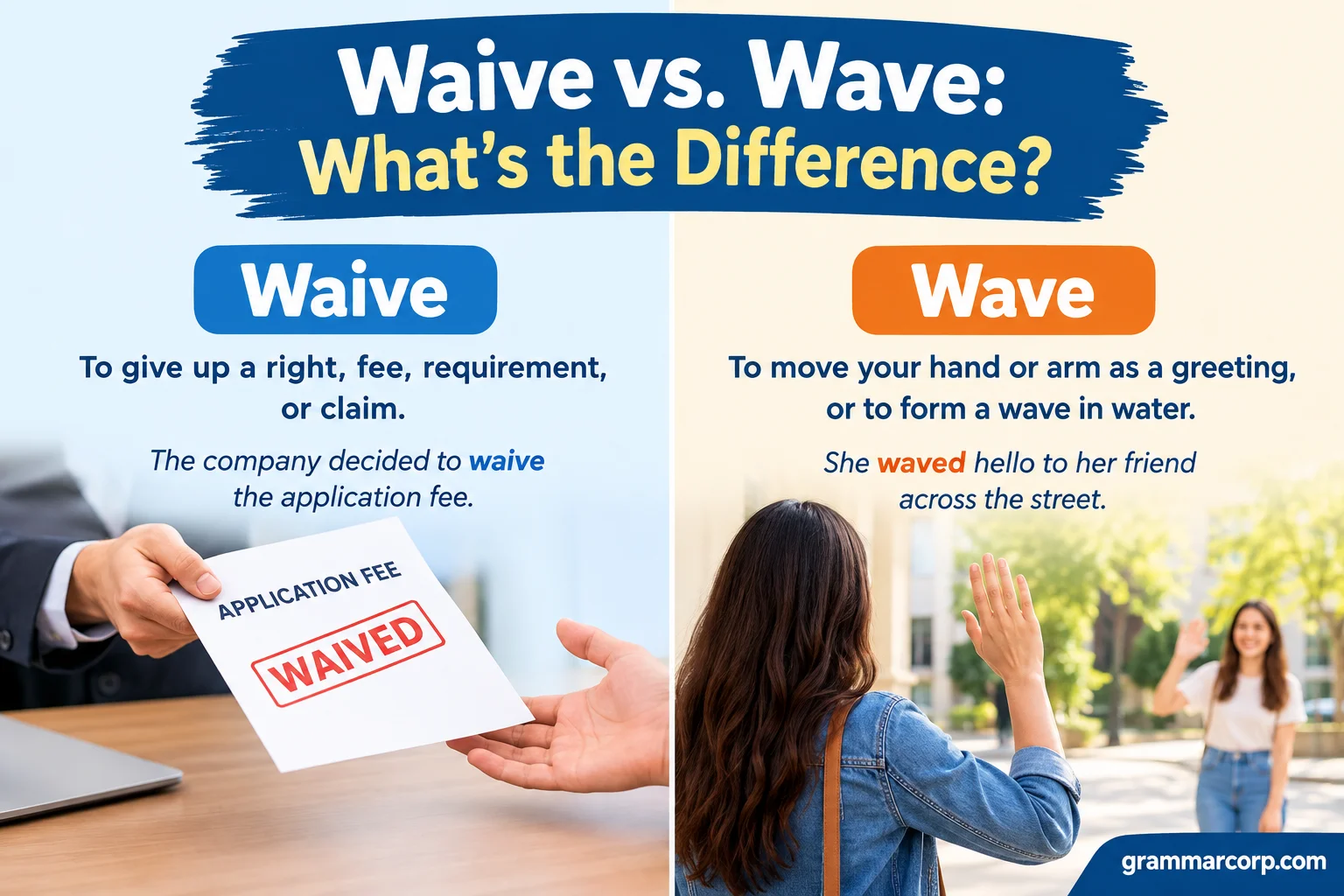
Waive vs. Wave: What’s the Difference? explains why these common English words sound alike but carry different meanings in everyday writing. Waive and wave are a common English word confusion because these words sound the same, yet have completely different meanings and usage. Waive means giving up, removing something, give up, excuse, or choose not to enforce something. You may waive a fee, waive a requirement, or waive a legal right.
A fee, requirement, legal right, rights, rules, or requirements can be waived when a school agrees to remove an application fee so a student does not have to pay, or when a person signs a paper to waive a claim. This may appear in contracts, legal notes, and formal permissions, especially when someone is giving up a right. In my teaching experience, I have seen learners and native speakers make this common confusion because Waive and Wave are homophones with an identical sound, although their meanings are different. Wave, in contrast, usually describes movement, a gesture, or physical swell. You can wave your hand, make a hand gesture, or wave goodbye to a friend across the street.
A wave can also mean a moving swell of water in the ocean, a physical movement, flowing movement through a crowd or place, or a body of water. You might watch a wave roll toward the shore, see someone waving, or notice a wave of excitement after good news. The distinction can be tricky because spell-check may not identify a mistake, since both are correctly spelled English words. The correct choice depends on the meaning you intend, and this difference matters for clearer writing in emails, school assignments, business documents, legal statements, everyday messages, everyday writing, academic writing, professional writing, professional emails, academic papers, legal documents, business communication, and social media posts.
Quick Answer:
Waive means to voluntarily give up, remove, or choose not to enforce something, such as a right, fee, rule, requirement, or penalty.
Wave means to move something back and forth, make a hand gesture, or describe a moving swell or surge.
The easiest rule to remember
- Waive = give something up or remove it
- Wave = move something back and forth
For example:
- The company agreed to waive the fee.
- She waved goodbye to her friend.
- The school may waive the admission requirement.
- He waved his hand across the room.
- The lawyer asked the client to waive the right.
- A large wave crashed against the shore.
If you’re talking about giving up, removing, or excusing something, choose waive. If you’re talking about movement or a gesture, choose wave.
Comparison Overview
| Feature | Waive | Wave |
| Basic meaning | Give up, remove, or not enforce something | Move back and forth or refer to a swell/surge |
| Main use | Rights, fees, rules, requirements, conditions | Gestures, objects, water, signals, patterns |
| Part of speech | Verb | Verb and noun |
| Pronunciation | Same as wave | Same as waive |
| Common phrase | Waive a fee | Wave goodbye |
| Another example | Waive a requirement | Wave a flag |
| Memory clue | Give up | Move |
The biggest difference isn’t pronunciation. It’s meaning.
Consider the sentence: The university will waive the application fee. The university isn’t moving the fee around. It is choosing not to require the applicant to pay it.
Now consider The student waved to the admissions officer. The student is making a physical gesture.
That small spelling difference completely changes the meaning.
Main Differences Between Waive vs. Wave
The difference between waive vs. wave becomes much easier when you focus on the action each word describes.
Waive Means to Give Up or Remove Something
When you waive something, you voluntarily give up a right, requirement, claim, condition, fee, or similar obligation.
For example:
The hotel agreed to waive the cancellation fee.
The hotel hasn’t physically moved the fee. Instead, it has decided not to charge it.
This use appears frequently in formal situations. You might see waive in contracts, school policies, financial agreements, insurance documents, workplace policies, and customer-service communications.
Common things people waive include:
- Fees
- Requirements
- Rights
- Penalties
- Conditions
- Claims
- Rules
- Restrictions
The word often suggests a conscious decision. Someone has a right or requirement that could apply, but they choose not to enforce or exercise it.
Wave Means Movement or a Gesture
Wave has several meanings, but its central idea involves movement.
As a verb, wave can mean moving your hand or another object back and forth.
For example:
- She waved at her neighbor.
- He waved the flag.
- The child waved goodbye.
- The lifeguard waved for everyone to move back.
As a noun, wave can describe a moving ridge of water.
For example:
- A huge wave reached the beach.
- The surfers waited for the next wave.
- Several waves hit the shoreline.
The word also has broader meanings. A wave of excitement, for example, describes a strong feeling that spreads through a group or arrives suddenly.
What Does Waive Mean?
Waive is a verb meaning to voluntarily give up, surrender, remove, or choose not to enforce something.
The object being waived usually involves a right, obligation, requirement, or condition.
Waive a Fee
One of the most common uses is waive a fee.
If a business waives a fee, it chooses not to charge that fee.
Example:
The bank agreed to waive the monthly service fee.
The fee still exists as a normal charge. The bank simply chose not to apply it in that particular situation.
Other examples include:
- The gym waived the enrollment fee.
- The airline waived the change fee.
- The school waived the registration fee.
- The company waived the processing charge.
Waive a Requirement
You can also waive a requirement.
This means someone decides that a person doesn’t need to meet a normally required condition.
Example:
The university waived the language requirement for the applicant.
The requirement normally applies. However, the university chose not to require it in this case.
Waive a Right
Legal and formal writing frequently uses waive a right.
If someone waives a right, they voluntarily give up that right or agree not to exercise it.
Example:
The agreement states that either party may waive certain rights under specific conditions.
This usage can have important legal consequences. In formal documents, waive shouldn’t be treated casually because the exact wording can determine what someone has agreed to give up.
Waive a Penalty
A person or organization can also waive a penalty.
For example:
The landlord agreed to waive the late-payment penalty.
That means the penalty won’t be charged or enforced.
Waive a Condition
You can waive a condition when you decide not to require that condition.
For example:
The buyer agreed to waive the inspection condition.
The exact meaning can vary depending on the agreement, so formal contracts should always be read carefully.
What Does Wave Mean?
Wave can work as both a verb and a noun. Its meanings generally connect to movement, gestures, or something that rises and falls.
Wave as a Verb
As a verb, wave commonly describes moving your hand or an object from side to side.
Examples include:
- She waved at the camera.
- He waved to his parents.
- The teacher waved the students over.
- They waved a flag during the parade.
You can also use wave for a signal.
For example:
The worker waved for the driver to stop.
Here, the person uses movement to communicate.
Wave as a Noun
As a noun, wave can refer to a moving body of water.
For example:
A powerful wave rolled toward the shore.
The word also describes various kinds of physical or figurative movement.
Examples include:
- A wave of heat
- A wave of sound
- A wave of excitement
- A wave of new customers
- A wave of change
In these expressions, wave often suggests something that moves through an area or group.
Waive vs. Wave in Real Sentences
Seeing the words in context makes their difference much clearer.
Examples With Waive
Here are natural examples of waive:
- The company agreed to waive the delivery fee.
- The school may waive the application requirement.
- The customer asked whether the bank could waive the charge.
- The organization decided to waive the penalty.
- The applicant requested that the university waive the requirement.
- The contract explains when a party can waive a right.
- The manager agreed to waive the additional cost.
- The clinic offered to waive the administrative fee.
- The organization can waive certain conditions in special circumstances.
- The customer service representative offered to waive the fee.
Notice the pattern. Each sentence involves something being removed, excused, surrendered, or not enforced.
Examples With Wave
Now compare those sentences with examples using wave:
- She waved to her friend.
- He waved goodbye before leaving.
- The child waved at the camera.
- The sailor waved a flag from the boat.
- She waved her hand to get attention.
- The crowd waved banners during the event.
- A large wave moved toward the beach.
- The surfer waited for the next wave.
- A wave of excitement spread through the crowd.
- The scientist studied how the wave traveled through the material.
Here, the word describes movement, a gesture, or a moving pattern.
Waive a Fee vs. Wave a Fee
This is one of the easiest mistakes to spot.
The correct phrase is:
Waive a fee
For example:
The company agreed to waive the service fee.
This means the company won’t charge the fee.
Wave a fee doesn’t express this meaning. A person can wave a hand or flag, but a fee isn’t something you normally wave.
More examples
| Incorrect | Correct | Meaning |
| Wave the fee | Waive the fee | Remove the fee |
| Wave the charge | Waive the charge | Forgive or remove the charge |
| Wave the requirement | Waive the requirement | Excuse the requirement |
| Wave the penalty | Waive the penalty | Remove the penalty |
A useful test is to replace the word with remove or forgive.
If the sentence still makes sense, waive is probably the right choice.
The company will remove the fee.
Therefore:
The company will waive the fee.
Wave Goodbye vs. Waive Goodbye
The correct phrase is:
Wave goodbye
For example:
She waved goodbye as the bus pulled away.
Why? Because the person is making a physical gesture.
You could also say:
- Wave hello
- Wave at someone
- Wave to someone
- Wave goodbye
- Wave your hand
You wouldn’t normally use waive in these expressions.
Why the mistake happens
The confusion comes from pronunciation. Waive and wave are homophones in standard English. They sound alike even though their spellings and meanings differ.
That means you can’t always choose the correct word by listening to the sentence.
You need to identify the intended meaning.
Waive vs. Wave Pronunciation
Waive and wave are pronounced the same in standard English.
They both have the pronunciation commonly represented as /weɪv/.
This makes them homophones: different words that share the same pronunciation but have different meanings and spellings.
| Word | Pronunciation | Meaning |
| Waive | /weɪv/ | Give up, remove, or not enforce |
| Wave | /weɪv/ | Move back and forth; a swell or surge |
This is why spoken English can make the distinction difficult.
If someone says, We will waive the fee, you can’t identify the spelling from sound alone. The context tells you which word they mean.
Waive and Wave Word Forms
Knowing related forms can help prevent spelling mistakes.
Forms of Waive
Common forms include:
- Waive
- Waived
- Waiving
- Waiver
Examples:
The company waived the fee.
The customer requested a waiver.
The organization is waiving the usual requirement.
A waiver is the noun related to waive. It usually refers to a document, agreement, or act involving the giving up of a right or requirement.
Forms of Wave
Common forms include:
- Wave
- Waved
- Waving
- Waves
Examples:
She waved at me.
He was waving from across the street.
Several large waves reached the shore.
There’s an important spelling point here.
Waive → waiving
The final e disappears before -ing.
Wave → waving
The same spelling pattern applies to wave.
Common Mistakes With Waive vs. Wave
Because both words sound identical, writers often select the wrong spelling.
Mistake: Wave a Fee
Incorrect:
The company decided to wave the late fee.
Correct:
The company decided to waive the late fee.
The company is removing the fee rather than moving it.
Mistake: Waive Goodbye
Incorrect:
She waived goodbye.
Correct:
She waved goodbye.
The person is making a gesture.
Mistake: Wave a Requirement
Incorrect:
The school waved the entrance requirement.
Correct:
The school waived the entrance requirement.
The school decided not to enforce the requirement.
Mistake: Waive at Someone
Incorrect:
He waived at his friend.
Correct:
He waved at his friend.
The person is making a greeting gesture.
Why Spell-Check May Not Help
Spell-check software may not flag these mistakes because both words are legitimate English words.
For example:
The store will wave the fee.
The spelling of wave is correct. The problem is that the word doesn’t fit the intended meaning.
This makes context especially important.
A Simple Way to Remember Waive vs. Wave
The easiest memory trick is:
Waive = Give up
Think of waive whenever someone gives something up, removes something, or chooses not to enforce something.
- Waive a fee
- Waive a requirement
- Waive a right
- Waive a penalty
Wave = Move
Think of wave whenever something moves back and forth or describes a physical or figurative swell.
- Wave your hand
- Wave goodbye
- Wave a flag
- Ocean wave
- Wave of excitement
A quick mental test can help:
Are you giving something up?
Use waive.
Are you moving or making a gesture?
Use wave.
Waive vs. Wave Practice
Try choosing the correct word in each sentence.
Fill in the blanks
- The hotel agreed to ___ the cancellation fee.
- She ___ goodbye from the train.
- The university may ___ the application requirement.
- He ___ his hand to attract attention.
- The lawyer explained that the client could ___ certain rights.
- A large ___ hit the beach.
- The company decided to ___ the penalty.
- The child ___ at the camera.
Answers
- waive — The hotel is removing the fee.
- waved — She is making a goodbye gesture.
- waive — The university is removing or excusing a requirement.
- waved — He is moving his hand.
- waive — The person is voluntarily giving up rights.
- wave — This refers to moving water.
- waive — The company is choosing not to enforce the penalty.
- waved — The child is making a gesture.
The pattern becomes obvious once you identify the action.
Read More : Have You Seen vs. Did You Seed: What’s the Difference?
Waive vs. Wave in Different Contexts
The two words appear in very different types of writing.
| Context | Correct Word | Example |
| Banking | Waive | Waive the service fee |
| Education | Waive | Waive the admission requirement |
| Legal | Waive | Waive a legal right |
| Customer service | Waive | Waive the cancellation charge |
| Greetings | Wave | Wave goodbye |
| Communication | Wave | Wave for attention |
| Ocean | Wave | A large ocean wave |
| Flags | Wave | Wave a flag |
| Science | Wave | A sound wave |
| Figurative writing | Wave | A wave of excitement |
This distinction can help you choose the word quickly without memorizing dozens of individual examples.
A Practical Case Study: Waive vs. Wave in an Email
Imagine a customer writes:
Can you wave the $25 service fee?
The intended meaning is clear from context, but wave is incorrect.
The customer should write:
Can you waive the $25 service fee?
The second version uses the correct verb because the customer wants the company to remove or forgive the fee.
Now imagine an employee writes:
I waved goodbye to the customer.
That’s correct because the employee made a physical gesture.
The words sound identical when spoken, but their meanings couldn’t be more different.
Waive vs. Wave: Quick Reference Table
| Question | Answer |
| What does waive mean? | To voluntarily give up, remove, or not enforce something |
| What does wave mean? | To move back and forth or refer to a swell, surge, or similar pattern |
| Is waive a verb? | Yes |
| Is wave a verb? | Yes |
| Is wave a noun? | Yes |
| Do they sound the same? | Yes, in standard English |
| Are they homophones? | Yes |
| Is waive a fee correct? | Yes |
| Is wave goodbye correct? | Yes |
| Is wave a fee correct? | No, when you mean remove the fee |
| Is waive goodbye correct? | No, when you mean make a goodbye gesture |
| What is the best memory trick? | Waive = give up; wave = move |
FAQs:
1. What is the difference between waive and wave?
Waive means to give up, excuse, or choose not to enforce something, such as a fee, requirement, or right. Wave usually refers to a hand gesture, movement, or a swell of water.
2. Is it waive or wave a fee?
The correct phrase is “waive a fee.” It means that someone chooses not to require payment of the fee.
3. Is it waive or wave goodbye?
The correct expression is “wave goodbye.” Here, wave describes the hand movement used when saying goodbye.
4. Are waive and wave homophones?
Yes. Waive and wave are homophones because they have the same pronunciation but different spellings and meanings.
5. How can I remember the difference between waive and wave?
Think of waive as giving something up, such as a fee or right. Think of wave as a movement, such as waving your hand or watching a wave in the ocean.
Conclusion
Understanding Waive vs. Wave: What’s the Difference? becomes easier when you connect each word with its meaning.
Use waive when something is given up, excused, or not enforced, and use wave for a gesture, movement, or water swell. Remembering these simple distinctions can help you avoid confusion in everyday, academic, professional, and legal writing.







2 thoughts on “Waive vs. Wave: What’s the Difference?”